Dear Dad, It’s African American History Month.
by Elouise
Dear Dad,
It’s African American History Month, and I’ve been thinking about our family history in the Deep South during the 1950s. We moved there from Southern California in the early 1950s. Total culture shock for me. I wonder what it was like for you.
I never knew you as anything but my father the ordained clergyman. Whether you were working with the mission organization, serving as an interim pastor or speaking here and there, it was always the same. You were the ‘Reverend.’
Most of the time I was proud to be a preacher’s kid. It gave me a little status I didn’t have to earn. But I didn’t like being kidded about it. And I hated having people assume I was an angelic child so they had to be good around me.
In the 1950s you sometimes preached at the colored [black] church near where we lived on the river. It was usually a special event Sunday, like Easter Sunday, Christmas Sunday or Father’s Day.
There weren’t any colored people in the churches we attended. But some got to know about you. Probably through Mr. and Mrs. Jeaudon who worked for the Turners at the house next to ours.
Do you remember when the Jeaudons invited us to tea so we could meet their daughters? Their house was pretty, set back from the road that went through colored town. I think you and he liked talking about trees and plants.
The colored church met in the community hall on Sunday evenings. They didn’t have their own church building. I thought that was strange, because the community hall was always full, with some standing around the back.
When we arrived, people had already gathered for the service. We girls wore our Sunday best church clothes, as did everyone else. Hats were a big item, too. I especially liked going on an Easter Sunday.
One of the men always greeted you warmly as we got out of the car. Then we followed you in with Mom. An usher escorted us to the front row where chairs were reserved for each of us.
I never told you this, but I felt self-conscious. I didn’t like all that attention. People looked at us. They also smiled and nodded. But I felt embarrassed and ashamed of being white. I didn’t understand why the South had all these spoken and unspoken rules about race.
Once the service began, I usually felt better. Especially when the singing got going. I can’t say I remember any of your sermons. Instead, I concentrated on sitting still and not bringing attention to myself or disgrace on our family.
After you preached there was more singing and praying, along with warm thanks for your sermon. Finally it was time to go. People waited as the ushers came to walk us out of the building. Some of the men would reach out and shake your hand as you walked by. A few called you “Brother John.”
You always seemed relaxed and at home when we were there. But I didn’t. Even though I enjoyed parts of the service, I felt more embarrassment and shame as we left and walked toward our car. Why didn’t everyone just leave at the same time? And why were there never many cars or trucks in the yard outside the building?
I didn’t realize this back then, but there isn’t just one story of my life. There’s the one I tell, and then all the other stories behind, before and beneath my story. Especially stories about the history of black people in the South. Stories I was never told. They fill out the full picture of what else was happening when I was growing up. The true cost of the houses I lived in, the clothes I wore and the schools I attended as a white girl.
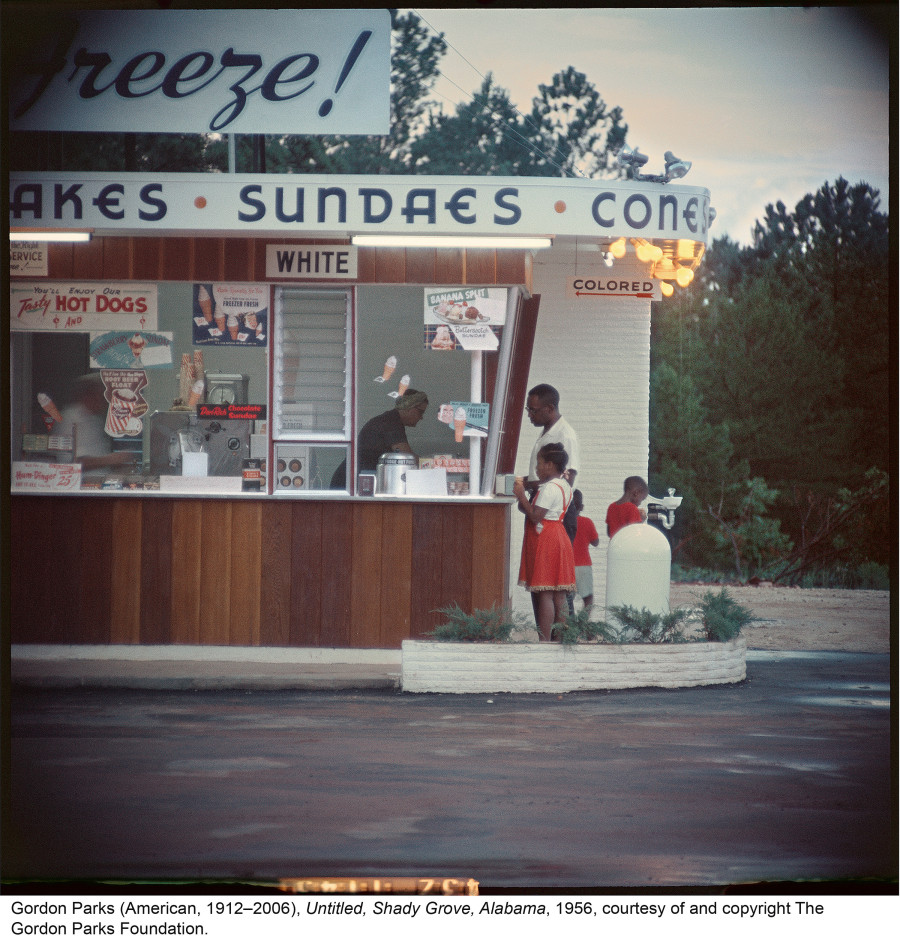
I wonder how you dealt with this as a white man? Sadly, I don’t remember having any conversations with you about this. The photo above looks all too familiar. For more photos, click here.
Love and hugs,
Elouise
© Elouise Renich Fraser, 17 February 2015
Photo credit: Gordon Parks Foundation and Priscilla Frank’s 20 August 2014 review in the Huffington Post, with rare color photos.
 Telling the Truth