our inmost garments
by Elouise
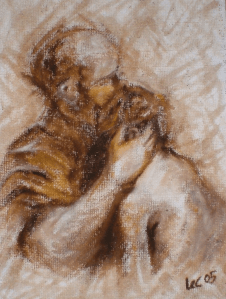
MacDonald has death on his mind. Not death as a process, but death as the proper goal of life. His images are positive, though the realities he names aren’t usually welcome. My comments follow.
August 11
Well may this body poorer, feebler grow!
It is undressing for its last sweet bed;
But why should the soul, which death shall never know,
Authority, and power, and memory shed?
It is that love with absolute faith would wed;
God takes the inmost garments off his child,
To have him in his arms, naked and undefiled.George MacDonald, Diary of an Old Soul
Augsburg Fortress Press 1994
MacDonald’s first line is emphatic and realistic. His body is growing feeble! It’s winding down, experiencing one loss after another. Yet he doesn’t seem distressed about this. It’s to be expected. In his mind, his body is “undressing for its last sweet bed.” That would be his deathbed. A lovely image for a sometimes distressing reality.
We know exactly what he’s talking about. Loss of physical strength, eyesight, teeth, hearing, and hundreds of other small and large annoyances. They’re to be expected. After all, new cars become old cars; new houses become old houses; brand new bodies become old bodies. And then they die.
Though MacDonald may not like this, he understands it. It’s part of human aging. Getting ready for death.
However, he isn’t so sure about other changes. We also have attributes and faculties that seem embedded in our souls. Things that mark our personal identities, that make us one of a kind—though not entirely unique. He names three—authority, power and memory.
If my soul isn’t going to die, why should these attributes of my humanity drop away? They seem important, even necessary hallmarks of my personhood.
Yet looking around, MacDonald can’t miss noticing that personal authority, personal power and personal memory also get stripped away. Especially, but not only, as we age.
Loss of teeth or hair is one thing. But this seems to go too far. Unlike some disabilities, loss of authority, power and memory aren’t easily covered up or replaced.
When they diminish or get taken away, they’re gone. Perhaps we didn’t expect to lose them so suddenly or so soon. Sometimes we experience this as dehumanizing. Less than fully human. We’re left without clear authority, power, or ability to recall the past and recognize the present.
Who am I without authority to get things done? Without power to make my voice heard? Without memories that represent my life and connect me to people I know and love? Would I matter anymore? Would anyone notice or care?
MacDonald’s last three lines remind me of the Garden of Eden. Yet it isn’t quite the same. Here, without outer or inner garments, there’s no sense of being naked or defiled. Indeed, God removes the inmost garments of the soul and lays them aside. They aren’t bad or inappropriate. They simply block our vision of God and God’s vision of who we are at the core of our beings.
Removing them lets our true identity shine in the light of God’s love. We are beloved children, created for one purpose only. To glorify and enjoy God forever, as God already enjoys us.
I’m grateful God doesn’t have a dress code or a list of our gifts and accomplishments. God is looking for our eager child-like selves. Eager to see and be held by our Creator. No hiding behind the fig leaves of our supposedly advanced or enlightened beings. And no defilement, or the shame that goes with it.
© Elouise Renich Fraser, 19 March 2016
Artist unknown; found at rustyrev.wordpress.com
 Telling the Truth
This was lovely and touching. A picture of God embracing our most vulnerable true selves, like a parent cradling a newborn.
Can you tell me about the pastel drawing that you posted along with it? I was equally moved by its tenderness. Thank you.
LikeLiked by 1 person
You’re welcome, April. I find this particular sonnet very moving and tender. I found it online via Google. It was taken from a WordPress blogsite (see the address at the bottom of the post). The author hadn’t identified the source for the image. One commenter asked him about it and he said he couldn’t remember where he found it. I looked at one other version of the same image on Google, but it was attached to a memorial site without attribution. It did, however, include a title – The Prodigal Son. I wish I knew the artist.
Elouise
LikeLiked by 1 person
Oh, Elouise, I found this most touching and comforting – a needed reminder that God loves me as I truly am, and that with him, I am always in my “birthday suit” in every way, for God knows me as I truly am. What a relief.
Thank you for offering your own thoughts to the rest of us, who need and appreciate them – and you, dear friend. 🙂
LikeLiked by 1 person
You’re welcome, Debbie. I love your birthday suit language! Absolutely spot on…. 🙂
Elouise
LikeLike