Telling the Truth

connecting the dots of my life

mountain of sorrow

mountain of sorrow
strewn with graves of the slaughtered
cannot forget

I wrote this after watching a special report last night on the PBS News Hour. It included video of hastily dug stone-marked graves for men and boys slaughtered on Sinjar Mountain during genocidal war against Yazidis in Sinjar District, Iraq.

It caught my attention because it happened in the last several years, just ‘yesterday,’ right before our eyes. Genocide is an attempt by some human beings to disappear other human beings from the face of the earth. Uncounted numbers of men, boys, women and girls were found unworthy of belonging to the human race. Their crime: being Yazidis.

Advent has its dark side. A Jewish baby born to a young unmarried Jewish woman will one day be judged by his own people and others, and declared unworthy to belong to the human race.

His crime? Speaking the truth about people who populated his world. Sometimes it was unwelcome truth, delivered in unconventional ways. He didn’t hold back or grease the hands and reputations of religious leaders, politicians, or everyday human beings like you and like I.

Nor did he hold back in showing us how to live, speak, and die for truth. Especially when other human beings are being disappeared.

This challenges me. I don’t want to be among the disappeared. Nor do I want to collude in the disappearance of others. What does this mean for me, looking ahead?

© Elouise Renich Fraser, 19 December 2017
Photo found at thestar.com
Advent and Lullabies

evensong
wraps today’s anguish
in lullabies

Living with unexpected physical challenges feels like a roller-coaster ride. Up one day, down the next. My short list of essentials for each day is simple: write, read, listen to or play music, exercise, rest, and prepare food as required for my diet. Sometimes my energy level is up, and I’m able to do everything and then some. Other days, I pare it down.

I’m not in love with this situation. Nonetheless, over the last two years I’ve accepted my wellbeing as my number one priority–not the way the house looks, or showing up for gatherings I used to attend regularly.

As the first-born of four daughters, I learned to neglect my own wants and needs in favor of caring for others. Today I often think of myself as the little girl I once was. I focus on listening to her and comforting her–acknowledging in the present that she still lives in me and still needs affection and affirmation.

All I have is one moment at a time–the precious gift of the Spirit of my Creator. Writing has been my best tutor when it comes to connecting with myself in the present. It’s demanding, but immensely rewarding when a haiku or poem begins to take shape on paper because it’s taking shape in me–echoing what’s going on inside me. The haiku above is a case in point.

Even Jesus wasn’t born into this world immune to tough choices or anguish. I can imagine his earliest comfort included lullabies. They also work for me. Especially when I sing them to myself as a way of bringing my past into the present.

The Christmas Lullaby tune above is “Restoration” from William Walker’s shape-note song book, Southern Harmony. It’s an old American tune, sung here by Doc Watson.

© Elouise Renich Fraser, 18 December 2017
YouTube video found here 

Listening to Extreme Poverty

An article this morning about Australian Professor Philip Alston’s survey of extreme poverty in the USA did me in. It’s Advent. A time for hope, joy and expectation. Yet for over 41 million Americans there is no expected arrival of anything but escalating hunger, despair, disease, death, and promises not kept. Professor Alston’s written report will go to the United Nations next May.

It’s easy to blame politicians and corporations. Or the super rich. But that doesn’t cut it.

Taking time to listen deeply is a spiritual discipline. I love pondering a beautiful flower or sunset. It’s something else, though, to ponder a problem this large. What is this reality trying to tell me?

There’s a growing divide between those who care to understand extreme poverty, and those who choose to ignore it or put the blame somewhere else. For example, we know charitable agencies, churches, outreach programs and governmental services work daily to ease the anguish and dehumanization of USA-style extreme poverty.

We may also believe that if extreme poverty isn’t addressed systemically, our personal efforts are mere bandages–a waste of time, effort and money. Yet the message of Christianity and other faiths includes the importance of showing hospitality to strangers. Especially those in distress.

So what can I do about any of this?

I don’t have answers. The easiest thing would be to shake my fist at politicians and super-rich ‘one-percenters.’

I’m reminded of Dorothee Soelle’s book on Suffering. What’s needed from me isn’t outrage, shaking my fist, or solutions to solve the problems of people trapped in extreme poverty. What’s needed is simpler than that, and a thousand times more difficult.

I need to listen in silence, the way Dorothee Soelle listened to victims of the Viet Nam war. That might mean listening to long, painful silence before words are found and haltingly spoken with anguish or rage.

Yet if I don’t learn to listen patiently for the story of a person trapped in the despair, humiliation and disenfranchisement of extreme poverty, I won’t understand my story. ‘Their’ story is another piece of my story, whether I like it or not. It’s also part of the story of the USA, whether we like it or not.

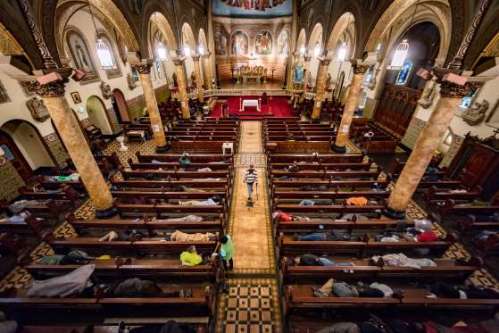
The photo at the top shows the sanctuary of a church in San Francisco that opens its doors weekdays from morning through mid-afternoon for homeless persons to rest and sleep. It came from the article I read this morning.

Praying each of you will have a hope-filled Sabbath rest.

© Elouise Renich Fraser, 16 December 2017
Photo of St. Boniface in San Francisco found at msn.com in “A Journey through a Land of Extreme Poverty: Welcome to America” 

sitting alone

sitting alone
in her outdoor living room
lost in memories

Is she resting? Waiting for someone? The sun looks warm, and the park grounds are inviting. She seems lost in thought, sitting there in the sun. What stories might she tell me? Or we could just sit there silently, basking in memories and resting. Perhaps smiling at each other  from time to time. Listening to the birds and watching passersby. There’s room for one at least one more person on that park bench. Two are better than one, aren’t they?

© Elouise Renich Fraser, 15 December 2017
Painting found at pinterest.com
Painting by Morteza Katozian, Iranian Artist

bleak winter knocks

bleak winter
knocks on the door –
my heart leaps

We’re in the middle of an unusually cold, windy December. Too cold to do my normal outside walking. Gusts of wind rattle our old house, toss garbage cans around in the driveway. Our cat Smudge goes on high alert.

It’s also Advent, time to prepare for the coming of the Messiah. I can’t help making the connection between our bleak winter and one of my favorite Christmas carols, “In the Bleak Midwinter,” words by Christina Georgina Rossetti.

The last verse is my favorite. I memorized it when I was a child.

What can I give Him,
Poor as I am? —
If I were a Shepherd
I would bring a lamb;
If I were a Wise Man
I would do my part, —
Yet what I can I give Him, —
Give my heart.

As a child I didn’t understand what it meant to give my heart. Today I understand more, but not everything. It’s comforting to give my heart to the One who knows me best. Especially when bleak winter comes knocking at the door in the midst of uncertainty and change. Perhaps my small heart will warm and comfort this Child who is so like and unlike I am.

Advent blessings to each of you, from my heart to yours.

© Elouise Renich Fraser, 14 December 2017
Photo by David Byrne, found at http://www.85mm.co.uk
Bleak Winter,” Scotland

startled birds

startled birds swerve
surfing updrafts and downdrafts —
thick tree trunks sway

As seen early this morning. Birds and trees dealing with a turbulent, invisible ocean of air.

I’m looking out a window in our heated house, wondering whether I could survive outdoors. It’s hard enough to survive inside.

Life is turbulent. It isn’t easy to surf icy blasts of unexpected change and disorientation. Witness the last few weeks and years, with more to come.

Sometimes I wish I were more like birds riding updrafts and downdrafts, swerving and turning with the wind. Or like huge tree trunks that sway precariously, yet survive virtually unscathed.

Then again, maybe they figured it out ages ago, and have tried for decades to show me how it’s done. I think I’m beginning to catch on, though it still takes my breath away.

© Elouise Renich Fraser, 13 December 2017
Photo found at pinterest.com

evening silence

evening silence
seeps through weary pores
calms my heart’s breath

Do hearts breathe? Mine does. In and out, day and night. Life-giving blood flows constantly, silently moving through my body to cleanse and renew.

There’s nothing like evening silence. It’s almost palpable. I feel it reaching out to me, willing me to relax. Putting the day’s activity, noise or even silence into perspective. Calming my heart’s breath.

Advent also reaches out. Inviting me to be conscious of, but not stuck in the bleak winter in which we live. Sometimes up, sometimes down. Sometimes almost to the ground. Flat on our faces with despair or heartache.

Into bleak winter I look for Light and Hope to arrive in surprisingly ordinary ways. Secretly and silently. Can you see it flickering? Sometimes I can, especially when I invite evening silence into my ordinary life.

© Elouise Renich Fraser, 12 December 2017
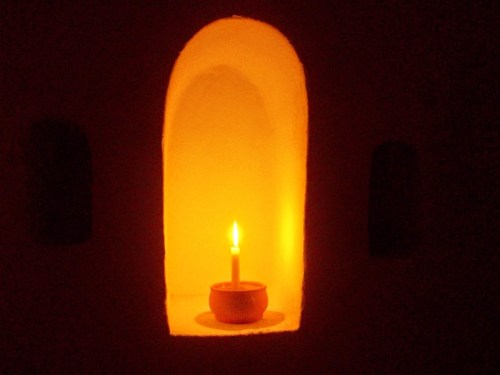
Photo found at nilemuse.blogspot.com – evening prayer candle in a Coptic chapel, Egypt

disappeared


disappeared seeds
sown in haste germinate –
my heart skips a beat

It’s the late 1950s. I’m a young teenager, sitting at the supper table with my parents and my three sisters. I’m teary, feeling crampy and a bit nauseous. Not eager to eat anything.

My father tells me to stop crying and eat my dinner. I can’t stop crying, and my stomach ache isn’t going away.

My father tells me to stop this nonsense immediately, or he’ll give me something to really cry about. I burst into loud tears and run upstairs to my bedroom, sobbing my heart out.

My childhood, youth and adulthood are littered with occasions that replicate or echo these dynamics. My biggest problem, so it seems, is that I’m over-emotional and haven’t yet learned to control myself.

I learned to ‘disappear’ myself by choking on my emotions, swallowing them, eating them alive, or trying to paste a happy face over my true face.

When I wrote about the pain of retirement, I said I feel ‘disappeared.’ I didn’t hear it then as a loaded word. But now I do. A cue of sorts. The kind that suggests the opposite of what it seems to say. Following is my un-disappeared, crystal clear comment about myself.

No, I do not feel sorry for myself. No, I’m not stuck in a gear I need to shift out of. No, I’m not simply repeating myself over and over and over again.

My words are my words. My feelings are my feelings. I’m as entitled to them as anyone else is to his or hers. I dare not sit on them, deny them, modulate them to suit your ears, or beg forgiveness for not living up to what you believe should be the standard for my life.

I’ve never understood why some men (also some women) have, throughout my life, felt free to give advice about how I should NOT be. Or about what I should be ‘over’ by now.

My father buried and tried to smother in his body and soul the very things he demanded I bury in my body and soul. Not because they would harm me, but because they made him uncomfortable, or didn’t fit his view of the woman he wanted me to become. Or the man he thought he was.

I’m grateful for my feelings. I admit to feeling uneasy sometimes about letting them show. Yet overall, I’m grateful to be a highly sensitive woman of a certain age. Unleashed, untamable, not prone to shame or responsive to scolding.

© Elouise Renich Fraser, 11 December 2017
Image  found at ucg.org

the morning after first snow

snow cones perched
on back porch rail posts
reach for blue sky

yew decked out
with thick white icing
bows gracefully

oak leaves lie hidden
beneath heavy white carpet
glistening in sun

I sit behind glass
basking in wonderland
this fine Sunday morn

I took the photo with my iPad – not quite as spectacular as the real thing, but good enough. I’m enjoying an Emily Dickinson Sunday morning in Nature’s cathedral—as seen from my kitchen window, with the heat turned up.

© Elouise Renich Fraser, 11 Dec 2017
Photo taken by me from my kitchen window

This isn’t what I expected

I wrote the free-verse poem below last night after writing a long journal entry about the current state of my life. The poem is an open letter to my Creator. An attempt to lay it out just as it is, given unexpected health events of the last few years that seem to have hemmed me in.

This isn’t what I expected
This endless run of days and nights
Wondering why this and not that

Retirement was a golden orb
A sparkling promise that kept me going
Until I couldn’t go any longer

There’s so much to love about it
That it feels like betrayal to say this:
I don’t feel retired; I feel disappeared.

Disappeared from what’s happening
Disappeared from minds and memories
Disappeared from action, whatever it is today

I wake each morning wondering
What will be the meaning of this day?
What will it add up to when the sun goes down?

Writing is a gift and blessing I gladly receive
Not going to work each day is also a blessing
Until I no longer have any ‘real work’

No need to be somewhere at a certain time
No collaboration about things that make a difference
Or participation in discussion about things that matter

And there’s the rub—this strange reality of just being
Instead of measuring myself by what I do
Or how many people are counting on me to ‘be there’

Is it really enough to take care of this tired old body
With its growing list of limitations and special needs?
Is this the meaning of my life at this time?

Please advise.
Elouise

P.S. to my Dear Readers: I’m grateful beyond words for your presence in my life. Blogging is my lifeline. I can’t imagine the last several years without it. Thank you for being here—many of you from the beginning. I pray you’re finding hope and peace this Advent season, no matter what your current circumstances may be.

© Elouise Renich Fraser, 9 December 2017
Image found at rccbonsecours.com