Telling the Truth

connecting the dots of my life

Category: Emily Dickinson

A Thought went up my mind today —
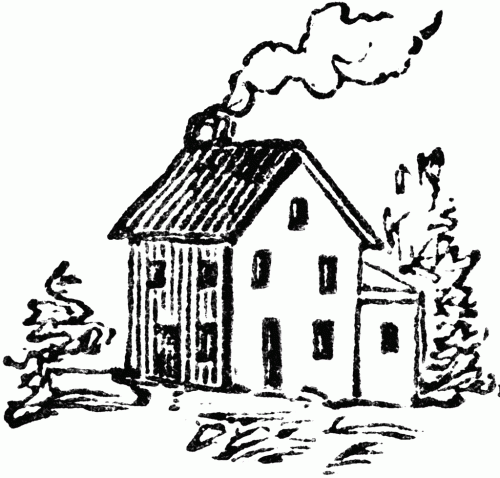
Here’s indisputable evidence of Emily Dickinson’s ability to capture everyday experiences with an economy of words. My comments follow.

A Thought went up my mind today –
That I have had before –
But did not finish – some way back –
I could not fix the Year –

Nor where it went – nor why it came
The second time to me –
Nor definitely, what it was –
Have I the Art to say –

But somewhere – in my Soul – I know –
I’ve met the Thing before –
It just reminded me – ‘twas all –
And came my way no more –

c. 1863

Emily Dickinson Poems, Edited by Brenda Hillman
Shambhala Pocket Classics, Shambhala 1995

I love this poem from Emily, especially the opening suggestion that her mind is a chimney. The poem itself is amazingly clear and simple, without losing its mysterious reference to the Thought.

In fact, we could spend a little time right now trying to figure out what Emily’s as yet unformed Thought was. Isn’t that what interpretation of poetry is all about? Emily’s poem is like a tongue-in-cheek joke as she sits back to see what we might discover about her deep Thought. So deep that not even she could remember or articulate it.

They say that if you’re a writer you should always carry a notebook to record all the stunningly insightful Thoughts that pass through your mind unbidden. Brilliant Thoughts! Creative Thoughts! Catch them before they fade away! You might use them someday. Right?

Well….the problem for me, and, I’m guessing, for most writers (including Emily), is that we’re an amazingly Thought-filled tribe. We don’t control the incoming tide or the evaporating mist of our precocious insights.

Just maybe, instead of carrying around scraps of paper or heavy notebooks for our genius thoughts, we should carry around butterfly nets! Then we could run around in meadows capturing those flighty bits of precocious wisdom and turns of phrase before they flit away!

Or then again, we might console ourselves with the Thought that having experiences like Emily’s is a sure sign we’re writers! Bravo! It’s our trademark! How else to explain and celebrate our brilliance?

© Elouise Renich Fraser, 24 October 2017
Smoking Chimney image found at cliparts.zone
Butterfly net image found at neh.gov
Daily Prompt: Trademark

A Bird came down the walk —

Here’s another childlike poem from Emily Dickinson that’s filled with adult insight. My comments follow.

A Bird came down the Walk –
He did not know I saw –
He bit an Angleworm in halves
And ate the fellow, raw,

And then he drank a Dew
From a convenient Grass –
And then hopped sidewise to the Wall
To let a Beetle pass –

He glanced with rapid eyes
That hurried all around –
They looked like frightened Beads, I thought –
He stirred his Velvet Head

Like one in danger, Cautious,
I offered him a Crumb
And he unrolled his feathers
And rowed him softer home –

Than Oars divide the Ocean,
Too silver for a seam –
Or Butterflies, off Banks of Noon
Leap, plashless as they swim.

c. 1862

Emily Dickinson Poems, Edited by Brenda Hillman
Shambhala Pocket Classics, Shambhala 1995

Here’s how I see this poem today—informed by my own observations, and the article I mentioned earlier about possible trauma in Emily’s life. The author saw multiple signs of this, especially in poems written around 1862 and beyond. Emily was about 32 years old when she wrote this poem.

  • Despite the childlike language and scenario, Emily’s poem conveys a sense of mystery. The Bird hopping down the walk is being watched and doesn’t know it. Might it have done something else if it had known someone was looking?
  • Though the Bird does something natural, the unnoticed onlooker doesn’t simply say the Bird ate a worm. Each action gets a full line in this short poem, perhaps to emphasize the suddenness and horror of the unsuspecting Angleworm’s demise. Is it important to identify the Angleworm? Or are they just a dime a dozen or more. Dispensable.
  • Stanza 2 seems to say life goes on as normal for the Bird. Still, it isn’t clear why this Bird hopped aside to let a Beetle pass, since birds regularly eat beetles.
  • Beginning with Stanza 3, Emily seems to know this Bird. She sees a vigilant, even frightened Bird whose eyes and head can’t rest. Constantly scanning for what?
  • The opening line of Stanza 4 is ambiguous. Who is in constant danger, Cautious? Perhaps both the Bird and Emily. Emily cautiously offers the Bird a crumb. Is this all she has to offer? In other poems she describes herself as starved. Yet we already know this Bird isn’t starving. Instead of taking the crumb from her hand, it spreads its wings like oars and heads for home.
  • Stanza 5 almost painfully highlights the ease and beauty with which the Bird and Butterflies, row softly and soar brightly above this ocean world in which vigilance is a constant companion.

I think Emily wishes she were a Bird or a Butterfly—beautiful in flight as she soars silently, through and above this ocean-like world of danger. Somewhere above the Banks along the seashore, making her way to a place called home.

© Elouise Renich Fraser, 4 October 2017
Photo found at favim.com

A Bird came down the Walk —

I just found this nimble, lively, graceful, agile and elegantly athletic interpretation of Emily’s well-known poem. Emily wrote the poem in about 1862. The young woman who produced the video prepared it for one of her school classes. Don’t miss her creative credits at the end, or her short interpretive written summary.

The video is short–less than 2 minutes. I’ll have my say about the poem later this week. Here’s the written version, in case it’s difficult to catch all the words in the video:

A Bird came down the Walk –
He did not know I saw —
He bit an Angleworm in halves
And ate the fellow, raw,

And then he drank a Dew
From a convenient Grass —
And then hopped sidewise to the Wall
To let a Beetle pass —

He glanced with rapid eyes
That hurried all around —
They looked like frightened Beads, I thought —
He stirred his Velvet Head

Like one in danger, Cautious,
I offered him a Crumb
And he unrolled his feathers
And rowed him softer home —

Than Oars divide the Ocean,
Too silver for a seam —
Or Butterflies, off Banks of Noon
Leap, plashless as they swim.

Emily Dickinson, written c. 1862

Happy Monday!

Elouise

© Elouise Renich Fraser, 2 October 2017
Video found on YouTube
Daily Prompt: Athletic

A gaping void

In the beginning
there was before–
now there is after–
nothing between

A jagged rift
runs through me
marking me for life
despite all things beautiful
that whisper of something better

No path however enticing
takes me back to before
Nor can my fingers find
notes adequate
to mourn the loss
or soothe my aching soul

Yesterday’s maps
fade in dying light

I wake,
longing to shed this dusty self
and be born—
yet again

About 4:15 this morning I couldn’t get back to sleep. I wasn’t restless; I was sad about the distance that lies between my life before and after trauma.

I began this blog nearly 4 years ago. It was my first attempt to write openly about my childhood trauma. As a preacher’s daughter, oldest of four daughters, I always put on my happy face.

After beginning the blog, I discovered Emily Dickinson’s poetry. I love reading it, puzzling over it, making connections between her cryptic words and images, and life as I know it.

Yesterday I read an article sent by a friend who follows this blog. The author, a medical doctor who understands trauma, confirms and gives evidence for the strong possibility that Emily was a survivor of childhood trauma. I found her convincing. If you’d like to read the article, here’s a link.

I don’t know all the secrets hidden within Emily’s cryptic poetry. Yet I understand the need to cloak my language so that truth is told slant. Told in ways that don’t implicate others or me, yet invite us to think about ourselves and the worlds in which we live.

The author of the article suggests that writing poetry was Emily’s way of talking about the unspeakable—whatever it was. A way to stay connected to herself when there was no one around to help her, and possibly, no other way out.

The trauma done to me began before I have memories of it. I don’t remember life without it. Writing poetry has become a lifeline to creative sanity instead of depression. It helps me know and accept myself, just the way I am. Hence the poem above, jotted down in its first version at 4:30am this morning.

Thanks, as always, for reading and listening.
Elouise

© Elouise Renich Fraser, 30 September 2017
Photo found at pixabay.com

Who has not found the Heaven — below —

Wouldn’t you love to find heaven on earth? If so, Emily Dickinson’s little poem offers food for thought. My comments follow.

Who has not found the Heaven – below –
Will fail of it above –
For Angels rent the House next ours,
Wherever we remove –

Emily Dickinson, Poem #1543
Found on Wikisource.org

When I went looking for this poem, I found a second version. One of the pitfalls of having poems published is dealing with editors who think they have a better way of saying things. In general, Emily’s cryptic, almost abrupt speech and layout betrays her hand.

Just for comparison, here’s the edited version that’s out there. All cleaned up and, from my perspective, changed in its meaning.

Who has not found the heaven below
Will fail of it above.
God’s residence is next to mine,
His furniture is love.

Found in Emily Dickinson, Collected Poems, published by Courage Books 1991

Sweet, but not what Emily wrote.

In the poem at the top, Emily says the key to finding Heaven lies with us, not with God or even with Angels. Not because they don’t exist, but because it all depends on our ability to recognize them. Not high above this earth, but right beside us, no matter where we are.

Emily suggests that each of our neighbors has the capacity to point us toward Heaven. It isn’t because they have deep theological insights, or preach sermons or make statements about heaven. Nor is it because they’re perfect, glow in the dark, or have wings and shining robes.

Rather, it’s because from time to time they bring a bit of heaven into our lives. Just when we most need it. It doesn’t matter what they believe or don’t believe about angels. What matters is that they bring a bit of heaven into our lives. Just when we most need it, even though we don’t always like to admit we’re needy.

This little poem seems to put us on notice. Emily isn’t asking us to become Angels. She’s asking us to keep our eyes open for Angels. They may show up on our doorsteps when we least expect them. Not from Heaven, but from “the House next to ours.”

This life offers preparation for something beyond our current sight. Not doctrinal proof of Heaven or of Angels. Rather, a whisper, a suggestion, a hint of reality that visits us from time to time. Especially when we’re in need, whether we realize it or not.

Sometimes it isn’t easy to accept help from Angels who aren’t wearing brilliant robes or sprouting wings from their shoulders. They might look like the people next door, or just around the corner, or standing next to us in the checkout line at the grocery store. We may have decided they couldn’t possibly be angels.

Yet there they are, momentary messengers from God who let us know we’re not alone. With their words and deeds they show us a bit of what Heaven looks like on this earth. All so that we’ll recognize it “above.”

Have you been visited lately by an Angel?

© Elouise Renich Fraser, 16 September 2017
Painting: Granville Redmond (1871-1935), A Sunset Sacrament
Found at parabola-magazine-tumblr.com

We never know how high we are

Dear Emily,
I have one small suggestion to make about your poem below. Please add ‘or queen’ to your last line. Just in case that’s not possible, I’m going to do it for you every time I read it. You’ll find my comments below your lovely poem.
Respectfully,
Elouise

We never know how high we are
Till we are called to rise;
And then, if we are true to plan,
Our statures touch the skies –

The heroism we recite
Would be a daily thing
Did not ourselves the cubits warp
For fear to be a king –

Poem #1176, written about 1870
Found on Poets.org

Dear Friend of this World,
I’m sending you this little poem today from Emily Dickinson. Maybe you never heard of her. I think she was a bit shy and bashful. You know, like many of us who don’t want to become a public ‘thing,’ even though we do enjoy being noticed and appreciated.

I think that deep down, Emily wanted us to know about her little poem. Or at least to notice it. So please read it over, and over again. Once is good, five times is better.

Do you know how important your words and deeds are? Perhaps you’re tempted to water them down by over-thinking. Or you get stuck in fear. Especially fear of failure, or fear of going against expectations–your own or those of others. I do.

Sometimes I wonder whether Emily understood her own queenly power.

If you have any doubt about yourself, look and listen to what you already do every day. Just getting up in the morning is a big deal. Or smiling and offering to help a friend or stranger. Or doing what you know will honor your body and spirit or someone else’s.

The way I see it, God gave us our selves, each other, and this world with its unnumbered inhabitants as our earthly home. We’re the only caretakers God has on this earth. We’re a big deal, individually and together.

In fact, God loves nothing more than watching us step up to our full kingly and queenly stature. Especially despite our worst fears, and without expectation of payment, reward or even a ‘thank you.’ Sometimes it takes an emergency to jumpstart our royal blood. But we don’t want to wait for that, do we?

Thank you most kindly for visiting and reading.
Elouise 

© Elouise Renich Fraser, 12 September 2017
Image found at pinterest

Response to WordPress Daily Prompt: Disobey

He fumbles at your Soul

Hurricane Harvey’s recent visit brought me back to this poem from Emily Dickinson. My comments follow.

He fumbles at your Soul
As Players at the Keys
Before they drop full Music on –
He stuns you by degrees –
Prepares your Brittle Nature
For the Ethereal Blow
By fainter Hammers – further heard –
Then nearer – Then so slow
Your Breath has time to straighten –
Your Brain – to bubble Cool –
Deals – One – imperial – Thunderbolt –
That scalps your naked Soul –

When Winds take Forests in their Paws –
The Universe – is still –

c. 1861

Emily Dickinson Poems, Edited by Brenda Hillman
Shambhala Pocket Classics, Shambhala 1995

A disclaimer: I don’t think this poem from Emily is to be figured out. It resists. Emphatically.

Yet after more than a year of pondering it and the events of the last weeks, I’m ready to comment on it. Strangely, I’m sticking with my first impressions.

I’m a musician. A pianist. This poem is about music and a lot more. Not everyday music, but music that happens rarely in a lifetime.

I hear Emily describing a pianist, the power of music in the hands of a gifted performer, and the effect on the listener. This isn’t just any music, but the kind that begins innocently enough and ends with power that stuns the soul into silence. Not applause, but silence.

Some musicians were masters at this. Chopin comes to mind. I’m thinking about what’s called ‘the Raindrop Prelude.’ You can watch and hear Vladimir Horowitz perform it here. It doesn’t follow the flow of Emily’s poem precisely, but the opening raindrop notes, repeated throughout, set the stage for what’s coming. In the finale, Chopin doesn’t end with a flourish, but with a gradual distancing of the storm, raindrops still falling and fading into the distance.

I hear Emily describing the music of Nature. The kind that begins with the far-away sound of approaching thunder, and the first erratic fall of rain. Hammers, set in motion by fingers hitting piano keys, strike strings hidden from view. We hear the storm approaching. Sometimes waning, yet always moving our way.

The music draws us in, adding voices and turns of phrase, shifting and turning from here to there, sometimes lulling the listener into a reverie. Then, without warning, like the closing bars of Beethoven’s Pathetique, comes that unanticipated bolt of thunderous lightning followed by utter silence. You can watch and hear Daniel Barenboim’s performance here.

After that, nothing else matters. The music/storm has undone you. Totally. Silence is the only appropriate response. All the standup applause and shouts for more mean nothing. The finale already said everything.

Emily believed in God, and seems to have had a healthy on-again, off-again relationship with God. She also believed in the power of nature to reveal truth about us and about God. I wonder what Emily would make of Hurricane Harvey and its aftermath.

I can’t help noticing that the Winds in Emily’s poem take Forests in their Paws, not in their teeth or claws. Perhaps there’s an invitation to see more than cruel destruction here, or a vengeful God who is somehow punishing us.

Maybe God wants our attention, and is offering us another chance to attend to each other. Strangers as well as friends and family. Costly? Yes. No matter how you look at it. Pain free? Never.

© Elouise Renich Fraser, 6 September 2017
Photo found at Shutterstock

Response to WordPress Daily Prompt: Anticipate

Emily Dickinson meets Mary Oliver

Last year a friend gave me a volume of poems by Mary Oliver. It’s safe to say I’m as mesmerized by Mary’s poetry as I am by Emily’s. Both are keen observers of nature, both external nature and human nature.

Which brings me to the reason for this post.

For the last few weeks I’ve been tantalized by a small poem of Emily’s. Cryptic as always, but not totally mysterious. Even so, I’ve wondered what to say about it. Then a few weeks ago I was reading Mary’s poems and was caught by a stanza in one of her longer poems.

First, Emily Dickinson’s poem:

To see the Summer Sky
Is Poetry, though never in a Book it lie –
True Poems flee –

c. 1879

Emily Dickinson Poems, Edited by Brenda Hillman
Shambhala Pocket Classics, Shambhala 1995

Now the third stanza of Mary Oliver’s poem:

The deer came into the field.
I saw her peaceful face and heard the shuffle of her breath.
She was sweetened by merriment and not afraid,
but bold to say
whose field she was crossing: spoke the tap of her foot:
“It is God’s, and mine.”

But only that she was born into the poem that God made, and
called the world.

Mary Oliver, Thirst, stanza 3 from “More Beautiful than the Honey Locust Tree Are the Words of the Lord,” Beacon Press 2006

Mary’s words helped me think about Emily’s poem. So here’s what I’m suggesting as one way to interpret them together.

  • No mortal words of poetry will ever do justice to this world, God’s poem. Nor do we understand ourselves unless we give up all efforts to capture in our words the reality of what God created and invited us to inhabit as caretakers. We can look and point; we cannot replicate.
  • Furthermore, no poetic words of ours will ever improve upon God’s great poem. Still, as humans we’re at our best when we reflect in our lives the grandeur of  creation.
  • Surely the summer sky, the deer, and all parts of God’s creation are dignified not because of what each does, understands or even writes in flowing poetry. Rather, we owe our dignity to being part of “the poem that God made, and called the world.”

Have a wonderful Sabbath rest.
Elouise 

© Elouise Renich Fraser, 26 August 2017
Image found at smartpress.com

Response to WordPress Daily Prompt: Dignify

I wonder if when Years have piled —

I don’t wear a crucifix around my neck, yet I find myself in the company of those who, like Emily Dickinson, can’t escape Grief. It doesn’t matter how many years have lapsed. My comments follow her poem.

I wonder if when Years have piled –
Some Thousands – on the Harm –
That hurt them early – such a lapse
Could give them any Balm –

Or would they go on aching still
Through Centuries of Nerve –
Enlightened to a larger Pain –
In Contrast with the Love –

The Grieved – are many – I am told –
There is the various Cause –
Death – is but one –and comes but once –
And only nails the eyes –

There’s Grief of Want – and Grief of Cold –
A sort they call “Despair’ –
There’s Banishment from native Eyes –
In sight of Native Air –

And though I may not guess the kind –
Correctly – yet to me
A piercing Comfort it affords
In passing Calvary –

To note the fashions – of the Cross –
And how they’re mostly worn –
Still fascinated to presume
That Some – are like My Own –

c. 1862

Emily Dickinson Poems, Edited by Brenda Hillman
Shambhala Pocket Classics, Shambhala 1995

Emily begins by wondering whether Harm that has Years “piled on” it might be like a Balm. Perhaps like piling ice or heat on an injury? Some would say time heals all wounds.

Does it? Perhaps the passing of Time simply multiplies the Pain of this Harm. Especially in contrast to Love lost, withheld or betrayed.

Emily does a brief roll call of various kinds of Grief. She names Death first, yet doesn’t dwell on it since once it arrives, it simply “nails the eyes” shut. She may have in mind the person who dies, not the survivors.

She then points to other forms of Grief. They’re examples of the barely recognized yet obvious Grief humans carry every day. She names Grief of Want, of Cold, and of Despair. This is the kind of Grief that doesn’t nail the eyes shut. It’s the Grief of being invisible, shunned, ignored, banished from sight in full view of others. Not allowed to breathe air that supposedly belongs to everyone. Native Air that makes one a ‘real’ person.

In the last two stanzas, Emily imagines Grief as a crucifix, a fashion item. Something like a personal Calvary. She observes an assortment of styles and ways of wearing them.

I imagine some are barely obvious; others weigh the bearer down like a heavy wooden cross. Some are flaunted like medals of honor; others hidden beneath bravado or bullying. Yet each is real, whether acknowledged or not.

Emily finds ‘a piercing Comfort’ in her observations. Perhaps she isn’t as alone as she sometimes feels. Perhaps some Crosses are like her own.

When I was growing up, no one told me that grief could be an asset. It was something I would eventually get over. Not a strange gift that could connect me with others.

I don’t want to know everything about each person I meet. I do, however, need to take into account the reality of human grief. There’s nothing so isolating as having one’s grief overlooked or ignored. Or making it a personal problem to solve or get over–as quickly as possible.

Jesus bore our griefs and carried our sorrows. Surely as his followers we can do a bit of this for each other, if not for ourselves.

© Elouise Renich Fraser, 12 August 2017
Image found at wallcrossesandmore.com

Will there really be a “Morning”?

Here’s an Emily Dickinson poem that appeals to the child in each of us. I also find it timely, all things considered. My response follows her poem.

Will there really be a “Morning”?
Is there such a thing as “Day”?
Could I see it from the mountains
If I were as tall as they?

Has it feet like Water lilies?
Has it feathers like a Bird?
Is it brought from famous countries
Of which I have never heard?

Oh some Scholar! Oh some Sailor!
Oh some Wise Man from the skies!
Please to tell a little Pilgrim
Where the place called “Morning” lies!

c. 1859

Emily Dickinson Poems, Edited by Brenda Hillman
Shambhala Pocket Classics, Shambhala 1995

Dear Emily,
I wonder what was on your mind when you wrote this. Maybe the War between the States? Family members who fought in it? Or how about the devastation left behind when so many cities and fertile fields were laid waste via fire?

Some people don’t think things here are that bad now; others don’t agree. I’d say we at least have something like it.

Then again, maybe you were thinking of less visible things. Perhaps a personal loss you couldn’t show the world. Or the piled up anguish of watching one family member after another decline in health and leave this world. Or your keen awareness that this world doesn’t always value what you value, or see things the way you do.

I think we have all of that right now, and more just keeps coming. I also think we’re getting tired of it.

Maybe you were lonely when you wrote this. So lonely that you would have been happy to leave this life behind. You might have been lonely for the birds and insects, trees and shrubs, water lilies and butterflies, sunrises and sunsets. All creatures great and small. Your outdoor cathedral and congregation where you felt safe, understood and appreciated. Without having to explain yourself over and over.

In your poem you call yourself a little Pilgrim. I like that. It’s a very kind and tender way to talk about yourself. Almost, but not quite putting yourself down because you don’t happen to be a scholar, sailor or wise man from the skies. I think you’re already a wise woman, a sailor of sometimes treacherous social seas, and a deep scholar of human life.

Now that you’re There, I wonder whether, as a Wise Woman from the skies, you might tell me where the place called “Morning” lies. Could you? Would you? It seems we have many lost souls here who are looking for that place. If not here, then where? Can you help us find it? Or at least send us a little poem about it?

Your pen pal, Elouise 

© Elouise Renich Fraser, 27 July 2017
Photo found at collegewritingpoetry.wordpress.com

Response to WordPress Daily Prompt: Hidden