Telling the Truth

connecting the dots of my life

Category: Haiku/Poetry

Misformed and misinformed

Misformed and misinformed
She emerges from childhood
Before its wonders take root

Sheltered from life and herself
Dim vision narrows down
Lest warm rays of truth find her
Huddled in unsafe cellars
Waiting for life to begin
Before it ends

The poem is about me and it’s not only about me.

Yesterday I listened to No Place to Run, a radio rebroadcast of an investigative report into foster care in the USA. The report focused on two young women in Texas. Their stories were eerily similar. I’ve heard similar stories about foster care here in Pennsylvania.

Each young woman (one still a child) was placed in a foster care setting. Both ended up on the streets, abandoned by systems that failed them. And both were betrayed by a political machinery determined to avoid or ignore the need to fund competent, monitored, successful foster care.

I applaud foster care parents who put their hearts and their energy into caring for foster children. I also applaud lawyers, judges and politicians determined to make a difference now, not later, with systems that work for the benefit of foster children and young people.

At the end of the day, however, I wonder whether I’m ready for the full truth about this shadow world. Especially since I’m routinely horrified at the latest revelations, already dressed up for public consumption.

©Elouise Renich Fraser, 13 August 2018
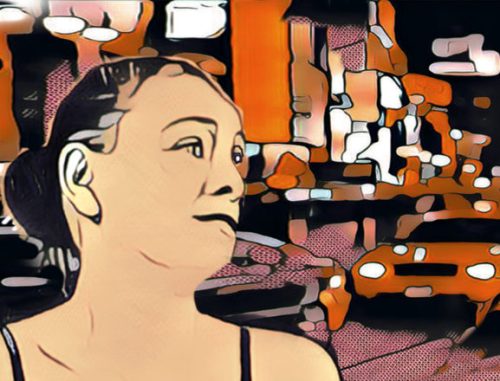
Art found at http://www.revealnews.org

Report from nowhere

This week I feel like an alien in my own body skin and clothes
Who is this woman? Why is she here? Do I know her anymore?
And what’s she trying to tell me? Does it even matter just now?

On top of which we have a tropical depression bearing down.
Waves of heat and humidity that don’t wave or move at all
They just sit there undulating like serpents in a pit of pain

I want to be my own free agent yet there’s always something
Something else needs attention or adjustment or acceptance
Tears well up in my eyes even when I try to smile at myself

You say all is well that ends well and yet nothing seems to end
It just spools out like pink or purple thread that won’t be contained
Knotted and tangled in a heap waiting for me to do something

Though I don’t know what it is and couldn’t care more than I do
For this body You gave me all white with blue eyes and straight
Hair that just sits there looking at me begging me to love it

This morning I wake with a dream the first I’ve had that makes
Halfway sense in this upside down world of retirement that
Feels nothing like the resurrection I need just now in my soul

In the dream a young family takes my words and music and spins
Them into beautiful visions I recognize yet don’t recognize as
Mine in the soulful music and art now accompanying our conversation

All this and more before I wake up not wanting to bid them farewell
And find myself in an airport café wondering where on earth I’m going
And why I didn’t bring any luggage and don’t want to leave just yet

©Elouise Renich Fraser, 11 August 2018

Suffering

Dorothee Soelle, German poet and theologian, wrote the following poem during the Vietnam War era. The poem, titled “Travel Notes,” has seven parts. Below is the first part, followed by my comments.

Hospital in Haiphong

Doan is three years old
in his head a fragment
of that handy bomb
that leaves buildings undamaged
never puts a factory out of production
doesn’t even harm bridges

Doan is three years old
in that handy bomb
are millions of tiny fragments
just for doan
meant for his feet
designed for liver and lung

Doan is three years old
his mother is gone
the president of the united dead
sent her an invitation
to a high standard of living and a lasting peace
he sent a handy bomb

Doan can’t write yet
so I’m writing this letter
to the workers in st paul Minnesota
asking if they couldn’t make
a toy boat out of plastic
instead of bombs because
doan is only three years old

Dorothee Soelle, from Revolutionary Patience, pp 71-72
English translation published by Orbis Books 1977
First published in German by Wolfgang Fietkau Verlag, Berlin 1969 and 1974

I discovered Dorothee Soelle’s writing in the late 1970s when I was studying theology in graduate school. As one of only several well-known women theologians (also a poet), she made her mark by teaching, publishing, and practicing what she preached.

All poems in Revolutionary Patience  are about the Vietnam era. So is one of her best-known books, Suffering. It’s her cry against apathy toward sufferers, and against views of God that accept suffering as ordained by God. She discusses the nature of suffering, how to recognize it, and how to listen in person to people who suffer. The goal isn’t to fix them, but to support their empowerment as change agents.

The most crucial skill Soelle  describes is silence. Listening without an agenda. A skill anyone can use with a child or adult so traumatized that at first he or she has no words. Sometimes it takes a long time to find the words.

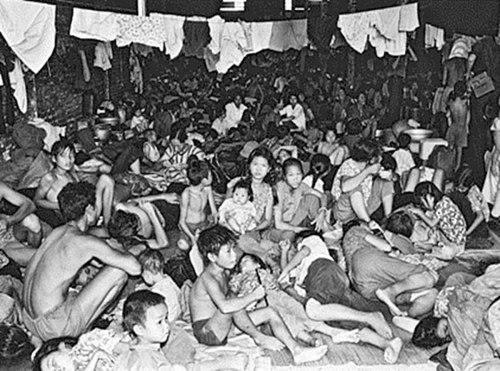
When I read Soelle’s writing today I think of myself and every child, teenager, woman or man marked by childhood trauma. I ask myself whether I’ve yet ‘arrived.’ Or am I stuck somewhere, still under the unseen yet keenly felt power wielded by perpetrators or by their stand-ins?

The poem above also reminds me of migrant children caught in the web of our recent national and international humanitarian disaster. They and their families are already marked for more suffering. Not because God wanted it that way, and not because they deserved it.

I wonder how much we’ve learned from the Vietnam era. Do we know how to deal with suffering that’s taken place on our own soil since the beginning of our nation? Especially suffering hidden beneath piles of bureaucratic red tape, political expediency, finger-pointing, inattention, and rewritten history.

©Elouise Renich Fraser, 8 April 2018
Photo of Vietnam Refugees at Guam found at afsa.org

Alive and kicking

Heat blasts my cold skin
Cicadas blast my eardrums
Hot sun beams relentlessly
Plays hide and seek beneath
Green trees gasping for air

Climbing the baby hill
My heart speaks to me
Sensations from the past
Flood memory banks
All is well that ends well

Park maintenance crew
Arrives pulling a trailer
Full of noise makers
They greet me politely
I nod and return the favor

Just yesterday I froze in church
From the crown of my head
To the soles of my feet
Air conditioning for the young
Of which I am not one

Warmed by my husband’s body
Cheered by a hot sermon
More than satisfied with a crumb
Dipped in grape juice
I return to my seat

Grateful I’m still alive and kicking
This hot summer day in August
Out and about to survey
The landscape and forms of life
In my corner of the world

© Elouise Renich Fraser, 6 August 2018
Photo found at flickr.com

The air of early August

Sights and sounds of life
Fill this morning’s dense humid air
Gray and white clouds sail across blue sky

Gentle breezes persist
Carrying the voices of children
On a mission in the park
Earnestly they discuss strategies
For climbing the maple tree
Towering above them

A woman heavy with child
Drops off a friend heavy with back pack
And her young toddler eager
To climb steps on the playground gym
Preparing for those Mt. Everest trees
Waiting on the perimeter

All of us serenaded
By a chorus of birds and cicadas
Rising and falling in concert
On the air of early August

Just a few observations from my morning walk. Plus a downloaded photo of a butterfly bush plus butterfly. I walk by butterfly bushes nearly every day. Lots of lovely blossoms, but not many butterflies yet.

Being a sometimes teary sort, I’ll admit to getting the sniffles when I saw children playing in the park. A reminder of how quickly life comes and goes, taking us with it.

I don’t know if there’s a secret to living with joy and gratitude. I am, however, certain butterflies and children can show me the way when I’m willing to have a childlike heart. Which is all I’m asked to have in the presence of the One who knows me best.

Elouise

©Elouise Renich Fraser, 3 August 2018
Photo found at almanac.com

Somewhere she waits

Surfacing above deep waters
Her body a hieroglyphic vision
Of life’s subterranean journey
Through unseen landscapes
Sacred and scarred
Inspected and celebrated
Not for character or fame
But for enduring and surviving
An endangered relic
Visited periodically
In a backwater museum
Somewhere she waits

For all senior citizens periodically celebrated for living yet another year. Keepers of wisdom and history, we’ll never know them unless we ask and listen with our hearts and minds wide open. No matter how foreign, slow or garbled the language. Old age doesn’t automatically confer wisdom. It is, nonetheless, an often ignored tablet of history that shaped, blessed and haunts us.

I wrote the poem after looking at a recent photo of my Aunt’s 91st birthday party. She has multiple daughters and sons who care for her. Not all are so blessed. Though even when blessed, it’s painfully possible to be seen without being heard.

©Elouise Renich Fraser, 1 April 2018
Ukrainian Black Ink Drawing found at 123rf.com

About Emily and Me

As of today, 30 July 2018, I’ve made interpretive comments on 44 of Emily Dickinson’s poems. My first, If your Nerve, deny you —, was posted on 5 February 2016. It’s high time Emily had a Category of her own. Scroll down to the bottom of every post and you’ll now find an Emily Dickinson category. Click on her name, and you’ll wake up in Emily country!

My relationship with Emily’s poetry happened almost by chance. D and I were visiting his sister and her husband. We stayed overnight. In the guest room was a small bookshelf filled with tempting titles. On the top shelf, lying there by itself, small and unobtrusive, was a Shambhala Pocket Classic titled “Emily Dickinson Poems.”

I picked it up, began reading, and couldn’t put it down. David’s sister kindly told me to take it home and keep it! I was, and still am thrilled.

Emily isn’t an easy read. Dipping into a poem here and there convinced me that, like the Hebrew and Christian Scriptures, I would get to know Emily the hard way. That means reading silently and out loud, pondering and paying close attention to every word, every pause, every abrupt combination of words or structure.

No, I’m not an Emily scholar. But I am a better scholar of my life than I was before I began reading her enigmatic, sometimes off-putting poetry. It isn’t all pretty. Truth, when it follows life, isn’t all pretty.

And so Emily has become an interpreter of me. Not in place of, but not unlike the way Hebrew and Christian Scriptures interpret me. She helps me make my way from here to there without giving up hope or losing my strong voice.

I taste a liquor never brewed –
From Tankards scooped in Pearl –
Not all the Vats upon the Rhine
Yield such an Alcohol!

Inebriate of Air – am I –
And Debauchee of Dew –
Reeling – thro endless summer days –
From inns of Molten Blue –

When “Landlords” turn the drunken Bee
Out of the Foxglove’s door –
When Butterflies – renounce their “drams” —
I shall but drink the more!

Till Seraphs swing their snowy Hats –
And Saints – to windows run –
To see the little Tippler
Leaning against the – Sun –

c. 1860

Emily Dickinson Poems, Edited by Brenda Hillman
Shambhala Pocket Classics, Shambhala 1995

© Elouise Renich Fraser, 30 July 2018

startled into flight

startled into flight
the young striped robin eyes me
from a nearby fence

twice it hops away
juvenile instincts awake
it heads for the trees

I’m just back from my morning walk. A beautiful day so far–not so hazy and humid, a little breeze in the air. Well…there was that giant mower roaring across the park hillside. But other than that, and grandparents and parents delivering young children to a summer program at the elementary school, I was blessedly alone. Until I came around the corner of the school and the poor robin, eating breakfast on the school grounds, got spooked.

Still, a great way to begin a summer day. And now I get to write about it. Icing on the cake!

Cheers!
Elouise

©Elouise Renich Fraser, 30 July 2018
Photo found in the National Audubon Field Guide

I have not told my garden yet

This poem from Emily Dickinson caught my eye this week. I found it in a volume of her poems for young people. Nonetheless, I heard it as an adult poem about adult pain. My comments follow the poem.

I have not told my garden yet,
Lest that should conquer me;
I have not quite the strength now
To break it to the bee.

I will not name it in the street,
For shops would stare, that I,
So shy, so very ignorant,
Should have the face to die.

The hillsides must not know it,
Where I have rambled so,
Nor tell the loving forests
The day that I shall go,

Nor lisp it at the table,
Nor heedless by the way
Hint that within the riddle
One will walk to-day!

Emily Dickinson: Poetry for Young People, edited by Frances Schoonmaker Bolin, illustrated by Chi Chung. Published by Sterling Publishing Co. (2008)

This poem is about death: Emily’s preoccupation with death, and her own death. Whether final or as daily reality. Each stanza adds depth to her poetic riddle.

Stanza 1. Emily thinks about her garden, the place that brings her happiness and peace. It seems she’s afraid she might not survive breaking the news, though we’re not yet certain what the news is. It’s clear this won’t be easy or happy news. Not for the garden, the bee, or her.

Stanza 2. Emily thinks about village shops that stare at her when she’s out and about. There she’s known as shy and perhaps ignorant. She has no intention of letting the shops know her plans. They wouldn’t believe that she, of all people, would have “the face to die.”

I take this “face to die” as setting her face toward death, which she names in the last line of the stanza. She faces death with determination, perhaps the way Jesus ‘set his face’ toward Jerusalem—the city in which he would die.

For Emily, it doesn’t matter what the shops or shoppers might think about her. She’s stronger than she’s given credit for. Indirectly, she’s saying they don’t know her at all. So why should she tell them anything at all about her “face to die.”

Stanza 3. Emily now thinks about the hillsides and the forests. She loves both settings yet determines to keep them in the dark. It seems that if she doesn’t tell the hillsides about it, they won’t tell the forests. Perhaps they’ll think she doesn’t love them anymore? Or perhaps the hillsides and forests will die of sorrow?

The verb ‘rambled’ has more than one meaning. It could mean rambling around in the woods, as well as the rambling of Emily’s voice speaking freely to the trees and hillsides. Not to ramble anymore would be a great loss for them and for her. Here she can speak out loud freely and directly. Yet she isn’t going to tell them the day she’ll “go.”

Stanza 4. Finally, Emily has no intention of talking about this at “the table,” which I take to be her family circle. Not even in what we might call baby talk that’s less than clear. She’s also determined not to suggest that “within the riddle” is a hint that “One will walk to-day!”

The last stanza seems to have two meanings: one about her family circle; the other about the poem itself. Which has me wondering whether this is ‘only’ a riddle, or a veiled clue to her unhappiness and desire, if not clear intention, to “walk to-day.” To die to her family and her beloved garden, and never return. A form of death no matter how you read the poem.

I don’t know whether Emily wrote this poem before or after she wrote I Years had been from Home. I do know these are the words of a woman in distress who chooses to tell the truth but tell it slant.

Yes, my heart goes out to her. Emily has a level of courage I haven’t often seen or heard in this life.

Thanks for visiting and reading, and leaving your own interpretive comments or questions if you’d like.

©Elouise Renich Fraser, 29 July 2018
Photo found at correntewire.com
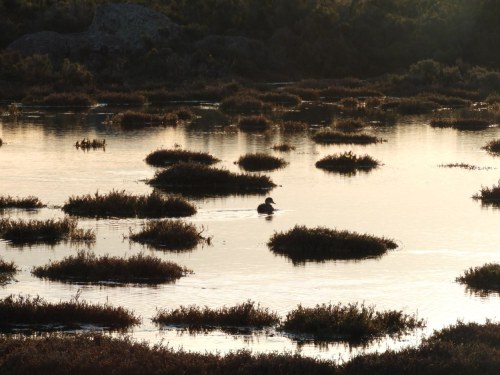
shadowy islands beckon

shadowy islands beckon
the end of the day

promises of greatness
if not prosperity linger
dying on the surface

perhaps tomorrow
will bring clarity and color
to a world gone missing
before the first day ended

(Many thanks to my Australian blogging friend John for permission to use one of his beautiful photos.)

As each week ticks by, seconds tick down with frightening speed. Especially when we measure damage done in what amounts to the blink of an eye. For example, almost overnight our government and its officials have created conditions that ensure hundreds if not thousands more children, young people and parents will suffer from PTSD.

When nighttime falls or even when daylight breaks, the nightmares won’t end.

The photo above isn’t ugly or deeply disturbing. It’s beautiful. At the same time, it’s full of ambiguity about what’s happening, especially beneath the surface and in the distance.

It reminds me of the shadowy picture Mr. Trump projects now under the guise of Beauty. As in, ‘It’s going to be really really Beautiful!’ As though repeating this mantra will calm us down or reassure us.

Yet when push comes to shove, I don’t see evidence that Beauty is happening for everyone in this country, much less elsewhere. Nor do I see a clear and present pathway from here to there that doesn’t involve backtracking and distractions and attempts to make something really really big out of nothing.

We have deep rifts and problems that need solutions. But creating more enemies internally and externally just doesn’t add up to a good day’s work or a good night’s sleep for any of us.

I still believe Resistance is Never Futile. If it doesn’t get us killed, it can make us both softer and stronger. I consider myself part of the loyal Resistance. It would also be nice if we could all enjoy a peaceful evening by a duck pond.

Peace to each of you,
Elouise

©Elouise Renich Fraser, 27 July 2018
Photo by John of Australia. You can check out his blog site here.