Telling the Truth

connecting the dots of my life

Category: Spiritual Formation

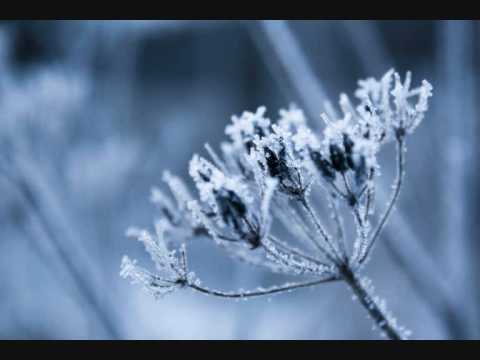
Why writing feels dangerous

Last night I read about a woman who couldn’t get in touch with sensations in her body because she felt disconnected. Numb.

I relate to her. All my life I’ve experienced numbing out—sometimes on purpose; other times as the general go-to mode of my body. That means I feel out-of-place, lost, or just not interested in the vulnerability of connecting.

Years of neglect also hang out in my body. No wonder I get weary and can’t always stay awake emotionally. Perhaps some part of me has lost its memory or its ability to function with and for me.

And so I move on to something else instead of sitting with it. Or wondering about it, loving or even soothing it. Or welcoming it as a major part of the woman I’ve been and have become.

I’m a writer. I want to connect with what’s going on inside me, not just with thoughts running through my mind. I want to listen to myself, speak from within myself. Yet I’ve guarded so much for so long.

Can numbness lead to death? I don’t know. Perhaps I’m hiding from my voice. Sometimes I’m apprehensive about what I might discover or write and then let go. Even before I understand it fully.

From the moment I became a living human being, You’ve been there. Even when I was too terrified to be there. Too terrified to sit quietly with whatever was going on inside this woman I keep calling ‘me.’

Am I afraid right now? I want to believe You hold me close and won’t let me stray far from home. Yet I still think it’s my job to keep myself from straying. Maybe that’s why writing feels dangerous. My words are out there. I can’t control how they’re read or used or abused. Or heard and dissected.

A voice seems more fragile than a body. More connected to soul. More vulnerable to attack. Yet when I’ve done my best to be truthful, and have given it away so that the river moves on within and through me, I’m not sure what else I can do except build a dam.

I know about dams. I’ve constructed many in my lifetime. Little dams. Big dams. Complex, contorted, impenetrable dams. Trying desperately to escape the truth about me.

And what if the truth about me is beautiful? Lovely? What then? Have I killed it?

A small Christmas cactus blossom rests in front of me on my desk. A lovely, fading pinkish magenta. Its fragile petals look like limp gauze wings folded around its core. It isn’t ugly; it’s dying. Doing what lovely flowers do after giving themselves away.

It’s the only way to live. Not forever, but in this present moment. My calendar lies to me daily. It promises more than it or I can deliver. I want to live this one day as if there were no tomorrow. No more, and no less.

© Elouise Renich Fraser, 15 January 2018
Photo found at pxhere.com

A Georgia Song, by Maya Angelou

In tribute to Maya Angelou, Martin Luther King, Jr., and all African-American poets and dreamers who see into us and into our history with razor-sharp eyes, ears and tongues.

As a transplanted (from California) citizen of Savannah, Georgia, I grew up surrounded by two stories–the white story splashed boldly across the city of Savannah and its outlying communities, and the black story inextricably woven into the warp and woof of everyday life. Visible yet invisible. Maya Angelou’s poem is haunting for its accuracy, its longing for something better, and its painful memories. I’ve included a few explanatory notes at the end.

A Georgia Song

We swallow the odors of Southern cities,
Fat back boiled to submission,
Tender evening poignancies of
Magnolia and the great green
Smell of fresh sweat.
In Southern fields,
The sound of distant
Feet running, or dancing,
And the liquid notes of
Sorrow songs,
Waltzes, screams and
French quadrilles float over
The loam of Georgia.

Sing me to sleep, Savannah.

Clocks run down in Tara’s halls and dusty
Flags droop their unbearable
Sadness.

Remember our days, Susannah.

Oh, the blood-red clay,
Wet still with ancient
Wrongs, and Abenaa
Singing her Creole airs to Macon.
We long, dazed, for winter evenings
And a whitened moon,
And the snap of controllable fires.

Cry for our souls, Augusta.

We need a wind to strike
Sharply, as the thought of love
Betrayed can stop the heart
An absence of tactile
Romance, no lips offering
Succulence, nor eyes
Rolling disconnected from
A Sambo face.

Dare us new dreams, Columbus.

A cool new moon, a
Winter’s night, calm blood,
Sluggish, moving only
Out of habit, we need
Peace.

Oh Atlanta, oh deep, and
Once lost city,

Chant for us a new song. A song
Of Southern peace.

Poem found in Maya Angelou: Poetry for Young People, Sterling Children’s Books, New York, published 2013

Cities in Georgia named in this poem: Savannah, Macon, Augusta, Columbus and Atlanta

Fatback is a Southern delicacy – fat from a side of pork, often fried like chips; here, the reference is to harsh treatment of slaves.

“Tara’s halls” refers to the home of Scarlett O’Hara in Gone with the Wind.

Abenaa – a girl born on Tuesday (in the Fanti language)

Creole – of mixed African and European ancestry

Sambo – stereotypic nickname for an African American boy

The painting at the top depicts the beginning of Sherman’s March through Georgia in the 1850s — from Atlanta to Savannah, with the goal of total submission of the South, along with the so-called end of slavery. The uncounted tragedies of this war include the attempt of our country to root out anyone standing in the way of our ‘pre-ordained greatness.’ Hence, on the other side of this Uncivil War, lurked attempts of some to drive out or destroy American Indians who stood in the way of railroads and the gold rush.

Dr. Martin Luther King, Maya Angelou and other poets challenge us to rise above our past. To become truly great as human beings, unafraid to look up, greet each other, and join the human race.

© Elouise Renich Fraser, 15 January 2018
Artwork found at allpurposegurulcom; painter and title not identified

Counting the hours

A small
Limited world
Greets me
With a question –
And what of today…?

Indeed –
What of it?
With or without me
It will cycle by
Rehearsing its hours
Yet again in a chain
Of semi-predictability
Without need
For me to sit
At this window
Watching the day slip
Before my eyes
Through fingers chilled
By winter’s dull sky
And frozen vegetation
Waiting for spring
And release

Life is in a different key these days
I’m still not sure what it is
Or how to play it

© Elouise Renich Fraser, 11 January 2018
Image found at ytimg.com

Scars upon scars

Scars upon scars
cover futile attempts
to distance pain
of yet another blow
to my body, soul, dreams
or soothing denial

It’s nothing
I can take this
I don’t need to talk about it
I dealt with that long ago
Didn’t I?

And how can I help you today?
I have plenty of time.
I can proofread that if you’d like.
It’s nothing. Really. Nothing at all.
No problem. It won’t take long.
No need to apologize
for anything, really.
We all make mistakes.

Time passes
skin thickens
spine goes rigid
demeanor tentative
neutral eyes scan
from the periphery
avoid other eyes
awkward at best
antennae soar heavenward
nothing and nobody is
safe but this last remnant of
body-soul on alert
not to be lulled into
carelessness

It wasn’t being born female that scarred me. It was overtime, double duty hyper-vigilance plastered layer upon layer with each attempt to control, use or fix me.

Over time petrified limbs of my body and soul cowered whether I wanted them to or not. I fell into protective behaviors that stifled every hint of unhappiness or, God forbid, revulsion. I was physically and emotionally exhausted.

Each woman is different. Internal scars from child abuse, and sexual harassment or unjust workplace practices that disadvantage women are not the same as external scars or physical challenges. Sometimes the best way to begin healing is to find a trusted friend or referral service to suggest next steps that might work for you.

I was initially helped by a twelve-step group of over 20 women meeting weekly in a church basement. It didn’t cost me anything but my pride plus $1 a week (optional) in the basket. For 5 years I showed up 2 or 3 times each week for this and other twelve-step meetings. All while I was teaching full-time at a seminary. It took me that long to realize I needed professional help. By then I was in my late 40s.

I began blogging four years ago to break silence about my childhood and teenage years. Today it’s about more than that—though dealing with my past helped free me to write as I do today.

When we women invest wisely in our emotional, spiritual and physical health, we do the most important work of our lives. We don’t deserve to carry heavy layers of scars. Some can be laid aside. Others we get to keep. They connect us to sisters and brothers, and can, from time to time, add to our beauty and wisdom.

© Elouise Renich Fraser, 10 January 2018
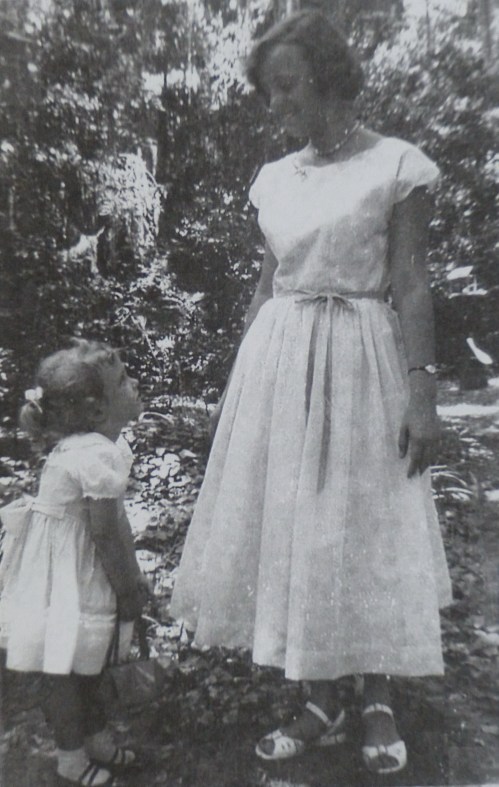
Photo taken by my father, 1954/55, my youngest sister and I, Savannah, Georgia

hovering

hovering
betwixt and between
slow drip to nowhere

This morning small icicles were dripping outside my bathroom window. Destined to be gone by the end of this sunny day.

I wrote the haiku thinking about icicles. Yet the truth goes deeper. It reflects how I feel about our national preoccupation with the Washington DC ‘Reality Show.’ Guaranteed to make multiple appearances on popular late-night commentary shows dedicated not to commentary or thoughtful analysis, but to making one side or the other a laughing matter.

On top of which we now have a newly released tell-all book, guaranteed to bring gasps of horror and indignation, not thoughtful analysis.

And what of our future, our cohesion as a nation? Are we caught up in a slow drip to nowhere? Mesmerized by the theatrics of reality-show performances supported by friend and foe alike? Laughing our way to nowhere?

It’s good to ask questions. But not if the answer that most pleases us is a lame joke that takes the edge off our responsibility to be actively informed citizens. The future of our nation and our planet deserve out best efforts. Especially when it feels like the tide is against us.

© Elouise Renich Fraser, 9 January 2018
Photo found at beachfrontbroll.com

silence settles

silence settles
fills cracks in evening darkness
ticking clock whispers

It’s my favorite time of day. Quiet and dark, nothing making a sound except the hum of our refrigerator, water gurgling through the radiator, my heartbeat echoing in my ears, and the calm, super-quiet tick of my now-ancient desktop clock. I bought it in Germany in the 1970s. It sits on our kitchen table, faithful and timely for nearly four decades.

Last night I was bemoaning (only slightly, mind you) my housebound captivity during our early winter cold spell. I’ve always enjoyed this time of day. I get to read a little, write a little, eat a little snack on behalf of my blood sugar, and often listen to evening hymns—singing along if I’m so inclined.

So last night I decided to write a haiku about my evening surroundings. Writing it was more than enough to calm and lift my spirits. If I can’t walk in the woods, I can wander through my house of memories. Surrounded by reminders of where I’ve been, how many amazing people and places I’ve known along the way, and the beauty of late evening silence.

Happy Monday!
Elouise

© Elouise Renich Fraser, 8 January 2018
Photo found at pixabay.com

A letter to our Creator

Dear Creator of this World, though not the creator of its craziness,

I have a dilemma, so I’m bringing it to You. Hoping for a little light, as one of many followers of Your Son Jesus of Nazareth.

I’m to pray for those in official authority over me. In particular, those who have responsibility for governing this nation. Important people such as the President of the United Sates, the governor of Pennsylvania, Senators and those who serve in Congress at state and national levels.

The easiest way to pray is that they will rule wisely, with special consideration for the poor, widows, orphans, refugees and others who struggle to make it from one day to the next.

This way of praying has always worked for me before. Yet today I feel compelled to pray in a different way, and for different leaders in our country and abroad.

For example, I feel compelled to pray daily for officials who run nonprofit organizations. The kind that help pick up the pieces and make ends meet. It seems our current government has abdicated too much of its responsibility toward those with the least resources, while also lining the pockets of the wealthy who already have way more than enough.

Here’s something else. I’m also tempted to pray against some of the officials I’m exhorted to pray for. In fact, it seems that the only way to pray for some of them is to pray against them. If the goal is to have wise decisions that serve us well, perhaps it’s time to pray that certain plans will fail. Or that those who create these plans will get caught in the traps they set for others.

Finally, as You already know, our President has dismissed, mocked and denigrated women who come forward to tell the truth about powerful men who made their lives nightmares. He also seems to get away with his loose talk and loose living, and with abdicating his responsibility to lead this nation.

Tomorrow is Sunday, and I’ll probably be in church. We always pray for those who govern us. I know good national leadership is good for all of us, to say nothing about the rest of the world. Still, I feel the need to pray against some who govern us, and to pray for those who have the courage to stand up and be counted on the side of truth.

One more thing. I don’t see or hear Jesus of Nazareth holding back in his assessment of political and religious leaders of his day. And, as noted above, I want to follow in Jesus’ footsteps.

Please advise.
Elouise

© Elouise Renich Fraser, 5 January 2018
Image found at englishforschools.wordpress.com

Playing my card – a poem

,

Is being born female a scar?
A blemish a blot an
unfortunate role of the dice?
Something to disguise or
hope might fade over time?

Mind your scar dear
You wouldn’t want to be
laughed at, jeered at, taken
for granted or trashed

Here love let me help you make
the most of your scar perhaps
then they won’t notice it so much

Who knows
you might even win adulation
and a real man if you play
your scar card just right

Remember you’re in this
for the long haul so buck up
and smile like a million dollars
someday you’ll be rewarded for
your dumbed down version of
the woman every man wants

Not to worry there’s still plenty
of time to make your mark you
just need to keep at it no cracks
in the façade

Don’t get me wrong dear I’m not
saying you haven’t been doing it
the right way

It’s just that the cracks in your
scar are showing and we wouldn’t
want you to bleed all over the place
and your clothes

So you’ll just have to stop picking
at it and let it heal the way it’s
supposed to heal all flat and flawless and
invisible just like you

This is my attempt to capture the ethos that informed my growing-up years, as seen today through my adult eyes. I would be less than truthful if I said this kind of approach wasn’t also part of my professional life. It was. Gratefully, by then I had a company of women and some men who helped me make it through. Not as a scar on the face of humanity, and not all flat, flawless and invisible.

© Elouise Renich Fraser, 5 January 2018
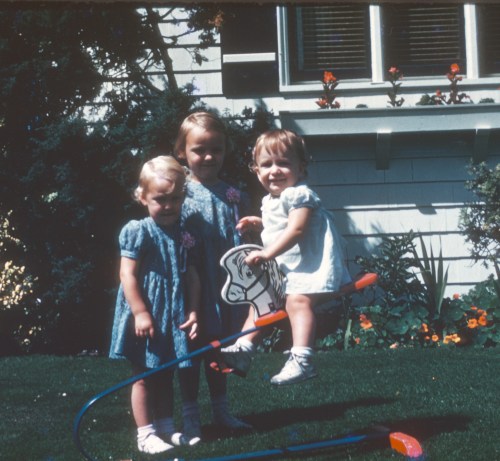
Photo taken by my father in 1947 — Seattle, Washington, with Daughter #2 (of 4) and a young friend

powdered snow

powdered snow
pirouettes on storm-tossed wind
iced firs sparkle

A winter wonderland set to silent music blowing here and there – rising and falling – whirling, twirling and sweeping rooftops at will. This morning’s glory—enjoying it while it lasts.

The naked snow pairs nicely with a poem I read this morning. It’s from a gathering of larks: letters to Saint Francis from a modern-day pilgrim, by Abigail Carroll.

Here’s the poem.

Dear Son of Pietro Bernardone,

Nicodemus had nothing on you:

When he heard, You must be born again,
he wondered how on earth
to climb back inside his mother’s womb,

but you knew precisely what to do: remove
your clothes in the public
square, by your nakedness loudly, irrevocably

declare whose you were, whose you chose
to be. It was a start, and though
the bishop tried to spare you shame, protect

your rich father’s name with his holy golden
robe, hide your tender
olive frame, you refused. Instead, walked

shoeless toward the winter woods wearing
nothing but a hair-shirt
and a song (in French, no less). Priest

to beggars and sparrows, hills, and the lilies
of the field, it wasn’t long
before the lepers took you for their own.

Francis, what was it like to finally belong?

With admiration,

© Abigail Carroll, 2017, a gathering of larks, p. 14
William B. Eerdmans Publishing Company 2017

What does it mean to go ‘all out’ in order to live a life of openness and truth? Nature shows me how, without the agony of having to decide what to wear or which dance it will be today or what to eat or not eat. Even closer to home, with whom will I stand when push comes to shove?

There’s something about the nakedness of a wild snow storm that’s terrifying. The little sparrow being hurled by my kitchen window this morning comes to mind. He was able to land in a shrub, but barely.

Unpredictable winds of war and change are here, whether we choose to acknowledge them or not. I pray for  grace to let the Spirit’s wind carry me where it will, depositing me where I belong, with my voice and spirit intact.

© Elouise Renich Fraser, 4 January 2018
Photo found at shutterstock.com

What I can’t take with me

My electric toothbrush died this morning. After more than 20 years. Burnt out. Busted. Going nowhere.

Which got me thinking about something else I can’t take with me. Not because it’s tangible, but because it’s intangible. Irreplaceable. Even valuable.

I struggle with giving it up because it’s valuable. Which is another way of saying two things.

  1. It isn’t valuable unless I give it away. Hoarding it does nothing for me.
  2. If I hesitate, the opportunity will be lost. Whether it helps anyone or not isn’t the point. I don’t want to live in fear mode. Especially about things that relate to me personally.

So what is it? It’s the opportunity to speak now, in this present moment, on behalf of all women everywhere who, with me, carry scars piled on scars. I don’t omit men and their scars. This time, though, I’m focusing on women.

Women are yet again (in my lifetime) pushing beyond the ‘normal’ cycle of news reporting. Insisting on being heard not once or twice, but over and over. Relentlessly.

Sadly, this has set in motion growing push back, with calls for ‘time out’ to slice and dice various permutations of inappropriate behavior toward women. Why? Because the men being talked about may be unfairly lumped together with all men. Which suggests we have generations of men and women who don’t yet get it.

Sexism, like racism, is in the air. The air we breathe, consciously and unconsciously from cradle to grave. No amount of slicing and dicing will ever capture the reality of what sexism does to the embodied soul of one woman or one little girl. Or the reality that no one is safe from sexism’s fallout.

It will take all of us—women and men alike—to begin turning the tide. We desperately need safe spaces for women to breathe, stand up and speak their minds. Telling their stories, often for the first time. Without fear of being judged, questioned as though on trial, or turned into side shows.

I’m tired of hearing subtle and not-subtle calls for women to Shut Up and Sit Down. It’s time to move on and try Listening for a change. Asking how we got here, and what we already know in our hearts needs to change, and what each of us can do about it.

Last night, just before I went to bed, I wrote these words in my journal as a kind of prayer:

I crave the companionship of women and men who carry scars like mine. Perhaps by naming my scars yet again I’ll find them, or they will find me. And then what will we say to each other and to the world?

Thanks again for listening, and for considering what part you might play in your neighborhood, or wherever you have a voice.

© Elouise Renich Fraser, 2 January 2018
Quote found at squarespace.com