Telling the Truth

connecting the dots of my life

Tag: Childhood

What females do not deserve

We don’t need fancy degrees
Or positions of so-called power
To agree on one thing:

In today’s downhill avalanche
And dismissive coverup of truth
About women and girls of any age
Soul-searching is quickly dismissed
In favor of shameful, angry blaming
Of women who dare speak
Their own minds or
Live their own lives
Despite the cost

Females of any age do not deserve to be shamed, humiliated, or silenced.

Nearly 28 years ago, on the eve of my 50th birthday, I said to my father: “I did not deserve to be shamed, humiliated, or silenced by you.” I wish I could say that making this statement fixed everything for me as a woman. It did not.

Instead, as an adult professional, I still had to live with sometimes brazen attempts to shame, humiliate or silence me. For example,

  • Disgruntled students who didn’t approve of my gender or my approach to teaching and learning sometimes filed written complaints with my dean or the president of the seminary.
  • In my work with and in the seminary dean’s office, my value was sometimes measured by my willingness to go along.
  • My questions weren’t always welcome, especially regarding university decisions that impacted the seminary.

Bottom line: Most of my paying jobs involved a significant degree of holding back, keeping my mouth shut and my emotions under wrap. Sadly, the same was sometimes true in churches I attended, especially regarding issues of concern to women and children.

My decision to meet with my parents in 1993 was costly for our entire family. Would I do it again? Yes. My life today would not be what it is without this tough family work. In some ways, it became my fulltime job, the underpinning of my professional and personal life. As I’m able, I’ll be posting about this from time to time, drawing on written notes I made years ago, and correspondence with some family members.

Thank you for the privilege of sharing some of my life with you. Next Friday I’ll have tests on my feet and legs. Hopefully I’ll learn more about what can and cannot be done to alleviate the pain. Peripheral neuropathy stinks!

Thanks for stopping by,
Elouise

© Elouise Renich Fraser, 15 October 2021
Quotation found at thewei.com

Whatever lies ahead

Walking toward me this morning,
the fortyish adult woman seemed
unhappy and despondent,
clutching her light jacket
and looking away

Just across the street,
grade school children shouted
in frenzies of laughter, competition
and the need to be seen and heard

How does it happen so quickly —
This fierce need to be part of the gang?

And how is it that some of us
were held back by heavy rules
and unnumbered regulations?

I’ve rarely felt so lost as I do today
during this unruly period between
diagnosis and unpleasant tests
coming toward me down a road
I never thought I would travel

Yes, I have health issues on my mind. I’m also thinking about my writing. The physical impact on my body is taking a toll. I’ll be relieved when the next set of tests has been completed.

For years, I’ve had a storyline in my head: Eldest daughter of a strict pastor/father gets married and finally has a life of her own. Rules for Good Girls go out the window. Free at last, she flies away and finds out she is a real human being.

I wish. It’s wonderful to celebrate the moment I spoke truth to my father. It was the eve of my 50th birthday. I did not deserve to be shamed, humiliated, or silenced. What was taken from me in my childhood and youth is gone forever.

Until now, I’ve hesitated to write about what it was like to study, teach, and serve as dean in academic and seminary settings. Nor have I written much about my life as a member of Christian churches.

Something tells me this is an opportunity to be welcomed. Right now I’m not so sure. Yet I know it’s time.

Thanks for listening,
Elouise

© Elouise Renich Fraser, 12 October 2021
Photo taken by DAFraser, 10 September 2021 in the Longwood Meadow Garden

I go down to the shore | Mary Oliver

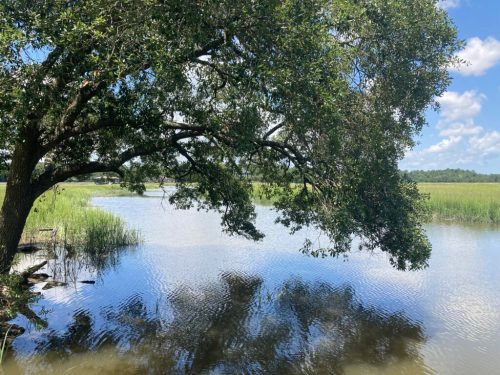
Vernon River and Marshland, Georgia, USA

This short poem by Mary Oliver has been haunting me for over a week. My comments follow.

I go down to the shore in the morning
and depending on the hour the waves
are rolling in or moving out,
and I say, oh, I am miserable,
what shall—
what should I do? And the sea says
in its lovely voice:
Excuse me, I have work to do.

Mary Oliver, A Thousand Mornings, p. 1
© 2012 by NW Orchard, LLC
First published by Penguin Press 2012

Compact. To the point. No nonsense. Nothing but truth.

That’s how I want to be. Not just in my writing, but in my ability to ‘hear’ what the sea and the sky, trees and birds, clouds and thunder are saying with their busy, if not always lovely work.

The last few months have offered several opportunities to say with Mary, “Oh, I am miserable.” Or better, “Growing older is much more daunting than I dreamed it would be.” Right now I’m inundated with forms to fill out for an appointment with a new doctor next week.

It would be nice to have a shore close by, with the sea “rolling in or moving out.” Or even the Vernon River of my childhood with its 24-hour cycle of ebb and flow.

On the other hand, every morning when I go down to our kitchen I’m greeted by birds, squirrels, chipmunks, flowering shrubs, trees, clouds, wind, rain or sunshine — all with work to do. Whether I feel like working or not. Whether I’m happy or not. Whether the sun is shining or not.

Thanks for stopping by today. And dare I say, in my lovely seashore voice, of course: “Excuse me, I have work to do.”

Elouise

© Elouise Renich Fraser, 6 September 2021
Photo of the Vernon River and Marshland found at ogeecheeriverkeeper.org

Something about fireworks

Coming up for air
My eardrums breathe
A sigh of relief

Something about fireworks
Doesn’t sit well with
my wondering soul

Why this grand
Display of pseudo-bombs
Bursting in air?

Sound-echoes of death
To enemies and the weak
Linger in putrid air

Turning the corner
I make my way home
In deepening shadows

It was fun when I was a child in the 1940s and 50s. Nothing more dangerous than fire crackers and sparklers. Usually purchased from a temporary ‘store’ on the side of the road, and enjoyed in our back yard.

I also remember growing anxiety about safety, and the fight within each state over whether to allow unlicensed firework stands to set up temporary operations. Usually this happened around New Year’s Eve, and July 4. If you couldn’t purchase fireworks legally, you could cross over into the next friendly state and find more than enough to go around.

Only when D and I moved to Pasadena, California in the early 1970s did we see a proper July 4 fireworks display. It was in the Rose Bowl. The best seat in the house wasn’t in the stands. It was up high on a ridge overlooking the Bowl. More than enough to awe any child or adult.

Given the current state of our disunion, however, I find the sound of huge fireworks displays disturbing. I can’t help thinking about guns fired too frequently every night of the year, and the trauma this creates.

I also can’t help noticing the bravado that sometimes emerges from adults and young people when engaged in these activities. Is this entertainment, or a way of signifying who we think we are or should become?

I don’t lose sleep about this. Nonetheless, I wonder about the impact and imprint of what feels more and more like a troubling display of misplaced or misdirected patriotism.

Praying your week brings joy and opportunities to connect with family and neighbors.

Elouise

© Elouise Renich Fraser, 5 July 2021
1940s and 50s Fireworks Stand photo found at pinterest.com

My unquiet mind

Last night’s fierce rainstorm
lingers in air clothed in fluffy clouds,
bright blue skies and hungry birds

Chill air seeps through cracks
In this old house still breathing
deeply in lockdown mode

My mind flies unbidden to
a youthful storm about what
mattered yet didn’t end well

Despite the lingering chill
my skin burns with heat and
anguish about changes in plans

Tired old ganged-upon feelings
stir within my memory
before spilling over into today

Yet again my blood boils
with anger and shame
eager to take me down a notch

When I grew up, I didn’t have the option of being too angry, sad, happy, or loud. Worse, my father got to decide when I was too anything. His clear intention was to break my will and keep me in line. Not just because he was my father, but because God told him not to spare the rod.

Several days ago I posted “Farewell, Savannah.” I meant it then and still mean it today. Nonetheless, I’m challenged to let go of the worst injustices of my growing-up years. Especially during the years I lived in Savannah, prior to my marriage.

In the later 1940s and the 1950s, proactive services and opportunities for women and young girls weren’t at the top of our national agenda. Nor are they today.

I applaud President Biden’s determination to make this a top priority. Not as a symbolic act for women at the so-called top of the ladder, but for women and girls everywhere. In families, churches, schools, sports, medical offices, hospitals, workplaces, politics, the military and much more.

The shame and anger I feel isn’t only about what happened to me back then. It’s also about what’s happening right now to women and young girls in the USA. Surely we can do better than this.

Elouise

© Elouise Renich Fraser, 6 May 2021
Image found at pinterest.com

Loneliness | Mary Oliver

I still tear up when I read this lovely, perceptive poem from Mary Oliver. My comments follow.

Loneliness

I too have known loneliness.
I too have known what it is to feel
misunderstood,
rejected, and suddenly
not at all beautiful.
Oh, mother earth,
your comfort is great, your arms never withhold.
It has saved my life to know this.
Your rivers flowing, your roses opening in the morning.
Oh, motions of tenderness!

Poem written by Mary Oliver, first published in Blue Horses (2014)
© 2017 by NW Orchard LLC
Published in 2020 by Penguin Books in Devotions: The Selected Poems of Mary Oliver, p. 23

When we’re born we have one chance. One chance to hit the jackpot of perfect parents, perfect siblings, perfect grandparents and all the other stuff that comes with perfection.

Yes, it includes gender, color of skin, color of hair, cuteness or ugliness, fat or skinny. You name it, and someone somewhere has known loneliness over these or other unchosen marks of our supposed superiority or lack thereof.

I grew up feeling like a fat girl with three younger sisters who were invariably cuter and more exciting than I was. To be fair, the preferred family term that stuck with me wasn’t ‘fat.’ It was ‘pleasantly plump.’

Every dress my mother made for me was ‘adjusted’ to mask my pleasant plumpness. My thin, straight hair was subjected to permanents every three months, even though the perms disappeared down the bathroom sink within two or three weeks. I never seemed to smile enough, laugh enough, or have enough girlfriends or boyfriends.

Yet thanks to our living arrangements, mother earth was always right there waiting for me. Unlike my father, she never told me to suck in my stomach, stand up straight, or wipe that frown off my face. Never.

Nor did she say “I told you so” when I was one of the last girls chosen for athletic teams. She just kept showing up, giving me time and space to turn my loneliness into freedom and a life of my own.

Thank you, Mary Oliver, for this heartwarming poem. I cried the first time I read it, and the second, and the third…. What a gift we have in rivers and roses. The handiwork of a Creator who understands us better than we understand ourselves.

Elouise

© Elouise Renich Fraser, 3 May 2021
Photo by Phil Banks, pixels.com

Farewell, Savannah

secrets of the Deep South
are etched in and on my body

scars and memories fester
even as they grow faint with age

what I love about Savannah
no longer makes up for what I loathe

steaming fear and flashbacks
to my growing up years sometimes boil

transporting me back to childhood trials
and the belief that I’m a misfit

not entitled to happiness or joy
or feelings of deep satisfaction

hence the necessity of these two words
I don’t want to say–

Farewell, Savannah

I’ve been pondering these two words for the past week. My youngest sister (#4) is selling the last house she and her deceased husband, and our deceased parents lived in.  It’s a small, cozy, beautiful little house. Full of memories and full of heartache.

I didn’t grow up in this house. I grew up in a large house that looked out on the Vernon River (above). I only know the house that’s now up for sale because I visited as often as possible after my parents moved in. It’s a lovely house in a small semi-rural community. A great place to visit. Neighborhood houses are built along and near marshy muddy banks and creeks near the end of the Vernon River.

It isn’t that the house holds memories (it does). It’s the reality of the Deep South and the way it both encouraged  and covered up abusive behavior in families like ours, in churches, in schools, and in work places.

Sometimes, when I’m discouraged or frightened, my mind, body and emotions revert to childhood fears and realities of my growing up years in the Deep South. Especially, but not only, my father’s treatment of me. I’m tempted to believe The Big Lie that says I’m Nobody. Or the other Big Lie that says Things Will Never Change.

It’s time to move on. Which is exactly what my youngest sister is doing. I celebrate her bravery and her sense of adventure as she moves from Savannah to be with her granddaughter and family far from the shores of the Vernon River.

Thanks for stopping by.
Elouise

© Elouise Renich Fraser, 28 April 2021
Photo of the Vernon River taken by DAFraser in 2010

Easter Lilies and Justice

Easter Lilies

This story still makes me teary. As a nation, we haven’t figured out how to ensure justice for today’s children. Easter offers an opportunity to ponder this tragedy and ask ourselves what we’re doing on behalf of our children. All of them. Diane is Sister #3 in our family. She was born on Easter Sunday in 1949, and died of ALS in February 2006.

Dear Diane,

Easter Sunday always reminds me of you. Not just because you were born on Easter Sunday in 1949, but because the Easter lilies at church always take me back to your funeral service and heaps of Easter lilies around the casket at the front of the church.

Today was no different. I walked in, saw the Easter lilies and tulips, and dissolved into tears as we sang the first hymn. It all came flooding back, along with a story Dad told me when he was in hospice care.

The story was about you and his flower garden in our back yard. Maybe you remember it. That was when we lived on the river. The flower garden had tons of flowers, including Easter lilies and Dianthus, all planted by Dad. He used to say the Dianthus were there because they reminded him of you.

Dianthus

One day Dad noticed that some of his special Easter lilies were missing from his flower garden. When he went back into the house he found them–in flower vases and glass jars here and there!

It didn’t take long to find out you had done this dastardly deed. He said you listened quietly without tears. Then as you turned to walk away you asked, “Where are the flowers for the children?” Cut him to the quick, he said. And I have to admit, he had tears in his eyes as he told the story.

Do you remember that square patch of flowers near the rear of the back yard? It wasn’t very large. Maybe 5 feet wide. It had posts with twine supports for some of the flowers. Most were bright zinnias.

Dad told me, with tears in his eyes, that he planted that flower garden just for the children. We could pick them anytime, as many as we wished. All because you had the guts to ask the most important question of all. “Where are the flowers for the children?”

Today I wonder the same thing. Sadly, we’ve gone downhill when it comes to things for the children. Flowers for the children tend to show up after children or teenagers are killed with guns. Survivors are asking all of us so-called grownups, “Where are the safe places for the children?”

That’s another subject, except for this: It takes guts to stand up and fight for the rights of children and young people. I’m rooting for the children and young people.

Love and hugs, plus Happy Easter and Happy April Birthday—not that you’re counting anymore!
Elouise

©Elouise Renich Fraser, 1 April 2018, adapted from an earlier post, reposted 2 April 2021
Photo credit: wallpapersup.net (Easter Lilies); robsplants.com (Dianthus)

Sometimes I want to give up

I want to turn into a bird and
join the community at the birdfeeder
A sometimes raucous group and yet
they manage to fly in and out
without mayhem or madness
taking them down bird by bird

This little poem was in the middle of a long list of things bothering me yesterday.  They included personal health issues, life with our dear cat Smudge who vomits every now and then, the mess that passes as my desk, and our national mayhem and madness.

Early yesterday morning I was watching birds at the feeders outside our kitchen window. Even though it was freezing cold with ice and snow on the ground, I suddenly got all teary. I wanted to be a bird! Free to come and go without fear.

Thankfully, a telephone conversation with a longtime friend helped get me back on track.

There’s a reason I felt like packing it in. The real problem isn’t what’s out there, or even my health challenges. It’s my voice. My writing voice. Put simply: Writing on WordPress is about as safe as it can get. Visitors don’t have to agree with me, and I have the privilege of speaking my mind.

For several years I’ve wondered about publishing some of my writing, and have said No. I’ve already published as an academic; I don’t need to publish anything else.

And yet…I wrote my two published books while I was a professor and my father was still alive. I hedged my language, thinking he might read them. They included memories about my childhood, but not about the way things really were for me at home.

Blogging gave me an opportunity to describe my childhood and youth, come to terms with them, and move on as a writer. So here I am today wondering why, with a manuscript nearly ready to publish, I’m nervous and even fearful.

Yet the truth is simple: Though I don’t write to please or appease my father, I still have a whisper of fear in me. This may sound crazy. Still, I need to do this for myself, my mother and sisters, our children and grandchildren, and women and men who have encouraged me as the writer I now am.

More later about the book. Right now I’m back to proofreading.

Happy Friday, and a prayer that we’ll find our way through these troubled days.
Elouise

© Elouise Renich Fraser, 12 February 2021
Photo found at news.wisc.edu

Eulogy for Sister #3 – revisited

Diane, Sister #3, is on my mind today. Diane died from ALS in February 2006. Her death was a mixed blessing. A release from imprisonment in her physical body, and a reminder that the ‘good’ life is about more than being free of catastrophic illness. Including Covid-19.

Houston, Texas – 17 February  2006

Diane directed that my remarks today be “personal, with no preachy tones.”  As I thought about what to say, I came up with only one topic that guarantees I’m being personal—that I’m not avoiding the subject Diane knows none of us can avoid when we talk about her.

Remembering Diane’s Body

Diane had a human body—loved by God
A female body:
—The body of God’s beloved daughter child
—Known to Jesus Christ as a sister for whom he died
—A female temple of God’s Holy Spirit on this earth

A one-of-a-kind body:
—Created and sustained by God
—Loved and nurtured by God’s ministering servants here on earth:
——Her husband, two sons and one daughter
——Her large, extended biological family
——Her church family
——Her nursing family
——Even the family collection of dogs

Diane’s life was shaped by bodily infirmity.
—She would hate that I just used that word!

Diane refused to think, act or behave as a person identified by an “infirmity.”
Yet the truth is simple:
—Diane’s life was shaped by loss in her left arm due to polio.

From a parental point of view, Diane’s weak arm was cause for protective measures.

From Diane’s point if view it was cause for excelling in whatever she supposedly couldn’t or shouldn’t do.

Not only would she do all these things,
She would do most of them better than any of us, things like
—Riding a bike, swimming and playing basketball
—Sewing dresses and suits
——not hankies and curtains, but fancy dresses, and suits with tailored blazers
—Then there was photography, not with small, lightweight equipment,
——b
ut with the best possible equipment and attachments she could afford and lug around!

Diane developed an uncanny knack for figuring out how to carry out activities like these without compromising quality or expertise in the slightest.

She also developed an uncanny knack for taking advantage of our parents’ desire to protect her.

Only as an adult did she confess that her habit of disappearing from the house to do yard work (and not housework) was not motivated chiefly by her pure desire to help Daddy.  Rather, she knew neither Daddy nor Mother would send or call her back inside the house for the latest instruction or practice in vacuuming, dishwashing, dish-drying, table setting, ironing or putting clothes away.

To us, Diane’s body was both normal and different—though it all felt pretty normal most of the time.  Certainly not life-threatening.

Then each of us, her three sisters, got a telephone call from Diane in January 1996.
Diane had ALS.  She was direct and clear:
—There is no cure.
—The disease is terminal.
—I’m going to need help.  Lots of help.

Diane’s left arm shaped her as a child, as a young person and as an adult.
Now Diane’s entire body began shaping her and her family,
beginning most painfully with her husband, two sons and daughter,
and reaching out to all of us gathered here today.

For the last 10 years I’ve flown down to Houston about 4 times a year to visit Diane.  But not just to visit her.  I’ve come to witness a journey—Diane’s very personal journey with ALS.  A journey that relentlessly put Diane’s physical body at the center of attention.

As young girls we weren’t encouraged to pay much attention to our bodies. 
Bodies were a necessary but usually uncomfortable necessity—especially female bodies.  Now, with ALS, Diane was consumed by what was and was not happening in her body.

She suffered losses beyond comprehension—most in fairly rapid succession over a period of years, starting with physical losses such as mobility, ability to care for her own personal needs, eating and swallowing, ability to speak on her own, and breathing. 

She also suffered loss of her position here at the church:
—Loss of her dream of being ordained
—Loss of work and personal relationships as her body more and more seemed to intrude as a difficulty or a problem to be solved
—Loss of time for herself or her family and friends, as personal care began gobbling up hours out of each day
—Loss of privacy:  total and absolute, with only one exception—the thoughts in her mind, which included her life with God
—Loss of little things such as swatting at a mosquito feasting on her neck (as she put it); scratching where it itches; singing in church; being in the middle of the action and making wisecracks

More painfully, she suffered loss of other things such as giving her children a hug, or embracing her husband face to face.  As a female she suffered what most women dread—loss of control over personal presentation of herself:  hairstyle, makeup, body language.  She became the subject of stares and quickly averted eyes.

Diane’s body seemed to be calling the shots.

True to who she already was, however, Diane kept showing up—fully with and in her body marked more and more by ALS.  It was as though she were saying

  • I’m still here—in my body
  • I’m still Diane—in this body
  • I am not whatever you think a terminally ill person should be
  • I am not predictable
  • I am not a saint
  • I’m still Diane!
  • I’m still here and I’m still fully engaged in living–living with ALS
  • I will be who I am—angry, frustrated, filled with anxiety, filled with human longings and everyday needs; direct and clear without being mean
  • I’m dying
  • We need to talk
  • Now

As always, nothing was too sacred for a good healthy laugh.  Especially about her body with its unpredictable body parts, behaviors and small crises:  facial movements, biting her own lip, laughing uncontrollably, head falling over from time to time, drooling from time to time.

Diane continued to be who she already was:
—Determined to speak for herself in her own words, not yours or mine
—Determined to be heard and heeded

She was still directive—now in ways that boggled the mind:
—To-do and Do-not-do lists for family, nurses, friends and strangers
—Rules for how Mom is to be driven in her new van and who gets to say when the rules are being broken (Mom, of course).
—She was still a masterful strategic planner—only now she had to figure out how to get you to do what she could no longer do, but somehow knew must be done.

As always, Diane wasn’t about to fade into the woodwork.  She kept showing up in the flesh—in her ALS-shaped flesh:  at church, in shopping malls, at weddings for her daughter and one of her sons, and even—one month ago, believe it or not, to inspect her daughter, son-in-law and granddaughter’s new home.

Diane remained insistent that she be given choices, and that her choice was the final choice:
—Clothes and accessories for church
—Medical options
—What to keep and what to discard from the kitchen cupboards
—Which movie to watch
—And how this service today would be shaped,
——including the names of all active male pallbearers
——and the names of all 25 honorary female pallbearers!

Diane made her concrete mark in, with and through her concrete, ALS-shaped body.
To deny she was among us in the flesh would be to deny her existence.

To some extent, each of us gathered here to honor and grieve her passing has been a witness.  So many of you are so full of memories.  I can’t speak for you and I won’t get preachy, but I will be confessional:

  • I’m listening, God, for what my relationship to Diane means for the rest of my life in this world you love so much.  Amen.

Eulogy delivered 17 February 2006, © Elouise Renich Fraser, 17 February 2006
Blog post © Elouise Renich Fraser, 15 April 2014