Telling the Truth

connecting the dots of my life

Tag: Christian Faith

Emily Dickinson meets Mary Oliver

Last year a friend gave me a volume of poems by Mary Oliver. It’s safe to say I’m as mesmerized by Mary’s poetry as I am by Emily’s. Both are keen observers of nature, both external nature and human nature.

Which brings me to the reason for this post.

For the last few weeks I’ve been tantalized by a small poem of Emily’s. Cryptic as always, but not totally mysterious. Even so, I’ve wondered what to say about it. Then a few weeks ago I was reading Mary’s poems and was caught by a stanza in one of her longer poems.

First, Emily Dickinson’s poem:

To see the Summer Sky
Is Poetry, though never in a Book it lie –
True Poems flee –

c. 1879

Emily Dickinson Poems, Edited by Brenda Hillman
Shambhala Pocket Classics, Shambhala 1995

Now the third stanza of Mary Oliver’s poem:

The deer came into the field.
I saw her peaceful face and heard the shuffle of her breath.
She was sweetened by merriment and not afraid,
but bold to say
whose field she was crossing: spoke the tap of her foot:
“It is God’s, and mine.”

But only that she was born into the poem that God made, and
called the world.

Mary Oliver, Thirst, stanza 3 from “More Beautiful than the Honey Locust Tree Are the Words of the Lord,” Beacon Press 2006

Mary’s words helped me think about Emily’s poem. So here’s what I’m suggesting as one way to interpret them together.

  • No mortal words of poetry will ever do justice to this world, God’s poem. Nor do we understand ourselves unless we give up all efforts to capture in our words the reality of what God created and invited us to inhabit as caretakers. We can look and point; we cannot replicate.
  • Furthermore, no poetic words of ours will ever improve upon God’s great poem. Still, as humans we’re at our best when we reflect in our lives the grandeur of  creation.
  • Surely the summer sky, the deer, and all parts of God’s creation are dignified not because of what each does, understands or even writes in flowing poetry. Rather, we owe our dignity to being part of “the poem that God made, and called the world.”

Have a wonderful Sabbath rest.
Elouise 

© Elouise Renich Fraser, 26 August 2017
Image found at smartpress.com

Response to WordPress Daily Prompt: Dignify

restless energy

restless energy churns
from here to nowhere
searching for answers
without clear questions

Loneliness has been a companion ever since I was a child. Most days it doesn’t come sneaking out of nowhere to grab me. Today was an exception.

Memories from my past haunted me, especially memories about my spiritual formation. Not because of what I did or didn’t do, but because of things done to me, whether knowingly or unknowingly. I felt old, lonely and unprepared for what might be coming in the future. And whether D would be there for me.

We’ve just returned from afternoon tea and conversation with our next-door neighbors. So right now I’ve put aside my memories and my restless search for clarity and reassurance. Instead, I’m going for a walk outside. In the company of trees, grass, birdsong, cicadas, dog-walking neighbors, and the setting sun.

© Elouise Renich Fraser, 21 August 2017
Photo found on Pixabay.com

Response to WordPress Daily Prompt: Lurch

beggars all

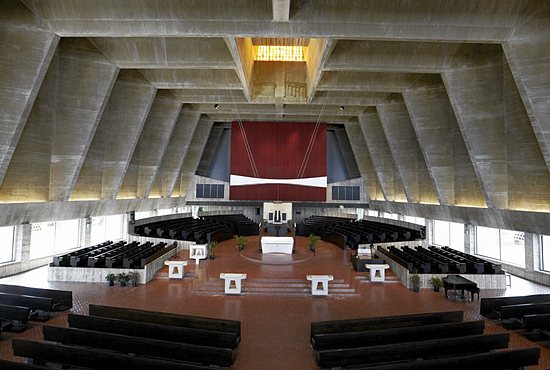
St. John's Abbey Church Interior

feet shuffle
down multiple aisles
approach the altar
sacraments of life
and death remembered

the sound of shoes
resonates against concrete
moves us to receive
hope for life and death
a crumb and a drop
spiritual food for body and soul

It’s 1980-something. I’m sitting in a long pew just beneath the balcony in St. John’s Abbey Church. The sanctuary is full of visitors, members, and local residents of Collegeville, Minnesota. We’ve begun moving forward to multiple stations where we’ll receive the sacraments. This is an ecumenical Eucharist; all are welcome.

It isn’t far to the stations set up near the center of the sanctuary. Architect Marcel Breuer collaborated with Benedictine monks to design this space. They ensured no one would be more than 85 feet from the altar. They also excluded columns, drapes and sound baffles.

No ecumenical Eucharist has moved me to tears as this did. It was the sound. It wasn’t the readings or the homily, or even the hymns. It was the inescapable sound of feet shuffling along the concrete. Beggars all, slowly making our way forward and then back to our seats. Like the thief on the cross. The one who didn’t stay sitting in his seat, but got up and led the first procession to the cross on which Jesus lived and died for us.

***
I first posted this on 30 September 2015. Yesterday I noticed someone had read it. So I checked it out.

I couldn’t help making a connection with recent events here in the USA. No one event captures everything. Instead we’re faced daily with more evidence that things fall apart, and that nothing we do can put them back together.

Yet we have every reason to hope. Not because we’re people of good will, love everyone, exercise deeds of kindness and mercy, or anything else we might find praiseworthy. Rather, it’s because of what God offers us through Jesus Christ.

All we need to do is get up out of our seats and get in line behind the thief on the cross. Offering ourselves just as we are, and counting only on God’s great mercy.

Praying you find rest for whatever is wearying you this Sabbath.
Elouise

© Elouise Renich Fraser, 19 August 2017
Photo found at thecatholicspirit.com

I wonder if when Years have piled —

I don’t wear a crucifix around my neck, yet I find myself in the company of those who, like Emily Dickinson, can’t escape Grief. It doesn’t matter how many years have lapsed. My comments follow her poem.

I wonder if when Years have piled –
Some Thousands – on the Harm –
That hurt them early – such a lapse
Could give them any Balm –

Or would they go on aching still
Through Centuries of Nerve –
Enlightened to a larger Pain –
In Contrast with the Love –

The Grieved – are many – I am told –
There is the various Cause –
Death – is but one –and comes but once –
And only nails the eyes –

There’s Grief of Want – and Grief of Cold –
A sort they call “Despair’ –
There’s Banishment from native Eyes –
In sight of Native Air –

And though I may not guess the kind –
Correctly – yet to me
A piercing Comfort it affords
In passing Calvary –

To note the fashions – of the Cross –
And how they’re mostly worn –
Still fascinated to presume
That Some – are like My Own –

c. 1862

Emily Dickinson Poems, Edited by Brenda Hillman
Shambhala Pocket Classics, Shambhala 1995

Emily begins by wondering whether Harm that has Years “piled on” it might be like a Balm. Perhaps like piling ice or heat on an injury? Some would say time heals all wounds.

Does it? Perhaps the passing of Time simply multiplies the Pain of this Harm. Especially in contrast to Love lost, withheld or betrayed.

Emily does a brief roll call of various kinds of Grief. She names Death first, yet doesn’t dwell on it since once it arrives, it simply “nails the eyes” shut. She may have in mind the person who dies, not the survivors.

She then points to other forms of Grief. They’re examples of the barely recognized yet obvious Grief humans carry every day. She names Grief of Want, of Cold, and of Despair. This is the kind of Grief that doesn’t nail the eyes shut. It’s the Grief of being invisible, shunned, ignored, banished from sight in full view of others. Not allowed to breathe air that supposedly belongs to everyone. Native Air that makes one a ‘real’ person.

In the last two stanzas, Emily imagines Grief as a crucifix, a fashion item. Something like a personal Calvary. She observes an assortment of styles and ways of wearing them.

I imagine some are barely obvious; others weigh the bearer down like a heavy wooden cross. Some are flaunted like medals of honor; others hidden beneath bravado or bullying. Yet each is real, whether acknowledged or not.

Emily finds ‘a piercing Comfort’ in her observations. Perhaps she isn’t as alone as she sometimes feels. Perhaps some Crosses are like her own.

When I was growing up, no one told me that grief could be an asset. It was something I would eventually get over. Not a strange gift that could connect me with others.

I don’t want to know everything about each person I meet. I do, however, need to take into account the reality of human grief. There’s nothing so isolating as having one’s grief overlooked or ignored. Or making it a personal problem to solve or get over–as quickly as possible.

Jesus bore our griefs and carried our sorrows. Surely as his followers we can do a bit of this for each other, if not for ourselves.

© Elouise Renich Fraser, 12 August 2017
Image found at wallcrossesandmore.com

Thirst

Thirst
consumes me
parches my soul
throttles energy
makes me wary
cautious
lest I lose
one precious drop

Hoarding
sets in like drought
grows and multiplies
invades every
vein in my body
sucks me dry
prepares me
for death

Gasping
I refuse
to relinquish
what is mine
by right and law
wrung from
this earth by
my own hands

Heedless
I rush headlong
into a desert
of my making

No one
looks my way
or offers
one precious drop

***

Here’s another option from the prophet Isaiah:

Come, all you who are thirsty,
come to the waters;
and you who have no money,
come, buy and eat!
Come, buy wine and milk
without money and without cost.

Why spend money on what is not bread,
your labor on what does not satisfy?
Listen, listen to me,
and eat what is good,

and you will delight in the richest of fare.

Isaiah 55:1-2 (New International Version)

I’ve been thinking about the way we seem to be turning inward. Supposedly protecting ourselves and our own, lest something terrible happens and we’re left high, dry and more vulnerable than ever. But I wonder.

Ironically, the best way to ensure disaster may well be to shut down our hearts and hang onto our assets, however meager they may be.

This isn’t about political parties, racial identity or religious beliefs. It’s about our common humanity. The capacity in each of us that’s capable of welcoming and providing hospitality to strangers. And the capacity to receive this from others.

It isn’t easy. We’re never promised success, safety or survival for ourselves or others. We are, however, promised the satisfaction of receiving and passing on small bits of grace and gratitude. Some of those tiny drought-proof seeds that grow only when they’re given away.

© Elouise Renich Fraser, 5 August 2017
Image found at feelgrafix.com

My story from the inside out

I grew up in a church that wanted to know exactly when and where you were converted, and from what. The deeper the degradation, the more your story was valued. Unfortunately, I had no dramatic story. Sometimes I wondered whether I was a ‘real’ Christian.

In November 2013 I wrote the following brief piece to read at a church meeting. I read it this morning and teared up. A timely reminder of how God works in my life.

I don’t remember when I received Jesus into my life. I do, however, remember times when I was lost, and God came looking for me. One of these was a huge turning point in my life.

I was in my 40s. Outwardly I seemed to be following Jesus; inside, I was lost.

  • I was filled with shame and terrified that any day I would be exposed as a fraud, an imposter.
  • I was plagued by chronic anxiety about events at home and at work.
  • I was harshly judgmental toward myself and toward others.
  • I felt my life was out of control, yet I kept trying to make it work.

In my mid-40s, I learned about family matters over which I had no control. Secrets I’d been carrying inside me for years began to eat away at my gut. I fell into deep depression. At home I sat for hours doing nothing but staring out the window, or weeping uncontrollably. At night I frequently asked God to just take me while I was sleeping. I didn’t want to wake up the next morning. I wanted to die.

I had always survived by being a good girl on the outside, and hiding what was on the inside. This took great effort. I had also become addicted to running my own life and thinking I could run everyone else’s too! But it wasn’t working; my body, my emotions and my spirit were in turmoil.

I believe God was trying to get my attention. And there was a price: I would have to come out of hiding and ask for help. I was terrified. What would people think of me? Fortunately, I was also desperate.

So I began attending a 12-step program to deal with some of my family matters. At my first meeting no one frowned, judged me, or expected me to perform. They weren’t shocked when I told them why I was there. They just welcomed me, smiled, listened, encouraged me, and said to keep coming back.

So I did. Slowly, I began to relax, join the rest of the human race, and trust that God was in this process.

Today I’m still a recovering human being and a grateful follower of Jesus Christ. Sometimes I still struggle with shame and anxiety, and try to control my life or change other people. I don’t, however, suffer from deep depression or pray that God will take me while I’m sleeping. I remind myself daily that I am God’s beloved daughter child, and that this is more than enough to bring God delight. When the time comes for my final home-going, my only hope will be to appear before God then as I do now: just as I am without one plea.

If you’re feeling lost or despondent today, God may be trying to get your attention.

Elouise ♥

© Elouise Renich Fraser, 30 July 2017

hanging on for dear life

P1040831

hanging on for dear life
gnarled roots exposed
soil sifts away with
each new flash flood
no rock bottom in sight
turbulence guaranteed
in more than the air
reeking with harbingers
of hard times ahead
soil ill-prepared
for these upheavals
brittle dry sinews of our
vulnerability on display
slow motion relentless
yesterday disappearing
before our eyes can adjust
in this foreboding present

Every day my eyes are pulled to headlines and news articles that sometimes offer more than they can deliver. Instead, they leave me without comfort or enlightenment. Sometimes they destroy any iota of clarity I thought I’d achieved. It isn’t laughable; it’s tragic. Not because of the news industry, but because of what passes these days as news.

So here’s the news I’m counting on these days–good for me, good for you and good for the animals and mother earth!

Your love, Lord, reaches to the heavens,
Your faithfulness to the skies.
Your righteousness is like the highest mountains,
Your justice like the great deep.
You, Lord, preserve both people and animals.
How priceless is your unfailing love, O God!
People take refuge in the shadow of your wings.
They feast on the abundance of your house;
You give them drink from your river of delights.
For with you is the fountain of life;
In your light we see light.

Psalm 36: 5-9 (New International Version)

Psalm 36 was written during politically troubled times filled with those who flattered themselves “too much to detect or hate their sin.” So-called leaders were failing to “act wisely or do good” and did not reject what was wrong.

The only antidote to evil and falsehood is truth. Speaking it, yes. Even more potent, living it. Daring to live each day in the light of our Maker—the only light in which we see light, whether we live and whether we die. The unseen source and goal of our dear lives.

Praying this day will bring moments of deep calm and clarity.

Elouise 

© Elouise Renich Fraser, 28 July 2017
Photo credit: DAFraser, October 2012, Hoyt Arboretum, Portland, Oregon
Response to WordPress Daily Prompt: Shallow

Smell of fear

Smell of fear
Binds her tongue
Without
And within
Residue
Of storms
Long past
Hovering
Just beyond
Eyesight
Deep within
Her psyche
Spawning fear
Of her powerful
Voice locked
In neutral
Going nowhere

I always die a little when I speak in public. It doesn’t matter how confident or calm I sound on the outside. I shake on the inside, sometimes trembling physically when I’m finished. If fear were a fragrance, I would reek of it.

I’ve always chalked this up to being an introvert with thin skin. Afraid of what people will think of me and my ideas. Especially when I’m speaking in a religious setting.

Little wonder. My thinking and writing about God, the world and Christian faith aren’t always considered acceptable, much less mainstream by either more conservative or more liberal listeners.

Nonetheless, I think this fear runs deeper.

This weekend I had a small dialogue with myself about my voice. Especially my writing voice. I love it. Often, looking back at old posts, I’m moved to tears.

Nonetheless, I’ve been dragging my feet on the idea I floated well over a month ago. Dragging my feet while pretending to move ahead. Hoping to generate enough energy to begin working on an e-book of selected postings.

This past weekend, I hit pay dirt. Here’s what I wrote in my journal on Friday and Saturday evenings, lightly edited for clarity.

Friday evening, after lots of agonized words about getting nowhere.

Right now this is an undocumented project. Notes, but no measurable, incremental steps recorded….I say I don’t have to do this, yet I want to do it! What’s holding me back? I want to know. I feel a little stuck and frightened. Of what? I don’t know. Am I afraid of my own voice?

Then Saturday evening:

Yes! I’m stuck and I’m frightened of my own voice…Today I read through about 15 of my most liked poems and chose one to reblog—the Amy post about being weary of my life—her lament that’s so like mine. “You are about my bed.” Where I’m lying—stuck and frightened of my own voice.

I accept this truth and want to welcome it as a stranger…rather than denying its existence, and thus denying the dormant power of my voice….Was this one reason my father tried to beat my voice out of me??? Did he see something I couldn’t see? Something that frightened or threatened him and his voice? “You are about my bed.”

And Sunday evening:

Yes! I have a powerful voice, and have had all my life.

I’m sure I’ll learn more along the way. But this is where I find myself today, Monday.

Thanks for listening and reading!

Elouise 

© Elouise Renich Fraser, 24 July 2017
Response to WordPress Daily Prompts: Fragrance; Dormant

Something about prayer….

My history with prayer is all over the map. I’ve probably heard more prayers than I’ve heard sermons. Too many to count. On the other hand, I’ve always struggled with prayer. Here are two posts talking about my childhood struggles with prayer: here and here.

Last year a friend gave me a slim volume of poems by Mary Oliver, a winner of the National Book Award and the Pulitzer Prize for poetry. The volume I’m reading is Thirst.

What caught my eye this week was the first stanza of a longer poem titled “Six Recognitions of the Lord.” I’m still taking in the first stanza.

I know a lot of fancy words.
I tear them from my heart and my tongue.
Then I pray.

When I read these simple words, I feel lighter. I grew up hearing and trying to replicate, in my way, prayers that would be polite and proper. Yes, I spoke from my heart no matter when I prayed. Yet I also felt unbearably self-conscious about my prayers, especially about the words I used.

It didn’t matter whether I was praying privately or publicly, I feared my words wouldn’t live up to what God expected to hear from me. Or that they would be used by others to judge my spiritual formation.

Looking back, I know my family upbringing contributed to some of this. Whether by design or not, my prayers to God felt like baring my soul to whomever was listening. I feared someone was grading, judging or scrutinizing me. Would I pass the test?

Mary Oliver’s words are to the point and liberating. They’re also primarily about personal prayer, not public prayer. Though they may apply there as well.

The best analogy I can think of would be a child talking to a trusted parent or caregiver. Freely, without shame or hiding. With no need to impress anyone. Not calculating or careful about choice of words or what the other person might think about what I’m saying.

God just wants me to show up, talk and listen. Listen and talk. Using my own words. No matter how I feel today about God or myself.

First, Mary Oliver invites me to tear all fancy words from my heart and my tongue.

Praying your Sabbath is filled with childlike joy and delight.

Elouise 

© Elouise Renich Fraser, 15 July 2017
Artwork found on Google at http://www.royaldoors.net

Why I haven’t buried God

I can’t count how many times people ask why I haven’t given up on God. Why I don’t curse God. Why I still call myself God’s beloved daughter-child.

Even though I’m a theologian, my reasons are deeply personal. Rooted in childhood experiences with my father who insisted I call him Daddy.

Daddy, a preacher, had his own kind of God. He desperately hoped his God would have mercy on him, though I never knew exactly why. Daddy also hoped his God would straighten me out into the submissive little girl and young woman Daddy thought proper and seemly for his #1 of 4 daughters, no sons.

So why didn’t I curse God, or at least bury God with honors? After all, Daddy kept saying he was following God’s law. God’s order. God’s instructions for parents and for children. And then he would beat me. All within a strangely church-like ritual that required my full attention, cooperation and submission to Daddy as God’s servant.

It wasn’t church. And it didn’t feel like a safe home. It was worse than being left out in the cold. Furthermore, I now know the God on which Daddy called was not God. He was more like a quixotic bully to be avoided and feared. Friendly one moment; cold and calculating the next.

So why haven’t I buried God? Because my parents did something for me, early on. My primers weren’t little Jack and Jill reading books. They were hymns, choruses, verses and entire passages from the Bible. All memorized and reviewed at home, and later in my grade school Bible classes from grade 2 through 7.

My father had a phenomenal memory and was eager for me, his daughter, to exercise her memory as well. Especially Scripture, but also hymns and poetry. I took to it like a duck to water.

My favorite was Psalm 23. Yes, it’s beautiful. And it’s more. It helped me endure many beatings. Daddy wielded his rod. But Jesus used his to comfort me. To shield my soul and give me strength to endure.

I also grew up hearing and reading the Bible. I loved the story about Jesus welcoming the children when large, grownup know-it-all disciples tried to send them away. Jesus rebuked the disciples, called the children to him and blessed them.

I don’t know what God looks like. But I know what God’s Son Jesus did with children just like me. The kind who seem to make too much noise. A distraction from the serious things of life. Always getting into trouble, or wanting to talk to Jesus about trivial stuff—not theology, or when the kingdom is going to arrive.

Like Jesus, God never sent me away, but offered a safe haven, especially when things weren’t safe. I never felt rejected or unwelcome. Nor do I today. I like to think that as God’s beloved daughter-child, I look a bit like one of Jesus’ sisters from time to time.

Why would I ever want to bury this God?

© Elouise Renich Fraser, 12 July 2017
Image found at pinimg.com

Response to WordPress Daily Prompt: Bury