Telling the Truth

connecting the dots of my life

Tag: Death and Dying

Saying Goodbye to Mom | Memories
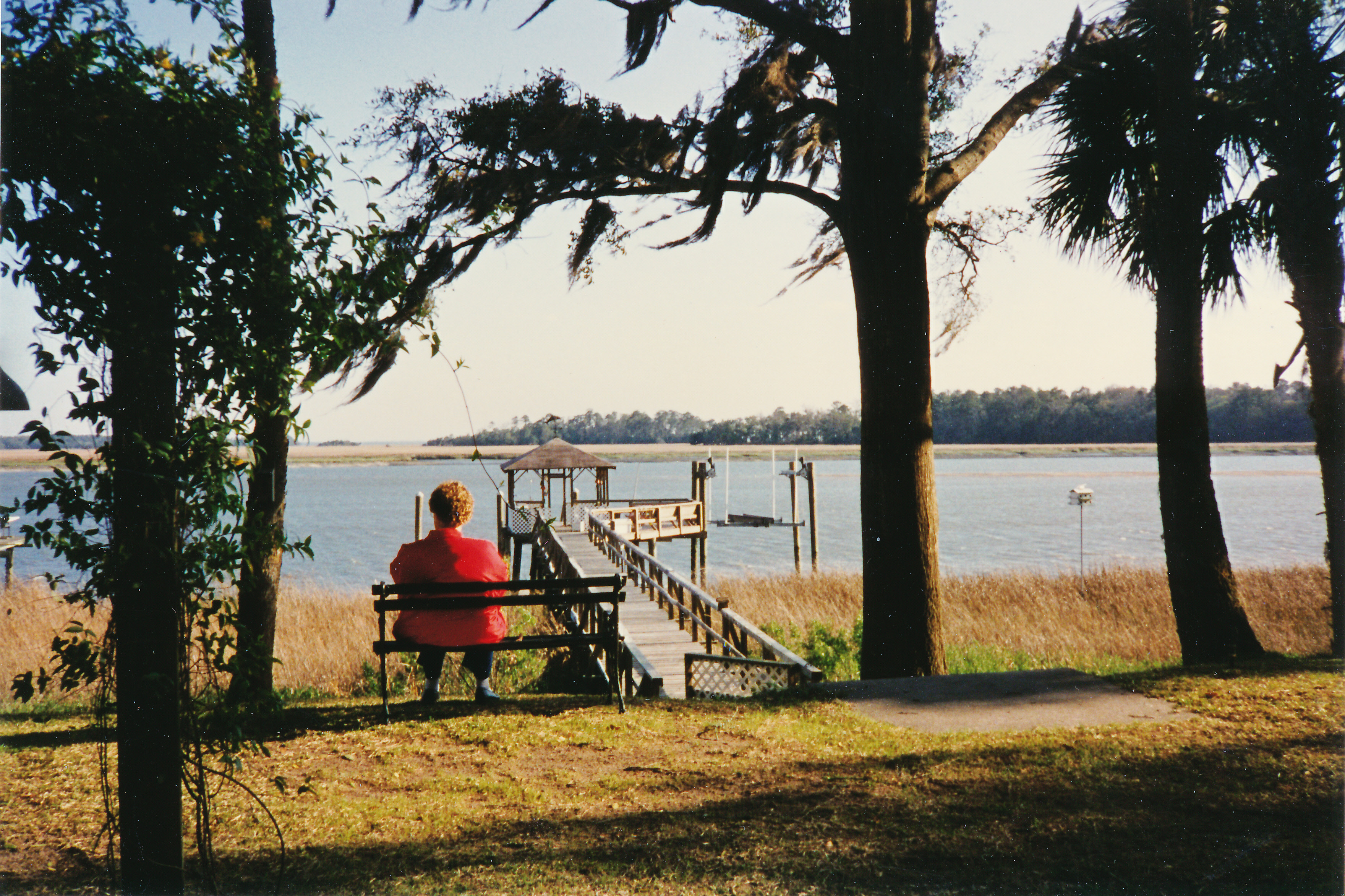
1996, Diane on bench, Montgomery house

Diane at our old house on the river, 1996

Regrets. This one grabbed my attention after I’d written my piece about Mom and Arnica Ointment. It all began in 1998 with a telephone call to let me know Mom had just had a stroke. The news immediately set off a firestorm of self-recrimination in me. Here’s why.

In late 1998, two months before Mom’s stroke, she and Dad flew to Houston to visit Diane and her family. I’d flown to Houston two days earlier–the first time I’d visited Diane since she had gone on a ventilator.

Even though I’d been there before, I wasn’t ready for the sound of this monster machine pumping, wheezing and making noise night and day. Add to that the agony of never hearing Diane’s voice again.

Two days later I drove to the airport to pick up our parents. Mom was in a wheelchair. She was wearing a new, unobtrusive microphone that picked up and projected her weak voice. Suitcases were piled high on a cart. Some filled with equipment to ease Mom’s increasing difficulties with post-polio syndrome.

Mom and Dad’s visit with Diane was painfully difficult. They didn’t seem to know how to relate to her, given dramatic changes in Diane’s ability to communicate.

Two years earlier in March 1996, Diane, her husband and daughter drove to Savannah for a small family reunion. We all knew Diane had ALS, and that this was her last trip to Savannah.

There were awkward moments, especially when Mom choked more than once while trying to swallow food. We all knew Mom wasn’t well. Nonetheless, the visit was happy, a nostalgic stroll down memory lane.

We drove downtown to see the old grade school we sisters attended, and where Mom taught kindergarten. We also drove out to our old house on the river, seen in the photo above, sandbar peeking through at low tide.

Diane’s body already showed limitations from ALS. Yet they were nothing compared to what she now lived with, just over two years later.

Here are a few excerpts from my Houston journal that describe what I observed in my parents in late 1998.

Silence and sadness and inability to speak. . . .Very uncomfortable to watch. . . .Neither of them [my parents] knowing what to say or how to act. Awkward.

The air was heavy with longing and with stunned silence. Not knowing what to do or how to relate. Sometimes projecting onto Diane thoughts and feelings that seemed to keep them from admitting their own sense of grief and helplessness.

I tried to help bridge the gap, but it didn’t work. I felt stuck. Unable to move things forward. Nothing about this visit felt normal—even though we were all dealing with the new normal.

My parents were there for five days. On the sixth day, Diane’s daughter and I drove them to the airport. I wasn’t sure how I would tell them goodbye. A lot of old buttons got pushed in me during this visit, and I was relieved that they were returning home.

Still, the thought of my parents negotiating the airport alone weighed heavily on my mind. I was about to suggest we park and go in with them when Mom spoke up. She said she didn’t want us to go in with them because she didn’t like goodbyes.

So we dropped them off at the curbside check-in and left them there. Two very frail human beings. As we drove away I had second thoughts.

Two months later I got the call about Mom’s stroke. I’d talked on the phone with her once since the Houston trip. It was my last verbal conversation with Mom.

For years I blamed myself for not parking and going into the terminal. Strangely, it seems Mom’s stroke and my arnica ointment helped ease the way for both of us–even though it was late.

Perhaps that’s how I discovered what I wanted to say to her, and how. Still, I prefer earlier goodbyes. And fewer regrets.

© Elouise Renich Fraser, 6 July 2015
Photo credit: DAFraser, March 1996

Reality check | Dear Diane

In this piece, Diane shares two moments of truth about her life with ALS. I add a moment I remember in my response to her.

Reality check

Two experiences reside permanently in my mind, moments when the reality of what was happening to my body came crashing in and seemed suffocating. They were both points of dramatic transition in the disease process.

I remember literally walking away from the job I loved on a Friday afternoon. I was grateful all the men with whom I worked happened to be out of the office. I didn’t think they would know how to respond to the situation and I didn’t want to deal with awkwardness. It was difficult enough to walk away from the women in the office.

Clay was with me and my second son just happened to return with others from a church activity as we walked out the door. I wanted to hide, especially from my son. Instead he became a source of comfort as we walked silently to the car. He understood. He shared my loss.

Another moment of truth came three years later as I was wheeled toward the operating room for a tracheostomy. I’ve never felt anxiety over surgery, just a desire to get on with it. I felt the same about this procedure but my unexpected tears wouldn’t stop. I was grateful they hadn’t started until I was out of sight of my kids. They might have misunderstood. They had enough of their own emotions to process. I feared Clay would misunderstand as he walked with me through the endless corridors. I shouldn’t have worried.

When the medical personnel with me tried to calm my apparent fear, Clay became my voice explaining my tears. I wasn’t fearful or anxious. I had no second thoughts about my choice to extend my life with a ventilator. I was grieving yet another major transition, another loss. I was recognizing the cumulative enormity of our losses and wondering where it would all end. Somehow Clay understood. Perhaps he had the same thoughts.

June 2000

Dear Diane,
“The enormity of your losses,” yours and Clay’s together, hits me in the gut. It’s a place I know nothing about. There’s you. There’s Clay. And then there’s whatever that magic reality is that’s called Diane and Clay. Together. Husband and wife, parents of three beautiful children. All of you living with ALS.

I can’t forget the day they brought in your single hospital bed. The delivery and setup men were all business-like as they invaded your bedroom. You wept as you watched them dismantle the bed you and Clay had occupied for decades. You said it was like watching them take your marriage apart.

Nor have I forgotten what happened to your bed—yours and Clay’s. It got set up in the guest room. Now it was mine to sleep in. That first night it seemed I was betraying you by sleeping in it. Somehow I was desecrating it. Becoming one of ‘them.’ Those people and machines who were relentlessly invading your life and pushing you and Clay farther and farther apart in your bodies if not in your spirits.

There’s something about ALS that’s different from other diseases. It brings sudden death over and over and over again. Without warning. Here today, gone tomorrow. Little things. Big things. Including the death of hope that ALS will stop its relentless invasions.

I also witnessed moments when Clay and your children ‘got it.’  Each in his or her way. The ever-growing collection of Beanie Babies from one of your sons, the quiet coming-alongside of your other son, and the faithful sunny presence of your daughter as she became a young woman and mother.

And then there was Clay. Quietly attending to yard work, shrubs, flowers and bird feeders for your enjoyment. Working away on your computer or some other machine to make sure it did what it was supposed to do. Looking into your eyes, touching you.

If this seems a sad letter, it is. I loved accompanying you on your journey. I didn’t love what ALS meant for you and your family.

Love and hugs,
Elouise

baptismal waters

baptismal waters
rise gently enfolding her
world-weary body

* * * * *

I’m standing in a windowless, high-ceiling concrete room
with a concrete floor, drainage holes and air vents.
A deep whirlpool tub stands in the middle
filled with warm steamy water.
The room faintly resembles a large sauna minus the wood.
Functional, not beautiful.

Mother is in hospice care after suffering a stroke weeks ago
and then developing pneumonia in the hospital.
Her ability to communicate with words is almost nonexistent.
Today she’s going to be given a bath.
I’m told she loves this, and that
Sister #4 and I are welcome to witness the event.

For the past hour caregivers have been preparing her–
removing her bedclothes, easing her onto huge soft towels,
rolling and shifting her inch by inch onto a padded bath trolley,
doing all they can to minimize pain and honor her body.
Finally, they slowly roll the trolley down the hall.

The hospice sauna room echoes with the sound of
feet, soft voices, and running water.
It takes a team to carry out this comforting
though strange and even unnerving ritual.
Mother is safely secured to the padded bath table and
then lowered slowly into the water.
Her eyes are wide open.

For a few moments she fixes her eyes on mine.
The table  descends bit by bit.
How does she feel?
What is she thinking?
At  first her eyes seem anxious.
Is she afraid?
The warm waters rise around her and the table stops descending.
Her face relaxes and she closes her eyes.

The team works gently, thoroughly, not in haste.
They focus on her, talk to her and handle her body with reverence.
My eyes brim with tears.
This woman who bathed me, my three sisters
and most of her grandbabies is being given a bath
by what appears to be a team of angels in celestial garments.

They finish their work and roll Mother back to her room.
Her bed has clean sheets.
Fresh bedclothes have been laid out.
Caregivers anoint her body with oil and lotion, turn her gently,
and comment on how clear and beautiful her skin is.
They finish clothing her, adjust the pillows to cradle her body,
pull up light covers and leave her to fall asleep.

* * *

Last Sunday I witnessed the immersion baptism of seven young people at my home church.  I couldn’t help recalling this tender, even sacramental immersion just days before Mother’s death, and decided to share it with you.

Haiku written 3 June 2014
© Elouise Renich Fraser, 3 June 2014