the mother’s hand
This sonnet captured my heart last Friday. In my comments I’m imagining what George MacDonald might have heard and seen in his mind’s eye as he wrote. Read the rest of this entry »
This sonnet captured my heart last Friday. In my comments I’m imagining what George MacDonald might have heard and seen in his mind’s eye as he wrote. Read the rest of this entry »
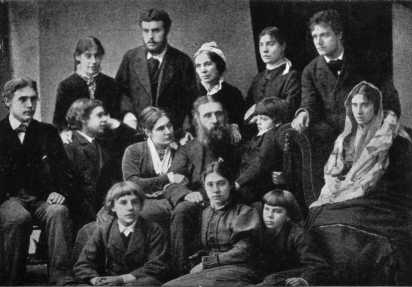
George and Louisa MacDonald with their 11 children
plus eldest daughter Mary’s fiancé
Maybe it’s my age. Or the ever-present reality of death in our media-saturated world. I’m grateful for these words from George MacDonald. Good Friday invites me to consider death with my eyes wide open.
March 21 and 22
O Lord, when I do think of my departed,
I think of thee who art the death of parting;
Of him who crying Father breathed his last,
Then radiant from the sepulchre upstarted.—
Even then, I think, thy hands and feet kept smarting:
With us the bitterness of death is past,
But by the feet he still doth hold us fast.Therefore our hands thy feet do hold as fast.
We pray not to be spared the sorest pang,
But only—be thou with us to the last.
Let not our heart be troubled at the clang
Of hammer and nails, nor dread the spear’s keen fang,
Nor the ghast sickening that comes of pain,
Nor yet the last clutch of the banished brain.George MacDonald, Diary of an Old Soul,
© 1994 Augsburg Fortress Press
Here, as in an earlier entry, MacDonald thinks about the four children he has lost to death. He longs to be with them. No one where they are now can possibly love them as he does.
Yet as great as his fatherly love is, he would “die of grief to love you only so.” That is, from afar. From this side of death.
He notes that his Lord is “the death of parting.” This gives him hope; the distance between him and his children will end someday.
He imagines that the resurrection, as wonderful as it was, still left Jesus with pain in his hands and feet. The bitterness of death was removed, yet “by the feet he still doth hold us fast”—with his “smarting” hands. Death isn’t the last word; nonetheless, it’s painful. It leaves scars, and empty seats around the table. The deathly silence of missing voices.
Because of this, MacDonald vows to hold Jesus’ “smarting” feet just as tightly as Jesus holds him. As though glued to each other. Inseparable. It’s the only way he can imagine making the journey from this world to the place where his children have gone.
And there’s one more challenge. No matter how much he tries, he can’t hold fast to Jesus’ scarred feet all by himself. His holding on depends on the strong, scarred hands of Jesus holding him. Lest he stray from the path.
Jesus has been through his death. Four of MacDonald’s eleven children have been through theirs. Now it’s MacDonald’s turn, and he knows he won’t make it unless Jesus holds his feet “to the last.”
“But by the feet he still doth hold us fast.”
© Elouise Renich Fraser, 3 April 2015, Good Friday
Edited on Good Friday, 30 March 2018
Photo found at georgemacdonald.info
Do you ever second-guess your writing? I do. Take a look at this George MacDonald sonnet about writing. My comments follow. Read the rest of this entry »
Do you fall in love with gorgeous sunsets and starry skies? Here’s a sonnet from George MacDonald that talks about this and more. I’ll comment at the end. Read the rest of this entry »
Here’s an excellent reading for today. It’s George MacDonald’s sonnet for February 29. I know, this isn’t a leap year. It is, however, appropriate for the end of any day, week or month of the year. Including February! So here it is, with my comments following. Read the rest of this entry »
Dear God,
I ended my last letter with a question: “When I go to the door to open it to You (the stranger), how will I know it’s You?” I’ve been puzzling over my question all week. Read the rest of this entry »
I’m surprised at feelings I’ve had since I began writing Dear Dad letters. Sometimes I’m afraid I’m trying to get something from Dad that he can’t give me. I don’t think I am. I definitely feel I’m ‘out there,’ in the driver’s seat without a finished roadmap, uncertain where this will lead.
Most surprising, though, Read the rest of this entry »

It’s November. My husband and I just finished a hike through the meadow at Longwood Gardens Though the weather forecast promised warm afternoon sun, it’s gray, cold and misty. On a whim, I ask my husband to take a picture of this sign. Read the rest of this entry »
Three of my favorite devotional authors loved and were loved by children: Amy Carmichael, George MacDonald and Oswald Chambers. They seemed to understand life from a child’s point of view.
I want to be a child forever! Read the rest of this entry »
 Telling the Truth