Telling the Truth

connecting the dots of my life

Tag: Health and Wellbeing

Living and Dying in Fake History

Lift up your eyes,
not your voices—
Weep with those who weep

Open your ears
to strangers

Resuscitate your heart
grown still and cold from neglect

Or have we already sold our souls
for greenbacks, glory
and false faith in firearms?

Listen

Hear the voice of our Creator
lamenting loudly over
distant hearts
grown accustomed to
the way we thought things were
yet will never be
in this life or the next

I’m in the process of reading several accounts of national history, including church history. Each study corrects fake history written to silence victims, and glorify victors who were as human as we are, and less than pure in their motives. They raise the obvious question: How did we get here centuries and decades later? And what must we do next if we want something better?

Reading won’t magically change the way I am in the world. Hopefully I’ll think more clearly and act with greater intent.

In addition, my soul won’t be in it if I haven’t also lamented loudly, listened silently, asked questions, meditated on what I see and hear, and made changes in my lifestyle.

What’s happening today isn’t just a matter of historical data or who we want to be the next POTUS. It’s about the content of our character, beginning with me and with you. How willing are we to stand up before friend and foe alike, on behalf of new friends and strangers?

Easier said (or written about) than done. But as they say rather glibly these days, “We’re all in this together.” Aren’t we?

Happy Monday, despite the lopsided agonies of Covid-19, the struggle against Black Lives Matter, and the failure of POTUS to lead by example. Which doesn’t let us off the hook.

Elouise

© Elouise Renich Fraser, 6 July 2020
Quote found at azitanahai.com
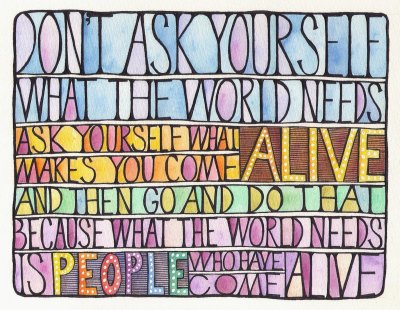
What the world needs | Howard Thurman

Howard Thurman made things straightforward, simple and down to earth. My father did not. I was raised in a Christian culture (presided over by my father) that saw life outside our ‘safe’ space under attack by twin demons: complexity and danger. Especially if life outside made me come alive.

  • Dancing? No way! Definitely the first step toward raucous, immoral behavior.
  • Lipstick? No way! A sure sign of debauchery. (Until it suited my father to make it imperative.)
  • Dating unchurched and thus unreliable (might grope or rape me) males? No way! (Not that dating was high on my list.)

So here I am today. A supposedly grown-up white woman still figuring out how, at this age and under our current circumstances, to go and do what makes me come ALIVE!

All things  considered, I don’t plan on going anywhere for a while. However, reading and writing make me come alive. Along with music and poetry. Talking with my children and grandchildren. Stopping for a street-side chat with neighbors. Hearing from friends all over the world. Playing with Smudge.

Then there are lovely morning walks. I’m just back from one with D, seeing and hearing birds sing at will. No officious patrol cars tracking them down and locking them up for looking suspicious or disturbing the peace.

The end of the matter is this: I’m most alive when I’m an uncaged songbird! I want to spend my short life singing songs of truth, especially when I’m surrounded and it looks like the sky is falling.

These are trying times. It’s the 4th of July. I wish I could say Hurray for the USA! We’ve come a long way baby! Break out the champagne! Let the fire crackers fly through the air!

But I cannot. Why not? Because right now this contentious, at-risk world needs people who have come alive. Women, men and children willing to tell the truth about their lives regardless of the cost. Willing to listen long and hard to songs they’ve never heard before. Willing to look into the eyes of strangers, smile, and say “Good morning! Would you be willing to tell me about your life?”

Hoping you have a thoughtful 4th of July filled with songs and stories you’ve not heard before.

Elouise

© Elouise Renich Fraser, 4 July 2020
Image found at quoteswave.com

haunted streets and swollen cathedrals

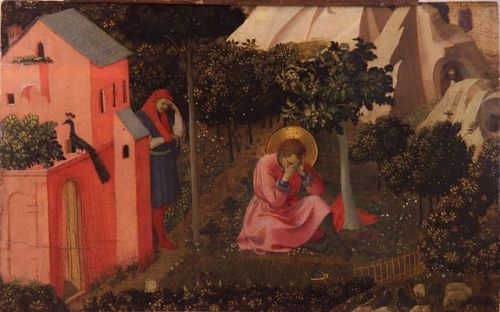
The Conversion of Saint Augustine of Hippo
by Fra Angelico, between 1430 and 1435

signs and symbols
of wealth and poverty
thrown together
in a mixed stew
of pride and prejudice
haunt the streets
and swollen cathedrals
of life and death

take your pick
it’s free or
at least as painless
as possible
this habit of
indulging while
looking elsewhere
as though this
just happened
out of the blue

yes sir
no sir
thank you ma’am
and excuse me
for a moment if
I digress
to point out
obvious trinkets
decorating the outside
contaminating the inside
sick unto death

false pride and bankrupt prejudice
bursting now on streets
and in back alleys
everywhere

This is a comment on public or private displays of spite and outrage over what isn’t working well in this nation. And yet….so much needs to change. What’s a body to do? Yes to pointed protests. And what about our inner lives?

Augustine of Hippo leaves no space for disinterested onlookers or commentators on world or local history. In City of God, he suggests that every war ‘out there’ is at least an invitation, if not a mirror in which we are to discern our personal (invisible) wars. To his credit, he was at least as hard on himself as he was on anyone else.

This means my past as a white woman matters. Somewhere in me I still have unresolved warfare, some raging since my childhood. Other pieces were stirred up along the way. Life isn’t simply a gift to unwrap and enjoy in a personal orgy of bliss. It’s also an invitation to face hard truths about myself and my relationships.

Do I like this? Not necessarily. It’s difficult and time-consuming. The work of a lifetime. Right now the focus is on my inherited ‘whiteness,’ and how I’ve dealt with it (or not), and what comes next. What does it mean to tell the truth about that?

Elouise

© Elouise Renich Fraser, 2 July 2020
Image found at wickipedia.com

James Baldwin on Race Relations

It’s 1943, one of the years Harlem race riots break out. It’s also the day James Baldwin’s father was laid to rest.

In Notes of a Native Son, Baldwin talks about his relationship with his father. The chapter ends with his account of what sparked the 1943 Harlem riots, the nature of the rioting (only in the ghetto, chiefly against white businesses, not white people), and the nature of Black America’s long relationship with White America.

His account of this relationship is telling. Here’s how he describes “the Negro’s real relation to the white American.”

This relation prohibits, simply, anything as uncomplicated and satisfactory as pure hatred. In order really to hate white people, one has to blot so much out of the mind—and the heart—that this hatred itself becomes an exhausting and self-destructive pose. But this does not mean, on the other hand, that love comes easily: the white world is too powerful, too complacent, too ready with gratuitous humiliation, and, above all, too ignorant and too innocent for that. One is absolutely forced to make perpetual qualifications and one’s own reactions are always canceling each other out. It is this, really, which has driven so many people mad, both white and black. One is always in the position of having to decide between amputation and gangrene….The idea of going through life as a cripple is more than one can bear, and equally unbearable is the risk of swelling up slowly, in agony, with poison. And the trouble, finally, is that the risks are real even if the choices do not exist.

In some  ways, this is discouraging. As a white woman, it suggests I’m in bondage to a perpetual dilemma. Even more distressing is the possibility that this was brought on by my need to forget, not see, disremember, dress up in different clothes, and ultimately, dismiss as someone else’s battle or disease to fight.

Nonetheless, I find James Baldwin’s description of the relationship between Black and White Americans/America compelling. I’ve often heard Black women and men say they know us (White people) better than we know ourselves. I believe them, though they may not know me personally.

Put another way, I can’t count on being White-but-not-really due to my years of serving at a multiracial, multiethnic, multinational seminary. Instead, I can only be the White woman I am, a beginner every day of my life.

Elouise

© Elouise Renich Fraser, 30 June 2020
Moon Over Harlem painting by
William Henry Johnson found at americanart.si.edu

Poor little rich white girl

Poor little rich white girl
from everywhere
and nowhere in particular
Shrinks in horror
And confusion from
Imperious or friendly voices
Vying for her attention
Her full support
Her obedience
Her submission
Her silence

To be or not to be?

Fear wins the lottery
As she retreats into
Familiar shadows
Of false safety
Unraveling her soul
From the inside out
One stitch at a time
Drifting into slumber
Overflowing with dreams
Of what might have been
Once upon a time before
The clock struck midnight

Covid-19 has disrupted my life. Black Lives Matter has galvanized me. Not because I think we’ll overcome racism in my lifetime, but because I grew up as a poor rich white girl. I was ignorant, confused, and filled with shame about being white and female. Questions about obvious inequalities on display every day of my life went unanswered.

As a preacher’s kid I was fully immersed in the culture of conservative Christianity as interpreted by my father, plus other male preachers and Bible teachers I encountered along the way.

When I married D and left home, I chose to follow a different understanding of Christian faith. Yet even this didn’t give adequate attention to underlying disasters and sins of this country. These included treatment of native American Indians, and treatment of Black women, men and families captured and put on sale to serve as slaves to white Americans.

Being silent today is not an option. Neither is carrying on life as usual.

So I’m asking questions. What does all this mean for me at this time in my life? How will it affect my reading and writing? How will it affect my relationship to the church? What can I do, and What must I NOT do? This isn’t about my generation; it’s about our collective future. With and without me.

I’m also wondering how all this impacts your daily life.

Elouise

© Elouise Renich Fraser, 29 June 2020
Photo of me with my younger sisters; taken by JERenich in 1953; mixed rural neighborhood outside Savannah, Georgia

In the Evening, in the Pinewoods | Mary Oliver

Who knows the sorrows of the heart?
God, of course, and the private self.
But who else? Anyone or anything else?
Not the trees, in their windy independence.
Not the roving clouds, nor, even, the dearest of friends.

Yet maybe the thrush, who sings
by himself, at the edge of the green woods,
to each of us
out of his mortal body, his own feathered limits,
of every estrangement, exile, rejection—their
death-dealing weight.

And then, so sweetly, of every goodness also to be remembered.

© 2008 by Mary Oliver
Published by Beacon Press in Red Bird: Poems by Mary Oliver, p. 63

A few weeks ago, out walking in the evening, I heard a wood thrush. One of the most haunting, beautiful sounds on earth. It was singing in the woods behind a nearby church and graveyard.

So many deaths right now. So many regrets, angers, crushing sorrow and disbelief.

I’ll never forget the cries of a mother Canadian Goose nesting just outside my office at the seminary. A noisy raptor had been circling and screaming for too many minutes. Father Goose was sitting nearby, clearly agitated, watching the sky from time to time.

Yes, the inevitable happened. The raptor stole the baby from the nest, unmoved by the parents’ frantic, furious cries and attempts to save their newly-hatched chick.

When I arrived at the seminary early the next morning, Mama Goose was sitting immobile, holding silent vigil on grass in the back courtyard of the seminary. Her loyal partner sat nearby, watching her and waiting. It looked and felt like a mourning ritual. They were there for most of the day before they flew away.

So much sorrow and anguish right now. That’s why I need to hear a wood thrush from time to time, along with its many neighbors calling out to me: There’s more to life than meets the eye. Mourn, have faith, and carry on.

Written a few days after the loss of one of my forty-nine first cousins, and in view of my own mortality and the current situation in this world.

Thanks for visiting.
Elouise

© Elouise Renich Fraser, 23 June 2020
Video found on YouTube

What ‘human rights’ don’t look like

Recently a friend sent me the following list. I haven’t been able to get it off my mind. It was compiled by Dr. Valerie Bryant, a Black therapist in Brooklyn, NY. In the list she names black citizens threatened or killed in recent years while engaging in the behaviors she names.

Think of Dr. Bryant’s list as a roll call clarifying the difference between living black or brown, and living white in the USA. It’s also an invitation to reflection about ourselves, and the meaning of human rights.

…As a white person when you go out in the street, you don’t have to think twice of being murdered by a police officer or citizen acting like a police officer.

Or as a white person,

I can go birding (#ChristianCooper).
I can go jogging (#AmaudArbery).
I can relax in the comfort of my own home (#BothemSean and
#AtatianaJefferson).
I can ask for help after being in a car crash (#JonathanFerrell and
#RenishaMcBride).
I can have a cellphone (#StephonClark).
I can leave a party to get to safety (#JordanEdwards).
I can play loud music (#JordanDavis).
I can sell CD’s (#AltonSterling).
I can sleep (#AiyanaJones)
I can walk from the corner store (#MikeBrown).
I can play cops and robbers (#TamirRice).
I can go to church (#Charleston9).
I can walk home with Skittles (#TrayvonMartin).
I can hold a hair brush while leaving my own bachelor party (#SeanBell).
I can party on New Years (#OscarGrant).
I can get a normal traffic ticket (#SandraBland).
I can lawfully carry a weapon (#PhilandoCastile).
I can break down on a public road with car problems (#CoreyJones).
I can shop at Walmart (#JohnCrawford) .
I can have a disabled vehicle (#TerrenceCrutcher).
I can read a book in my own car (#KeithScott).
I can be a 10yr old walking with our grandfather (#CliffordGlover).
I can decorate for a party (#ClaudeReese).
I can ask a cop a question (#RandyEvans).
I can cash a check in peace (#YvonneSmallwood).
I can take out my wallet (#AmadouDiallo).
I can run (#WalterScott).
I can breathe (#EricGarner).
I can live (#FreddieGray).
I can be arrested without the fear of being murdered. (#GeorgeFloyd)

***These are NOT human rights if only white people have them.*

With compassionate rage
Valerie Bryant, PhD
Fort Greene Bklyn 11205

How would my world change if I woke up with different colored skin than I now have? Can I remember how I was taught to think or talk about skin color?

© Elouise Renich Fraser, 21 June 2020
Image found at stlpublicradio.com

Just for today

Finally
After months of fighting
acceptance

Comes knowledge
That this is the way things are
and didn’t have to be

Plus willingness
to accept limitations
and whatever today offers

Ready
To give and receive small gifts
No matter the outcome

Refusing
To look the other way
While lifting my voice in prayer

Content
With what I can do this day
Unlike any other

Several times in the last few weeks I’ve heard friends and strangers talking about prayer. In particular, how we pray right now, given the current situation in the White House, in governing and non-governing bodies, and in our neighborhoods.

It’s time for lament. The kind that looks into the reality around us without trying to go back to the way things were. Lament that acknowledges our personal grief, anger, rage, and our betrayal by POTUS and others more concerned with glory than with grace. Lament that implores our Creator to have mercy on us, no matter the cost.

I’m in lament mode. I’m also beginning to understand how to get up in the morning and let the day be what it is. An opportunity to be invested in something larger than myself, without getting sidetracked by the mucky morass that wants to capture and kill my energy.

Praying you’re finding your way in this day unlike any other.
Elouise

© Elouise Renich Fraser, 19 June 2020
Photo found at m.economictimes.com

It’s been an age

Tree

This is one of my favorite poems, at least as true today as it was when I posted it in November 2014. Today has been filled with a mixture of happiness and contentment, along with a lurking feeling that we’re all at sea, and the ship of state is stressed.

How do you see yourself and others today? I hope you’ll give yourself a great big smile before the day is done. Then give away at least one more smile. All we can count on is the present.

It’s been an age since I first met you—
You there, looking back at me
Three score years plus eleven to be exact
You haven’t changed a bit, they say
You and I know better
Sometimes I can’t believe it’s you
I hardly know you
Could we start over do you think?
Would it be as much fun?

I don’t know.
Was it fun for you?
Are you as puzzled as I am?
I seem to have more questions than answers today
Where and when did we find each other?
We seem to get along
But then we always did even when we didn’t
So who am I to say?

All I know is looking back at me
Wondering where the time has flown
And who this beautiful woman is
Smiling at me through the mirror

* * *

© Elouise Renich Fraser, 20 November 2014, reposted 18 June 2020
Photo Credit:  DAFraser, December 2012
Hoyt Arboretum, Portland, Oregon