Telling the Truth

connecting the dots of my life

Tag: Interpretation of Poetry

Two Poems from Maya Angelou

For several weeks I’ve been reading Jim Wallis’s bestseller, America’s Original Sin: Racism, White Privilege, and the Bridge to a New America. Alongside this I’m reading again some of Maya Angelou’s poems. I find them tough, true and invitational. They invite me to see things through the eyes of others.

First, a sing-song poem for children living in Harlem, home to many African Americans, located in northern Manhattan in New York City.

In this first poem I hear seeds of resistance, resilience, pride, and discernment about how things are, and what it takes to stay alive. Try sing-songing it as though you were hopping or singing along with one of the children in the photo above. Can you imagine yourself in his or her feet? Why or why not?

Harlem Hopscotch

One foot down, then hop! It’s hot.
Good things for the one’s that’s got.
Another jump, now to the left,
Everybody for hisself.

In the air, now both feet down.
Since you black, don’t stick around.
Food is gone, the rent is due,
Curse and cry and then jump two.

All the people out of work,
Hold for three, then twist and jerk.
Cross the line, they count you out.
That’s what hopping’s all about.

Both feet flat, the game is done.
They think I lost. I think I won.

Here’s the second poem, also about life in the USA. This time from the perspective of an adult living on the edge. The note says this poem is to be sung. Can you find a tune that would work? Or make up a tune?

Contemporary Announcement

Ring the big bells,
cook the cow,
put on your silver locket.
The landlord is knocking at the door
and I’ve got the rent in my pocket.

Douse the lights,
hold your breath,
take my heart in your hand.
I lost my job two weeks ago
and rent day’s here again.

Both poems are from Maya Angelou, one of the Poetry for Young People series, published by Sterling Children’s Books in 2013; pp 14 and 15.

Here’s to a thoughtful, relaxing, challenging and uplifting weekend!

© Elouise Renich Fraser, 19  October 2018
Photo found at blackthen.com

The morns are meeker than they were

Here’s an Emily Dickinson poem for all children, including you! Plus my note to Emily below.

The morns are meeker than they were,
The nuts are getting brown;
The berry’s cheek is plumper,
The rose is out of town.

The maple wears a gayer scarf,
The field a scarlet gown.
Lest I should be old-fashioned,
I’ll put a trinket on.

Emily Dickinson: Poetry for Young People, edited by Frances Schoonmaker Bolin, illustrated by Chi Chung. Published by Sterling Publishing Co. (2008)

Dear Emily,

It pains me to say this, but I never thought of you as a trinket kind of girl or woman. But then again, it shouldn’t surprise me. You have a way of seeing beauty and even the entire creation in the smallest bird or flower.

I wonder if you had a trinket box like the one above. It comes from your century, and has a mustardy yellow autumn look about it. To say nothing of those pretty leaves and that bird in the center.

It’s too bad we don’t have photos of your trinkets. I was always told they could make or break a woman’s image. Nothing too big. Nothing too gaudy. Nothing that would call attention to me. As though I were saying, ‘Look at me!’

But your little poem has a different outlook. You want to be part of nature’s annual parade of colors. Or maybe it’s a great production. Or better yet, a grand ball in the ballroom of fields and forests glowing with bright colors.

Whatever it is, it won’t do not to smile back when nature smiles at us. So I’m off to my oldest trinket box to find something to wear today to the ball. I think I’ll look for that topaz birthstone ring my mother gave me when I was a child.

With kind regards,
From grown-up Elouise and baby Marie

© Elouise Renich Fraser, 9 October 2018
Photo of 1800s Trinket Box found at pinterest.com

A Conceit | Maya Angelou

This short poem from Maya Angelou resonates today. Especially in light of undeclared and declared wars raging in the USA and around the globe. Note that a conceit is an image or metaphor as often found in poetry. So use your imagination as you read! Maya Angelou is painting a picture in poetic language. My comments follow.

Give me your hand.

Make room for me
to lead and follow
you
beyond this rage of poetry.

Let others have
the privacy of
touching words
and love of loss
of love.

For me
Give me your hand.

Maya Angelou, in Poetry for Young People
Edited by Edwin Graves Wilson, PhD
Illustrated by Jerome Lagarrigue
Published in 2013 by Sterling Children’s Books

In this short poem I hear Maya Angelou saying two things about life and poetry.

  • Poetry can be emotionally moving while remaining a private indulgence.
  • This poem asks for more than this. Will you come with me?

Her phrase “beyond this rage of poetry” gives us a clue. This rage isn’t about anger. It’s the raging emotions of literary writing. This includes poems that convey deeply felt, sometimes prophetic emotions.

Maya Angelou’s poem demands more than our feelings, our sentimentality. It invites action. Not simply alone, but also together.

It may sound trite to say we need each other. Of course we do. Yet this poem is about more than that.

On its own, poetry can’t bring about change. It doesn’t matter how persuasively a poem describes our agony or our ecstasy, our losses or our love. What matters most is what we do or don’t do about it.

And so Maya Angelou’s poem offers an alternative to living in the private world of poetry. The alternative moves me into public worlds in which I am not yet present just as I am. Vulnerable, a beginner, falling down and getting up to begin again. Hanging onto Maya Angelou’s hand for dear life. Sometimes leading the way.

This first step doesn’t absolve me of responsibility for the direction we take. Yet if I don’t take Maya Angelou’s hand and follow her lead, I won’t discover what we may need to do next.

My gender, color, family background, or other markers of my so-called ‘identity’ won’t help me solve a problem I don’t yet understand.

Where are we going? We’ll find out together, ‘beyond this rage of poetry.’ Beyond its private intensity and enthusiasm of words.

© Elouise Renich Fraser, 3 October 2018
Image found at wikia.com

Emily Brontë – Start not….

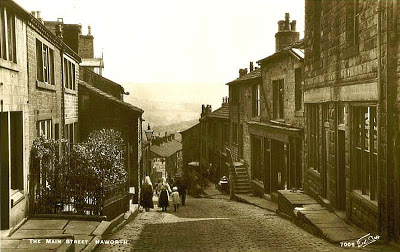
Death is on my mind. Especially since I’m in the last chapter of my life—however long or short it may be. The photo above shows the Haworth churchyard as it may have looked in Emily B’s time. Note the flat-stone grave markers, like beds. My comments follow Emily’s poem and a second photo.

Start not upon the minster wall
Sunshine is shed in holy calm
And lonely though my footsteps fall
The saints shall shelter thee from harm

Shrink not if it be summer noon
This shadow should right welcome be
These stairs are steep but landed soon
We’ll rest us long and quietly

What though our path be o’er the dead
They slumber soundly in the tomb
And why should mortals fear to tread
The pathway to their future home?

Emily Brontë, from Brontë Poems, p. 33
Published by Alfred A. Knopf 1996
© 1996 by David Campbell Publishers Ltd.

Emily Brontë was born on 30 July 1818, and died on 19 December 1848, one month after her younger brother Bramwell’s death. She lived most of her adult life in Haworth, Yorkshire, where her father was the parson. The photo above shows the main street in the 1800s. The parsonage and churchyard were near the top of the steep climb uphill. The major things missing from the photo are horses, garbage of all kinds flowing downhill, and the stench.

When I read this poem, I imagine Emily B walking up the steep hill beside me, coaching and encouraging me.

First Stanza
Don’t flinch or turn aside! Don’t be startled when you ‘come upon’ the path leading to the churchyard wall, looming at the end. Don’t swerve with dread, like horses in the heat of battle. Stay calm. Trust you’re in the best of hands. It will warm and brighten your way.

Yes, it’s uncanny and even frightening to hear your own footsteps on the stony path up this particular hill. Just remember all the saints who went this way before you. You can’t see them, but they’re cheering you on, encouraging you to stay the course instead of breaking away as though you could escape harm, pain or death.

Second Stanza
Yes, the noonday sun is blazing hot right now. Don’t try to hide from it. Look up ahead! There’s a shadow that will welcome you sooner, not later. It probably feels steeper now than it did at the beginning. It’s normal to be weary of the uphill grind. Still, your goal is just ahead. It won’t be long now. Then we can rest for a long time in utter quiet.

Third Stanza
It doesn’t matter that this path might have us walking on resting places of the dead. They’re already sleeping soundly beneath the ground in the churchyard. Besides….

…why should mortals fear to tread
The pathway to their future home?

Something like that, I think.

Thanks for visiting and reading, even though the topic isn’t everyone’s favorite.
Elouise

© Elouise Renich Fraser, 17 September 2018
Photos found at kleurrijkbrontesisters.blogspot.com

My Life had stood – a Loaded Gun –

Here’s an Emily Dickinson poem that’s been widely studied by scholars. I’m still not sure what to make of it. I can, however, connect it to what I’ve experienced in my life. My personal comments follow.

My Life had stood – a Loaded Gun –
In Corners – till a Day
The Owner passed – identified –
And carried Me away –

And We roam in Sovereign Woods –
And now We hunt the Doe –
And every time I speak for Him –
The Mountains straight reply –

And do I smile, such cordial light
Upon the Valley glow –
It is as a Vesuvian face
Had let its pleasure through –-

And when at Night – Our good Day done –
I guard My Master’s Head –
‘Tis better than the Eider-Duck’s
Deep Pillow – to have shared –

To foe of His – I’m deadly foe –
None stir the second time –
On whom I lay a Yellow Eye –
Or an emphatic Thumb –

Though I than He – may longer live
He longer must – than I –
For I have but the power to kill,
Without – the power to die –

c. 1863

Emily Dickinson Poems, Edited by Brenda Hillman
Shambhala Pocket Classics, Shambhala 1995

This poem has kept me coming  back for well over a year. Here are a few thoughts about the poem, which reads more like a small story or long riddle than a philosophical or political point of view.

This poem is at least indirectly about Emily. It’s about her life as a prolific poet, a well-known figure in her setting, and lover of the outdoors. And the reality that she is a woman. My first comment, then, is that she’s contemplating her life as she has experienced it. A loaded gun standing there in the corner–waiting, as something she doesn’t fully own.

The action begins only after the owner appears, identifies himself and carries her away. Not as a person, but as a weapon that will benefit him. It strikes me as sad that the adventure is in the forests, valleys and mountains she loves to roam. We know this from other poems. Yet now her function isn’t to talk to the animals, the trees or the birds, but to do her owner’s bidding. Shoot to kill, on demand. Beginning with a Doe about which we know nothing more.

Emily comments on her new-found ‘half-life’ (my term, not hers). Her Master depends on her to do his bidding. Not some of the time, but spectacularly, all the time. She finds comfort in this new-found power to guard her Master’s head, as well as in the reputation and safety she now enjoys as the rifle/voice of the Master.

It’s a messy situation. We don’t know where Emily stands with all this. In the last stanza she struggles with an unresolved question about power. If her Master dies, what will happen to her? Perhaps she fears she’ll be picked up by someone else and used as his obedient, powerful speaker/killer. Surely she didn’t enjoy killing that Doe.

The poem reminds me of times when so-called Owners used me, beginning with my father. In these situations they used my voice or my words without my permission, to distort truth or amplify their own power. I often wished I could die or disappear.

©Elouise Renich Fraser, 16 August 2018
Photo found at Nature Photography, jonrista.com

I have not told my garden yet

This poem from Emily Dickinson caught my eye this week. I found it in a volume of her poems for young people. Nonetheless, I heard it as an adult poem about adult pain. My comments follow the poem.

I have not told my garden yet,
Lest that should conquer me;
I have not quite the strength now
To break it to the bee.

I will not name it in the street,
For shops would stare, that I,
So shy, so very ignorant,
Should have the face to die.

The hillsides must not know it,
Where I have rambled so,
Nor tell the loving forests
The day that I shall go,

Nor lisp it at the table,
Nor heedless by the way
Hint that within the riddle
One will walk to-day!

Emily Dickinson: Poetry for Young People, edited by Frances Schoonmaker Bolin, illustrated by Chi Chung. Published by Sterling Publishing Co. (2008)

This poem is about death: Emily’s preoccupation with death, and her own death. Whether final or as daily reality. Each stanza adds depth to her poetic riddle.

Stanza 1. Emily thinks about her garden, the place that brings her happiness and peace. It seems she’s afraid she might not survive breaking the news, though we’re not yet certain what the news is. It’s clear this won’t be easy or happy news. Not for the garden, the bee, or her.

Stanza 2. Emily thinks about village shops that stare at her when she’s out and about. There she’s known as shy and perhaps ignorant. She has no intention of letting the shops know her plans. They wouldn’t believe that she, of all people, would have “the face to die.”

I take this “face to die” as setting her face toward death, which she names in the last line of the stanza. She faces death with determination, perhaps the way Jesus ‘set his face’ toward Jerusalem—the city in which he would die.

For Emily, it doesn’t matter what the shops or shoppers might think about her. She’s stronger than she’s given credit for. Indirectly, she’s saying they don’t know her at all. So why should she tell them anything at all about her “face to die.”

Stanza 3. Emily now thinks about the hillsides and the forests. She loves both settings yet determines to keep them in the dark. It seems that if she doesn’t tell the hillsides about it, they won’t tell the forests. Perhaps they’ll think she doesn’t love them anymore? Or perhaps the hillsides and forests will die of sorrow?

The verb ‘rambled’ has more than one meaning. It could mean rambling around in the woods, as well as the rambling of Emily’s voice speaking freely to the trees and hillsides. Not to ramble anymore would be a great loss for them and for her. Here she can speak out loud freely and directly. Yet she isn’t going to tell them the day she’ll “go.”

Stanza 4. Finally, Emily has no intention of talking about this at “the table,” which I take to be her family circle. Not even in what we might call baby talk that’s less than clear. She’s also determined not to suggest that “within the riddle” is a hint that “One will walk to-day!”

The last stanza seems to have two meanings: one about her family circle; the other about the poem itself. Which has me wondering whether this is ‘only’ a riddle, or a veiled clue to her unhappiness and desire, if not clear intention, to “walk to-day.” To die to her family and her beloved garden, and never return. A form of death no matter how you read the poem.

I don’t know whether Emily wrote this poem before or after she wrote I Years had been from Home. I do know these are the words of a woman in distress who chooses to tell the truth but tell it slant.

Yes, my heart goes out to her. Emily has a level of courage I haven’t often seen or heard in this life.

Thanks for visiting and reading, and leaving your own interpretive comments or questions if you’d like.

©Elouise Renich Fraser, 29 July 2018
Photo found at correntewire.com

I like a look of Agony

It’s been a while since I’ve commented on one of Emily Dickinson’s poems. Here’s one that seems right for this season of national and international rhetoric. My comments follow, in free-verse form.

I like a look of Agony,
Because I know it’s true –
Men do not sham Convulsion,
Nor simulate, a Throe –

The Eyes glaze once – and that is Death –
Impossible to feign
The Beads upon the Forehead
By homely Anguish strung.

c. 1861

Emily Dickinson Poems, Edited by Brenda Hillman
Shambhala Pocket Classics, Shambhala 1995

Emily doesn’t like false feelings or pretense. In this poem she looks to Death for an example of true feelings. Not expressed in words, but literally, on the forehead of a dying person. No one can possibly play make-believe when it comes time to die. Convulsions and the intense agonies of death, whether physical, spiritual or emotional, can’t be faked.

Nor can those telltale ‘Beads upon the Forehead’ of the dying person. Even silent Anguish cries out with tears that leak through the skin. Beads of Anguish strung upon the Brow. Thus Death gives strange birth to Truth. The truth of Agony and Anguish.

Below is my free-verse response to Emily’s poem. I’m struck by how many ‘fake’ emotions parade before our eyes and ears each day. We live in an age that celebrates Faux or at least Exaggerated Feelings. Perhaps to such an extent that we no longer discern what is Manufactured from what is Real.

With apologies to Emily:

We live in an age of Faux Feelings
Or at least an age that rewards them
Not with congratulations but with Attention
and Faux Gasps of Horror or Delight

Perhaps we forgot or never knew
How to have, much less allow air time
For True Feelings not ratcheted up
To the nth degree — especially True Agony

The kind not found by looking in a mirror
Trying to get just the right look that will
land just the right response be it Attention,
Applause, Laughter or the Disgust of the Moment

Unsocial Commandments hamstring us
Pulling chains that avert our eyes instead of
Encouraging us toward each other in life and
In death as family and next of kin, not strangers

Life and Death itself seem to propel us toward
Ever-greater depths of make-believe and denial –
Hiding behind masks that mimic or minimize feelings
We most fear to acknowledge, sit with or name

Perhaps our Deaths are the only unscripted
Roles we play with unfiltered, uncosmeticized
Feelings of True Agony, Grief, Pain and Love,
Finally crossing all sides of divides that bind us

©Elouise Renich Fraser, 14 May 2018
Photo found at blog.xuite.net

The Work of Christmas | Howard Thurman

This week I received a lovely Christmas note with a poem by Howard Thurman on the front. Howard Thurman (1899 – 1981), was a key figure in the life of the USA during the 20th century. Thurman was an author, philosopher, theologian, educator and civil rights leader. He was also an early leader and mentor in the nonviolence movement that shaped and included Martin Luther King, Jr.

Here is Thurman’s poem, followed by a few comments.

When the song of the angels is stilled,
When the star in the sky is gone,
When the kings and princes are home,
When the shepherds are back with their flock,
The work of Christmas begins:
To find the lost,
To heal the broken,
To feed the hungry,
To release the prisoner,
To rebuild the nations,
To bring peace among all,
To make music in the heart.

Howard Thurman, from The Mood of Christmas, p. 23
Published and copyrighted by Friends United Press, 1985

The work of Christmas isn’t about enjoying or returning gifts we received, feeling good about giving money to charities, getting on with the thankless work of putting away the decorations until next year, or writing thank you notes. In fact, it isn’t even about telling everyone the story of Christmas.

Rather, it’s about embodying it. Being and becoming the good news announced with the birth of Jesus Christ.

  • We, the lost now found, are to find other lost women, men and children. We the broken, the hungry, the prisoners, the residents of war-torn nations, the restless, the aggrieved, the disappeared—we are to pass along what we have received. A reason to hope, and a measure of peace in the midst of strife.

This isn’t about hoarding things for ourselves. It’s about making haste to share peace and hope that passes all understanding. Not with stingy hearts, but extravagantly. Making music in our hearts that spills over into our relationships and communities. Not always happy music, but music that tells the truth, especially when the truth isn’t pretty.

I’m praying I’ll find renewed peace and hope for myself, along with you, and new ways to do the work of Christmas in this coming year.

© Elouise Renich Fraser, 23 December 2017
Image found at examiner.com.au

I wonder if when Years have piled —

I don’t wear a crucifix around my neck, yet I find myself in the company of those who, like Emily Dickinson, can’t escape Grief. It doesn’t matter how many years have lapsed. My comments follow her poem.

I wonder if when Years have piled –
Some Thousands – on the Harm –
That hurt them early – such a lapse
Could give them any Balm –

Or would they go on aching still
Through Centuries of Nerve –
Enlightened to a larger Pain –
In Contrast with the Love –

The Grieved – are many – I am told –
There is the various Cause –
Death – is but one –and comes but once –
And only nails the eyes –

There’s Grief of Want – and Grief of Cold –
A sort they call “Despair’ –
There’s Banishment from native Eyes –
In sight of Native Air –

And though I may not guess the kind –
Correctly – yet to me
A piercing Comfort it affords
In passing Calvary –

To note the fashions – of the Cross –
And how they’re mostly worn –
Still fascinated to presume
That Some – are like My Own –

c. 1862

Emily Dickinson Poems, Edited by Brenda Hillman
Shambhala Pocket Classics, Shambhala 1995

Emily begins by wondering whether Harm that has Years “piled on” it might be like a Balm. Perhaps like piling ice or heat on an injury? Some would say time heals all wounds.

Does it? Perhaps the passing of Time simply multiplies the Pain of this Harm. Especially in contrast to Love lost, withheld or betrayed.

Emily does a brief roll call of various kinds of Grief. She names Death first, yet doesn’t dwell on it since once it arrives, it simply “nails the eyes” shut. She may have in mind the person who dies, not the survivors.

She then points to other forms of Grief. They’re examples of the barely recognized yet obvious Grief humans carry every day. She names Grief of Want, of Cold, and of Despair. This is the kind of Grief that doesn’t nail the eyes shut. It’s the Grief of being invisible, shunned, ignored, banished from sight in full view of others. Not allowed to breathe air that supposedly belongs to everyone. Native Air that makes one a ‘real’ person.

In the last two stanzas, Emily imagines Grief as a crucifix, a fashion item. Something like a personal Calvary. She observes an assortment of styles and ways of wearing them.

I imagine some are barely obvious; others weigh the bearer down like a heavy wooden cross. Some are flaunted like medals of honor; others hidden beneath bravado or bullying. Yet each is real, whether acknowledged or not.

Emily finds ‘a piercing Comfort’ in her observations. Perhaps she isn’t as alone as she sometimes feels. Perhaps some Crosses are like her own.

When I was growing up, no one told me that grief could be an asset. It was something I would eventually get over. Not a strange gift that could connect me with others.

I don’t want to know everything about each person I meet. I do, however, need to take into account the reality of human grief. There’s nothing so isolating as having one’s grief overlooked or ignored. Or making it a personal problem to solve or get over–as quickly as possible.

Jesus bore our griefs and carried our sorrows. Surely as his followers we can do a bit of this for each other, if not for ourselves.

© Elouise Renich Fraser, 12 August 2017
Image found at wallcrossesandmore.com

Will there really be a “Morning”?

Here’s an Emily Dickinson poem that appeals to the child in each of us. I also find it timely, all things considered. My response follows her poem.

Will there really be a “Morning”?
Is there such a thing as “Day”?
Could I see it from the mountains
If I were as tall as they?

Has it feet like Water lilies?
Has it feathers like a Bird?
Is it brought from famous countries
Of which I have never heard?

Oh some Scholar! Oh some Sailor!
Oh some Wise Man from the skies!
Please to tell a little Pilgrim
Where the place called “Morning” lies!

c. 1859

Emily Dickinson Poems, Edited by Brenda Hillman
Shambhala Pocket Classics, Shambhala 1995

Dear Emily,
I wonder what was on your mind when you wrote this. Maybe the War between the States? Family members who fought in it? Or how about the devastation left behind when so many cities and fertile fields were laid waste via fire?

Some people don’t think things here are that bad now; others don’t agree. I’d say we at least have something like it.

Then again, maybe you were thinking of less visible things. Perhaps a personal loss you couldn’t show the world. Or the piled up anguish of watching one family member after another decline in health and leave this world. Or your keen awareness that this world doesn’t always value what you value, or see things the way you do.

I think we have all of that right now, and more just keeps coming. I also think we’re getting tired of it.

Maybe you were lonely when you wrote this. So lonely that you would have been happy to leave this life behind. You might have been lonely for the birds and insects, trees and shrubs, water lilies and butterflies, sunrises and sunsets. All creatures great and small. Your outdoor cathedral and congregation where you felt safe, understood and appreciated. Without having to explain yourself over and over.

In your poem you call yourself a little Pilgrim. I like that. It’s a very kind and tender way to talk about yourself. Almost, but not quite putting yourself down because you don’t happen to be a scholar, sailor or wise man from the skies. I think you’re already a wise woman, a sailor of sometimes treacherous social seas, and a deep scholar of human life.

Now that you’re There, I wonder whether, as a Wise Woman from the skies, you might tell me where the place called “Morning” lies. Could you? Would you? It seems we have many lost souls here who are looking for that place. If not here, then where? Can you help us find it? Or at least send us a little poem about it?

Your pen pal, Elouise 

© Elouise Renich Fraser, 27 July 2017
Photo found at collegewritingpoetry.wordpress.com

Response to WordPress Daily Prompt: Hidden