Telling the Truth

connecting the dots of my life

Tag: Life-Changing Decisions

The Journey | Mary Oliver
Is Mary Oliver talking about herself in this poem? What do you think? My comments follow.

The Journey

One day you finally knew
what you had to do, and began,
though the voices around you
kept shouting
their bad advice—
though the whole house
began to tremble
and you felt the old tug
at your ankles.
“Mend my life!”
each voice cried.
But you didn’t stop.
You knew what you had to do,
though the wind pried
with its stiff fingers
at the very foundations,
though their melancholy
was terrible.
It was already late
enough, and a wild night,
and the road full of fallen
branches and stones.
But little by little,
as you left their voices behind,
the stars began to burn
through the sheets of clouds,
and there was a new voice
which you slowly
recognized as your own,
that kept you company
as you strode deeper and deeper
into the world,
determined to do
the only thing you could do—
determined to save
the only life you could save.

© Mary Oliver, reprinted in New and Selected Poems, Volume One, pp. 114-15, Published by Beacon Press 1992

The first time I read this poem I was puzzled. Instead of writing directly about herself, Mary seems to be writing to someone else. Or to a past version of herself?

This poem was first published in 1986 in a collection called Dream Work. The current collection includes 18 poems from Dream Work. They focus on Mary Oliver’s personal life. Not a subject she’s particularly thrilled to write about. And yet….

Without her personal story, it’s possible to think Mary Oliver enjoyed a charmed life of wandering in the woods. Visiting ponds and streams. Watching foxes, fish and birds. Lying in fields of Spring flowers. Making notes in her hand-made notepads. Living a magical life in her chosen world that celebrates nature, beauty in the presence of death, and the perfectly sad and glorious ending of each season.

Wrong. Mary Oliver worked hard to ‘save’ her life. She left home. Literally. She walked away from her father’s abusive behavior, and from voices that incessantly cried out for her to mend their lives. Death followed by what? Nothing?

This poem celebrates Mary’s decision to make a clean break. It also celebrates what she found along the way. Something she didn’t even know she had: a life of her own and a voice of her own.

For that alone, I’m grateful. I’m also challenged to keep listening for my own voice in unexpected places.

© Elouise Renich Fraser, 15 August 2019
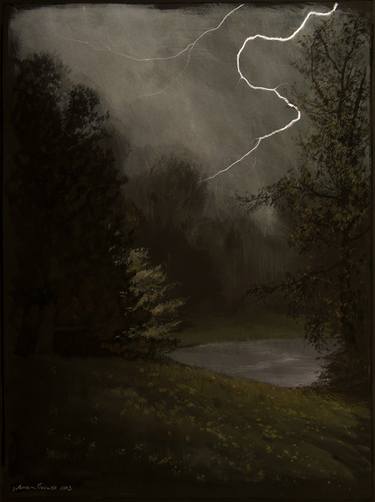
A Dark and Stormy Night, by Warren Criswell, found at saatchiart.com
Going to Seminary | Part 2

FTS Women, Color, T-Women-Collage-min

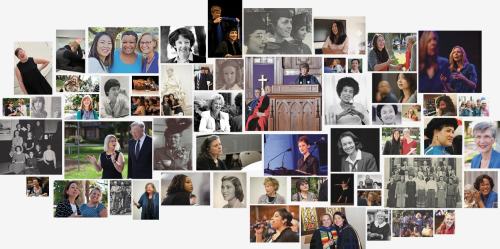
~~~Women students, staff and faculty at Fuller Seminary through the years

I thought it would be easy to move into my new Going to Seminary series. But it isn’t. Why? I think because this wasn’t an easy or seamless transition in my life.

Compared with getting married, this felt like an earthquake. A seismic shift. I didn’t understand this back then. Today I understand at least the following.

Being a Faculty Wife was a fairly low-profile role. Even though people were suspicious about women with minds and lives of their own, they were still courteous and polite to women who ‘knew their place.’

As long as I kept my head down, took care of our children and showed up at the Bible College to contribute my musical skills and presence, things went smoothly enough.

Nonetheless, sometimes I felt lost and misunderstood. Especially when I described to friends how I felt about not-so-public parts of my life. It seems I didn’t fit the pattern.

But then again, I never did fit the pattern. My father knew this and did his best to change me.

My family upbringing prepared me to survive and even flourish in the Deep South 1960s culture of the Bible College. It was all about being a proper lady, whether as a student or later as a Faculty Wife. I knew how to play the game and succeed, at least on the outside.

Now it’s 1973 and I’m on my way to seminary in California. I don’t have the home team advantage, and the seminary doesn’t have second-class expectations for women. When it comes to academic work, I have to pull my own weight.

When I take a course, D won’t take it for me. He won’t write or edit my papers. He won’t think for me.

This is a seismic shift, though I didn’t appreciate that back then. Gone is the world that groomed me to marry a good Christian man and follow him to the ends of the earth, bearing all the children he might want to beget.

Now I must stand on my own two feet and do my full share of caring for the children, cooking, and housecleaning. I must earn my own grades, write my own papers, make my own oral presentations and take my own exams.

At the Bible College, theology and Biblical studies were supposedly the domain of men like my father. Though women weren’t unwelcome intruders, they were foreigners from another planet.

Women belonged in clearly defined domestic roles, supporting their men who were doing the really important thinking and doing. If married women absolutely had to work outside the home, fine. Just don’t let it interfere with domestic duties.

At the Bible College, most men had no problem with women studying the Bible. Nonetheless, if women had questions about the Bible or theology, they should ask their husbands or their male pastors or professors. Why should they need to bother their pretty little heads with anything difficult or contentious?

As one of my theology professors at Bible College announced: “The next topic is for men; you women can ‘go pick daisies’ if you’d like.”

That didn’t mean we could leave the room; it meant we didn’t have to understand the next topic or take extensive notes about it. We could think about whatever we wished during the next half hour or so. It shouldn’t be of concern to us. The topic? The end of the world (Eschatology)!

When I was accepted into the MA in Bible and Theology, I was elated and terrified. Nine years had passed since I graduated from the Bible College. I was about 10 years older than many if not most other students in my courses. I was also the mother of two young children.

The stakes were high, no matter what I did or didn’t do with this degree. No wonder I was anxious and self-conscious. My life was about to change.

To be continued….

© Elouise Renich Fraser, 23 November 2015
Collage image thanks to http://www.fullermag.fuller.edu