Telling the Truth

connecting the dots of my life

Tag: Relationships

The distance between then and now

The distance between then and now
Boils down quickly to a handful of
Opportunities lost in translation

Heavy baggage dumped in swamps
Still unopened and never claimed

On-demand smiles of yesterday hidden
Beneath faces lined with sadness and grief

Moments of vulnerability unexplored
In favor of stiff upper lips and privacy

The openness of childhood and youth
Shut down in favor of family reputation

Yet miles of heart-stopping space open
Like the Grand Canyon between us and
old photos tugging at our lonely hearts

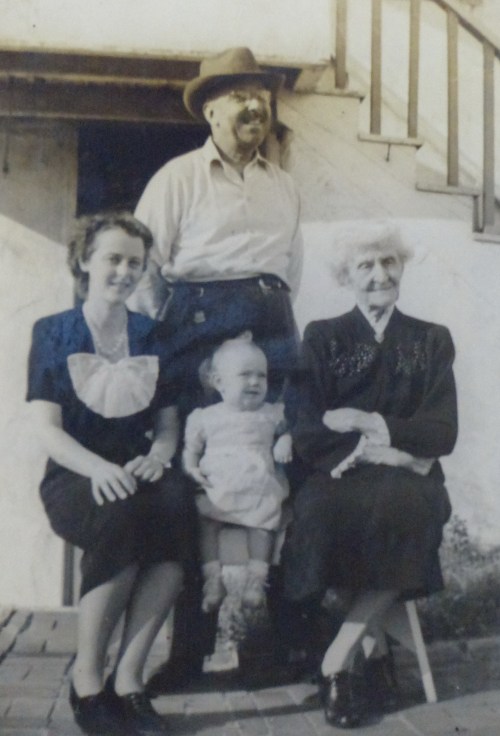
I feel sad and happy every time I look at this old photo. I’m sitting on the bench surrounded by my mother, her father, and her father’s mother. Four generations. The poem reflects how difficult I find it to become a human being. Especially when working on family-related issues.

Becoming human may be our greatest achievement. Not wealth or happiness or helping people all over the world, but the ability to become who we are from the inside out. Sort of like the velveteen rabbit, so that by the time we leave this world, we’ve become Real human beings.

Here’s to heaps of practice and a few great breakthroughs every now and then!

The photo at the top was taken by my father in 1944. We’re in California, visiting with my Grandpa Gury and my very proper Great Grandmother Gury (an immigrant from France). I’m sitting in the middle; my beautiful mother is on my right.

Elouise

© Elouise Renich Fraser, 20 February 2020
Photo taken by my father, JERenich in 1944, California

Frances Ellen Watkins Harper | Poet and Abolitionist

Thanks to Poem-a-Day for introducing me to Frances Ellen Watkins Harper’s poetry. And thanks to Black History Month for bringing it to mind. My comments follow.

Aunt Chloe’s Politics

Of course, I don’t know very much
About these politics,
But I think that some who run ’em
Do mighty ugly tricks.

I’ve seen ’em honey-fugle round,
And talk so awful sweet,
That you’d think them full of kindness,
As an egg is full of meat.

Now I don’t believe in looking
Honest people in the face,
And saying when you’re doing wrong,
That “I haven’t sold my race.”

When we want to school our children,
If the money isn’t there,
Whether black or white have took it,
The loss we all must share.

And this buying up each other
Is something worse than mean,
Though I thinks a heap of voting,
I go for voting clean.

First published by Ferguson Brothers in Sketches of Southern Life (1891), now in the public domain
Published online by Poem-a-Day on 23 June 2019, by the Academy of American Poets

“Honey fugle” means to deceive by flattery or sweet talk, to swindle or cheat. Click here to see the full definition.

I love Aunt Chloe’s straightforward language. Rigged voting machines and gerry-mandering didn’t begin yesterday. Nor did pie-in-the sky promises and ‘street money’ handed out to influence our votes. As Aunt Chloe points out, it doesn’t matter what color your skin is if the money isn’t there to fund those lovely promises. Everyone loses, no matter the color of our skin.

Aunt Chloe nailed it decades ago. Her words are presented in a no-nonsense voice that invites us to believe her and do something about it. Maybe it’s as simple as getting off our political bandwagons and taking a look at ourselves.

So….The next time you hear politicians making promises too good to be true, think of a flugel horn (profuse apologies to lovers of flugel horns). It may sound sweet and mellow. Nonetheless, sweet music and stars in our eyes won’t buy groceries, pay for medical bills, or turn manipulation into truth. Instead, the cost will continue falling on all of us.

© Elouise Renich Fraser, 19 February 2020
Image found at Wikipedia.org

Sunday morning musings

Sunday morning
Sitting near the back row
In a neighborhood church
Pondering the reality
That I am now one of the
Old Folks at Home
An aging white woman
Wondering what on earth
I have to offer this generation
Drowning in possibilities
I never dreamed about

A life —
That’s all I have
A life already lived
Partially grieved and celebrated
Now halfway resting
In this odd space
Called retirement with
all the time in the world
yet no spare time to be found

So what’s left to offer?
Just one thing comes to mind —

Smiles
Free smiles and maybe a kind word
No manipulation
No smirking
No hesitation
No holding back
No looking away
No pretending not to see
the child or young person before me
carrying an invisible cup running over
too often with confusion, self-judgment or worse

Smiles
That’s all I have to offer
Smiles that say
With or without a word
I’m so happy to see you today!
Smiles that reflect our Creator’s delight
in each child or young person’s beauty
whether they get this yet or not

Simple things. That’s what I can do. No promises made. No lists of things to do after this moment. Just a smile and a silent prayer for that child or teenager already dealing with the heaviness of being in this world. Who can’t relate to that?

Elouise

© Elouise Renich Fraser, 18 February 2020
Photo found at pinterest.com

February’s lightness of being

Looking for just the right words
To convey lightness of being
Descending through rainbows
To the ground of our heaviness
Bent beneath cares and sorrows
Though the sun shines brightly
This first and only Monday morning
Of week three and counting down

How do we live with sinking feelings
As friends and strangers known
To us if not by us wither and pass
Beyond veils of mist and ashes
Dying quickly as lines form
At the rear and out of control
If not out of mind and time
Waiting to hear the bell toll

This isn’t directly about the latest virus. It’s about how we get through one day at a time in a world that seems to be falling apart. Virus or no virus. I vote for rainbows and the Creator to whom they point. How about you?

Here’s to a Happy Monday, no matter the circumstances. Not because it’s cheery, but because this day belongs to Someone Greater than ourselves, who loves us and wants nothing more than our faithful presence. Especially when things seem to be falling apart.

Elouise

© Elouise Renich Fraser, 17 February 2020
Photo found at orcaissues.com

A Visitor | Mary Oliver

This haunting poem by Mary Oliver comes from a 1986 collection called Dream Work. My comments follow.

A Visitor

My father, for example,
who was young once
and blue-eyed,
returns
on the darkest of nights
to the porch and knocks
wildly at the door,
and if I answer
I must be prepared
for his waxy face,
for his lower lip
swollen with bitterness.
And so, for a long time,
I did not answer,
but slept fitfully
between his hours of rapping.
But finally there came the night
when I rose out of my sheets
and stumbled down the hall.
The door fell open

and I knew I was saved
and could bear him,
pathetic and hollow,
with even the least of his dreams
frozen inside him,
and the meanness gone.
And I greeted him and asked him
into the house,
and lit the lamp,
and looked into his blank eyes
in which at last
I saw what a child must love,
I saw what love might have done
had we loved in time.

c. 1992, Mary Oliver
New and Selected Poems, Volume One, pp. 116-117
Published by Beacon Press

Mary Oliver left home early in life to get away from an abusive situation. Now, years later, wild knocking in the dark of night reminds her of what she ran away from. If she opens the door, she must confront the man she remembers having a “waxy face” and “a lower lip swollen with bitterness.”

She ignores the pounding on the door. The knocking persists at all hours of the night. And so she “stumbles down the hall,” and the door “falls open.”

In an instant, Mary Oliver knows she has nothing to fear. In fact, it seems she’s surprised to discover her father is “pathetic and hollow.” Even his smallest dreams have frozen, and his meanness has vanished.

She greets him, invites him to come into her house, lights a lamp, looks into his “blank eyes” and sees what was needed when she was a child, plus what might have been “had we loved in time.”

The poem isn’t about Mary Oliver’s father; it’s about Mary. In the end, It affirms her decision to leave home, and acknowledges the high cost she and her father paid. With grief, and without apology.

© Elouise Renich Fraser, 12 February 2020
Book cover image found at amazon.com

Outcomes predetermined

Outcomes predetermined –
No need for witnesses

News cameras keep rolling —
Capturing unwillingness
to accept self-evident truths

We have not administered
justice for all with an even hand

We have not allowed freedom for all
in this land of the free and home of the brave

We have not believed
Each person of any color or religion
is created equal and entitled
to full protection under the law

Nor have we been able to stem
today’s flood of party-line mantras
and childlike temper tantrums
from The White House

Welcome to Trump’s world and
the world in which brothers and sisters
now celebrating Black History Month
have lived all their lives

Thank you Mr. Trump
for this unexpected opportunity
to move beyond our current state
of habitual denial and fear

Now playing in your city or town
Every night of the week
No tickets needed

Several days ago I read a news report from CNN. It was about the farce of Trump’s impeachment trial. The message from black folks for white folks: “Welcome to our world.” Ironically, this is Black History Month. What will we make of it?

The meaning of justice has always been skewed against black people in this country. The movie Just Mercy shows how difficult it is in this so-called ‘enlightened age’ for black citizens to get justice. The so-called impeachment trial simply used the same tactics, this time to the advantage of a white male President.

  • a pre-ordained verdict
  • jury nullification (deliberate rejection of evidence or refusal to apply the law)
  • the judge as a prop, offering a pretense of impartiality
  • one of similar trials in which white men are favored

This is a rare opportunity for all of us. Especially, but not only white citizens. It’s still Black History Month. What better topic than the state of our union?

© Elouise Renich Fraser, 11 February 2020
Photo of Lynching Memorial found at heraldnet.com

clear night air and moonlight

How much longer do we have
On this earth disappearing
Daily into a pit of promotional
Hype and unachievable goals

Besides which there is this–
The bottomless pit is gasping
Spewing junk into air heavy
With the weight of our denial

Perhaps we can agree on this:
We have a problem that isn’t
Going to dissolve like a sunset
Into clear night air and moonlight

I don’t have a clue where this came from. Best guess: from listening to statements about the way this or that disruption of nature will lead to a bright tomorrow. Especially for corporations and individuals playing winner take all.

Yes, I’m sure it’s more complicated than that. If I sound a bit cynical, so be it. Given my generous life span, I’ve seen and heard enough to feel anything but sad about the current state of our denial.

Do I have hope? Yes. Not necessarily for our planet, but for everyday people who inhabit it with grace, with interest in strangers and neighbors alike, and eyes still in awe of clear night air and moonlight.

© Elouise Renich Fraser, 10 February 2020
Photo found at cottagelife.com

On the other side of yesterday

Morning rain drops and
tears of cleansing spread
welcome relief on streets
torn with grief and disbelief

An ambulance screams
by my window racing
to aid the sick the dying
and the dismembered

A distant bell tolls mindlessly
chiming out its last breath
of hope for better tomorrows –
Or at least a reprieve from public preening
blind to yesterday’s attempted slaughter
of truth and justice for all

No, Mr. Trump, you did not receive justice.
Nor did many of your friends honor you with truth.
Sadly, enablers are a dime a dozen.

I applaud each leader and member of congress who dared stand up and be counted on the side of truth and justice.

I do not applaud congressional and religious leaders who cheered and applauded Mr. Trump’s rant at yesterday’s nonpartisan, interdenominational and interreligious prayer breakfast. We are all dishonored by behavior like this, no matter what our political preferences may be.

© Elouise Renich Fraser, 7 February 2020
Photo found at bbc.co.uk.jpeg

Human indignity for all?

Is this the best we can offer?

Indignity: treatment or circumstances that cause one to feel shame or to lose one’s dignity. Regardless of gender, race, ethnicity, religion or country of origin. Which, in my book, amounts to indignity for all of us.

Martin Luther King, Jr.’s dream was simple: human dignity for all.

Or, as Dr. King put it when writing in 1963 about his own children:

I dream that one day soon
they will no longer be judged by the color of their skin
but by the content of their character.

The quote comes from the opening pages of Dr. King’s book, Why We Can’t Wait.

Today, 57 years later, we’ve gone backwards. Especially, though not only for African Americans.

Yesterday D and I went to see Just Mercy, a recently released movie. It’s based on Bryan Stevenson’s book, Just Mercy: A story of Justice and Redemption. Stevenson, a Harvard-trained attorney and recipient of a MacArthur Genius Grant, writes about one of his first cases as a young black attorney working in the South.

The movie depicts what happens to two black men placed on death row before receiving a fair trial, and what it takes to deal with the status quo. The judicial system’s message is clear: You won’t get out of here alive, no matter what evidence is produced in your trial or on appeal. But what happens in the end, and how?

February is Black History Month here in the USA. Just Mercy is being shown in several cinemas in the Philadelphia area. If you haven’t or can’t see the movie, check out a copy of the book. It’s at least as clear, heartbreaking and challenging as the movie.

This movie was my choice yesterday evening, rather than watching/listening to the President’s State of the Union address. It was a splendid choice.

© Elouise Renich Fraser, 5 February 2020
Image from the movie found at rogerebert.com

Kindness Matters | Memories

kindness

This post from January 2016 came to mind this morning.
A sobering read, given the current state of our disunion.

My Mom died in 1999. During the last year of her life she showed me a photo of a childhood friend, a write-up about her, and an obituary.

Sybil was a few years younger than I. Her mother kept the outdoor hog pen I describe in my poem, 1951. To me, Sybil was a friend in name only. I was put off by her lack of manners, her unkempt clothes, constant problems at home, poor grammar and general lack of social graces. I was also embarrassed to be seen with her.

Sybil and I were thrown together in grade school. We were scholarship students—unable to pay our own ways. I saw her as ‘poor,’ though I didn’t identify myself that way. We lived in a big house on the river. She lived about three-quarters of a mile down the road toward the city, just beyond colored town, in a rickety old structure beside a large hog pen and across the road from the tavern.

Sybil lacked social graces and, in my eyes, physical beauty. She was sometimes rough, callous, loud, rude and sarcastic. She was an only child, living with her mother on the second floor of a now closed, dilapidated gas station.

The hog pen sat beside this structure. About 20-25 adult hogs roamed free in a large fenced-in area and wallowed in muddy pig slop laced with decaying food scraps. To say they stank would be an understatement.

Sybil’s mom owned and cared for the hogs. They were her ticket to food and money—at least enough for survival. She lived with a man on the second floor of the old filling station.

Were they married? I was never sure. He liked alcohol. They both liked cigarettes. They didn’t always get along. Sometimes Sybil got the worst of it. Sometimes she missed school.

As chance would have it, for a couple of years Sybil’s mom took turns with my father picking us all up after school in downtown Savannah, and driving us 15 miles home.

In spite of my impressions about Sybil, she became a sometime ‘friend’ who reminded me daily of what I did not want to be. She didn’t seem to have other friends, and assumed that because we rode together after school, I was her friend.

When Sybil’s mom came to pick us up, I held back. I pretended I didn’t see the noisy old run-down car waiting right there in front of the school. I didn’t want my friends to see me getting into it. They might think it was our car.

So I waited until the last minute, suddenly ‘saw’ the car, got into the back seat and immediately bent over as though I’d just dropped something on the floor. I didn’t sit up straight until we were at least a block away from the school.

My wish to distance myself from Sybil and her life generated nothing but guilt, shame and anger in me. Being seen with Sybil was not an asset.

Mom, however, stayed in touch regularly with Sybil and with her mom. She treated Sybil with kindness. She visited her mom, helped her out in small ways, and seemed to enjoy her company.

A few years before Mom died, Sybil got in touch with her. She had graduated from high school and studied to be an officer in a military unit. She brought Mom a photo of herself in uniform—beautiful, serene and confident. It was her way of thanking Mom for taking an active interest not just in her, but in her mom. Sadly, Sybil died about a year before my Mom died.

You might say I had a ‘normal’ child-like response to Sybil and her mom. I don’t know. Contempt is a learned behavior, often accompanied by invisible self-contempt. Sybil and I were damaged goods. She may have recognized herself in me; I didn’t recognize myself in her. Not back then.

Nonetheless, we were and are sisters, if not friends.

© Elouise Renich Fraser, 11 January 2016
Image from trans4mind.com