Telling the Truth

connecting the dots of my life

Tag: Relationships

Life gone missing

1963 Aug Elouise Double Exposure flipped

Disoriented
and out of touch
the old woman
blinks hard peering
at old photos
in scrapbooks–
traces of life
now gone missing

Is that building
still standing and
did the hurricane
demolish the
lovely roller rink
firmly rooted in
yesterday’s pristine
sand washed clean
with every tide?

Questions.
Nothing more
rises to the surface
of my weary mind trying
to visualize the way
back home

Yes, this could be about getting old. It’s also about how quickly we, as a conglomeration of nations, seem to be sinking into quicksand. Are we ready for this? How are we to live in the face of death and destruction at every turn?

Though victory has sometimes been snatched from certain defeat, I’m not convinced that will happen anytime soon.

Which brings me to the big question: Am I ready to die?

This is about more than being spiritually ready to die. It’s about not knowing what will happen next, no matter how carefully I may have planned for today or tomorrow. It’s about being bold in the way I live each day, knowing it could end at any moment. Not just from health issues, but from worldwide chaos, festering anger, lust for power, or attempts to wipe out people based on gender, color, religion, or whatever those in power love to hate.

One more question: What does it mean to make chaos my home? In the poem I end up trying to remember the way back home. Perhaps the poem is challenging me to find my way home. Not to what’s old or familiar back there, but to what’s real and certain right now, 21st-century style.

Am I ready for this? If so, how does that mean for the way I live today?
Elouise

© Elouise Renich Fraser, 17 March 2022
Double exposure taken (by accident) by DAFraser and a friend, August 1963 at Tybee Island Beach

I haven’t finished talking

Talking in my head
Talking in my sleep
Talking in my body language
Talking while he drones on

I try desperately not to
Break out in an avalanche
Of righteous indignation
Or galloping fear of retribution

One lesson after another
I learned to die and
How to accept living death
As my female normal

Yes, it began with my father. Sadly, it didn’t end there.

I used to think getting things straight in my head would be enough. If I could understand what happened to me, who did it and why, then I could get on with my life as an adult woman.

Tragically, that’s sheer nonsense. Every time women’s issues are raised, I’m struck by how naïve I’ve been. Talk doesn’t fix anything. It’s helpful, but by itself it isn’t a cure.

So here we are again in a nation that claims to celebrate international women and girls of all ages. It’s our one-day moment to feel accepted, needed, even courageous and bold. Then the day passes, and doors that were never fully opened slam shut yet again.

I’m not appeased by fancy talk or lovely tributes to courageous female angels out there. I want to see action that means business. Action fueled by changed hearts and minds. Plus legal action that gives teeth and dignity to women’s lives, liberty, and pursuit of happiness. I’m fed up with warmed-over pablum and niceties that do nothing to change harsh realities on the ground.

Ironically, this month an agreement to a cease fire in Ukraine was ignored, and a maternity hospital for women and children was bombed by Russians. Why now? And how does this tragedy alert us to women’s daily realities in our own countries? What do you think?

Elouise

© Elouise Renich Fraser, 11 March 2022
Image found at etsy.com

blue eyes

blue eyes pierce spring sky
join me on the river boat–
making our way home

* * * * *

Early Easter Morning 1949, Diane was born–Sister #3 with brilliant, piercing blue eyes.  On February 13, 2006, she died after living with ALS for ten years. The haiku above was inspired by a dream I had in November 2009.

Here’s the dream, followed by a few comments:

I’m at a gathering of people.  My husband is also there.  Suddenly I catch sight of Diane!  She’s looking alive, moving on her own (though a bit slowly), and is—as far as I can tell—acting independently of any nurses or family caretakers.

At first I see her as though I’ve just discovered one of my sisters who happens to be at this gathering, too.  I’m thrilled, and want to go talk to her and take in some recreational activities with her.

A bit later I realize she ‘shouldn’t’ be here!  She’s gone.  She died of ALS.  So why did I see her?

Crowds are milling around, pressing in very tightly, making it difficult to get to the spot where I can see and talk with her.  I don’t know whether she’s seen me yet.  There’s an optional boat ride later to tour the river.  It seems to be the river we grew up on in Savannah.

I decide to get Diane and ride with her in the boat.  We can talk and catch up and see old familiar places from a different perspective.  Her presence is a gift—and will be gone when this event comes to an end.

I’m excited, happy, and eager to hear what she might say to me.  I haven’t heard her voice or been able to relate to her as a fully functioning sister for years.  I also don’t know how long her present embodiment will last.  I wake up longing to be with her on the riverboat.

Lent and Easter always bring Diane to mind. One of my tasks during therapy was to connect with each of my three sisters. We hadn’t been in close touch with each other for years. “I’m doing personal work with a therapist.  Would you be willing to talk privately with me, one on one, about this work?”

Diane agreed to talk with me. We had multiple long-distance conversations. She listened, confirmed, added her memories and made astute, sometimes sad observations. In 1993, she flew from Texas to Georgia to witness the meeting with my parents. Diane sat on one side of me; my husband sat on the other. Silent witnesses while I broke my decades-long silence about my father’s harsh punishment.

Three years later Diane was formally diagnosed with ALS. For the next ten years she showed us how to live and how to die with grace and dignity, without once pretending everything was fine, just fine.

Thanks for stopping by today. I pray we’ll find peace, comfort and courage to face each day with its sadness and joy.
Elouise

© Elouise Renich Fraser, 9 March 2022
Photo of Diane and Elouise by the Savannah River,
taken by DAFraser on 20 November 1993

Life on the edge

The world is on edge. Refugees, weather patterns, political maneuverings, pandemic puzzles and outright war.

I hear an invitation to look into the mirror and take stock of where I am in the middle of all this. The church calendar invites me to look inward. It also invites me to ‘give up’ something between the beginning of Lent and the celebration of Easter.

For most of my early life I gave things up routinely. I was taught to live frugally. My family didn’t have much money. In fact, they considered not having much money a virtue, though we were clearly better off than our neighbors living in colored town.

That was then. What about today? We’re in a mess of gigantic proportions. So what am I to give up for Lent that both challenges me, and brings me closer to others living in this world that’s seems to be spinning out of control?

Several years ago I posted a challenging prayer that fit the spirit of Lent. It challenged me as an individual. Not once, but many times. Today, it’s challenging me as a world citizen and follower of Jesus of Nazareth. Am I willing to live as an undocumented refugee? As part of a family broken up by war, lies, and powermongers?

Everything in me wants to rage, fight back, make sure I’m on the ‘right’ side, shout back at the TV news, and run for cover. Instead, this simple prayer invites me to take another approach.

I let go my desire for security and survival.
I let go my desire for esteem and affection.
I let go my desire for power and control.
I let go my desire to change the situation.

Quoted by Cynthia Bourgeault in Centering Prayer and Inner Awakening, p. 147 (Cowley Publications 2004)

Will this solve everything? Of course not. It will, however, keep me centered. Not on myself, but on Jesus of Nazareth who showed and still shows me how to do this. One day at a time.

It also occurs to me that my life is the only thing I can ‘give away.’ But only if I’m not struggling to keep it and my privileges alive at any cost.

May our Creator have mercy on each and all of us.
Elouise

© Elouise Renich Fraser, 7 March 2022
Image found at pixabay.com

The world as God’s poem

Several years ago I posted “Emily Dickinson meets Mary Oliver.” A phrase from one of Mary Oliver’s poems had captured my imagination. As she puts it, we owe our dignity to being part of “the poem that God made, and called the world.”

With so much ‘undignified’ death flooding our news media, it’s difficult to hold onto Mary Oliver’s image. I don’t easily hear or see “the poem that God made, and called the world.” It’s easier to picture what’s happening today as a rising tide of undignified and wrongful deaths that should never have happened. Which may also be true.

Here’s my response, first posted in August 2017, and reposted below in light of today’s current events.

No mortal words of poetry will ever do justice to this world, God’s poem.

Nor do we understand ourselves
unless we give up all efforts to capture in our words
the reality of what God created and invited us to inhabit as caretakers.

We can look and point;
We cannot replicate.

Furthermore, no poetic words of ours
will ever improve upon God’s great poem.
Still, as humans we’re at our best when we reflect in our lives
the grandeur of creation.

Surely the summer sky, the deer,
and all parts of God’s creation are dignified
not because of what each does, understands,
or even writes in flowing poetry.

Rather, they and we owe our dignity to being part of
“the poem that God made, and called the world.”*

*Quotation from Mary Oliver’s poem,
“More Beautiful than the Honey Locust Tree
Are the Words of the Lord.” Published in Thirst, p. 31

~~~

Praying we’ll become open to seeing each human life and each creature great or small as part of God’s poem. Which, of course, includes each of us with all our flaws and our gifts.

Elouise

© Elouise Renich Fraser, 26 February 2022
Photo found at smartpress.com

A poem I can’t get out of my mind

It doesn’t take much effort to see what’s happening daily in many if not most of our neighborhoods, towns or cities.

Nonetheless, when it comes to actively joining efforts on the field, many of us would rather stay put in the grandstands. Glued to our seats. Gasping from time to time, but not joining the fray, or putting ourselves in harm’s way.

I’m no extroverted star. I’d rather stay on the sidelines. Study what’s happening on the field. Pray. Give money. Or read more about poverty in cities and surrounding towns, and what others are doing to come alongside with help. Certainly all those good things are important and necessary.

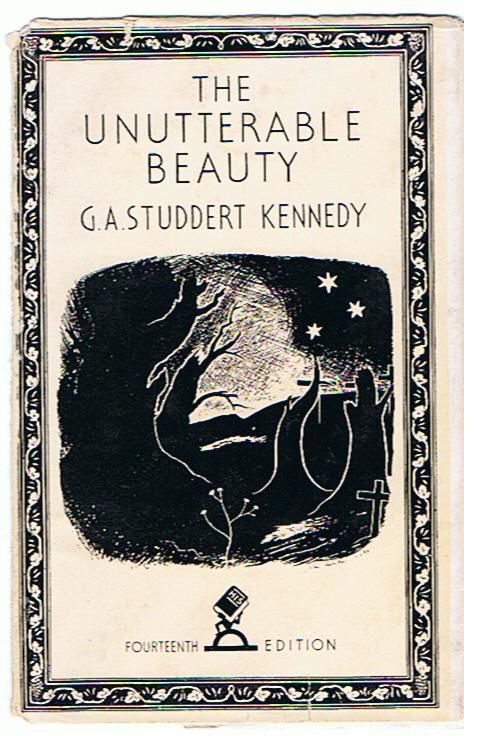
Here’s a poem that challenges me every time I read it. G. A. Studdert Kennedy served on the ground as a World War I army chaplain to British soldiers. Many of his poems reflect realities of life in the warzone. This one, however, reflects the reality of life in the city of Birmingham.

Indifference, by G. A. Studdert Kennedy (aka Woodbine Willie)

When Jesus came to Golgotha they hanged Him on a tree.
The drave great nails through hands and feet, and made a Calvary;
They crowned Him with a crown of thorns, red were His wounds and deep,
For those were crude and cruel days, and human flesh was cheap.

When Jesus came to Birmingham they simply passed Him by.
They never hurt a hair of Him, they only let Him die;
For men had grown more tender, and they would not give Him pain,
They only just passed down the street, and left Him in the rain.

Still Jesus cried, “Forgive them, for they know not what they do.”
And still it rained the wintry rain that drenched Him through and through;
The crowds went home and left the streets without a soul to see,
And Jesus crouched against a wall and cried for Calvary.

“drave” – drove

Indifference found on page 21 in The Unutterable Beauty – The Collected Poetry of G. A. Studdert Kennedy
First published by Hodder and Stoughton Limited, London (March 1927), reprinted June 1928
Second publication by Pendlebury Press Limited, Manchester, U.K., August 2017

There’s no end of women, children, young people and men who would welcome even a small sign of genuine interest from another human being. Maybe they’re next door, just down the street, sitting beside us in church or on a bus, or even sitting lonely in that big mansion up on the hill. In the end, Woodbine Willie was known for his commitment to being there. Not with answers, but with a listening ear and a praying heart.

Thanks for stopping by today.
Elouise

© Elouise Renich Fraser, 24 February 2022
Photo found at backwatersman.wordpress


The greatest gift

When I began blogging, I didn’t give much thought to writing poems. I loved to write. I loved using imagery. I loved playing things out in words. And I loved reading poetry.

But writing it myself? Not since my freshman year of college, when my writing professor told me I would never write poetry. I believed her. Until I began blogging.

This morning I read the poem below. I’ve read it many times, always accompanied by tears of gratitude along with recognition that my life is in its final chapter. I hope you enjoy it and are prompted to remember things that bring joy and music into your heart and mind.

music to my ears

I love the calm cadence of your voice
and the way you make rare 
the everyday

waves rolling in on the beach
wind whispering in the willows
my husband reading to me aloud
Mendelssohn’s E Major Song Without Words
J. S. Bach’s C Major Prelude #1
doves cooing in the morning
robins singing in dusky evening
the overwhelming calm of Psalm 23

I chose the Bach rendition above because of the player’s calm approach to Bach’s Prelude in C Major. Also because it’s being played by a so-called amateur who gets the nuances just right.

Wishing you a calming Tuesday no matter what’s going on around you,
Elouise

© Elouise Renich Fraser, 2/22/2022
Video found on YouTube

The Uses of Sorrow | Mary Oliver

Have you ever dreamed a poem? Here’s one from Mary Oliver. Short and to the point. My comments follow.

The Uses of Sorrow
(In my sleep I dreamed this poem)

Someone I loved once gave me
a box full of darkness

It took me years to understand
that this, too, was a gift.

© 2006 by Mary Oliver
Poem found in Thirst, p. 52
Published by Beacon Press

I first read Mary’s dream poem several years ago, then hurried on to the next page. I didn’t want to think about it. How could a box full of darkness be a gift?

In German, “das Gift” means poison. In some ways this blog was my way of beginning to take ‘das Gift’ seriously. When I began blogging, I agonized over what to say and how to say it. What was in my “box full of darkness,” and who gave it to me? Or, better put, who passed it on to me so that it became My Problem?

Sorrow isn’t a throw-away event, or series of events. As Mary Oliver says in the title, sorrow has its uses.

Nonetheless, real life doesn’t usually invite us to see a box full of sorrow as a true gift. Instead, we’re supposed to play the game ‘their way’ because that’s what the box of darkness is about. Put another way: It perpetuates the angst and anger of generations, without recognizing or fighting today’s poison. Easier all round for everyone, right?

Wrong. Understanding ‘das Gift’ as a true gift to be explored was and still is dangerous. Beginning to investigate the past brings an avalanche of consternation, anger, tears, honesty and humility. It dares me to turn my so-called gift into light. The kind that illuminates truth and empowers me to be the woman I am.

At this age, I’m still finding ‘stuff’ not yet examined from the box of poison passed on to me as a child and young adult. However, when I’m willing to step back and take a deep breath, I’m also able to take one more step in the right direction. For better and for worse, being in my elderly years means I have lots of material to work with, whether I like it or not.

Thanks again for stopping by. I’m doing quite well most days. Especially when I follow my heart instead of my head or my forever-lists of things to ‘do.’

Cheers!
Elouise

© Elouise Renich Fraser, 18 February 2022
Image found at pinterest.com

all things considered

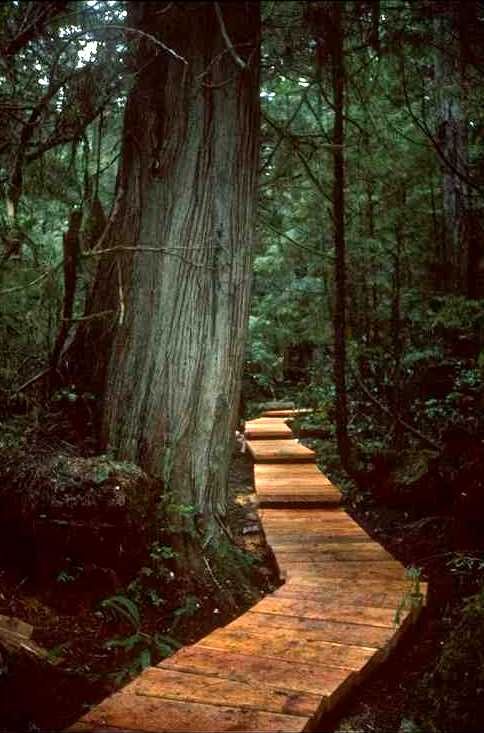
Olympic National Park, Ozette Triangle Trail

all things considered
I’d rather be a giant
with scars and deep roots

paths through dense forests
age quickly minus upkeep
or handrails for guests

lush green and daylight
create a silent backdrop
alive with birdsong

I’m captivated regularly by photos that document the beauty (and sometimes conundrums) of nature and our way of relating to it. I also wonder what these beautiful photos represent at this real-time moment in our Climate and Pandemic Change Journey as inhabitants of Planet Earth.

I’m heartened by simple photos like the one above. Small markers and reminders of what we might still become: students of trees, mountains, rivers, oceans, and wildlife. Each trying to tell us something about ourselves and our relationships with Mother Earth, with our histories, and with each other.

Today the sun is out, and we’re promised mild temperatures this afternoon. Maybe the last remnants of snow will finally melt!

Happy Thursday and thank you for stopping by.
Elouise

© Elouise Renich Fraser, 10 February 2022
Photo of Olympic National Park found at pinterest.com

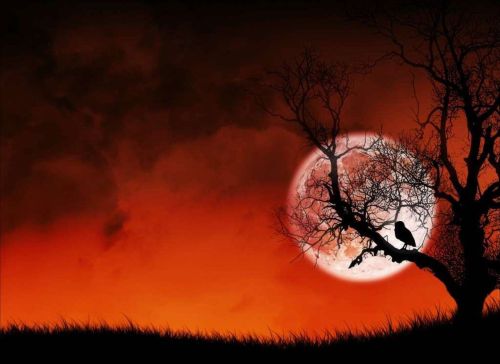
Colors of dusk and the unknown

Colors of dusk
lull my weary heart to sleep

Day fades into night
as this weary world
churns abruptly
from one horrifying
mess to another

Twilight melts into darkness
punctuated by distant specks of
bright stars and planets
peering into the morass
of today’s fading planet earth
sinking and disappearing
beneath melting icebergs
firestorms and tornadoes
to say nothing of unnumbered
human beings struggling
to keep the little they have—
Or, on the other side of the tracks,
retain monstrous wealth the elite
believe they own and control

Fast fading colors
invite me to lay down
my body and rest
for just a little while
within the unknown

Here are a few questions I wonder about these days.

  • Are we prepared to be a nation driven by greed, anger, lies and innuendos? Or, are we ready to take a stand?
  • Ready to call out lies and innuendoes that pretend to be truth? Ready to live with the consequences?
  • Or, might we try getting interested in what other people think and why?

I would love to see us take a stand, though not just any stand. Am I ready for this? I don’t know. Partly because I’m not sure which is more distressing: the status of our nation and perhaps every other nation in this world, or the status of my health. None of it looks great these days. I keep wondering what to say about all this.

I can’t ignore our nation, and I can’t ignore my health. The AlAnon/AA saying, ‘one day at a time’ works well IF I’m willing to focus on one day or one minute at a time. My mind and my feelings fight against me, as though things will be better (tomorrow!) if I do more research on my health issues. Or read more news articles.

Yet the truth is simple. I’d rather write a poem, play or listen to beautiful music, watch the birds outside our kitchen window, or watch the evening sky flaming out in glory.

Thanks for being part of my sanity plan for old age! I’m still trying to figure it out–one day at a time.

Elouise

© Elouise Renich Fraser, 6 January 2022
Photo found at unsplash.com