Telling the Truth

connecting the dots of my life

Tag: Relationships

The Shape of Forgiveness | Part 4 of 4

“We do our forgiving alone inside our hearts and minds; what happens to the people we forgive depends on them.”
“Forgiving happens in three stages: We rediscover the humanity of the person who wronged us, we surrender our right to get even, and we wish that person well.”
Lewis Smedes in The Art of Forgiving (Moorings 1996)

I’ve never found public or required displays of forgiveness helpful. I’m relieved that Lewis Smedes makes this a personal issue. Neither my father’s presence nor his acceptance of my forgiveness is necessary.

And so, given Smedes’ three stages above and the work I’ve already done, including naming what my father did and why it’s blameworthy, I’ve already forgiven my father.

  • What I discovered about Dad’s humanity was heartbreaking; he and I were more similar than I like to admit. I feel compassion for him every time I think about his life—not just as a child, but also as an adult struggling with his own trauma. He, too, was a survivor of childhood abuse. Sadly, he never sought healing.
  • Sometimes I made small, symbolic attempts to get even with Dad. These included behaviors that helped me feel ‘better’ or ‘safer’ around him, even though I didn’t. I maintained my distance physically and emotionally while seeming not to be distancing him. I thought I was inflicting small punishments on him, getting even for his punishments of me. I was not. Today I have no desire to get even with him.
  • Finally, though Dad died several years ago, I still wish him well. How so? I don’t know what life is like after death. I do, however, know that if our Creator offers ways to grow into life after death, I wish my father well. Especially as the daughter who is most like he was.

From the cross, Jesus prayed “Father, forgive them, for they know not what they do.”

He didn’t forgive his tormentors directly. He left that up to God. Instead, I see throughout the gospel narratives that Jesus understands the humanity of every person with whom he deals.

I also notice Jesus’ refusal to try to get even with those who opposed him. He spoke hard truth, sometimes with anger. Yet he didn’t grasp at his right to get even. Not in life or in death.

Finally, Jesus wept and prayed over Jerusalem, despite what he suffered from the hands of those in power who thought they knew better. They beat him, mocked him, paraded him in public as an ‘example,’ and hung him up to die. Still, he wishes them well.

Though Jesus doesn’t forgive his tormentors directly, he prays for them from the cross: “Father, forgive them, for they know not what they do.” This is the prayer I pray for my father.

I’m not responsible for offering him forgiveness. That’s God’s business. I am, however, responsible for the three steps at the top of this post if I mean business about forgiving him.

I’ve forgiven my Dad. Nonetheless, I can’t say this is a done deal. Forgiveness isn’t an event. It’s a process with a beginning and openness to whatever comes next. Childhood trauma has a way of bringing things to the surface when the learner is ready for more healing.

God forgives each of us daily. This is an act of stunning creation, not just for us individually, but for the families and communities in which we live. I want to be part of this ongoing spirit of forgiveness because I want to be part of God’s creative act, not part of the destructive problem.

And so I remain open to forgiving my Dad as often as needed.

© Elouise Renich Fraser, 8 April 2017

The Shape of Forgiveness | Part 3

“Forgiving does not remove our scars any more than a funeral takes away all of our grief.”
“We cannot forgive a wrong unless we first blame the person who wronged us.”
Lewis Smedes, in The Art of Forgiving, Moorings 1996

Denial. I lived with it daily. Not simply denial about my father, but about precisely what he had done to me. In a dark room in my mind I still, in knee-jerk fashion, hadn’t given up bearing ‘my’ share of responsibility for the nature of our relationship.

I experienced it as unrelenting warfare. Yet if you’d asked me about this even three years ago, I would have protected my father by denying the truth. All it took was an add-on phrase or two like these:

  • I wasn’t always an easy child.
  • Sometimes I deserved what I got.
  • Sometimes I asked for it by being stubborn.
  • I know I’m not entirely guilt-free.

All intended to soften the truth and point away from my father as the responsible adult party. If I didn’t, I feared no one would listen to me. I had to remind them that I know I’m not perfect, either.

One of the most difficult exercises of my adult life was to blame my father. Not generally, but specifically, and in writing. With clear reasons, and naming the reality for what it was. I worked on this during the summer of 2014, using Lewis Smedes’ book, The Art of Forgiving, as a guide to rethinking my relationship to Daddy (the term my father required us to use when addressing him).

According to Smedes, I couldn’t forgive unless I first blamed my father for what he had done–concretely, specifically, and with reasons that held water. I had never blamed him in that way. I’d spent all my life trying to share the blame. That had to go.

Forgiveness has a shape. It isn’t a feel-good exercise driven by required words or even attitudes of reconciliation. Nor is it intended to deflect my attention from the Big Stuff truth. What happened to me changed my life in negative ways that are not outweighed by any positives I might name as ‘balancing’ factors.

What, then, do I mean when I say, ‘I blame Daddy’? My denial was so deep that it took several weeks to clarify this. Here it is in short form. You can read more here and here.

I blame you, Daddy, for

  • Willfully, intentionally and without coercion from anyone, using your power in ways that abused my body, my spirit, my mind, my emotions, my developing sexuality, and my overall identity/sense of self
  • Abusing your power as my father, as an adult male, and as an ordained clergyman
  • Not knowing or loving me as I was and am, beginning from early childhood and continuing throughout my adult years
  • Creating an atmosphere of intimidation at home, not an atmosphere of safety

Thanks for listening!

To be continued (one more post) . . . .

© Elouise Renich Fraser, 6 April 2017
Daily Prompt: Denial

The Shape of Forgiveness | Part 2

“Forgiving is a journey; the deeper the wound, the longer the journey”
“We do not forgive because we are supposed to; we forgive when we are ready to be healed.”
Lewis Smedes, in The Art of Forgiving: When You Need to Forgive and Don’t Know How, published by Moorings, 1996

When I was a child, my father required me to beg forgiveness from him and from God. Most often after a beating, or as the so-called resolution of a sisterly argument about an alleged offence. This was often tricky, because I knew the facts as presented weren’t quite all the facts.

I’m grateful forgiveness isn’t a required event. Especially forgiveness of my father.

I didn’t know it then, but my process of forgiveness began the day I confronted my now-deceased parents about being shamed, humiliated and silenced. The process isn’t yet completed, but I’ve made unexpected, life-giving progress.

The meeting I set up with my parents took place the eve of my 50th birthday in 1993, more than 23 years ago. During the meeting I asked for my father’s apology, with no expectation that he would apologize. My husband, my sister Diane, my mother, and a trusted pastor witnessed the conversation between my father and me. It lasted for 1 ½ hours.

My father refused to apologize for anything. He wasn’t interested in revisiting what happened between the two of us or between him and my sisters. He’d already done all his business with God, privately. Nothing I said or did would change his mind.

I was on my own, without my father’s blessing. Disappointed but not surprised. Still determined to work on my healing.

We say punishment should fit the crime. Even so, I believe forgiveness must fit each situation, especially those with life-changing consequences. This isn’t about mistakes or forgetfulness. It’s about the Big Stuff we wish had never happened to us.

Forgiving my father has been a long, sometimes painful process. I’m not yet there. Still, looking back, I see several areas of progress. Sometimes with lightening-speed insight; most of the time with determination, grit and courage to take the next painful look at him and at myself.

Since that historic meeting in 1993, I’ve made progress in at least the following areas.

  • Acceptance of the life-changing enormity of what his behavior meant for me then and now
  • Interest in my father’s life story
  • Appreciation for his wounds, including his determination not to ask for help
  • Awareness of his deeply rooted shame
  • Compassion for him as another human being

I was surprised at how much more comfortable I became around my father, even though his opinions about me never changed. I enjoyed being in interview mode, though I didn’t always like what I heard. I was also comfortable being in the compassion mode. Especially because he carried many griefs, sorrows and disappointments similar to mine.

Nonetheless, I knew this change for the better wasn’t yet forgiveness, much less reconciliation. It was more like a cessation of warfare and a sometimes uneasy truce. I still had work to do.

To be continued….

© Elouise Renich Fraser, 5 April 2017

The Shape of Forgiveness | Part 1

My deceased father, an ordained clergyman, has been on my mind for the last several weeks. Especially the way his behavior toward me still affects my life.

I began blogging over three years ago because I was ready to break my silence. I wanted to tell the truth. Not just the truth about what happened to and within me back then, but the way it shaped the woman I’ve become.

If you haven’t read my earliest posts, I invite you read these, published over three years ago: Dear Dad and Rituals of Submission: Part 1 and Part 2.

Forgiveness has also been on my mind in the last few weeks. The topic almost always comes up when I describe my life as a child and young teenager.

My friends are concerned for me. It’s important, even necessary that I forgive my father. The sooner the better.

  • For some, this is the key to God forgiving me. Indeed, if I cannot forgive another human being, why should God forgive me?
  • For others, it’s important so I can ‘move on’ with my life. This means not getting stuck dwelling on this negative part of my life. Or at least not making it the leading theme of what is, after all, ‘my’ life. Even though it’s impossible for me to conceive of ‘my’ life without multiple connections with my father.
  • For friends who aren’t wired the way I am (an INFJ from way back and very happy, thank you!), forgiveness seems a reasonable exercise that would break the power of the past over me. By putting ‘his’ voice in one column, and ‘mine’ in another, I would simply clarify the truth and get on with my life. Almost like starting over with a blank slate. It sounds lovely; yet it isn’t true to reality as I experience it.

I appreciate each outlook. Yet I still get hooked by self-destructive attitudes and behaviors that arise daily.

  • My responses to these situations are rooted in my father’s attitudes and behaviors toward me.
  • Yet they seem to be my own beliefs and assumptions about myself.

Finally, I often wonder whether I can or need to forgive myself. If so, what would that look like?

As I see it, forgiveness isn’t a spiritual, intellectual, or strategic decision made once for all. It’s about my whole being and will take a lifetime. I face multiple opportunities each day to let go of my sometimes frantic desire for security and survival, affection and esteem, power and control, and my desire to change a situation.

A broken clay pot can’t be made whole by gluing it back together. No amount of glue will make it new. It’s still a damaged, cracked clay pot. The only way to repair the damage is to return the pot to the furnace, melt it down, and tenderly begin reshaping it. Not as an act of terror—though the process is terrifying—but as an act of love, acceptance and healing.

Time doesn’t heal all wounds. What might healing look like, and what kind of forgiveness would it take?

Thanks for reading, listening with your hearts, and commenting if you’d like.

To be continued….

© Elouise Renich Fraser, 1 April 2017
Image with quote found at wordsofbalance.com

The treasure we are

….when our hearts are free. Take a look and a listen. My comments  follow.

What would it take for me to be so free and focused? There’s no magic formula for what this pastor and his choir accomplished. What mattered was hard work, determination, shared vision, faithful allies and free spirits. Plus a Visionary Shepard who showed the way, encouraged, directed, reminded members of the goal, and participated in every painful, joyful step. Without apology, reticence, or pretense.

And what about us? There aren’t any short cuts. No magic wands. No overnight miracles. Just tons of practice plus the vision of becoming the treasures we are. Not alone, but alongside our Visionary Shepard. Each of us embodied treasure poured out freely, regardless of the high cost. Which, it seems, is full investment in a process that’s already taking us places we never dreamed we would go.

© Elouise Renich Fraser, 30 March 2017
Clip from Britain’s Got Talent, found on YouTube

Response to WordPress Daily Prompt: Fortune

Defending My Space

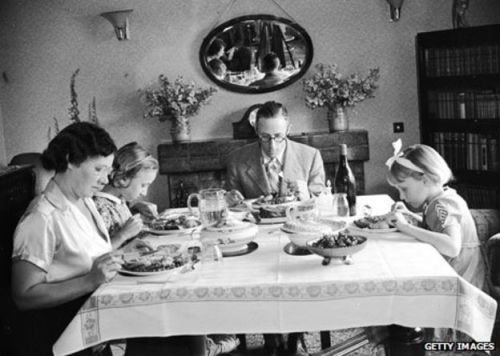
I’m about eight years old. I’m sitting at the dinner table, just around the corner from my father. The table is set, the food is spread before us, and we’re all in our seats waiting to begin. We haven’t yet asked the blessing. I’m playing with my dinner fork, just to the left of my plate. I’ve moved it a few inches away from my plate.

My father’s voice interrupts me. “Elouise, put the fork back where it belongs.”

I move it to the right, in the direction of my plate. “Elouise, put the fork back where it belongs.”

I move it slightly closer. My father’s voice remains firm and controlled. “Elouise, put the fork back where it belongs.”

By now my sisters are watching to see what will become of me. My mother is silent. This has become an event. Slowly I raise my hand to my fork and move it ever so slightly closer to my plate.

My father persists. So do I. Many repetitions later he’s satisfied; the fork has been returned to its proper place.

He proceeds with the blessing. He doesn’t know what I know: the fork is ever so slightly to the left of its proper place.

My father’s mission as a parent was to train us to keep the rules. My mission as his child was to break and keep the rules simultaneously.

Back then, perseverance meant getting through another day, using whatever survival skills lay close at hand.

If my father was persistent, I would be more persistent. If outward rebellions were too costly, I would invent creatively invisible yet superbly effective inward rebellions. If I was ordered to sit down and stop talking, I could continue standing and talking on the inside for as long as it took to comfort myself.

Indeed, this was the better way. In the private spaces of my mind no one could put me down, refuse to listen to me or try to break my will. In a family system intent on turning out obedient daughters, I survived by being secretly disobedient.

This memory from the 1950s, published nearly 20 years ago, is as vivid today as it was then.

The territory I defended was interior. I applaud the little girl who figured out how to do this. Nonetheless, my efforts were costly. They required constant vigilance, no matter where I was.

Abuse of power destroys safe space. It expects and demands behaviors, words, looks on faces, subtle and open signs of unquestioning and subservient submission.

What does it take to create and maintain safe space? Not just in our marriages and families, but in neighborhoods, nations, churches and schools? And how does my personal history connect with the racial history of the USA?

© Elouise Renich Fraser, 29 March 2017
Photo of 1938 family dinner found at bbc.com
Story excerpted from my book, Confessions of a Beginning Theologian (InterVarsity Press 1998)
Response to WordPress Daily Prompt: Territory

A Day! Help! Help!

I think Emily wrote this little gem just for today. Read on. My comments follow.

A Day! Help! Help! Another Day!
Your prayers, oh Passer by!
From such a common ball as this
Might date a Victory!
From marshallings as simple
The flags of nations swang.
Steady – my soul: What issues
Upon thine arrow hang!

c. 1858

Emily Dickinson Poems, Edited by Brenda Hillman
Shambhala Pocket Classics, Shambhala 1995

Emily Dickinson wrote this poem in the years leading up to the Civil War (April 12, 1861-May 9, 1865). I can’t help making a connection to what’s happening now in our country.

The short poem grabs my attention. There’s no such thing as an ordinary day. Like an arrow poised to fly through the air, each day arrives full of potential for Victory. Which I take to be a Victory for good. The good of all who dwell on ‘such a common ball as this.’

Common ball, you say? Doesn’t that mean a formal occasion focused on gorgeous apparel and elegant dancing? The kind of show that delineates the rich from the poor, the ins from the outs, the titled from the untitled?

Perhaps, but I can’t help noticing these are the years leading up to the Civil War, also known as the War Between the States. Or the North against the South, or vice versa.

And so I vote for the ball being this terrestrial ball. The planet on which we live. Or even better, this great dance of life to which all are both invited and entitled. A dance choreographed by our Creator, the true Host of the Party.

For me, the question is simple: Will I participate as a full partner? Or will I be relegated to the kitchen, the stables, the dungeon, or any other situation that keeps me in ‘my place.’

“Your prayers, oh Passer by!” Will each and all of us win together? Or will business return to business as usual?

I pray your day might be dated a Victory that bodes good for us all. No matter how insignificant your Victory seems to you.

© Elouise Renich Fraser, 24 March 2017
Response to WordPress Daily Prompt: Ordinary

Racial History and Denial

It began with conversation on a call-in National Public Radio show, “Indivisible Radio.” The topic was racism and protest. The conversation explored public protests. Why protest? Does it matter? Aren’t there so many protests now that it’s just a fad, if not a huge cacophony of meaningless sound?

One caller, a younger African American, described his personal commitment to ongoing protest. It was his way of life. His occupation. Though he didn’t give his age, he was part of the younger generation of black men whose lives are in danger every day.

The topic turned to the effectiveness of these protests. When you protest, what are you trying to accomplish? Do you think you can bring about change in the system or in the people on the other side of the protest?

He thought for a few seconds and then responded. “I don’t know if I can change them. I don’t want them to change me!”

He further explained that protest is his way of holding a moral position on behalf of change—for the longterm. If he became ‘one of them,’ they would win, and the long-term prospects for change would diminish. For the next generations, not for himself.

There’s much truth in this man’s wisdom. In my observation, most protests are attempts to change or control someone or something. Or they’re expressions of fear.

So what does this have to do with symptoms, much less racial history and denial?

Clearly, the proliferation of protest in the USA is a symptom of something. Or of many ‘somethings.’ For me, given the current state of our disunion in the USA, I believe it’s at least a symptom of denial.

We aren’t just in denial about what’s happening to our country, neighborhoods and presidency today. We’re in denial of our history as a nation.

History comes home to roost, especially when denied. Of many strands in our national history, I believe denial of our racial history is biting us, hobbling us in ways we don’t understand, putting it in our faces, doing whatever it can to get our attention. Individually and collectively.

We ignore it to our peril. This symptom isn’t going away. It cannot be dealt with quietly or in secret.

So I’ll be posting my thoughts on this from time to time, whether the WordPress Daily Prompt gives me a way in or not!

Thanks for listening and thinking about this with me. Especially if you care about our future as a nation among nations.

© Elouise Renich Fraser, 23 March 2017
Cartoon found at quotesgram.com
Response to WordPress Daily Prompt: Symptom

Crazy Happy Lady

For several weeks I’ve been thinking about end of life issues, wondering what my daily ‘plan’ is for getting from here to there. How will I order my life each day? I don’t own the time my Creator has entrusted to me. So how will I invest it?

Whatever chaos is, it’s the way I’ve experienced most of my life. A chaos of competing priorities, demands, expectations (yours and mine), rules and regulations, political realities….

I’ve spent years trying to get through and beyond chaos. Yet here’s what happened this past weekend.

From my journal:

It’s 3:30pm, Saturday afternoon. I’m not exercising in the house, not cleaning up the kitchen, not vacuuming, not playing music, not reading a book, not writing a poem, not going through files and piles, or anything else except this—showing up and writing this journal entry.

How I feel right now: weary, unmotivated, discouraged, somber….terrible. Wasting time. Trying to practice centering prayer yet falling asleep. Watching time slip away.

Do I enjoy this? I don’t think so, but sometimes I wonder. Perhaps this is more enjoyable to me than changing my habits.

…My most lethal enemy seems to be lethargy. A kind of glue that keeps me from having an active agenda of things I love to do.

My mind goes through tricks like these:

  • If I read a novel, I’m wasting time. If I play the piano, I’m wasting time. Can’t I see how much work needs to be done in the kitchen, the house, the attic, my office?
  • If I walk in the house or ride on my recumbent bike or bounce on the rebounder, it isn’t ‘real’ exercise—so why bother?

There’s a crazy logic here—if I do this, I won’t be able to do that. (Or it won’t count anyway.)

And then there are all those other good things I’m not doing that haunt me—

  • Sending notes and cards to friends who need encouragement
  • Vacuuming the house
  • Cleaning the curtains and windows
  • Weeding out unneeded kitchen utensils
  • Taking things to the Salvation Army or some other charity

Like I said in my last entry, I don’t have a plan for organizing my life. It seems all I do is make sure my food needs are met, wash laundry when absolutely necessary, rest and sleep enough, and do other maintenance work that demands my attention.

Later that same day (Saturday evening now), I was back to my journal. Here’s what finally broke through the chaos and lethargy and made me crazy happy.

From my evening journal:

The best part of today: posting this morning and getting tomorrow’s post ready to go. I can’t begin to express how important blogging has become for my growth and enjoyment. I’d even put it on the same level as walking out of doors. Even ahead of playing the piano…and reading.

Which led to my Crazy Happy Lady List of Priorities – things that top my list of things I love to do just for myself.

  1. Writing – if not for my blog, in my journal
  2. Walking – outside if possible, with no agenda but enjoying nature
  3. Music – playing the piano or listening to music I love
  4. Reading – poetry, novels, books that help me navigate my life
  5. Meditating — wherever I am, day and night

As for other activities,

  • As little as possible
  • As efficiently as possible
  • On an as-needed basis

Thanks for listening, and Happy Spring!

© Elouise Renich Fraser, 20 March 2017
Elegant Photo of Woman Writer found at salon.com
Response to WordPress Daily Prompt: Label

Upside down and inside out

The glories of being intuitive do not include being correct. As I’ve noted before, intuition is as flawed as any other remarkable gift. My intuition is prone to wander, prone to read things wrong, prone to finding a way to make it all work out so I’m still on the ‘right’ side of things.

I didn’t choose this. It’s how I survived childhood and youth as the first-born daughter of a clergyman who believed he was right and I was wrong.

My instincts back then were correct: I was NOT always wrong. Not that I could do much about it back then except pray for the day when I would be an Adult Woman. An Independent Agent living by her own instincts, not yours or anyone else’s. And, of course, with God’s blessing.

I had no idea what it would mean to live according to instincts and intuitions shaped by years of resistance to homegrown and social trauma. Even so, I was often on target, especially when I was dealing with other people and their situations.

Going through old notes from 1994, I recently discovered a small phrase I used in a forum. The phrase is simple: ‘upside down and inside out.’

The notes referred to Karl Barth, German theologian of the mid-20th century. He wrote and taught during Hitler’s reign, the Holocaust, and in the aftermath of World War II. Plenty of trauma going on there, don’t you think?

In the 1980s, when I was a graduate student, Barth invited me to turn my mind ‘upside down and inside out.’ Not to play tricks on reality, but to discover a different way of discovering and naming truth.

He argued that because of human confusion in and around us, we cannot trust our instincts. His theology is a grand effort to show how this works—turning our minds upside down and inside out. So that what we call good or even ‘normal’ is not necessarily that.

So today I’m back to thinking about my instincts. Instincts honed and shaped by what we now call childhood PTSD.

Back then it was all about survival. Getting through without falling apart (even though I fell apart regularly, especially on the inside). I dreamed of arriving at the magic moment when I could live without threat of imminent punishment or humiliation.

I left home at 16 years of age to go to college, never dreaming what my lifetime learning agenda would be. Especially about myself and my instincts. I thought thriving meant living on my own, having a job and maybe even a boyfriend.

Yet thriving isn’t about having a life or even letting go of things programmed into me as a child. It’s about welcoming, affirming and living as the woman I already am.

Put another way, it’s about living on the other side of letting go. I want to name and own what I love about myself and about life. I welcome this opportunity to turn my let-go thoughts and feelings upside down and inside out. I have much to put to rest, and much to bring back to life. Just like those beautifully upside down, inside out flowers and plants in the artwork above.

Elouise

© Elouise Renich Fraser, 15 March 2017
Lovely artwork found at akiane.com

Response to WordPress Daily Prompt: Instinct