words on paper

words on paper
nearly forgotten
traces of you Read the rest of this entry »
words on paper
nearly forgotten
traces of you Read the rest of this entry »
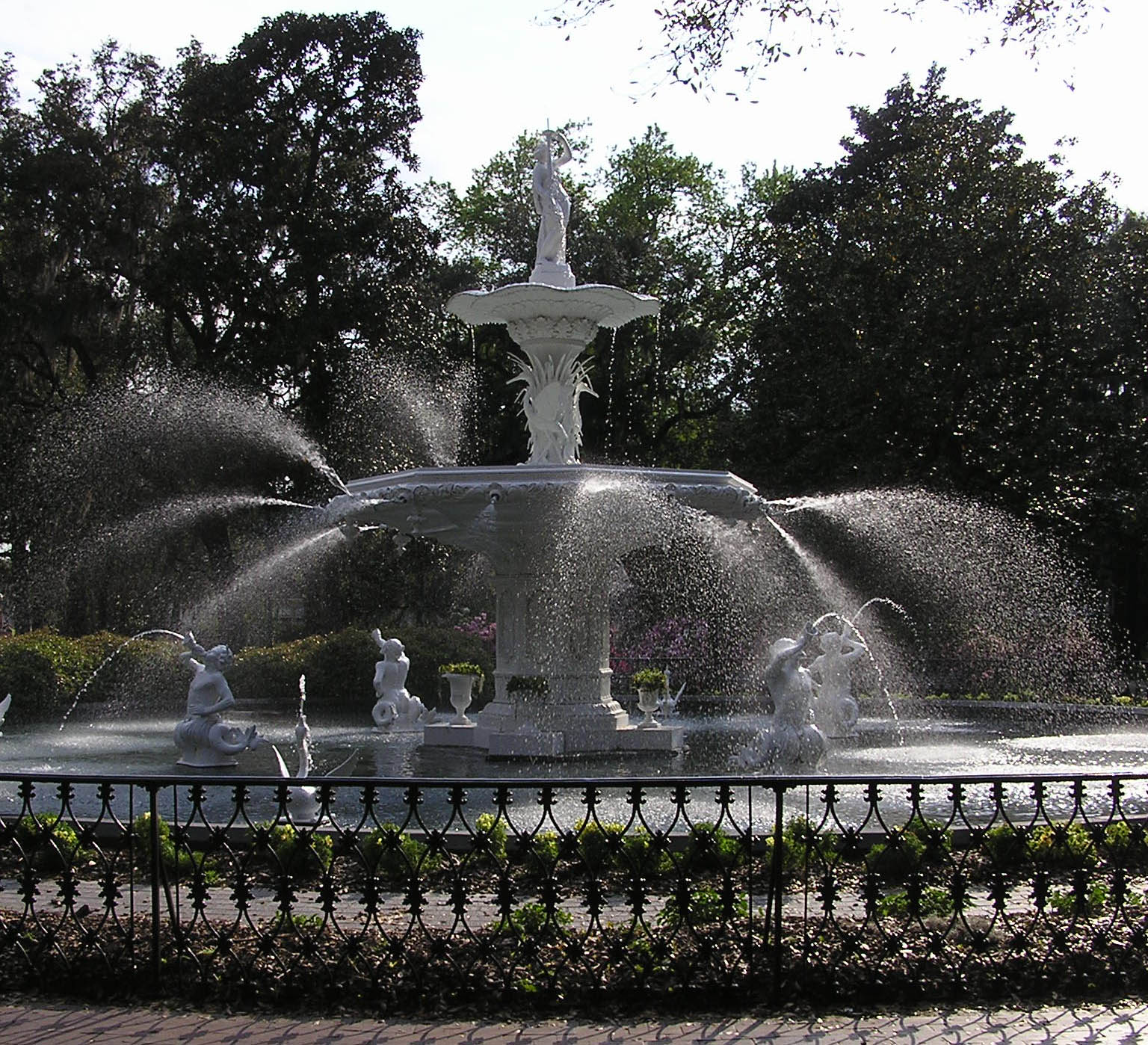
Forsythe Park Fountain, Savannah, Georgia
Dear Mom,
I miss you. I’d love to sit down with a cup of tea and continue the conversations we had before your stroke. Though you didn’t particularly like all my questions about your past, you did your best to answer them.
I’m grateful for every conversation we had back then. I’m also grateful that you wrote down memories of your early life. A bit of your personal history. Every now and then I find myself hungry for more, though most of the time it’s enough. Your written words give glimpses of your heart and your struggle with circumstances over which you had no control.
I’ve been thinking about your memorial service in 1999. I got to make remarks on behalf of the four of us, your daughters. I decided to show and tell how much you loved teaching children music. Not just to the four of us, but to the kindergarten children you taught after I’d married and moved away.
I still have your old spiral music notebook, filled with children’s songs. For your service I picked out several of my favorites and said a bit about each song before I played the music. I also read the words and demonstrated motions for at least one of the songs. The one about how elephants kalump along, their long noses swaying in time to the music!
The most fun was coming to the end of “The Polliwog’s Story,” and (like you, without warning) suddenly turning around on the piano bench to give everyone a big scare with the last line! They loved it! For a moment we felt your joy and exuberance, and celebrated your lively spirit and your love for children and music.
I also played some of your favorite adult hymns. Not too many, but just enough, with comments about why I chose each. The most difficult to get through was “Great Is Thy Faithfulness.” That was the hymn you tried to sing so often when you first got polio, even though your vocal chords were paralyzed.
I’m tearing up as I write this part. I owe you so much. I’ve been reading a book by Henry Nouwen. He talks about the way absence can cause our love for someone to grow. I’m beginning to understand what he’s talking about.
Part of it is my freedom to write you these letters and say things I couldn’t say while you were with us. It’s also because I understand our family dynamics more than before, and how costly they were for you, not just for me.
A few days ago I was thinking about my grandparents and how little I knew any of them except for your father, my California Grandpa. That got me thinking about the way you and he related to each other, especially since your Mom wasn’t around for most of your life.
When we lived on the West Coast, we spent lots of time visiting Grandpa and going with him to fun places like the Wilson Observatory and the Griffith Park Zoo. Even his apartment was fun! There were long sidewalks outside. I remember learning to ride my first bike on them. The bike he gave me, with training wheels.
After we moved to the East Coast, things changed. But you still kept in regular touch through letters. I know you wrote to him about us and what we were up to, because his letters to you sometimes included comments back to each of us.
He seemed to dote on us. It meant a lot to me back then to know he thought we were the best and the brightest little girls in the whole wide world. I’m guessing it meant a lot to you, too. You must have missed him terribly. I think you inherited your love of fun and of children from him.
How do you like the photo of the Forsythe Park Fountain? I love the water droplets flying through the air! If you enlarge it, you’ll see pink azaleas blooming in the background.
Love and hugs,
Elouise
© Elouise Renich Fraser, 1 March 2015
Part 1 focused on loneliness. How it felt to me, and the kind of person I looked for to dispel my loneliness. I described the impossible expectations I had of you and, of course, of myself in my search for someone who would adore me just as I was. Read the rest of this entry »
I just found this short piece plus two others Diane sent me via email. I’m adding them to my Dear Diane collection. For those who are new: Diane, my Sister #3, died of ALS in 2006. She wrote a number of pieces like this. Enjoy! Read the rest of this entry »
This poem came to mind yesterday.
First published 10 Feb 2015, it captures the vulnerability of a lonely soul.
Lost and looking for relief in all the wrong places.
* * *
searching for myself
lost somewhere out there
in your eyes your smile
your listening ear
your approval your tenderness
your dream for me Read the rest of this entry »
Loneliness isn’t new, and it isn’t going away. This post is about my loneliness, since I don’t know about your loneliness.
I can’t count how many times Read the rest of this entry »
From my house to colored town in the 1950s,
A short half-mile drive, walk or ride on my bike.
Until I began high school, we drove through it every day.
When I began high school I walked to the corner of colored town
to catch the whites-only bus to a whites-only high school.
Until I was 14 I rode my bike to the corner and turned right
every time I went riding around the rural white neighborhood.
The road I turned onto made a big loop past dense trees and shrubs
hiding big houses on the river, No Trespassing signs posted everywhere.
I wasn’t allowed to ride my bike through colored town.
I didn’t want to. It felt like trespassing. I wasn’t afraid.
But I wasn’t comfortable, either. I knew I was an outsider.
Colored town wasn’t hidden away in the shrubs or trees.
Most houses were lined up one right after another
along both sides of the narrow paved road.
No sidewalks, right of way or long driveways.
Just huge water oaks overshadowing a narrow rural road.
I was shocked and disturbed by what I saw.
Everything from simple, sometimes patched together houses
of wood and metal, some unpainted, to a handful of
more stable, sometimes unpainted concrete-block houses.
Some with small stoops. No fancy porches.
Easier to live in during warm weather; a stretch in the cold.
Most had chimneys, some didn’t. Some had electricity, some didn’t.
Windows and roofs could be sketchy, patched with metal and cardboard.
There were usually children running around.
Sometimes I could smell what was cooking for dinner.
I got used to it, but I didn’t get comfortable with it.
I felt awkward driving by and having people stare
at us and our car. What were they thinking?
My little girl heart went out to them. We drove slowly.
Every now and then a young child would smile and wave.
Public high school meant riding the yellow bus for white kids.
It also meant leaving our house early in the morning
so I could walk the half mile and not miss the bus.
I liked walking. I didn’t like standing at the corner
just outside someone else’s house, waiting for the bus.
This was colored town. I always felt like a trespasser.
Partly because I was standing in front of someone else’s house.
But mostly because it seemed my eyes were trespassing,
seeing private things, private property, the lives of others
who hadn’t invited me to visit them today.
One morning I smelled the aftermath of a fire.
When I got to the corner, the first house in colored town
didn’t exist anymore. Charred remains, smoke still in the air,
an eery silence. No walls, no children, no food cooking.
The death of a family’s private space in an unprivate setting.
My mind raced with questions I couldn’t answer.
Neither could either of my parents.
Where did the family go? What about all their clothes?
There weren’t even any people around looking at it.
It was here just yesterday. Gone overnight.
The tavern sat at the other end of colored town,
perhaps a quarter of a mile from where I caught the school bus.
The rural neighborhood was different on the other side,
thanks to the tavern and its late night services for customers.
It burned down years ago, taking many secrets with it.
© Elouise Renich Fraser, 20 February 2015
I don’t even remember her name. Her mother, Mrs. Jeaudon (called by her first name), was the cook and household helper for Dr. and Mrs. Turner. Mr. Jeaudon (called by his first name) took care of the yard work around their house. Read the rest of this entry »
 Telling the Truth