Telling the Truth

connecting the dots of my life

Tag: Self-reflection

Strange Visitors


Unplanned events
Crash into my life
Force change and create confusion

Chaos
Leers at me
Foils attempts to ‘sort things out’

Indecision
Haunts my behavior
Especially on days without sunshine

Lethargy
Creeps from head to toe
Lulls me into dreary gray oblivion

Dare I welcome
These strangers in
For tea and conversation?

I fight the urge
To show them the door
As though they didn’t exist

I want them to disappear
Like the unrealities
I want them to be

***

As a girl child I was instructed at home, in school and in church to avoid or get rid of all things negative. That included lying, cheating, pouting, complaining to my parents or fighting with my sisters.

Though this was supposed to make me good and happy, this negative approach seemed to border on magical thinking.

Avoid this or stop doing that, and you’ll win the Good Girl Lottery! It might not always be fun right now, but it will be spectacular later on—especially after you die and wake up in heaven.

And yet, with all that goodness drummed into me, I wasn’t protected then or now from difficult situations. Instead, my upbringing instilled voices and unhelpful habits that drive my behavior more than I like to admit. They kept me from exploring and celebrating my voice, and the woman I was becoming then and now.

I’m just beginning to recognize the way these drivers work in me, and let them go. They’re named in the litany I wrote about here:

  • My desire for security and survival
  • My desire for esteem and affection
  • My desire for power and control
  • My desire to change the situation

Saying I’m letting go is relatively easy. Living it out is difficult. It’s difficult to let go of what I’m not willing to understand. I want to welcome these desires as the realities they are, capable of supporting life or of putting it at risk. I don’t want to slam the door in their faces. They might be my best coaches—or at least helpful visitors I dare not silence or ignore.

So how do I welcome these strangers and listen to them? How and why did they become powerful and controlling in me? Who put their insistent, insinuating voices in me, and why? And how does this affect my responses to unplanned events, chaos, indecision and lethargy?

More fodder for self-reflection during and beyond this Lent season. Thanks for reading!

Elouise

© Elouise Renich Fraser, 18 March 2017
Photo found at islamforchristians.com
Upside down and inside out

The glories of being intuitive do not include being correct. As I’ve noted before, intuition is as flawed as any other remarkable gift. My intuition is prone to wander, prone to read things wrong, prone to finding a way to make it all work out so I’m still on the ‘right’ side of things.

I didn’t choose this. It’s how I survived childhood and youth as the first-born daughter of a clergyman who believed he was right and I was wrong.

My instincts back then were correct: I was NOT always wrong. Not that I could do much about it back then except pray for the day when I would be an Adult Woman. An Independent Agent living by her own instincts, not yours or anyone else’s. And, of course, with God’s blessing.

I had no idea what it would mean to live according to instincts and intuitions shaped by years of resistance to homegrown and social trauma. Even so, I was often on target, especially when I was dealing with other people and their situations.

Going through old notes from 1994, I recently discovered a small phrase I used in a forum. The phrase is simple: ‘upside down and inside out.’

The notes referred to Karl Barth, German theologian of the mid-20th century. He wrote and taught during Hitler’s reign, the Holocaust, and in the aftermath of World War II. Plenty of trauma going on there, don’t you think?

In the 1980s, when I was a graduate student, Barth invited me to turn my mind ‘upside down and inside out.’ Not to play tricks on reality, but to discover a different way of discovering and naming truth.

He argued that because of human confusion in and around us, we cannot trust our instincts. His theology is a grand effort to show how this works—turning our minds upside down and inside out. So that what we call good or even ‘normal’ is not necessarily that.

So today I’m back to thinking about my instincts. Instincts honed and shaped by what we now call childhood PTSD.

Back then it was all about survival. Getting through without falling apart (even though I fell apart regularly, especially on the inside). I dreamed of arriving at the magic moment when I could live without threat of imminent punishment or humiliation.

I left home at 16 years of age to go to college, never dreaming what my lifetime learning agenda would be. Especially about myself and my instincts. I thought thriving meant living on my own, having a job and maybe even a boyfriend.

Yet thriving isn’t about having a life or even letting go of things programmed into me as a child. It’s about welcoming, affirming and living as the woman I already am.

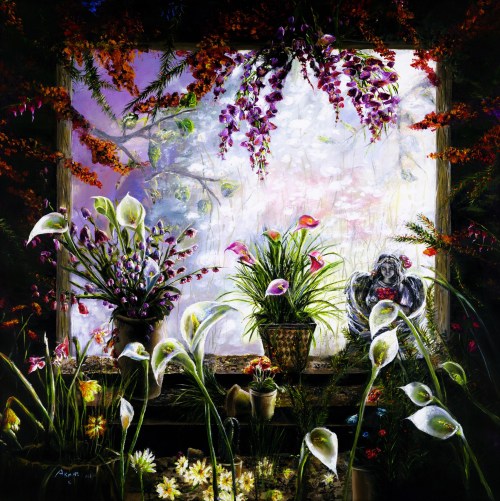
Put another way, it’s about living on the other side of letting go. I want to name and own what I love about myself and about life. I welcome this opportunity to turn my let-go thoughts and feelings upside down and inside out. I have much to put to rest, and much to bring back to life. Just like those beautifully upside down, inside out flowers and plants in the artwork above.

Elouise

© Elouise Renich Fraser, 15 March 2017
Lovely artwork found at akiane.com

Response to WordPress Daily Prompt: Instinct

What will they say about me?

I was late getting to bed last night. In the evening we’d attended a memorial service at our church for a long-time member. Kathleen made a difference in the lives of uncounted family, friends, neighbors and strangers. The sanctuary was filled with witnesses.

Kathleen’s life was long and lively. Always full of energy, joy, encouragement of others and raucous support for our local baseball team—the Philadelphia Phillies. Her husband died suddenly 17 years ago, a grief-fed love she carried with her every day of her remaining years on this earth.

The memorial service was outstanding. A collage of shared memories, a meditation on life and death, several of her favorite hymns, and multiple genres of music performed by visitors and members whose lives she touched.

I knew Kathleen, but not from way back. Until last night I had no idea how deeply she had immersed herself in the lives of others—via music, Phillies baseball games, family relationships, her neighborhood, and of course, the life of our church. Even though she had officially retired as music director years ago.

When I got home I felt sad and teary. I wondered what people might say about me when I’m gone. And how full the sanctuary would be for my memorial service.

Without intending to, I began comparing myself with my friend. The kind of comparison that leads to unhappiness. That gnawing sense of being ‘less-than.’ Feeling shame and even regret for my life and what I have and have not accomplished. Wandering around, trying to find myself, trying things on, wanting desperately to be somebody. And to be loved.

It’s Lent. Time to practice letting go my desire for affection and esteem…among other things.

Here’s what I wrote down before I went to sleep last night.

Remember the white stone! Your white stone! The one God will give you, with your new name. Not comparable to anyone else’s distinct new name. This isn’t a competition. Yet (comparison) has been a source of much discontent in my life.

Last night I was painfully aware of my desire for esteem and affection. I don’t want to fall off the cliff into a thicket of jealousy or envy. And I don’t want to be left hanging. I believe there’s another side of this practice.

Letting go isn’t about going away empty-handed. It’s about keeping my hands open, ready to receive my white stone and new name. My one-of-a-kind name. Inscribed by my Creator on the white stone. My one-of-a-kind ‘well done, beloved daughter.’

Plus any other gifts my Creator wants to give me before I receive the white stone. So long as my hands are open and receptive.

© Elouise Renich Fraser, 14 March 2017
Photo found at yldist.com
Response to WordPress Daily Prompt: Immerse

What I’m giving up

I didn’t grow up in a church tradition that required me to give things up for Lent. Yet today I’m asking what I’m giving up for Lent.

Why now? I think it’s related to my health, my age, my ability to live as an independent woman, my need to have things go my way at this time in my life.

I feel quite well most of the time. Perhaps weary and a bit stressed out now and then, but not awful. Yet sometimes I fall over the edge–into anger or fear. It’s usually triggered when something doesn’t go the way I anticipated it would. It’s like throwing a lighted match into a dry haystack. Or going over a cliff. Too late to step back and do something different.

So what to do? I don’t have a magic formula. However, I’ve been reading a wonderful book about prayer. It’s Cynthia Bourgeault’s book called Centering Prayer and Inner Awakening. It seems connected to what’s happening.

Her book is helping me reconsider these episodes. They flare up when I hit moments of extreme frustration. Sometimes they’re about my health and wellbeing. Other times they’re triggered by memories of things that happened to me as a professional woman.

The goal I’m after is this: to learn ways of interrupting what’s about to happen before I go over the cliff. I know I won’t learn this overnight. Still, I want to recognize, welcome and listen to those small signs before I go over the cliff or say things I’ll regret. Sometimes that’s not possible. Other times, it is.

As part of this discipline, Cynthia offers a litany written by a friend. It’s a prayer to be offered as often as needed, without having to make it up myself. It’s for the moment I realize my frustration and anger are escalating, ready to overflow. It won’t work if I’ve already exploded.

I grew up believing everything unwelcome in me needed to be  ‘fixed’ if not denounced and forsaken. Slam the door in its face! Send it packing! Or at least keep it hidden in a closet. It’s not the ‘real me.’

This, however, is about the real me. The person I am in God’s presence. Just as I am. Especially when I’m unhappy about the way things are going. What’s happening in me has something to tell me. Instead of slamming the door in its face or denying its presence, perhaps I could welcome it. Listen, and learn from it. After all, it’s part of me whether I like it or not.

So here’s the litany, an active giving up of something. Not just for Lent.

I let go my desire for security and survival.
I let go my desire for esteem and affection.
I let go my desire for power and control.
I let go my desire to change the situation.

Quoted by Cynthia Bourgeault in Centering Prayer and Inner Awakening, p. 147 (Cowley Publications 2004)

I long to stay fully present to God and, so far as possible, to the truth about myself. No matter what rises to the surface or comes at me without warning. Whether it’s anger, fear, pain or death itself.

© Elouise Renich Fraser, 11 March 2017
Image found at kairosjourney.org

The White Stone

To each who overcomes,
I will …give a white stone with a new name written on it,
known only to the one who receives it. (Revelation 2:17, NIV)

Imagine you’ve come to the end of your life. What are you expecting? I was brought up to expect judgment. The kind that points out how much I’ve failed, and assigns demerits for failures.

Will my failures outweigh the good? According to my childhood theology, that would be entirely in God’s hands. Woe to me if I fail to live up to expectations.

This made for a peculiarly nervous mode of life. Like nervous tics my failures sometimes seemed to have gained eternal life. Poking at me, cropping up at the most vulnerable moments, shadowing me like bad dreams. Casting a pall of loneliness around me and my closely guarded secrets.

I’ve been reading short excerpts from George MacDonald in the last few weeks. His comments about the white stone are nothing like my childhood theology.

The white stone and the new name are indeed God’s judgment. But with a difference. This is a judgment of grace. One white stone with a new name for each son and each daughter.

The stone with the new name makes visible what has already come into being. Not a hideous monster, but a breathtakingly beautiful daughter or son of the Creator. In fact, to receive the white stone with one’s own new name is the equivalent of ‘well done, good and faithful servant.’

It is only when the person becomes his or her name that God gives the stone with the name upon it. (George MacDonald: An Anthology: 365 Readings; C. S. Lewis, ed. (Harper One)

The secret name given only to me will capture perfectly what God saw in me from the moment I was created. Especially when I or others don’t or can’t see this. The name sums up the woman I will have become—through many dangers, toils and snares.

I can relax, take each day as it comes without a clear roadmap. When I get there, my Creator who kept faith with me will give me my white stone with my new secret name. One of a kind. I don’t need to keep asking “Am I there yet?” I’m already in good hands.

© Elouise Renich Fraser, 8 March 2017
Image found at ahnsahnghong.blogspot.com

Quotation  from the NIV
Response to WordPress Daily Prompt: Nervous

Chewing My Cud

~~~~~A tarine cow chewing the cud near the Habert de la Dame

Dear Friends,

Today’s Daily Prompt is ruminate.  You know—chewing the cud. Turning things over and over and over. Mashing them around. Trying to make digestible what might be indigestible. Spitting out what reminds me of liver and okra. Swallowing the rest and hoping the outcomes are good for me.

So what’s this post all about? Several things. Please note I need no sympathy. In fact, I abhor it. I’d rather have empathy or even your listening ear. You don’t have to like it, agree with it, think about it, try to solve it, or come back for more. If all you do is read with a listening ear, I’ll be deliriously grateful.

So let’s start with my health. It’s on my mind daily. Maybe that’s what happens in the golden years—things just sort of moosh together and feed on each other relentlessly.

The list gets longer: heart arrhythmia and heartbeat speed or lack thereof; non-diabetic hypoglycemia; jaw bone loss of memory and inability to function properly; kidneys showing signs of aging; on glaucoma watch with nothing to report lately; IBS ever with me and I with it; still allergic to chocolate; caffeine considered poison to my system; lactose and soy intolerant; those pesky little skin cancers that just seem to keep popping up; and whatever I forgot to mention or didn’t mention on purpose.

And yet.

I look around and am beyond grateful for this female body and the ability to care for it. I spend hours in the kitchen making sure the food train is ready to go, and cleaning up pots and pans. I have a lovely kitchen, enough food, water, cookbooks galore, and a pantry full of ingredients. Best of all, I have a kitchen dining area with a lovely view of our back yard, bird feeders, birds and bees, trees, shrubs, spring flowers, the sky, the occasional bunny rabbit, groundhogs, and did I mention squirrels or that stray cat?

Two days ago I was—and still am—sorrowful because another church friend died last week. Teared up all day. In church, out of church. Anxious about my health, given my age. Down in the dumps about the way this presidential election and outcomes have galvanized family, friends, neighbors and strangers against each other. I’m also lonely—feeling like Emily Dickinson’s poem from the inside out. Yet hungry for time alone, especially in the evening, and for music to sooth my spirit and bring on another wave of tears. Vulnerable and grateful.

And yet.

That very evening I had fallen apart. Out of control in the space of a heartbeat. Storming around the attic overwhelmed by messiness. We’re making great progress up there. Yet the messiness freaked me out. Not just my messes, but you-know-who’s messes. To say nothing about how I’ve been cleaning up (other peoples’) messes all my life and I’m sick and tired of it and I won’t take it anymore!

What’s going on? What if I tried something different next time? I don’t have answers. That’s why I’m writing about it. My way of ruminating. Out loud.

Thanks for listening, and not trying to solve my stuff. Empathy is also deeply appreciated.

Elouise

© Elouise Renich Fraser, 7 March 2017
Photo found at braemoor.co.uk

Response to WordPress Daily Prompt: Ruminate

Still Learning to Pray

learning-to-pray-by-talking-less

Today is a quiet day. Not because I’m sick, but because I need to take care of myself. So I’m revisiting several books on prayer. Why? Because current events in the USA tug me this way and that way. Sometimes I feel as though I’m wandering, lost in the trees. Uncertain how to pray or how that might help my focus from one day to the next.

Here’s what I’m certain of today.

  • The human confusion into which I was born multiples daily, and isn’t going away of its own accord. Ever. There are things I’d like to undo and re-do in this world and in myself. I want us to sort things out and be good neighbors. Yet I fear it isn’t going to happen, even though we’re all part of God’s good if not perfect creation, and need each other to survive.
  • Human confusion seems to have a life of its own. It feeds on itself, creating ever-more-shocking statements, behaviors, attitudes and reactions. It thrives when we’re fearful and distracted. On guard. Looking over our shoulders as we try to figure out what just happened, and miss what’s already brewing for tomorrow.
  • In my small world, confusion shows up in anguish about what I’m to do from one day to the next. I’m not utterly lost or clueless; yet I don’t feel grounded in a clear approach to what’s happening around me. I don’t have a clear goal for each day that calms my heart and helps shape my actions. I often feel uncertain and lost, especially when I start checking out tantalizing, infuriating headlines that pop up every minute of the day.

For the last few weeks I’ve been thinking about prayer. Granted, our pastor is preaching about it every Sunday, so it’s difficult not to think about it! At the same time, I wonder how I am to pray, given confusion around and within me.

I used to think once I learned to pray, I’d have it all figured out. As though it were like theology. I think about theology as dialogue with Scripture, traditional documents, other conversation partners, the newspaper and my experience as a woman. It works!

However, when I consider prayer, my major dialogue partners have been God or Scripture or what my parents or the church told me to do. The newspaper has been a secondary partner. And though I’m aware of myself as this woman (not just any woman), I haven’t figured out how that shapes my approach to prayer. Sometimes I fear there’s something wrong with me–even though I know there is not.

So I’ve decided to look into this and begin writing about it from time to time. I want to live boldly with the courage of my convictions, as this follower of Jesus Christ who is this woman living in these troubled times. Somehow, I believe my dilemma about prayer lies at the center of my anguish about who I am and how that shapes my prayers from day to day. Especially now.

© Elouise Renich Fraser, 25 February 2017
Photo found at parentingupstream.com

Awareness of pain

Awareness of pain
Life-shaping yet elusive
Lodges deep
In bones and sinews
Erupts without warning
Bleeding over pages
Of my life
Softening my heart
Longing for tenderness
Squandered in the past
Foolishly given away
To dull my pain

***

I don’t live in this awareness every day. I wouldn’t survive if I did. I’m grateful for God’s grace every day of my life. Still, moments of grief arrive, often taking me by storm. They don’t destroy me. Instead, they soften and connect me not just to my pain, but to that of others.

I used to think these waves of emotional and spiritual pain would fade. They haven’t. In fact, the more willing I am to live with grief, the more I find myself grieving and growing.

This past week I listened to Beethoven’s Sonata 8 (“Pathetique) and found myself right where this poem is. In the middle of a teary eruption. The kind that fosters life, not death, when I’m willing to live through it.

You can listen to a brilliant performance by Daniel Barenboim here.

© Elouise Renich Fraser, 11 February 2017
Response to WordPress Daily Prompt: Aware

The Soul selects her own Society —

house-door-1860s

I wish Emily Dickinson had left a note about this poem. It seems maddeningly ambiguous about her context and meaning. What do you think it’s about? My comments follow.

The Soul selects her own Society –
Then – shuts the Door –
To her divine Majority –
Present no more –

Unmoved – she notes the Chariots – pausing –
At her low Gate —
Unmoved – an Emperor be kneeling
Upon her Mat –

I’ve known her – from an ample nation –
Choose One –
Then – close the Valves of her attention –
Like Stone –

c. 1862

Emily Dickinson Poems, Edited by Brenda Hillman
Shambhala Pocket Classics, Shambhala 1995

Here are my thoughts as of today—informed by my experience as a woman and by social, national and international realities.

  • Is this a riddle? I don’t think so. Riddles can have more than one true answer, but only when all clues in the riddle line up with each possible solution.
  • The subject of the poem is named immediately – “the Soul.” Everything that follows describes choices of the Soul, personified as a woman.
  • The action in the poem is simple. The Soul makes her own choice about whom she will or will not receive. She then shuts the Door, cutting off access to all others and ensuring her own Majority (of one). This isn’t a decision made by consultation or by popular vote. It’s a one-way decision of the Soul.

If this is about a human being, I celebrate our ability to choose whom we will or will not allow through the Door – into our lives. That doesn’t mean each choice we make will be wise. It means the choice is ours, for good and for ill.

On the other hand, I think Emily is suggesting more than this.

Notice these words: The Soul ‘shuts the Door’ – is ‘Unmoved’ – is ‘Unmoved’ – is ‘Like Stone.’ This suggests a one-time decision such as how the Soul choses to live her life. These words might also suggest this Soul is a snob or merciless.

Yet I see no evidence of this. She doesn’t seem to come from high Society or live in a magnificent palace (note her low Gate). She simply makes her choice and doesn’t look back. Her nay is nay, and her yes is yes. No use trying to change her mind.

It’s possible the supplicants are trying to help this Soul in some way. Or perhaps use her? They may want her vote or her support. They might promise her one thing and deliver something else. Whether the Soul knows this or not, I still applaud her courage when she shuts the Door, Unmoved.

Emily’s poem challenges me to be wise and clear about opening the door of my soul. Some bargains and sure-things end up being disastrous. Not just in our private lives, but in our national and global life.

In the end it doesn’t matter whether someone thinks I’m a snob or blind to reality (which I sometimes am). My choices aren’t always wise. Still, I believe God gave me the capacity to learn wisdom and discernment, if I’m willing to practice it. This means, as Emily’s poem implies, going against popular wishes or expectations from time to time. Especially as a woman, though also as a family member, friend, neighbor and citizen.

© Elouise Renich Fraser, 4 February 2017
Image  found at remodelingnewburyport.com

Interrupt and Replace

I woke up this morning feeling down, weary and discouraged. ‘Dis-couraged.’ An interesting word. It means I had courage ‘back there,’ and now I perceive a deficit. How can this be?

If I go back to my childhood and teenage years, I know when dis-couragement happened and why I need to attend to it, lest I lose my voice or become an enabler.

As a young girl I knew when the flames started licking around my legs, weakening my focus and my courage. Back then I persistently carried focus and courage into every punishing situation inflicted upon me. First by my father, and later by men with power to inflict punishment on me as a professional. It’s called bully behavior.

One gift of being a childhood survivor with PTSD is the ability to feel when certain dynamics are in the air. Dynamics neither we nor the person in control are necessarily able to change.

The behavior we’ve seen thus far from our new president is the behavior we’ll most likely see for the next years of his tenure. We already saw it in the presidential election cycle. Nothing has changed except this: the power of the office of President of the United States of America now protects him.

So here I am today, feeling dis-couraged by the events of this past week.

What can I do to change things? I can’t change or replace him. Nor can I change or replace myself.

Back to my father. As a child I was powerless. There was no way I could replace him with a different father. Nor could I interrupt his agenda for me. Especially when he determined I needed to be punished.

I’m an adult now. I’ve done my homework. I’ve learned not just to interrupt and replace the internal voices that mess with me, but the voice of my father talking about himself. He died in 2010.

Now there’s Mr. Trump. I want to interrupt him. The presidency isn’t all about him. Nor is it a platform for bully-talk toward and about others. One painful example will do: his language and behavior toward women who are, apparently, there to serve the desires of his heart.

So how can I do my bit to interrupt Mr. Trump’s monologue and replace it with contrasting voices? Not in debate form, but as a proactive, fearless way to change the conversation, the topic, and the outcomes. The Women’s March is an example of other mass interruptions that changed the topic, the political conversation, and the outcomes.

I want to be part of a movement to interrupt political bully talk and replace it with dialogues that make a difference. I’d love to hear what you’re thinking about. Or how your courage is holding up.

Thanks for listening!

Elouise

© Elouise Renich Fraser, 30 January 2017
Response to WordPress Daily Prompt: Replacement