Telling the Truth

connecting the dots of my life

Tag: the human condition

Are you a Tardy Soul? | From an Old Soul

Today’s sonnet is for tardy women and men everywhere. Are you one of them? If so, you have lots of company, including George MacDonald himself. As is often the case, MacDonald’s route to this un-astonishing insight is Read the rest of this entry »

Fashioned for Freedom | From an Old Soul

Just because we’re designed for freedom, that doesn’t mean it comes easily or naturally. George MacDonald is thinking about himself and his struggle to be free of his dire darkness, his fear and doubt. He got me thinking about my struggles. My comments follow. Read the rest of this entry »

Bad sea-boats we | From an Old Soul

Oops! Maybe that flame-out rescue from his nightmare of dire darkness, the one George MacDonald asked for in the last sonnet, was a bit hasty. Not because it wasn’t worthy of God, but…. Read the rest of this entry »

Framing Freedom

re-framing freedom, seedquote

I’m writing this on July 4, Independence Day in the USA. A day that’s all about freedom. That intangible, inalienable ‘right’ highly valued in our national rhetoric.

When I was teaching theology I couldn’t help noticing how many seminarians defined Christian freedom as free will. The kind that makes choices—yes or no. As some said with fervor, ‘You can take away my house, and even my life, but don’t you dare try to take away my free will!’

I understand what they want to protect—their own freedom of choice, as a kind of inalienable right. Something God gave them that needs to be protected at all costs. The freedom to choose right or wrong, this church or that church, to believe and live this way or that way.

The ability for human beings to makes choices of any kind comes from our Creator. Yet I wonder. Do we understand the meaning of Christian freedom?

Even if I’m speaking of generic freedom, I’m not free to choose just anything. If I think I am, I’m overlooking most of my history.

  • I didn’t choose to be born in this country.
  • I didn’t choose my gender, my race, my parents, the color of my hair or my eyes, my sisters or my extended families.
  • Nor did I choose the way I was received into this world.
  • Or the genes I carry that shape the kind of person I am and the illnesses I might one day suffer.

In fact, I didn’t get to choose much of anything when I entered this world.

On the other hand, I don’t believe everything about me and the course of my life was or is chosen by a higher power or some shadowy political system.

My decisions count, though not every decision is equally weighty. What I wear today isn’t nearly as life-changing as choosing to marry this person instead of that person.

Still, I can choose to live in what I’d call false or make-believe freedom—as though I were God. Or the Queen of the Universe. But I am neither of these, and acting as though I were wouldn’t make it so.

My freedom as a Christian is about one thing.
It’s about freedom to choose life as defined by the Holy One
who created life and chose Jesus Christ (not me)
to be the person who shows us what a free and faithful life looks like.

My Creator doesn’t force this on me. Yet as a follower of Jesus, it’s the only truly free choice. Anything else would be pledging allegiance to some other god — to myself, or to some other human being or system of thought.

I’ve chosen to frame my life choices with reference to the narrative that runs through Hebrew and Christian Scriptures. That doesn’t mean it’s easy to negotiate relationships or the moral and ethical dilemmas that face all of us daily.

It does, however, mean I’m committed to being guided by (1) the life of Jesus Christ who shows us what freedom looks like, and (2) by the reality that I serve but one God—my Creator, Redeemer, and Sustaining Spirit.

It also means I’m free to be who I am—one of God’s beloved daughters and sons. Nothing more and nothing less.

I’m free to choose to love and serve God with all my heart, follow Jesus, and love my neighbor as myself. I’m also free to return home to God as often as needed—as the prodigal daughter I am, or as the self-righteous stay-at-home daughter I also recognize in myself.

Finally, I’m free to say No to others who demand my unswerving allegiance, or pretend to be my King or Queen for a day or a lifetime. In the end, saying No might mean my death–as it did for Jesus Christ and still does for many of his followers.

© Elouise Renich Fraser, 4 July 2015
Image found on internet at seedquote.jpg

Sabbath Sloth

Sloth from imgsoup.com

When I was studying theology in the late 1970s, I got excited about Karl Barth’s descriptions of sin. Weird? Maybe. At any rate, I’ve been thinking about one sin in particular—sloth. It’s one of the seven deadly sins. Often understood as laziness, as aptly demonstrated in the photo above.

It all started with my post about the mouth of a labyrinth. Read the rest of this entry »

Grey Evening Sky

gray_evening_skies_evenling_nite_red_clouds_sky_hd-wallpaper-1599016

It’s already early evening, and it seems I haven’t accomplished much of anything today. In fact, I seem to have gone backwards when it comes to getting things done. For example, I started writing a post for tomorrow and then abandoned it. Now the day is almost over and I’m not sure what it was all about. My comments follow Amy’s poem.

Grey Evening Sky

Thy day is almost done;
How few the victories won;
How slow thy crawl, thou who didst hope to fly!
Thou who has often told
Of shining, heavenly gold,
How grey thine evening sky!
Why art thou thus, merely a cumberer?
Was ever broken vessel emptier?

Be still, mine enemy;
I hear another word:
“Make melody
With music of the heart
Unto thy Lord.”

Amy Carmichael, Mountain Breezes: The Collected Poems of Amy Carmichael, p. 329;
© 1999, The Dohnavur Fellowship, published by Christian Literature Crusade.
First published in Fragments That Remain (compiled by Bee Trehane) 1987

This poem hits close to home. I know about my internal voice that comes out of the woodwork to judge me harshly, putting me down. It seems Amy also knows a thing or two about this. In the opening stanza of the poem she seems to be taunting herself. She seems to believe she’s useless. Or worse, a cumberer.

Here’s my version of what her internal voice says:

  • You’re nothing but a pile of stinking you-know-what, smack in the middle of the path.
  • Can’t you see you’re an annoying hindrance to people who are going places and doing things that are really important?
  • You’re a burden! Definitely more trouble than you’re worth.
  • Just look at you! You’re supposed to be part of God’s great plan to bring beautiful blessings to all these people around you, and you’re totally empty. As empty and useless as a broken flower vase.
  • In fact, you’re good for nothing but to be thrown out!

Whose voice is this? It seems to be the enemy’s voice. It’s clearly enemy-like. Yet in fact, it’s most likely Amy’s assessment of herself and her day.

I think her use of “thy” and “thou” means she’s talking to and about herself. Perhaps as though she were judging her day instead of leaving that to God? In any case, her assessment is anything but positive. Whatever this day was supposed to be about, she has made a royal mess of it.

Thankfully, her internal voice gets interrupted: “Be still, mine enemy.” In its place, Amy hears a gracious, inviting word that offers another way to end the day. Sing! Make melody!

Early last week I was at loose ends. I felt like a cumberer, a burden to myself and to everyone else around me. Drifting along, not knowing what to do with myself. On a slow ride down the hill to despair.

My internal voice got going. Since I was alone in the house, I began singing one of my favorite hymns out loud. In short order, tears followed.

My heart started melting. I thought about family members and friends who’ve been faithful to me over the years. Not in spite of, but along with seeing the chips and cracks in me. Not as God sees them, but the way we see and know each other as God’s human creatures. Making our way as best we can, forgiving and being patient with one another, making music of the heart together.

Music isn’t a magic cure. The grey evening sky, whether caused by me or not, still descends from time to time.

I’m grateful for Amy Carmichael’s self-reflective poetry. It helps me put some of this into words that heal and give me hope. It also helps me connect with God who gives me one day at a time, no matter how I feel about myself.

© Elouise Renich Fraser, 6 June 2015
Image from hdwallpapers.cat

petrified pieces of my heart | Memories

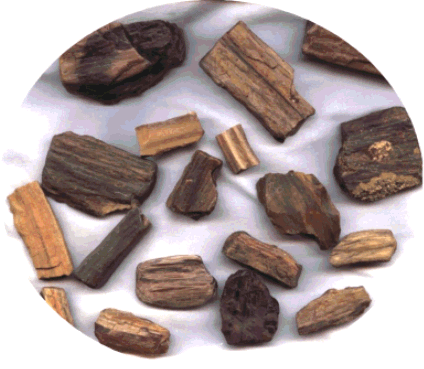
Petrified wood bits unpolished

“Petrified pieces of my heart.” Thank you, Mahmoud Darwish, for words that still move me to tears and help me better understand your exile and the importance of keeping lost memories alive.

In the opening pages of his Journal of an Ordinary Grief, Mahmoud Darwish writes these haunting words: Read the rest of this entry »

My heart still pounds | Part 3 of 3

What happened next
When I finished reading my statement, I felt exposed, apprehensive, and relieved that I’d finally put my thoughts together and said them out loud. Read the rest of this entry »

About You and Human Trafficking | Truth #3 of 3

Truth #3 – Ultimately, the battle against human trafficking is God’s battle, not ours.
This may sound easy, yet it’s precisely where I find myself struggling to stay on track.  Here are three things I sometimes forget.

First, I can’t expect God to launch a one-way God campaign against human trafficking.
True, it’s God’s battle, not ours.  But think about God, Moses and the Hebrew slaves.  Deliverance from slavery didn’t happen until Moses and the Hebrew slaves did their part.  The table was set, but the Hebrew slaves and Moses had to get moving. Read the rest of this entry »

day breaks

P1050091

day breaks sun rises

offers light energy

hearkens toward sundown Read the rest of this entry »