Telling the Truth

connecting the dots of my life

Tag: Vulnerability

An aching void

An aching void
stretches the length of a canyon
through my heart

What would it mean
to inhabit this land
waiting breathless
to learn its fate?

Bones of natives
and explorers
lie dormant
beneath
dead dreams
and living nightmares

Who are the settlers of today –
willing to inhabit the aching truth
of our collective past?

Truth about this country lies in yesterday’s buried news–told and untold. As a nation, we didn’t get here because of an ‘accident’ of history. We got here on the backs, shoulders, hopes, dreams, half-truths, lies and ignored truths of generations before us.

I’m grateful for the true settlers of today–courageous children, women and men unwilling to settle for half-truths, lies or apathy.

I’m also grateful for the weekend. Not as a diversion, but as an opportunity to focus on Sabbath rest. I don’t inhabit this land. I inhabit a tiny corner  of this world God created for sheer love of beauty. This Sabbath I want to rest in some of God’s beauty and truth.

© Elouise Renich Fraser, 25 August 2017
Response to WordPress Daily Prompt: Inhabit

A Gift from Maya Angelou

This morning I woke up with one of Maya Angelou’s poems on my mind. She wrote it for Bill Clinton’s presidential inauguration in 1993. She could have written it for today. It’s nearly 6 minutes long, well worth every second. There’s a link below to a printed version of the entire poem.

Why this poem? Because of the last lines. They grabbed my gut when I first heard them. Her words took me back just two years earlier. We were deep into planned conversations at the seminary where I was then on the faculty. In addition to Rodney King being on our minds, we’d had our own share of distressing racially charged incidents. Feelings were running high.

We were placed into small groups and given a set of questions to guide conversation. We met several times in mixed groups, with student, staff and faculty involvement throughout.

I’ll never forget a black student’s comments to me. I’d asked for examples of times when black students felt ignored, unwelcome or uncomfortable. At that time the seminary had at least 35% black African-American students. His response stunned me.

He said that when he passed me in the hallways I never looked him in the eye or greeted him. It didn’t matter where I was going or what I was doing. It didn’t matter that I’d never had him in a class. He felt unwelcome and unacknowledged as a human being.

He wasn’t angry. He felt offended, and put on guard. Not looking him in the eye, not even saying ‘Good Morning’ or ‘How’s it  going today?’ was, for him, a signal that he didn’t count in my world. Or worse, I thought he wasn’t worth getting to know.

Such a ‘simple’ thing. It was hard for me to hear, yet right on the money. I agreed to try this out for several days. Not just with him, but with other students as well.

The first few days were tough. I discovered I was especially reluctant to greet male students of any color. A sign of fear, especially around black men, and fear of sending mixed messages or worse. At the same time, it was a lesson I’ve never forgotten.

Here’s the very last stanza of Maya Angelou’s poem, “On the Pulse of Morning.” You can see why it caught my heart.

Here on the pulse of this new day
You may have the grace to look up and out
And into your sister’s eyes, into
Your brother’s face, your country
And say simply
Very simply
With hope
Good morning.

© Elouise Renich Fraser, 24 August 2017
Video of live reading found on YouTube

a pretty sure life

The rights and responsibilities
Of a pretty sure life
Hang weightless around her neck

She glides fairly easily
From one scene into the next
Wearing privilege on her skin

Without effort she blends in
Sometimes anxious but rarely for her life
Mature, sweet and polite she passes easily

A charming married woman with children
She meets the gold standard
Against which womanhood is weighed

No need to check her credentials
Her language or demeanor
No need to run a background check

She’s one of us
Sometimes unruly and annoying
Yet harmless
Because her heart beats white

I’ve been the beneficiary of many opportunities. Not strictly because of who I am, but because I’m a white woman. And because I’m not a rabble-rouser or revolutionary. I’m just a steady, dependable, meticulous, relationally gifted white woman who gets along with just about everyone. What more is there?

I don’t regret the opportunity to be part of an academic faculty and administration. I do, however, regret how oblivious I was to my white privilege even though I was part of an unusually diverse community of students, staff and faculty. Only with the Rodney King event and its aftermath at our seminary did I begin to scratch the surface of my white privilege.

I’m reminded daily of how easily our country ignores, suppresses and tries to bury our history. Mr. Trump has made visible what’s been there all along. No secrets here. Just inconvenient truth, and an opportunity to seize the moment.

My heart beats white. I’m still unpacking what this means for me.

Thanks for listening!
Elouise 

© Elouise Renich Fraser, 23 August 2017
Response to WordPress Daily Prompt: Visceral

restless energy

restless energy churns
from here to nowhere
searching for answers
without clear questions

Loneliness has been a companion ever since I was a child. Most days it doesn’t come sneaking out of nowhere to grab me. Today was an exception.

Memories from my past haunted me, especially memories about my spiritual formation. Not because of what I did or didn’t do, but because of things done to me, whether knowingly or unknowingly. I felt old, lonely and unprepared for what might be coming in the future. And whether D would be there for me.

We’ve just returned from afternoon tea and conversation with our next-door neighbors. So right now I’ve put aside my memories and my restless search for clarity and reassurance. Instead, I’m going for a walk outside. In the company of trees, grass, birdsong, cicadas, dog-walking neighbors, and the setting sun.

© Elouise Renich Fraser, 21 August 2017
Photo found on Pixabay.com

Response to WordPress Daily Prompt: Lurch

beggars all

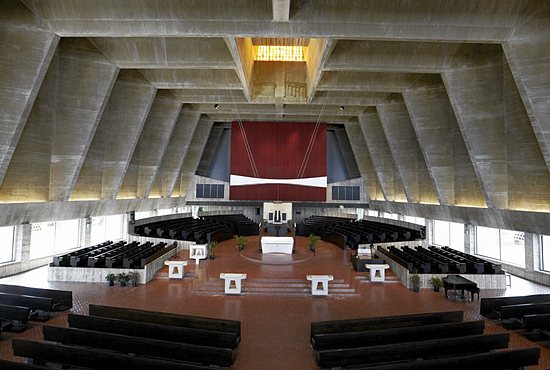
St. John's Abbey Church Interior

feet shuffle
down multiple aisles
approach the altar
sacraments of life
and death remembered

the sound of shoes
resonates against concrete
moves us to receive
hope for life and death
a crumb and a drop
spiritual food for body and soul

It’s 1980-something. I’m sitting in a long pew just beneath the balcony in St. John’s Abbey Church. The sanctuary is full of visitors, members, and local residents of Collegeville, Minnesota. We’ve begun moving forward to multiple stations where we’ll receive the sacraments. This is an ecumenical Eucharist; all are welcome.

It isn’t far to the stations set up near the center of the sanctuary. Architect Marcel Breuer collaborated with Benedictine monks to design this space. They ensured no one would be more than 85 feet from the altar. They also excluded columns, drapes and sound baffles.

No ecumenical Eucharist has moved me to tears as this did. It was the sound. It wasn’t the readings or the homily, or even the hymns. It was the inescapable sound of feet shuffling along the concrete. Beggars all, slowly making our way forward and then back to our seats. Like the thief on the cross. The one who didn’t stay sitting in his seat, but got up and led the first procession to the cross on which Jesus lived and died for us.

***
I first posted this on 30 September 2015. Yesterday I noticed someone had read it. So I checked it out.

I couldn’t help making a connection with recent events here in the USA. No one event captures everything. Instead we’re faced daily with more evidence that things fall apart, and that nothing we do can put them back together.

Yet we have every reason to hope. Not because we’re people of good will, love everyone, exercise deeds of kindness and mercy, or anything else we might find praiseworthy. Rather, it’s because of what God offers us through Jesus Christ.

All we need to do is get up out of our seats and get in line behind the thief on the cross. Offering ourselves just as we are, and counting only on God’s great mercy.

Praying you find rest for whatever is wearying you this Sabbath.
Elouise

© Elouise Renich Fraser, 19 August 2017
Photo found at thecatholicspirit.com

sequestered spaces

We retreat into sequestered spaces
somewhere on the boundary
of lived reality and death

Inexpressible loneliness
greets and enfolds us in grief
pierced raw by sorrows

Death of a child, a spouse, a friend, a stranger
Declining trust and good will
Specter of lost leaders and followers

Inexpressible anguish
stalks this land of promised opportunity
with freedom and justice for all

***

© Elouise Renich Fraser, 18 Aug 2017
Image found at chicagotonight.wttw.com
Response to WordPress Daily Prompt: Solitary

White Privilege Unfurled

On the day I was born, I received unearned privileges not available to everyone. Equally true, my life has been difficult because of unearned privileges available to men but not to me.

I was born White and Female. This complicates everything: gender and race; gender and politics; gender and academia; gender and the church; gender and role expectations; gender and power; gender and social events. Sometimes I’m welcomed with open arms even though I often experience something less than full welcome into the fold of privilege.

I’ve spent a lot of time thinking about white male privilege. I’ve spent considerably less time thinking about my white privilege. It’s easy to say I was born white, so it isn’t my fault. Which, of course, it is not.

Yet I know I’ve been the recipient of privileges friends and strangers of color do not receive. Many privileges are invisible to me. They’re the climate in which I live. I don’t need to think about them when I get up in the morning, or when I appear in a check-out line. More to the point, I count on them daily.

Today the USA is roiling, internally and externally, from a wound that has festered from the beginning. The assumption and reality of white privilege.

Here’s what I’m doing to clarify for myself what my white privilege looks like. Not yours. For me, this includes awareness of male privilege. Sometimes white male privilege only; sometimes all males.

For starters, I’ve located a website offering free material as well as formal leadership training (not free). I found two downloadable papers that will help me personally. Not simply with self-understanding, but with ideas about how I might change my daily habits as well as personal assumptions and goals.

Dr. Peggy McIntosh is the author of the papers and founder of The National SEED Project. In each paper she describes unpacking her own privilege. The papers include end notes in which she clarifies issues that arise when people begin to talk about privilege.

If you’re interested in knowing more, here are links to the website and two free downloadable papers.

Happy reading!
Elouise 

© Elouise Renich Fraser, 17 August 2017
Response to WordPress Daily Prompt: Unfurl

An epidemic of unforgiveness?

A few months ago I posted a series on forgiving my Dad, The Shape of Forgiveness. Since then, this question has been on my mind: Are we, here in the USA, caught in an epidemic of unforgiveness for which we have no remedy?

In the last post of the series I wrote this:

God forgives each of us daily. This is an act of stunning creation, not just for us individually, but for the families and communities in which we live. I want to be part of this ongoing spirit of forgiveness because I want to be part of God’s creative act, not part of the destructive problem.

Yet sometimes I hear or think words that seem to shut the door on a creative tomorrow: I’ll never forgive him – her – them!

Are we locked into a pattern that undercuts creative endeavors to find common ground, much less forgiveness?

I’m not looking for acres and acres of common ground. Right now I’d settle for a tiny patch anywhere in which we could safely listen and speak about our anguish. Perhaps we would begin finding ways to heal, ways to know each other and ourselves differently and better.

More recently, I’ve begun thinking about my experience in 12-step programs. It wasn’t indoctrination. It was a carefully sequenced program that helped me discover how to deal with myself first. My life had become unmanageable.

Twelve-step programs taught me to let things be so I could discover a better way. I wasn’t in charge. My higher power was. I didn’t have to slam doors or flounce out of the room in self-righteous indignation. Or solve everyone else’s problems. Or prop up the self-defeating behavior of others. Or defend my behavior and condemn others.

Instead, I learned to find safe people, talk with them about things that troubled me, and explore ways to change self-defeating habits. Slowly, I began to join the human race. I stopped standing on the sidelines trapped in patterns of harsh judgment of others and of myself.

How about a Citizens Anonymous program for recovering citizens and friends of citizens? A program that would help us put down our addictive bottles of news headlines, gossip, outrage, harsh judgment, denial, diversions, taunting, and other ways we sooth ourselves when we’re feeling out of control. Maybe together we could find small patches of common ground and nurture something new.

Just a thought. Or maybe this is already happening somewhere? If so, I’d love to hear about it.

Thanks for listening.
Elouise ♥ 

© Elouise Renich Fraser, 14 August 2017
Image found at callofthevedas.com

I wonder if when Years have piled —

I don’t wear a crucifix around my neck, yet I find myself in the company of those who, like Emily Dickinson, can’t escape Grief. It doesn’t matter how many years have lapsed. My comments follow her poem.

I wonder if when Years have piled –
Some Thousands – on the Harm –
That hurt them early – such a lapse
Could give them any Balm –

Or would they go on aching still
Through Centuries of Nerve –
Enlightened to a larger Pain –
In Contrast with the Love –

The Grieved – are many – I am told –
There is the various Cause –
Death – is but one –and comes but once –
And only nails the eyes –

There’s Grief of Want – and Grief of Cold –
A sort they call “Despair’ –
There’s Banishment from native Eyes –
In sight of Native Air –

And though I may not guess the kind –
Correctly – yet to me
A piercing Comfort it affords
In passing Calvary –

To note the fashions – of the Cross –
And how they’re mostly worn –
Still fascinated to presume
That Some – are like My Own –

c. 1862

Emily Dickinson Poems, Edited by Brenda Hillman
Shambhala Pocket Classics, Shambhala 1995

Emily begins by wondering whether Harm that has Years “piled on” it might be like a Balm. Perhaps like piling ice or heat on an injury? Some would say time heals all wounds.

Does it? Perhaps the passing of Time simply multiplies the Pain of this Harm. Especially in contrast to Love lost, withheld or betrayed.

Emily does a brief roll call of various kinds of Grief. She names Death first, yet doesn’t dwell on it since once it arrives, it simply “nails the eyes” shut. She may have in mind the person who dies, not the survivors.

She then points to other forms of Grief. They’re examples of the barely recognized yet obvious Grief humans carry every day. She names Grief of Want, of Cold, and of Despair. This is the kind of Grief that doesn’t nail the eyes shut. It’s the Grief of being invisible, shunned, ignored, banished from sight in full view of others. Not allowed to breathe air that supposedly belongs to everyone. Native Air that makes one a ‘real’ person.

In the last two stanzas, Emily imagines Grief as a crucifix, a fashion item. Something like a personal Calvary. She observes an assortment of styles and ways of wearing them.

I imagine some are barely obvious; others weigh the bearer down like a heavy wooden cross. Some are flaunted like medals of honor; others hidden beneath bravado or bullying. Yet each is real, whether acknowledged or not.

Emily finds ‘a piercing Comfort’ in her observations. Perhaps she isn’t as alone as she sometimes feels. Perhaps some Crosses are like her own.

When I was growing up, no one told me that grief could be an asset. It was something I would eventually get over. Not a strange gift that could connect me with others.

I don’t want to know everything about each person I meet. I do, however, need to take into account the reality of human grief. There’s nothing so isolating as having one’s grief overlooked or ignored. Or making it a personal problem to solve or get over–as quickly as possible.

Jesus bore our griefs and carried our sorrows. Surely as his followers we can do a bit of this for each other, if not for ourselves.

© Elouise Renich Fraser, 12 August 2017
Image found at wallcrossesandmore.com

The patient

The patient lies dying
Body wasting
Skin pale and taut
lethargic eyes stare
from hollowed out sockets
Faded remnants of life born in hope
disappear in deep shadows

A priest garbed in vestments
stands before a makeshift altar
Demeanor and voice concentrated
on the proper order of things
His hands grasp the sacrament of life
hanging heavy in this cramped space

A young altar boy looks on
Head and eyes slightly averted
Hands clasped close to his chest
Sad eyes try not to stare

Filtered through a small window
dying light descends into the room
touching the patient’s Madonna-like robe
with a gleaming halo of grace
This is somebody’s beloved child
Fragile and sick unto death
Beyond hope of survival
Now the center of attention
Seated in a chair of royal honor

Tender looks and hand of a caregiver
Rest lightly on the young child
A man sits in shadows
Body bent in despair
Head slumping on his hand
A small dog sits on his lap
Looking on with downcast eyes
The priest’s voice continues

©Elouise Renich Fraser, 11 August 2017
Painting found at Wickipedia
1888 Painting by Venezuelan artist, Cristóbal Rojas (1857-1890)
Rojas died of tuberculosis about 5 weeks before his 33rd birthday.