Early Marriage | Part 3
by Elouise
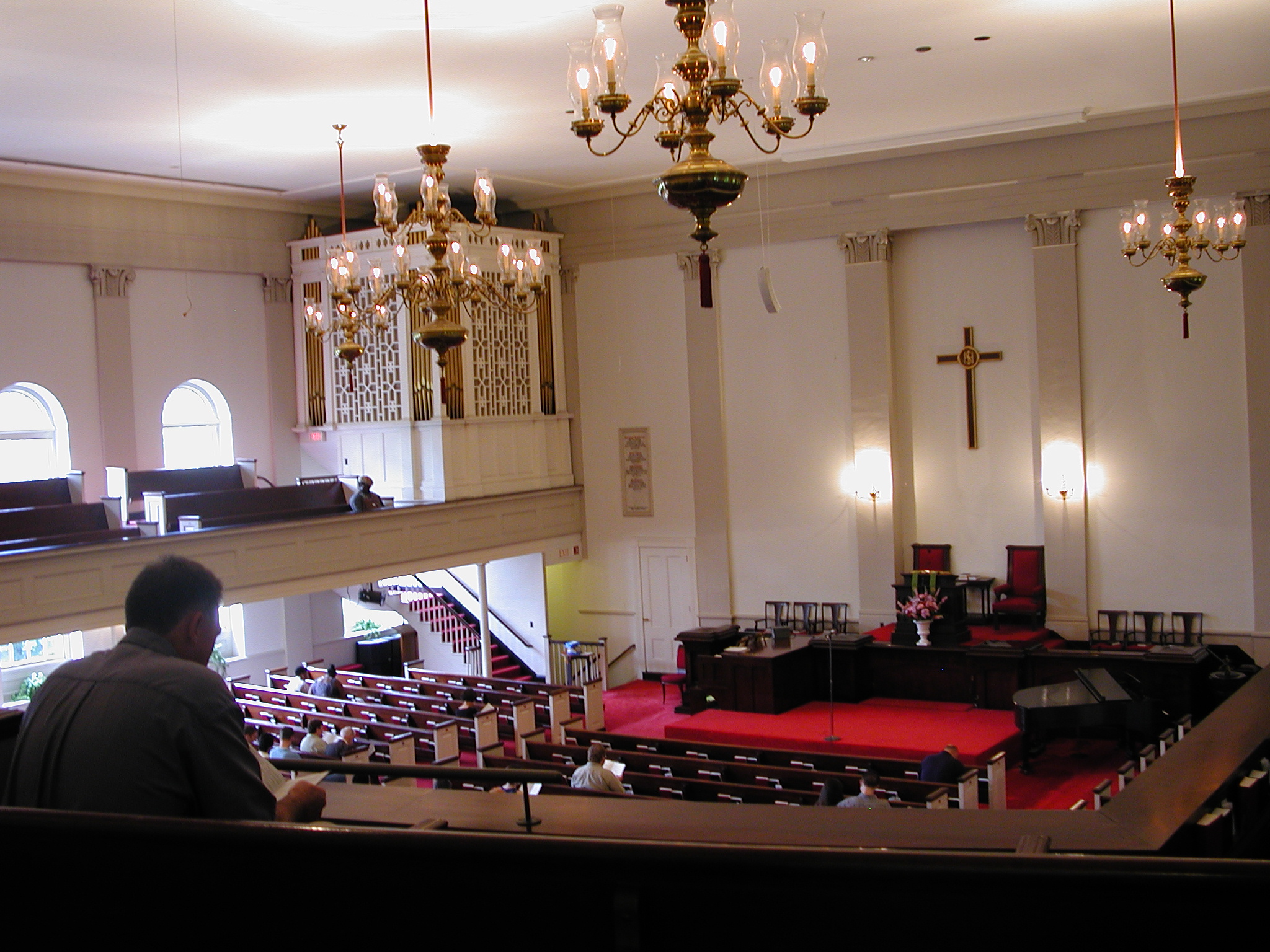
Park Street Church Sanctuary, Summer 2003
It’s Fall 1965. I’m 22 years old, just barely married. Whatever ‘women’s rights’ means, it hasn’t reached me yet. The word ‘feminism’ is unknown in my small circles. As far as I know, the term ‘sexism’ has yet to be invented.
The biggest civil rights issue I’m aware of is racism. Stories about race relations are in the daily news. If women are claiming their civil rights, I haven’t heard about it yet.
Right now, I’m back in the young adult group at Park Street Church, where I seem to be Mrs. D, a woman without a name or clear identity.
At home, in church and at the Bible college, I was taught to be a ‘lady in waiting.’ I was promised virtual heaven on earth if I waited for marriage and then waited on my husband in marriage. And what does heaven on earth look like? I don’t know. My mother didn’t live in heaven on earth. Nor did I as a child and young person.
I do my best to follow the rules, spoken and unspoken. This means maintaining a submissive, docile, cheerful, acquiescent, quiet and almost invisible presence. Especially at church, it seems.
When I’m visible, it’s to support my husband. It’s not about being self-seeking, brassy, strident, pushy or demanding. I do my best. On the inside, I sometimes feel like Nobody.
I don’t want to be a star. I just want to be a contributor. Part of the conversation. The way I am at home when D and I are talking together.
It occurs to me that I may need to be more assertive. I’m tired of waiting. I see that D’s attempts to include me in lively conversations at church aren’t working.
My solution? I work hard to think of a contribution I might make to this conversation and then wait for the right moment to risk calling awkward attention to myself by asking a question or making a comment that others may not understand because even I don’t always understand where I’m coming from or why what I’m saying or asking is so important to me.
My attempts feel weak. People seem interested for a bit, but they don’t know what to do with what I just said or asked. I become aware that I’m ‘different.’ I don’t think the way they seem to. Logically, using data, big words and very few (if any) personal examples.
Back home I talk about this with D, my one true ally. To his great credit, he understands with his mind (if not his experience) what I’m trying to articulate.
For a few months I watch some of my tentative questions or comments during Bible study being picked up, repeated by others, and affirmed as important contributions to the discussion. My resentment grows, especially when D does this, and my question or comment gets branded as D’s contribution.
In late Spring 1966, the pastor for young adults announces a summer Bible study. He’s in the planning process, and invites others to join him. D immediately says he’d like to be part of the group.
I mull this over and finally make a move on my own behalf. I want to be part of the planning group, too. I tell D what I’m thinking. I ask him if he thinks this would be OK.
D’s response is true to form. Simple, straightforward, no fuss: Why don’t you ask? So I did.
Not only was I on the planning committee of three (pastor, D and me), the pastor suggested we team-teach the Bible study for university students. So we did. All three of us. Now it’s a wonderful memory.
I never dreamed it would take this much energy to be a married woman. This wasn’t what I expected.
To be continued….
© Elouise Renich Fraser, 27 April 2015
Photo credit: DAFraser, Summer 2003
 Telling the Truth
This is a very interesting reflection on what we would call sexism. I wonder how much of what we experience as ‘typecasting’ and ‘exclusion’ might be our own minds jumping to conclusions, finding examples to justify what we believe or suspect about ourselves, what we fear.
You may have been unusual in your circles, the only woman who took an interest, but does that mean you were excluded, or were people just a bit dazed when you came along, and took a while to get used to a woman asking questions? Maybe there was not hostility, as much as incomprehension.
That has been my experience, anyway. Sure, there are some diehards in every crowd, but when I care to examine my conclusions about being left out, actually, it is as much about me excluding myself – by being too self effacing, by acting in role, and so forth – that it is about actively being excluded. I’m still unsure where I would draw the line through this, but it helps me to notice that I have too often been a doormat or acted through assumptions that are only in my head.
Bless you, and excuse me for this lengthy peroration! XXX 😀
LikeLiked by 1 person
Dear Fran,
No apologies needed! I like your “lengthy peroration”!
As for sexism, I believe it’s been around for ages. In that sense, it’s not new or strange. Yet each woman’s experience is different. At least that’s my observation. And each woman has to sort out what’s actually happening in her as well as around her. For me, given the trauma of my childhood and youth, I was doing more than acting out a role I thought I should play. I was trying to avoid punishment by the men who, given my background, had the power to make or break me. I valued their opinions and affirmation more than I valued my instincts. I had to learn to value my instincts and ‘not care’ what others thought/think about me. But that was a very long time coming, and took great effort.
I agree that women need to stop excluding themselves. I also know it takes great effort for some of us to believe we’ll survive the kickback. Not just from others, but from ourselves. Some don’t survive it.
In addition, I agree that we often fear the worst and project it out onto others. Bigtime. For me, this, too, is difficult if not impossible to overcome without safe, wise allies who stand by me no matter what happens. I didn’t have these allies or learn to be this for other women until I began working on my own ‘stuff’ in my mid-40s. As I look back to the 1960s, I was still a ‘baby.’ Ill-prepared for real life–with the one saving grace that I had marketable skills and the ability to get along with just about anyone! What was ill-prepared was my internal self. The one I (and now D) have to live with every day of the year! Marriage was not made easier because of this. I can smile now, but back then….
Elouise 🙂
LikeLike
I’m not sure this just a sexism thing, but at least partly related to our personality type. You have admitted to being somewhat introverted. I am also an introvert, and have always had trouble holding my own in group discussion. Often, it has taken some time to consider the opinions stated by others, and by the time I form a comment or response, the discussion has moved on and so I let it go. Or I just don’t want to stand out. I’m doing better in my old age, but it is still a problem. Fortunately, I can take my time to form a response to your posts.
LikeLiked by 1 person
Dear Waldo,
I’m right there with you on the introvert part. It complicates everything. In my experience it’s a mixture of habits and assumptions that make it difficult for women plus my introversion–shared with men who also have difficulty in conversation. Those who don’t (men like David, for example) aren’t just introverted. They’re also logical, data-driven thinkers–more easily recognized and valued in academia. Even sought out for their contributions.
Your last line made me laugh! I also do much better with written communication–unless it’s one on one and I know the person with whom I’m talking. I also relate to taking time to form opinions. In fact, I do better with that when I can talk it out or write it out. Unfortunately, some people don’t really want to hear me talk it out! Too bad for them, right? 🙂
Elouise
LikeLike
Right, yes indeed!
LikeLiked by 1 person