Kinderdijk | Viking Cruise
by Elouise
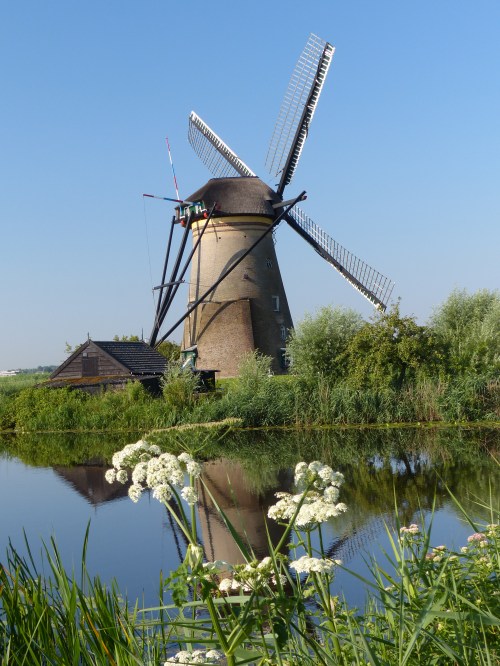
What’s missing from this picture? Wind! Not a breath of it while we were there. Still, the windmills were spectacular.
We sailed all night from Amsterdam, and arrived midmorning at Kinderdijk, a UNESCO World Heritage site. It was constructed as an outdoor museum, with examples of old windmills. Though they aren’t now used to drain water from low-lying land, they are functional. Citizens apply to live in them, with or without children. It’s considered an honor, and requires daily attention to maintenance and to changing winds to keep super-heavy windmill blades in motion.
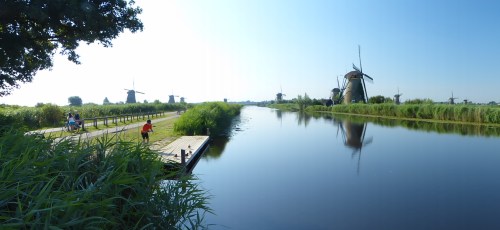
Kinderdijk means “children’s dike.” According to legend, it’s all about a cat, a cradle, and a baby who survived a storm thanks to a dike and a cat’s faithful instincts! The site includes a system of 19 windmills and was built around 1740. This is the largest concentration of windmills in the Netherlands today.
It’s 1421. A humongous storm and flood have subsided. Only one polder in the area isn’t flooded. A polder is a piece of low-lying land reclaimed from the river or sea via pumping the water up, out beyond dikes.
A rescuer goes out, walking along the dike to see what might be salvaged. There floating on the water is a wooden cradle! As it gets closer, he sees a cat in the cradle jumping back and forth, keeping it afloat and dry. Then, when it’s closer to the dike, he sees a baby sleeping in the cradle. A survivor, thanks to kitty’s great balancing act!
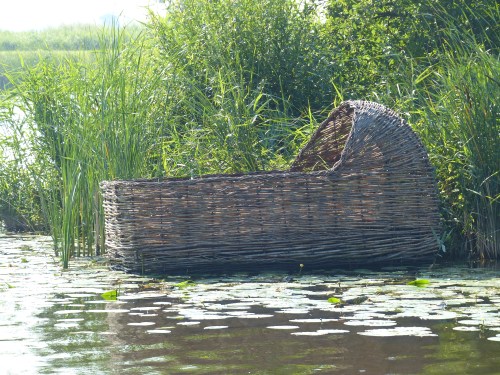
This story is celebrated in a folktale, “The Cat and the Cradle.” The cradle below commemorates kitty and baby’s successful cruise.
So how about a look at one windmill that allows us to get up close and personal?
Like most windmills on this site, it’s a grondzeiler, or ‘ground sail windmill,’
so called because the sails almost touch the ground as they turn.
First, a view from the outside, looking up.
Can’t help noticing how huge these things are
and how much human-power it takes to move the sails
when the wind changes direction.

Now for the interior of this ‘house.’
Don’t touch anything! Keep moving single file,
keep your head down, and be sure your walky-talky is turned on!
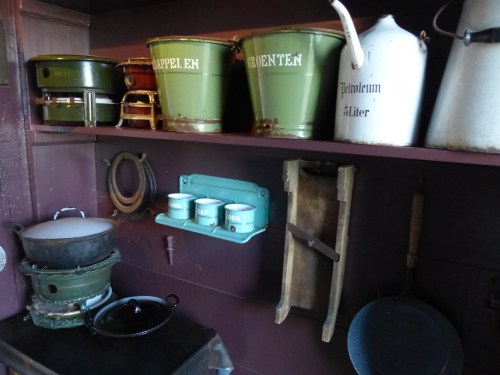
First, the main room. This is it, for all practical purposes.
Tiny, cramped and functional,
with touches of charm here and there.

I was told the short ‘double’ bed is also the lavatory.
Chamber pot conveniently located at the foot of the bed.
Out of sight.
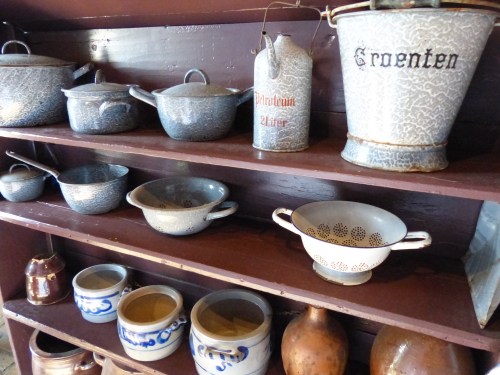

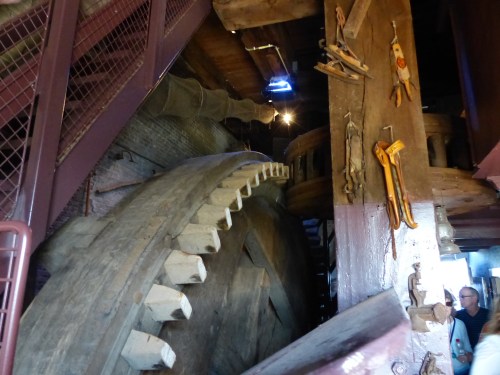
On our way out, we pass by some of the internal workings,
and get a welcome glimpse out the back window.

One more look up from the back of the windmill —

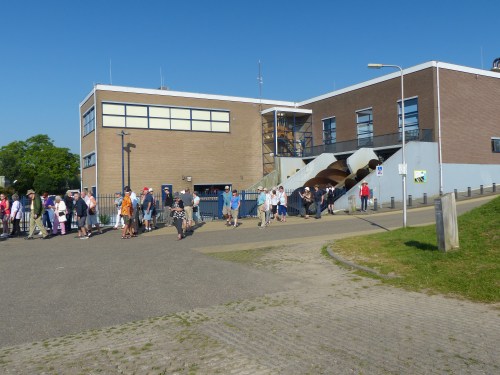
And a quick look at what it takes to drain the polder today.
Stay tuned for more!
© Elouise Renich Fraser, 28 February 2017
Photo credit: DAFraser, July 2016, Kinderdijk, The Netherlands
 Telling the Truth
So this is an earlier era’s version of the “tiny house”! I wouldn’t mind a tiny house – but having visited a working windmill (in rural France), where they grind grain, the dust quotient, along with the noise of the moving blades would be tough to live with, I think! Thanks for the pictures and the commentary, Elouise – a Tuesday delight! 🙂
LikeLiked by 1 person
The bed didn’t look long enough even for me! Thanks for this great comment, Debbie. So glad you enjoyed the post! 😊
LikeLike
this is so very cool, I’ve never been up close and personal except the turbines in NY and they pale in comparison to those, I could be an awesome writer in those tiny confines indeed, peace and a view 🙂
LikeLiked by 1 person
Yes indeed! Everything you could possibly need all right there close at hand! 😊
LikeLiked by 1 person
interesting
LikeLiked by 1 person
Glad you liked it!
LikeLiked by 1 person
Wonderful posts, thank you! 😀
LikeLiked by 1 person
You’re welcome! 🙂
LikeLike
A hardy race, the Dutch, great seamen and explorers (sort of)
LikeLiked by 1 person
Yes–certainly better at it than I would be! 🙂
LikeLiked by 1 person
They are/were second only to the English; We finished up beating them thoroughly 😈
LikeLiked by 1 person
🙂
LikeLike
Seems to meet with your approval! 🙂
LikeLiked by 1 person
Oh yes, William of Orange helped get rid of that Papist, James Stuart/Stewart
LikeLiked by 1 person