Defending My Space
by Elouise
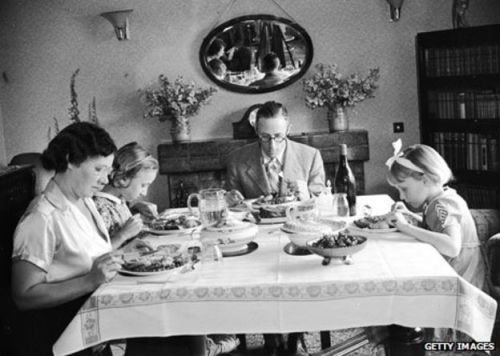
I’m about eight years old. I’m sitting at the dinner table, just around the corner from my father. The table is set, the food is spread before us, and we’re all in our seats waiting to begin. We haven’t yet asked the blessing. I’m playing with my dinner fork, just to the left of my plate. I’ve moved it a few inches away from my plate.
My father’s voice interrupts me. “Elouise, put the fork back where it belongs.”
I move it to the right, in the direction of my plate. “Elouise, put the fork back where it belongs.”
I move it slightly closer. My father’s voice remains firm and controlled. “Elouise, put the fork back where it belongs.”
By now my sisters are watching to see what will become of me. My mother is silent. This has become an event. Slowly I raise my hand to my fork and move it ever so slightly closer to my plate.
My father persists. So do I. Many repetitions later he’s satisfied; the fork has been returned to its proper place.
He proceeds with the blessing. He doesn’t know what I know: the fork is ever so slightly to the left of its proper place.
My father’s mission as a parent was to train us to keep the rules. My mission as his child was to break and keep the rules simultaneously.
Back then, perseverance meant getting through another day, using whatever survival skills lay close at hand.
If my father was persistent, I would be more persistent. If outward rebellions were too costly, I would invent creatively invisible yet superbly effective inward rebellions. If I was ordered to sit down and stop talking, I could continue standing and talking on the inside for as long as it took to comfort myself.
Indeed, this was the better way. In the private spaces of my mind no one could put me down, refuse to listen to me or try to break my will. In a family system intent on turning out obedient daughters, I survived by being secretly disobedient.
This memory from the 1950s, published nearly 20 years ago, is as vivid today as it was then.
The territory I defended was interior. I applaud the little girl who figured out how to do this. Nonetheless, my efforts were costly. They required constant vigilance, no matter where I was.
Abuse of power destroys safe space. It expects and demands behaviors, words, looks on faces, subtle and open signs of unquestioning and subservient submission.
What does it take to create and maintain safe space? Not just in our marriages and families, but in neighborhoods, nations, churches and schools? And how does my personal history connect with the racial history of the USA?
© Elouise Renich Fraser, 29 March 2017
Photo of 1938 family dinner found at bbc.com
Story excerpted from my book, Confessions of a Beginning Theologian (InterVarsity Press 1998)
Response to WordPress Daily Prompt: Territory
 Telling the Truth
Elouise, I am exhausted just reading this. It is hard to comprehend how much of an impact across the entirety of your life, and that of your sisters, this sort of thing must have had.
LikeLiked by 1 person
Your choice of words is appropriate. Exhausted/exhausting. I can only speak for myself as the eldest of 4 daughters. The impact across my life has become painfully visible only in my later adult years. I don’t know where I found the energy to maintain the good girl I was. And even so….not ever good enough for my father. I’m so grateful to have lived this long, with many professional and collegial friends who’ve walked with me in the last 30 years. I wouldn’t take anything for the adventure! Priceless. And sobering. Thanks, Meg.
LikeLike
Oh Elouise…what a profound question you ask at the end! I will be praying with the idea…the first thing that came to my mind is how we white skinned folks are like your dad, asking/sometimes demanding that our sisters and brothers with brown or black skin be unswervingly obedient to our “rules” (customs, ways/expectations)….indeed. what will it take for us to actively encourage/allow our friends of color to find safe space with us? One relationship at a time, in Christ? All I know is that I am being transformed by the Spirit in relationship to others who are different from me, learning more about God’s inclusive, all-pervasive love that calls – beckons us into community, starting with the communion of the Trinity. Thanks for sharing your memory and your ponderings.
LikeLiked by 1 person
Nancy, Thank you for your thoughtful comment. The connections you suggest ring true to my experience. I’m thinking about how to frame this as the white girl/woman I was and have become. It’s clear we can’t solve this on our own. Or from a position that simply repeats old patterns of overt and covert behaviors and attitudes, whether we’re aware of them or not. 💜
LikeLike
Hi Elouise
I read your post – incredible bullying! (and then watched Vitameatavegamin) – and am just pondering what you all missed, by insisting that the vital, spontaneous, sassy child that you were should be squashed out of sight. What is so shameful about children, after all? They know nothing about shame, unless we teach them.
There was a comment on a film I was watching last night – I’ll send you the link if you’re interested – from a guy who said that conventional schooling is there to educate its young to give a conditioned response – which must be hard to do, because it takes 12 years! – so we are not naturally inclined to obedience – with its undertone of threat – so much as to being loving and kind, which is how we are all born.
Which makes me wonder, just how much cruelty a child must have to absorb and endure, to become cruel.
Bless you, always. (((♥)))
LikeLiked by 1 person
Fran, I love your question at the end. I don’t know about today’s generation of children. I’d like to believe we’ve learned a thing or two about recognizing and supporting the potential of every child. Yet abuse of power, whether overt or covert, keeps cropping up. Replicating itself in new incarnations. I would love to have the link you mention. You can post it here or send it via email. Thanks! 😊💕
LikeLiked by 1 person
see, inside little E you were so very strong, knowing that you had to be true to you even if it was internal. Kudos for the writing of this, made me feel so sad for you and the family and being raised into the mans need for control. An issue I have to this day, adamantly guarding my space always ❤
LikeLiked by 1 person
It’s so strange to look back and see what was happening. It seemed then that it was all about my father and me. As you say, it was ‘home’ schooling in how girls and women must live according to ‘the man’s need for control.’ Which, ironically, encouraged my own need for control just to survive. Little E is so glad Adult E lived long enough to catch on to all this and start sorting it out with safe people! 🙂
LikeLiked by 1 person
I think I disagree with M/s Fran Macilvey; how is your father bullying by requiring you to sit at table properly? It appears that she approves of children ruling the roost.
Surely it was his home, his table and his rules.Had you have done as he asked in the first place then this confrontation would not have occurred; would it?
Which then makes you responsible for his persistence in requiring you to comply with his initial request. You were being completely disobedient, and in front of your younger siblings. a fine example.
I encouraged our three children in every possible way, but at table my rules applied. They are perfectly mannered and follow ‘the rules of etiquette’ they could sit at table with the Queen and not be embarrassed, nor have to watch to see which article of cutlery was to be used.
When our meal was finished Sarah the eldest would say ” Please daddy, may I leave the table” and I’d reply “Thank you Sarah, yes you may leave the table” then it was Emma’s turn, followed by Nathan Sebastian. This was their mothers doing.
Had I have been your daddy, I would have been more insistent, but my way would have been just to sit there, saying nothing, just looking at you, and nobody would be doing anything, no talking or eating., and after a reasonable time you would have been excused from the table and the meal would have been continued without you.
I do believe at the time your father would have been hurt, more than you’ll ever know.
LikeLike
Hi, Brian. I appreciate your description of the way you carried out your duties as a father when at the dinner table. Unlike Fran and others, you haven’t had the benefit of reading from the beginning of my postings. I’ll include a couple of links at the bottom for you to read.
My father was a bully. His behavior fits the description of a bully: “a person who uses strength or power to harm or intimidate those who are weaker.” I don’t hate him. I feel unbearably sad, though, to have spent my life living with the outcomes of his behavior. All passed on to him, of course, by his own father’s bully behavior. Family legacies matter, not just to the first generation of adult children. Breaking the cycle is the work of a lifetime. I’m grateful for the women and men who have helped me deal with these realities. Without them I wouldn’t be the person I am today.
Here are the links:
LikeLike
I ticked all the likes but I did not like what I read. Your father was a complete hypocrite; bully fool and a liar.
It’s too easy to become a ‘pastor’ obviously, and seemingly one didn’t need to be very bright/smart, but needs to be cunning, able to interpret the so called scriptures and twist them to suit their own ends/purposes.
My mother was a bully!
LikeLiked by 1 person
Dear Brian, thanks for reading the posts. Being a pastor is an awesome, demanding challenge. Sadly, as in every other vocation, there are wounded children inside those clergy robes (whether the robes are visible or not).
Having taught and served as dean in a seminary for 28 years, I dealt with many courageous women and men who faced up to their wounds and began working with professionals to deal with them. Pastors, like any human being, come to work with wounds from their past, too often denied, repressed, or discounted by them or by others. They aren’t superhuman, and don’t deserve special treatment because they’re ordained.
Unfortunately, the children of pastors, or children with whom pastors or priests work, are sometimes their most vulnerable victims. Most often, they’re passing on what they received. I admire those who take the risk of seeking professional help, and letting that shape the nature of their work. Sadly, my father didn’t do that, and his children lived with the secret consequences of his own father’s violence toward him.
I agree with your observation regarding the use of Scripture for their own, often unacknowledged purposes. Denial is an extremely potent reality. Especially when it feels normal and righteous.
LikeLiked by 1 person
To use a Jane Austen expression, I was, it was assumed, destined for the church. I’m actually doing a post/essay/blog in a few parts, for the amusement of my followers XD, I will not post until they are all finished, I’ve only finished the first and half way through the second.
There is no excuse for bullying. My wife is an exceedingly strong person and she took the responsibility for the discipline, and never had to resort to corporal punishment, when she spoke it was law! XD
Hence the war office 😈
LikeLiked by 1 person
I await your posts with keen interest! WO sounds like a Wise Woman. 😊
LikeLiked by 1 person
Not really, but she is a good mother, she and her sister had to bring up their 3 brothers after her father died in tragic circumstances and her mother had to go to work to keep her 5 children, and had very long odd hours that the 2 girls were left at a relatively young age and had the younger boys to look after
LikeLiked by 1 person