Telling the Truth

connecting the dots of my life

no poems today

no poems today –
somewhere young children
cower and weep

fear and longing
hold their collective breath
waiting the verdict

And when the verdict is in, then what?
How do bodies and souls find their way
In a world that quickly forgets
Just what the commotion was all about

Are we ready for masses of victims
Supposedly set free by newsworthy justice
Yet marked indelibly by sordid daily injustices?

And what about today’s other children
Living in bubbles of make-believe normalcy
Inhaling lies about love as an
Overnight fling or great adventure?

Every 24 hours soul-breaking rites of passage
Leave bitter spirits and aching bodies behind

Who will pick up our broken pieces
And love them back to life?

© Elouise Renich Fraser, 26 January 2018
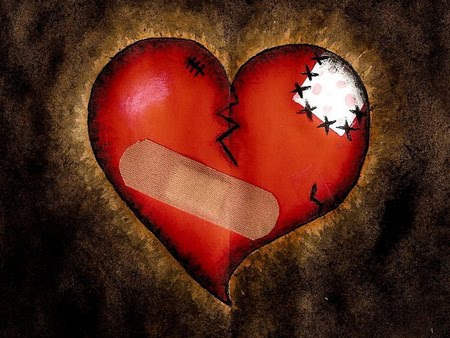
Image found at jewishcommunitywatch.org

raindrops

sparkling raindrops
fly headlong through sunlight —
cascade of diamonds

It happened so fast I almost missed it. Leafless trees shaking off fresh rain highlighted by a sudden burst of blazing sun that captured millions of diamonds flying through the air. Within seconds the sun had retreated behind gray storm clouds and everything looked as it was before. Wet.

It made my day. One of those sudden gifts, unanticipated, fleeting, and rare. Everything lined up just right, including my head turning to look out the window. Except for this. That’s not my photo above. It’s a substitute for the real thing stored in my memory.

© Elouise Renich Fraser, 25 January 2018
Photo found at staticflicker.com

buried

buried
beneath snow
life sleeps

Is there an angel in your life? Someone who was there for you at the very beginning when you were most vulnerable? Someone who gave you a gift you didn’t know you had until very late in life?

When I was born, my father had already been flat on his back for 8 months in a TB sanatorium. He came home weak and alive when I was 10 months old. If you’ve read my earlier posts, you’ll know my ordained clergy father was no angel in my life. For a quick summary, read Why I haven’t buried God.

When I was born, my mother was living with a young couple and their 8-year old daughter. Hence I lived the first 10 months of life surrounded by my mother and friends who thought I was God’s gift to each of them.

When my father came home from the sanatorium, things changed quickly. Dad was never one to take his duty lightly. It didn’t take long to change the atmosphere, beginning with a push and shove about whether Uncle Ed was my father or not. And, of course, who was now in charge of our little family. My mother or my father. I believe my mother lost dearly in that transaction. As did I.

Eight months after my father’s homecoming, we moved from Charlotte, North Carolina to Seattle, Washington. I took with me the seed of that elusive thing called resiliency. They say some children have it and some don’t.

In my case, I believe that seed was planted in me the first 10 months of my life. By my mother, Auntie Wyn and Uncle Ed, and their only child Grace. They loved and played with me, fed, encouraged and doted on me. I was the most beautiful baby in the entire world. And I got to hear my mother playing the piano, nurturing in me another invisible seed of resiliency.

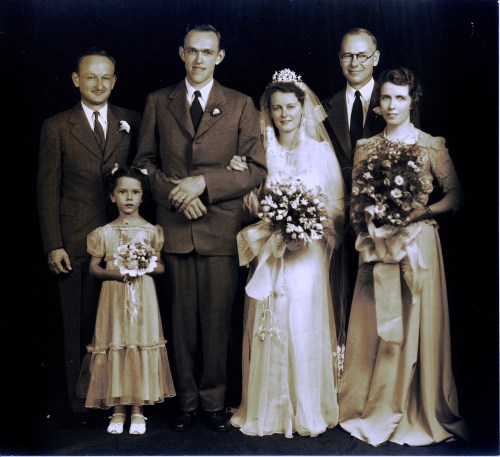
See the lovely photo at the top? All the important people (except me, of course) are there. My parents are already surrounded by my surrogate family: Auntie Wyn was mother’s maid of honor; Uncle Ed (with glasses) gave my mother away; Grace was my mother’s flower girl.

Perhaps the bond between my mother and me is stronger and deeper than I ever realized.

© Elouise Renich Fraser, 23 January 2018
Photo of my parents’ wedding in September 1942, Charlotte, North Carolina

feeling unnerved

a foot bridge beckons
park lights pierce dark midnight
the way ahead fades

***

Feeling unnerved tonight
wandering through my mind
not sure where I am
or what to do next

Life happens quickly
though it feels like slow motion
so little time to listen to myself
much less to You

It’s almost midnight now
and I’m still not sure where I am
or where I’m going

Would You be offended if I
just follow in Your footsteps
wide awake or stumbling
wondering Where and Why?

Many thanks to my blogging friend John for the photo at the top. It was taken in Caulfield Park at about midnight after a sweltering hot day in Melbourne, Australia. The ambiguity of the photo grabbed my attention, and John kindly agreed to let me use it for a poem not yet written.

John has followed my blog almost since its birth. You can check out the post about his midnight walk right here:

https://paolsoren.wordpress.com/2018/01/20/night-time-in-the-park/.

John’s posts are Australian to the core, full of entertaining, thought-provoking, irreverent, hilarious and enlightening insights. All dished up in his native tongue. I’ve told him at least a million times I wish I’d had him as a teacher. Somewhere along the line he got the gene. Now he’s retired, wandering around here and there with his camera, or pulling out old photos about the way things were when he too was very young.

© Elouise Renich Fraser, 23 January 2018
Photo taken by John (paolsoren) in Caulfield Park, Melbourne, Australia, January 2018

setting sun

setting sun
kisses cold western sky
clouds blush

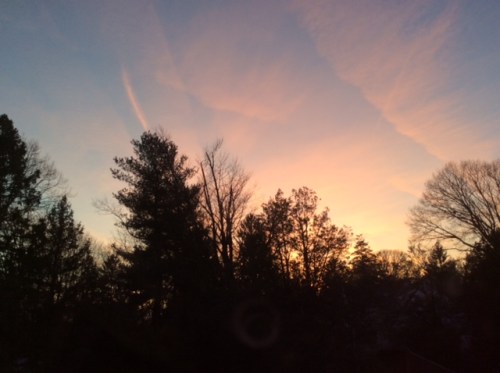
The magic lasted only seconds, and this photo captures but a reminder of what my eyes saw. And still I’m drawn to it. A magnificent flame-out at the end of the day.

I wonder, are we not meant to flame out in the last years or moments of our lives? I picture the human spirit about to set off into another world. Sometimes in dire circumstances, yet always still a living human being. Never without beauty even though our eyes may not know how to see it.

Do I know how to see beauty when the photo or the reflection isn’t beautiful by my standards? We seem to have become a race obsessed with beauty. Searching for it, measuring it, trashing it and moving on quickly if we don’t find it in the moment.

I’ve often felt disappointed about what I see in the mirror of my life. Not all of it, but significant chunks of it. These  days I’m beginning to see it differently. I see the reflection of a woman making her way slowly, yet surely, from one revelation about herself to another. The kind that often come at the end of the day. Beautiful to behold.

© Elouise Renich Fraser, 22 January 2018
Photo taken by me with my IPad, 21 January 2018

being at home

being at home
in her spacious small body
the caged bird sings

My life has felt unusually restricted this winter. It seems outrageous. Here I am, an adult woman with my working years behind me, and ‘nothing’ to do but record thoughts going through my mind.

I’ve almost finished my slow reading of Maya Angelou’s I Know Why the Caged Bird Sings. I’ve been on the lookout for times when the caged bird sings. Times when it seems there’s no way out. No way to reverse what’s happening. Until someone begins singing or writing or speaking, creating a different reality. Intangible yet real.

In addition, this morning I read the following lines from a favorite book on writing.

We can travel a long way and do many different things, but our deepest Happiness is not born from accumulating new experiences. It is born from letting go of whatever is unnecessary, and knowing ourselves to be always at home.

Sharon Salzburg, quoted in Gail Sher’s book, One Continuous Mistake: Four Noble Truths for Writers, p. 36, Penguin Group 1999

As Gail Sher puts it, “Home is where writing happens. The writer’s desk is a miniature world. Self-contained. Hopefully quiet. Anywhere else is somewhere else.”

It’s easy to write about somewhere else, or wish I were somewhere else. In someone else’s body or circumstances. I’m as prone to wandering as anyone. Besides, I think I’ve already had more than enough to say about myself.

Yet here I am today, feeling a tug to say more. In particular, more about my relationships with men. And saying it in a way that sets me free. The way Maya Angelou’s words about her life set her free.

Though my life might seem tame when compared with others, I used to think I would rather die than talk about my history with men. This past week I pulled out notes I made years ago that will help me do this. It’s important, because I believe my history with men was driven by things I was looking for. Not by something inherently wrong with me.

In the end, I want what sometimes has felt like a cage to be part of my home. The platform from which I sing.

© Elouise Renich Fraser, 20 January 2018
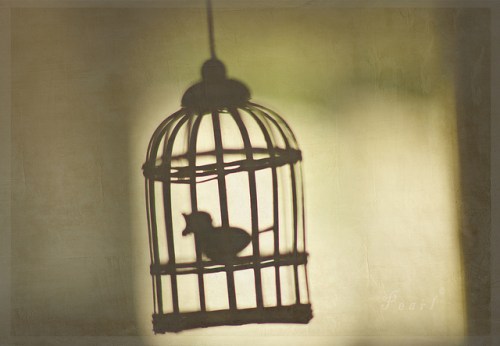
Image found at asfmtech.org

chilled to the bone

chilled to the bone
night’s deep silence descends
winter drifts through cracks

***

Disconnected from feelings
Numb and disbelieving
I want to write
So many unknowns
So much at stake
So little time left
Will I or Won’t I?
Sooner or Later?
Is Never still an option?

This week brought unwelcome news in a couple of areas. No catastrophic accidents. Just the knowledge of things I didn’t want to hear. About a friend and about my health.

Yesterday we drove through Valley Forge National Historic Park. Outdoor temperatures were subfreezing. Snow was on the ground, covering a thin layer of frozen sleet. We saw one brave soul walking his beautiful dog along one of the paths that circle and cut through Valley Forge. Everyone else was in heated four-wheel vehicles driving through the Park.

I didn’t write the haiku above after that drive. But it captures some of the angst and foreboding perhaps encoded in the few remaining buildings and cabins still standing here and there throughout the Park. Remnants of a winter nightmare followed by springtime diseases that took more lives than winter took.

They thought they would be going home to their families and friends.

foot paths meander
through fields of wartime sorrow —
home to the fallen

I want to find my way home. Don’t you? Life is filled with breathtaking beauty. The kind that makes leaving it breathtakingly painful. Right now I’m being invited to play life in a different key. And my cold fingers are stumbling around a bit, learning to be at home in what doesn’t always feel like home.

© Elouise Renich Fraser, 19 January 2018
Photo of cabins at Valley Forge found at history.org

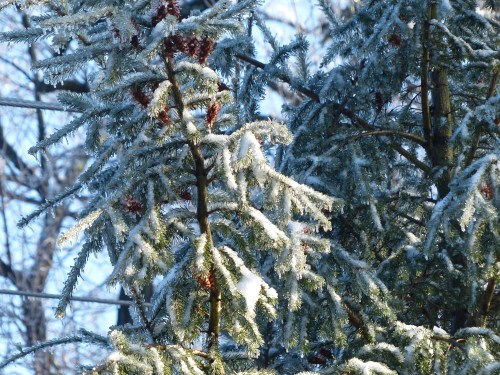
frozen branches

frozen branches
bent beneath iced snow –
blue-green brilliance

I can’t help thinking about the frozen beauty that resides in each of us. Waiting for a thaw. Hoping to make it through the harsh winter. Perhaps relieved when snow and ice transform our everyday into something magical. And grateful for the sun that eventually melts and softens us, one small drop at a time.

© Elouise Renich Fraser, 17 January 2018
Photo taken by DAFraser, December 2013 

Why writing feels dangerous

Last night I read about a woman who couldn’t get in touch with sensations in her body because she felt disconnected. Numb.

I relate to her. All my life I’ve experienced numbing out—sometimes on purpose; other times as the general go-to mode of my body. That means I feel out-of-place, lost, or just not interested in the vulnerability of connecting.

Years of neglect also hang out in my body. No wonder I get weary and can’t always stay awake emotionally. Perhaps some part of me has lost its memory or its ability to function with and for me.

And so I move on to something else instead of sitting with it. Or wondering about it, loving or even soothing it. Or welcoming it as a major part of the woman I’ve been and have become.

I’m a writer. I want to connect with what’s going on inside me, not just with thoughts running through my mind. I want to listen to myself, speak from within myself. Yet I’ve guarded so much for so long.

Can numbness lead to death? I don’t know. Perhaps I’m hiding from my voice. Sometimes I’m apprehensive about what I might discover or write and then let go. Even before I understand it fully.

From the moment I became a living human being, You’ve been there. Even when I was too terrified to be there. Too terrified to sit quietly with whatever was going on inside this woman I keep calling ‘me.’

Am I afraid right now? I want to believe You hold me close and won’t let me stray far from home. Yet I still think it’s my job to keep myself from straying. Maybe that’s why writing feels dangerous. My words are out there. I can’t control how they’re read or used or abused. Or heard and dissected.

A voice seems more fragile than a body. More connected to soul. More vulnerable to attack. Yet when I’ve done my best to be truthful, and have given it away so that the river moves on within and through me, I’m not sure what else I can do except build a dam.

I know about dams. I’ve constructed many in my lifetime. Little dams. Big dams. Complex, contorted, impenetrable dams. Trying desperately to escape the truth about me.

And what if the truth about me is beautiful? Lovely? What then? Have I killed it?

A small Christmas cactus blossom rests in front of me on my desk. A lovely, fading pinkish magenta. Its fragile petals look like limp gauze wings folded around its core. It isn’t ugly; it’s dying. Doing what lovely flowers do after giving themselves away.

It’s the only way to live. Not forever, but in this present moment. My calendar lies to me daily. It promises more than it or I can deliver. I want to live this one day as if there were no tomorrow. No more, and no less.

© Elouise Renich Fraser, 15 January 2018
Photo found at pxhere.com

A Georgia Song, by Maya Angelou

In tribute to Maya Angelou, Martin Luther King, Jr., and all African-American poets and dreamers who see into us and into our history with razor-sharp eyes, ears and tongues.

As a transplanted (from California) citizen of Savannah, Georgia, I grew up surrounded by two stories–the white story splashed boldly across the city of Savannah and its outlying communities, and the black story inextricably woven into the warp and woof of everyday life. Visible yet invisible. Maya Angelou’s poem is haunting for its accuracy, its longing for something better, and its painful memories. I’ve included a few explanatory notes at the end.

A Georgia Song

We swallow the odors of Southern cities,
Fat back boiled to submission,
Tender evening poignancies of
Magnolia and the great green
Smell of fresh sweat.
In Southern fields,
The sound of distant
Feet running, or dancing,
And the liquid notes of
Sorrow songs,
Waltzes, screams and
French quadrilles float over
The loam of Georgia.

Sing me to sleep, Savannah.

Clocks run down in Tara’s halls and dusty
Flags droop their unbearable
Sadness.

Remember our days, Susannah.

Oh, the blood-red clay,
Wet still with ancient
Wrongs, and Abenaa
Singing her Creole airs to Macon.
We long, dazed, for winter evenings
And a whitened moon,
And the snap of controllable fires.

Cry for our souls, Augusta.

We need a wind to strike
Sharply, as the thought of love
Betrayed can stop the heart
An absence of tactile
Romance, no lips offering
Succulence, nor eyes
Rolling disconnected from
A Sambo face.

Dare us new dreams, Columbus.

A cool new moon, a
Winter’s night, calm blood,
Sluggish, moving only
Out of habit, we need
Peace.

Oh Atlanta, oh deep, and
Once lost city,

Chant for us a new song. A song
Of Southern peace.

Poem found in Maya Angelou: Poetry for Young People, Sterling Children’s Books, New York, published 2013

Cities in Georgia named in this poem: Savannah, Macon, Augusta, Columbus and Atlanta

Fatback is a Southern delicacy – fat from a side of pork, often fried like chips; here, the reference is to harsh treatment of slaves.

“Tara’s halls” refers to the home of Scarlett O’Hara in Gone with the Wind.

Abenaa – a girl born on Tuesday (in the Fanti language)

Creole – of mixed African and European ancestry

Sambo – stereotypic nickname for an African American boy

The painting at the top depicts the beginning of Sherman’s March through Georgia in the 1850s — from Atlanta to Savannah, with the goal of total submission of the South, along with the so-called end of slavery. The uncounted tragedies of this war include the attempt of our country to root out anyone standing in the way of our ‘pre-ordained greatness.’ Hence, on the other side of this Uncivil War, lurked attempts of some to drive out or destroy American Indians who stood in the way of railroads and the gold rush.

Dr. Martin Luther King, Maya Angelou and other poets challenge us to rise above our past. To become truly great as human beings, unafraid to look up, greet each other, and join the human race.

© Elouise Renich Fraser, 15 January 2018
Artwork found at allpurposegurulcom; painter and title not identified