Telling the Truth

connecting the dots of my life

Category: Death and Dying

Before I die

In November 2013 I wrote the following opening and closing lines of Why This Blog?

I need to say some things out loud before I die. I’m not knowingly staring death in the face, yet I know my days are numbered….If I don’t tell the truth about my life, I will die inside. I want to live, and I want my children and grandchildren to live.

I didn’t know it then, but this blog isn’t just about the truth of my life as I’ve experienced it. It’s also about my death. Not that I know the day and hour. I don’t. Still, it’s closer now than it was in November 2013—the month before I published my first post.

I just searched my posts. So far, not by conscious design, I’ve written about death 175 times (out of 1398 total). It seems I can’t let this topic go.

I find writing about death is comforting. I didn’t grow up in a family that talked easily about death or dying. Nor have I been part of a community or church that focused on this, especially as part of life.

I’m not a morbid person by nature. I am, however, keenly aware of my mortality. Not just because of my age and health issues, but because of the increasing disruption and unpredictability of life on this planet.

So what does it mean to die? Not just at the end of life, but along the way from here to there. And how does that change my daily choices and relationships? Especially with my family members, beginning with D.

These are a few things on my mind these days. Which is another way of saying I’ll be posting more pieces about death. I’ll also post other things as well–my take on the current state of affairs in the USA, photo posts from adventures with D, poetry, the occasional report about life with Smudge, and whatever else wants to be written.

Thanks to each of you for visiting, reading, and sharing your experiences from time to time.
Elouise

© Elouise Renich Fraser, 27 April 2019
Photo taken by DAFraser in the Portland Rose Garden

An Easter Lament and Question

Nothing comes easy these days
Small deaths and large
Gaping holes
Clutter the landscape

Rain falls sideways
Streaking over my back yard
Daring me to will it
To the ground

Out of control and out of time
Bombs tick silently
Within this fragile planet of creatures
And plant life whipped
By gales of political
And personal expediency

So many deaths
Not enough tombs
Or people with vision
And voices to help us
Find our way home

‘Come to me
All who labor
And I will give you rest’
Yet even You were hung
On a tree whiplashed
And left to die

How will Easter
Arrive on this good earth
Not just for the flowers
But for all of us?

Is dying our only option?

© Elouise Renich Fraser, 20 April 2019
Photo found at pixabay.com

Thinking about death

A stranger to myself
Thoughts of this and that
Invade my mind —
One insight after another
Offering a panacea
to this earthly body
Plodding on despite
Resurrection of hope
And flashes of insight about
Who I am and why this
Right now instead of that

Yet like a sick rollercoaster
Moments of brilliance
Collide with weary batteries
Unable to keep up with
This ever more distant
Dream called normalcy
That sputters weak as
Watered-down tea in
Tasteless cups of vintage wine
Gone sour hidden in
Abandoned corners now
Littered with the debris
Of forgotten loves and
Laundry not hung out to dry

I’m dying
One breath at a time
Aided by living
One breath at a time
Do I understand this?
Somewhat
Do I like this?
No
Do I accept this?
Sometimes

And there’s this as well –
The daily rescue of my entire being
From the despair of not knowing
Whose or why I am in this world
And why the beauty of staying battles daily
With the beautiful lure of leaving

©Elouise Renich Fraser, 16 April 2019
Image found at bestwallpapers.in

Why stick around?

My fingers wait expectantly
Pause, take a deep breath and begin

A brief list of reasons to stick around:

No.

A brief list of reasons I’m needed:

Maybe.

Trying to get my bearings
In this age of approaching death
With scores of unanswered questions
Littering every inch of every path I’ve ever taken

And yet
I felt needed back then
Fully awake each day to challenges
That meant something to somebody
Things that would make a difference

Is that all this life is about? No.

Perhaps I’m going at this the wrong way

Maybe I need myself
Just as I am

Not to be a hero
Or the perfect aging-with-grace senior
But to love myself
Especially those aging parts that give me grief

Not so they’ll go away and leave me alone
Though I confess to the occasional daydream
But because they need me

They need me to go with them
Through this brilliant terrifying valley
Of aging and dying with or without dignity

Besides,

Who else would hear the true beat of my heart
From the inside out

Or sit in the attic loving the silence of treetops
Dancing in the wind

Or play the piano feeling waves of music
Flooding my soul

Or understand the sweet comfort of falling asleep
While leaning on D’s shoulder

©Elouise Renich Fraser, 11 April 2019
Photo of a German forest at sunset, found at pixabay.com

Overweight and unhappy

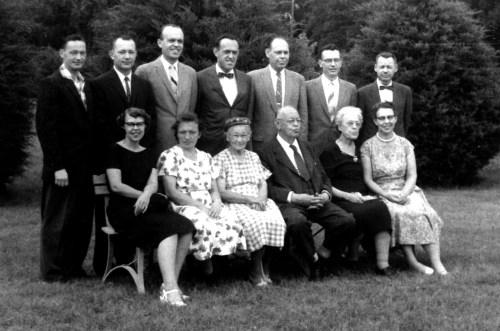
14 July 1958, Newton, Kansas. Grandpa and Grandma Renich, front row center with three daughters and a Great Aunt; my father in the middle on second row 

Overweight and unhappy
His bulk filled the back side
Of the old round kitchen table

Hour after hour he sat
A lonely figure staring silently
Or issuing ultimatums
Bushy eyebrows drawn together
Nowhere to go and little to offer
But weary leftovers
Of a grueling life plus
The occasional snarl
At young grandchildren

A memory from the early 1950s. I’m 7 years old. I’m in the kitchen of my paternal grandparents’ home in the Midwest. My parents dropped me off with Sister #2 while they drove with baby Sister #3 (Diane) to a conference in Philadelphia. When they returned, we continued our cross-country move from Los Angeles, California to Savannah, Georgia.

I’ll never forget how intimidated I felt around Grandpa Renich. He was given to frowning a lot and smiling seldom. He also took seriously his duty of administering punishment as needed, which he did at least once to Sister #2. I was happy I wasn’t going to live nearby.

Last night I watched a report on the growing rate of suicide among elderly men and women. For an alarming number, the feeling of being a leftover–old, forgotten and stale–becomes the dominant theme. Many also deal with debilitating chronic pain, loss of bodily functions, and illness. For some, this is worse than death itself. And so they opt to exit instead of waiting around for the inevitable.

My paternal grandfather wasn’t happy, and he didn’t take his life. Had he chosen to do so, I think I would understand now what I couldn’t understand back then.

©Elouise Renich Fraser, 10 April 2019
First Renich Family Reunion Photo taken in Newton, Kansas

How loud the storm sounds | Emily Brontë

For weeks, this short poem by Emily Brontë has haunted me. With a small handful of simple words Emily evokes feelings of grief and shock that come from unexpected death. My comments follow.

How loud the storm sounds round the Hall!
From arch to arch from door to door
Pillar and roof and granite wall
Rock like a cradle in its roar

That Elm tree by the haunted well
Greets no returning summer skies
Down with a rush the giant fell
And stretched athwart the path it lies

Hardly had passed the funeral train
So long delayed by wind and snow
And how they’ll reach the house again
Tomorrow’s dawn perhaps will show

From selected poems of Emily Brontë
Published in Everyman’s Library by Alfred A. Knopf, 1996

Perhaps it seems strange to talk about unexpected death, especially during a powerful storm that shakes foundations and roars as it gathers speed.

Yet of all the things that might have fallen, it was “That Elm tree by the haunted well.” A giant. A fixture in the landscape.

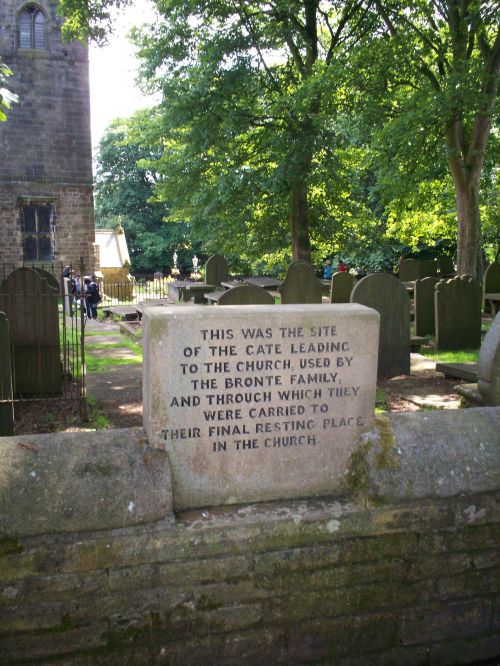
In addition, it fell across not just any path, but the path between house and Hall. That would be the Brontë house (church parsonage), and the church Hall where father Brontë served as a parson.

The house stands at the opposite end of a path leading to the church Hall. Besides getting to the church for services, it was also the pathway down which deceased members of the Brontë family were carried to be laid to rest in the family vault.

Emily refers to a funeral, already delayed by wind and snow. It’s finally taking place in the church Hall. Whose funeral? Emily doesn’t say.

Suddenly a furious storm erupts, and “That Elm tree by the haunted well” comes crashing down across the path. It seems the only solution is to stay in the church Hall until tomorrow. Perhaps by then we’ll be able to find a way back to the house.

So what does this poem suggest? Perhaps the giant Elm’s sudden death refers to a person whose life touches everyone. This could be a family member, such as Emily’s mother, or one of Emily’s siblings. We might also ask whether it’s possible to return the house as it was.

The poem describes the way we often experience death. It leaves us feeling lost and uncertain. Without a compass, or a clear map for how we’ll proceed from here.

The poem also invites us to consider each day precious. The end often comes without warning. Especially to those we most love and depend upon. Or to ourselves.

© Elouise Renich Fraser, 12 March 2019
Photo found at pinterest.com 

unmapped adventure

Restless uncertainties clamor
Living reminders of death
And the loneliness of aging
I stare out the window
Looking for a sign, a thought
That points the way ahead
Through shapeless days
Living within boundaries shifting
From one day to the next

Thou shalt not taunts me
Thou shalt snaps at my heels
Dares me to veer from this
Strange path to everything
And to nothing at all—
Dreams wander without clear
Themes or destinations
Days come and go
Like all the others

One day up
The next day down
The cup is full
The cup is empty
The magic recipe eludes me
Leaving nothing
But the raw gift of life—
Becoming myself
In this unmapped adventure

© Elouise Renich Fraser, 7 March 2019
Image found at pinterest.com

Why Mary Oliver’s words matter

A few years ago a friend introduced me to Mary Oliver via one of her books of poetry, Thirst. Spare on words and extravagantly beautiful, her forty-three poems grabbed my heart and my imagination. The collection focuses on her grief after the death of her longtime partner, and her struggle to find words that capture the reality of her faith.

Mary Oliver challenges me in ways similar to Emily Dickinson, with one exception. Oliver’s poetry, also heavy with meaning, is remarkably and painfully direct. In each poem she invites me to enlarge the way I see, experience and respond to what seems everyday and ordinary.

Since her death on January 17, scores of visitors have visited this site looking for posts about Mary Oliver. At the top of the list: It doesn’t have to be the blue iris, a poem about prayer.

In the last week I’ve read and listened to multiple tributes to Mary Oliver. Her poetry is stunning; her challenge to us as human beings is direct and piercing: Wake up, Observe, Report. Not simply about nature, but about this world and its creatures as part of God’s great poem. A reality we ignore to our great loss.

Here’s one of Mary Oliver’s shorter poems. I love the way it makes simple what isn’t always easy.

Musical Notation: 2

Everything is His.
The door, the door jamb.
The wood stacked near the door.
The leaves blown upon the path
that leads to the door.
The trees that are dropping their leaves
the wind that is tripping them this way and that way,
the clouds that are high above them,
the stars that are sleeping now beyond the clouds

and, simply said, all the rest.

When I open the door I am so sure so sure
all this will be there, and it is.
I look around.
I fill my arms with the firewood.
I turn and enter His house, and close His door.

Mary Oliver, from poems in Thirst, p. 38; published by Beacon Press (2006)

© Elouise Renich Fraser, 24 January 2019

The weather goes awry

So much
For forecasts
Or low odds
On life
Turning its tail
And running
Away
Without us

Howling wind
Sucks drafts
Of spinning leaves
And drunk robins
Heavenward
Tree branches
Lash out
In vain

All
We ever wanted
Gone
Up the chimney
In smoke
Churning with
Hopes and dreams
Unrealized

How quickly things fall apart–or fail to materialize. A death here. A death there. Unplanned events and unanticipated outcomes send us spiraling. Looking for something to soothe weary minds and hearts, and point us forward. Together, rather than scattered to the four corners of the earth.

Despair? Not yet. A sense of loss or betrayal? Sometimes. But more often aching loneliness for what might have been and may yet become. With or without us.

While I was writing this, the outside temperature plummeted toward single degrees, and wind from the north picked up speed. A good time for indoor Sabbath rest.

© Elouise Renich Fraser, 20 January 2019

For all the saints

weary spirits
laid to rest lie soft
on winter’s snow
breathless we linger
beneath the heavens

Written in light of

  • Motionless trees coated with snow outside my kitchen window
  • Frigid temperatures and a gray sky
  • Recent and long-ago deaths of family, friends, strangers, poets and irreplaceable bright stars in our lives
  • Escalating upheavals of the last few years, locally and globally
  • This season of reflection and resolution

© Elouise Renich Fraser, 18 January 2019
Photo of Sycamores in Central Park found at 123RF.com