Telling the Truth

connecting the dots of my life

Category: Devotional Writing

The world as God’s poem

Several years ago I posted “Emily Dickinson meets Mary Oliver.” A phrase from one of Mary Oliver’s poems had captured my imagination. As she puts it, we owe our dignity to being part of “the poem that God made, and called the world.”

With so much ‘undignified’ death flooding our news media, it’s difficult to hold onto Mary Oliver’s image. I don’t easily hear or see “the poem that God made, and called the world.” It’s easier to picture what’s happening today as a rising tide of undignified and wrongful deaths that should never have happened. Which may also be true.

Here’s my response, first posted in August 2017, and reposted below in light of today’s current events.

No mortal words of poetry will ever do justice to this world, God’s poem.

Nor do we understand ourselves
unless we give up all efforts to capture in our words
the reality of what God created and invited us to inhabit as caretakers.

We can look and point;
We cannot replicate.

Furthermore, no poetic words of ours
will ever improve upon God’s great poem.
Still, as humans we’re at our best when we reflect in our lives
the grandeur of creation.

Surely the summer sky, the deer,
and all parts of God’s creation are dignified
not because of what each does, understands,
or even writes in flowing poetry.

Rather, they and we owe our dignity to being part of
“the poem that God made, and called the world.”*

*Quotation from Mary Oliver’s poem,
“More Beautiful than the Honey Locust Tree
Are the Words of the Lord.” Published in Thirst, p. 31

~~~

Praying we’ll become open to seeing each human life and each creature great or small as part of God’s poem. Which, of course, includes each of us with all our flaws and our gifts.

Elouise

© Elouise Renich Fraser, 26 February 2022
Photo found at smartpress.com
A poem I can’t get out of my mind

It doesn’t take much effort to see what’s happening daily in many if not most of our neighborhoods, towns or cities.

Nonetheless, when it comes to actively joining efforts on the field, many of us would rather stay put in the grandstands. Glued to our seats. Gasping from time to time, but not joining the fray, or putting ourselves in harm’s way.

I’m no extroverted star. I’d rather stay on the sidelines. Study what’s happening on the field. Pray. Give money. Or read more about poverty in cities and surrounding towns, and what others are doing to come alongside with help. Certainly all those good things are important and necessary.

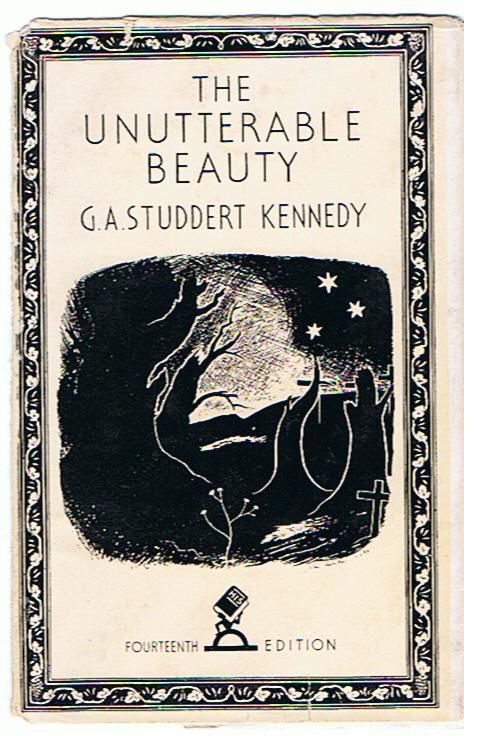
Here’s a poem that challenges me every time I read it. G. A. Studdert Kennedy served on the ground as a World War I army chaplain to British soldiers. Many of his poems reflect realities of life in the warzone. This one, however, reflects the reality of life in the city of Birmingham.

Indifference, by G. A. Studdert Kennedy (aka Woodbine Willie)

When Jesus came to Golgotha they hanged Him on a tree.
The drave great nails through hands and feet, and made a Calvary;
They crowned Him with a crown of thorns, red were His wounds and deep,
For those were crude and cruel days, and human flesh was cheap.

When Jesus came to Birmingham they simply passed Him by.
They never hurt a hair of Him, they only let Him die;
For men had grown more tender, and they would not give Him pain,
They only just passed down the street, and left Him in the rain.

Still Jesus cried, “Forgive them, for they know not what they do.”
And still it rained the wintry rain that drenched Him through and through;
The crowds went home and left the streets without a soul to see,
And Jesus crouched against a wall and cried for Calvary.

“drave” – drove

Indifference found on page 21 in The Unutterable Beauty – The Collected Poetry of G. A. Studdert Kennedy
First published by Hodder and Stoughton Limited, London (March 1927), reprinted June 1928
Second publication by Pendlebury Press Limited, Manchester, U.K., August 2017

There’s no end of women, children, young people and men who would welcome even a small sign of genuine interest from another human being. Maybe they’re next door, just down the street, sitting beside us in church or on a bus, or even sitting lonely in that big mansion up on the hill. In the end, Woodbine Willie was known for his commitment to being there. Not with answers, but with a listening ear and a praying heart.

Thanks for stopping by today.
Elouise

© Elouise Renich Fraser, 24 February 2022
Photo found at backwatersman.wordpress


Desmond Tutu, Mary and the oppressed

Pin on madonna

Mary’s song came to mind this morning when I read about Archbishop Desmond Tutu’s life and death. Not the version we hear in church during the Christmas season, but Rev. Zephania Kameeta’s version below.

Mary is often depicted in sumptuous gowns. Yes, we honor her faithfulness to her son, right up to his unjust death. At the same time, I can’t forget her social status. She wasn’t born into a privileged life, and her neighbors may have raised an eyebrow or two when she became pregnant.

The sting in Mary’s song is large, especially when we remember her status in society. From my perspective, Rev. Kameeta captures the sting and the reality of Mary’s song and Jesus’ birth. Not in general terms, but as it relates to his own rejected brothers and sisters in Namibia.

Zephania Kameeta sings the song of Mary – Luke 1:46-55

Today I look into my own heart and all around me,
and I sing the song of Mary.

My life praises the Lord my God
who is setting me free.
He has remembered me, in my humiliation and distress!
From now on those who rejected and ignored me
will see me and call me happy,
because of the great things he is doing
in my humble life.

His name is completely different from the other names in this world;
from one generation to another,
he was on the side of the oppressed

As on the day of the Exodus, he is stretching out
his might arm to scatter the oppressors
with all their evil plans.
He has brought down mighty kings
from their thrones
and he has lifted up the despised;
and so will he do today.
He has filled the exploited with good things,
and sent the exploiters away with empty hands;
and so he will do today.

His promise to our mothers and fathers remains new and fresh to this day.
Therefore the hope for liberation which is burning in me
will not be extinguished.
He will remember me, here now and beyond the grave.

Rev. Zephania Kameeta’s song was published in Why, O Lord? Psalms and sermons from Namibia, p. 15.
© 1986 World Council of Churches, published as part of the Risk book series

Thanks for stopping by today. These are troubled and troubling times. I pray we’ll find our way home, one day at a time.

Elouise

© Elouise Renich Fraser, 26 December 2021
Image found at pinterest.com

A lament for 9/11/2001 and today

I wrote the lament below for an open seminary forum held one month after the 9/11/2001 attack. Today, 20 years later, the lament rings painfully true.

We haven’t had more unexpected attacks on skyscrapers or the Pentagon. Instead, we’ve had a home-grown physical attack on Congress; home-grown political attacks masquerading as MAGA; routine home-grown attacks on people of color, immigrants, and women; unprecedented fires, floods, drought and tornadoes; and daily fallout from protracted global warfare and upheaval.

Back to 2001. I was one of several faculty members asked to open the forum. I’m speaking in our seminary chapel. A large wooden crucifix is on the wall behind me. Hence my reference below to Christ’s death being in the room.

It’s difficult to focus.
Voices and images
clamor for my attention,
my response,
my analysis of what is beyond all reason.

I force myself to stay close to the bone,
close to home, close to my Christian roots.

Death is in the room.
Not a new presence,
not even unexpected.

It, too, clamors for my attention,
masquerading in terrible new configurations.

I don’t want to die,
especially if I must suffer in my death.

From the throne of his cross,
the king of grief cries out….
‘Is it nothing to you, all ye who pass by?’

There is no redemption
apart from suffering and death.
None.

I want to be redeemed.
I do not want to die, or to suffer.
I’m not a very likely candidate for redemption.

Death is relentlessly in this room.
My death.
Your death.
Christ’s death.

Unfinished family business is in this room.
Violent behaviors and attitudes
passed down from father to daughter;
Habits of not telling the truth,
passed down from mother to daughter;
Withholding of love and affection,
Relentless inspection and fault-finding,
Love wanting expression but finding no voice,
Truth wanting expression but finding no listening ear.

Unfinished family business is in the room with death–
A gnawing ache more than my body can bear.

I like to think I’m ready to die.
But I am not.
Nor will I ever be.
Not today, not tomorrow,
Not in a thousand tomorrows.

If I say I am ready to die,
I deceive myself,
and the truth is not in me.

There’s always more work to be done–
Unfinished family business
Unfinished seminary business
Unfinished church and community business
Unfinished personal business

Christ died to relieve me
of the awful, paralyzing expectation
that one of these days
I will finally be ready to die.

Christ finished his work so that
I could leave mine unfinished
without even a moment’s notice.

The Heidelberg Catechism says it all–

“What is your only comfort in life and death?

“My only comfort, in life and in death, is that I belong–body and soul, in life and in death–not to myself but to my faithful Savior, Jesus Christ….”

Praying for ways to maintain lifegiving connections with those we love and those we too often love to hate.

Elouise

© Elouise Renich Fraser, 11 September 2021
Quote from the Heidelberg Catechism found at etsy.com

For Today and Tomorrow | Psalm 121

The last several weeks have been a roller coaster ride. Up one day, down the next. Hot/cold. Content/discontent. Causes known and unknown such as unresolved health issues, political moves of the unhelpful kind, war and destruction, plus the sinking feeling we’re stuck in old patterns that leave the future of this planet in the hands of the next generation.

This morning D and I went for a walk. The air was warm, humid, and heavy with the sound of cicadas. Just drawing a breath felt like the beginning of the end. As we were walking home, the words of Psalm 121 popped into my head. It’s one of several Psalms I memorized as a child. That would be in the King James Version, of course!

Here it is, slightly updated by me. The Psalm invites me to do something besides ruminating on how I feel or what I think about what’s happening in and all around me.

I lift up my eyes unto the hills, from whence comes my help.
My help comes from You, the Holy One who made heaven and earth.
You will not suffer my foot to be moved; You keep me without drifting off to sleep.
Indeed, You who keep all creation shall neither slumber nor sleep.
You are my keeper; You are the shade upon my right hand.
The sun shall not smite me by day, nor the moon by night.
You will preserve me from all evil; You alone shall preserve my soul.
You will preserve my going out and my coming in from this time forth,
and even for evermore.

No promise of rose gardens, or an easy coast from this life to whatever comes next. Instead, I’m reminded that I owe my full allegiance to our Creator, and that whatever comes next, I won’t be abandoned.

Good words for a mixed-up world full of anxious people everywhere. Including me.

Elouise

© Elouise Renich Fraser, 10 August 2021
Photo of hills in Judea taken by David Shankbone; found at wikipedia.com

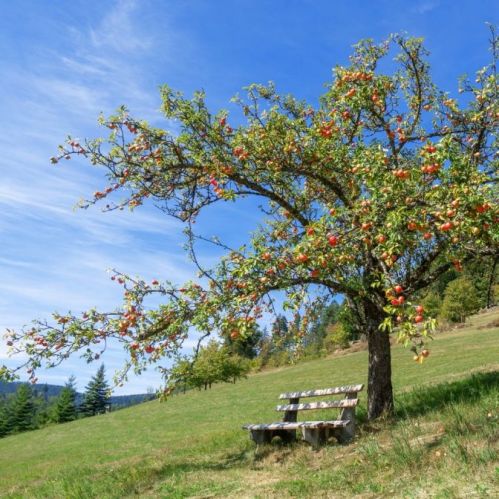
The Apple Tree

I want to be a poem tree. Reaching out and up to the heavens, blown by the wind of God’s Spirit, sheltering birds, bearing fruit, sinking roots deep into the ground, soaking up water, thriving in sometimes hostile circumstances. The kind of tree Psalm 1 describes.

A tree planted by living water
That brings forth its fruit in its season.
Its leaves don’t wither;
Whatever it does, it prospers.

Poem trees (surely you’ve seen one) don’t have only one way of communicating. Yet their impact is simple. They point to the inexplicable. The way a life sometimes can.

Which reminds me of Jesus of Nazareth. Not just as a human being and God’s beloved son-child, but as a tree. What kind of tree was he?

I think he was a poem tree. Pointing with ordinary words to the inexpressible, to what we discern through and beyond spoken or written words. The truth about God and about us. Grand, yet simple.

As simple and grand as a common, ordinary apple tree. Known and loved worldwide. Dependable, not full of exotic promises about heavenly hybrids that may offer curb appeal, but end up being a disappointment or just another pretty ad.

Jesus Christ the Apple Tree. I first heard this song in the 1980s when I was studying theology. The lyrics captivated me. I can’t be Jesus Christ the apple tree. Nonetheless, I want to be a poem tree with a small resemblance to the simple, poetic significance of this one life. I also want to rest a while, a very long while, beneath its shade.

To hear a performance of Elizabeth Poston’s haunting tune, click here. It takes only 2 minutes, 42 seconds. Well worth a listen!

Jesus Christ the Apple Tree

The tree of life my soul hath seen
Laden with fruit and always green
The tree of life my soul hath seen
Laden with fruit and always green
The trees of nature fruitless be
Compared with Christ the apple tree

His beauty doth all things excel
By faith I know but ne’er can tell
His beauty doth all things excel
By faith I know but ne’er can tell
The glory which I now can see
In Jesus Christ the apple tree.

For happiness I long have sought
And pleasure dearly I have bought
For happiness I long have sought
And pleasure dearly I have bought
I missed of all but now I see
‘Tis found in Christ the apple tree.

I’m weary with my former toil
Here I will sit and rest a while
I’m weary with my former toil
Here I will sit and rest a while
Under the shadow I will be
Of Jesus Christ the apple tree.

This fruit does make my soul to thrive
It keeps my dying faith alive
This fruit does make my soul to thrive
It keeps my dying faith alive
Which makes my soul in haste to be
With Jesus Christ the apple tree.

* * *

Lyrics published in Divine Hymns and Spiritual Songs 1797,
written by Joshua Smith/William Northup

Tune by Elizabeth Poston, 1905-1987, sung here by
The Choir of King’s College, Cambridge, about 1993.

© Elouise Renich Fraser, 25 June 2015, edited and reposted 20 July 2021
Photo from chiefrivernursery.com

Masks


Horst Lemke sketch for Psalm 139:1-6, Die Gute Nachricht, published by Deutsche Bibelstiftung Stuttgart, 1978

Every morning, along with enjoying the birds and squirrels, I read a bit of German. It’s a way to stay in touch with a language in which I was once fluent. I begin with a Bach Chorale each day (music plus 1st stanza in German). Most of the time that’s more than enough!

However…A few days ago, right after the Bach Chorale, I picked up my copy of The Good News in German, purchased in July 1980. It fell open to the sketch above by Horst Lemke. It struck a chord in me, partly because of our current situation in the USA and elsewhere. But mainly because Psalm 139 rightly assumes each of us owns at least one mask–though we may not own or be wearing a Covid-style mask.

I teared up as I read the passage below, given our current national and international challenges and catastrophes.

Psalm 139:1-12 from the Good News Bible in English (pp. 744-45)

Lord, you have examined me and you know me.
You know everything I do; from far away you understand all my thoughts.
You see me, whether I am working or resting; you know all my actions.
Even before I speak, you already know what I will say,
You are all around me on every side; you protect me with your power.
Your knowledge of me is too deep; it is beyond my understanding.

Where could I go to escape from you? Where could I get away from your presence?
If I went up to heaven, you would be there; if I lay down in the world of the dead, you would be there.
If I flew away beyond the east or lived in the farthest place in the west,
you would be there to lead me; you would be there to help me.
I could ask the darkness to hide me or the light around me to turn into night,
but even darkness is not dark for you, and the night is as bright as the day. Darkness and light are the same to you.

The rest of Psalm 139 is equally beautiful and powerful. Just what I need during these days of chaos, unplanned disasters, deep divisions, and masks behind masks.

Praying you’ll find your way today, knowing that the One who created each of us hasn’t forgotten our names, our faces, or our circumstances.

Elouise

© Elouise Renich Fraser, 17 July 2021
Sketch by Horst Lemke found in Die Gute Nachricht, p. 419
©1978 Deutsche Bibelstiftung Stuttgart

Just as I am

My unquiet mind
Spins out of control
Restless and uneasy

Unvoiced conversations
Saturate space yearning
For calm silence

When did it begin?
When will it end?

An old habit from childhood,
I explain myself to myself
As though minus these many words
I would not exist or be believed
Or convince myself or others
Of my worthiness

Like comfortable old clothes
I pull them close
Trying to assure myself
That I am worthy
Just as I am

The older I get, the more likely it is that ‘just as I am’ can’t possibly be good enough. Too much water down the river and over the dam. Too many roads not taken. Too many opportunities turned down because I was too busy, or afraid. And too many mistakes and unhappy chapters already written into my life.

I want to believe that the older I become, the less I need to prove my worth as a human being. I want to say without hesitation, “It doesn’t matter what you (or I) think about my life.”

I also want to accept the daily invitation to be who I am today in the eyes of my Creator. Not who I wish I were. And not who I might have been in the eyes of my father, my worst boss, or any other human being who has tried to make me into their image of me.

Surely the Judge of all the earth will do right. Not just by me, but by each of us.

Elouise

© Elouise Renich Fraser, 18 April 2021
Photo found at medium.com

Life on whose terms?

Falling asleep,
my body cries
for attention
and the comfort
of doing nothing
while awaiting new life
and energy that endures
forever and ever

Listening to the news,
I hear the beginning
of the end in post-Easter air—
especially if Jesus of Nazareth
isn’t allowed to rise from his
unseemly death and confront
our lackluster attempts
to live life on our own terms

I’m struck by how busy things become each year as Easter Sunday approaches. Part of the busyness is about special church services for those able and willing to attend.

But that isn’t what catches my eye. Instead, we have the tug of Easter egg hunts, Easter dinner arrangements, fancy Easter clothes or even mini-vacations that can suck the life blood out of Easter.

I like to enjoy life on my terms. However, Easter challenges me to look beyond myself and my limited resources. I wonder what it would look like for me to keep up with Jesus instead of the current idols of this world?

Thanks for visiting and reading.
Elouise

© Elouise Renich Fraser, 5 April 2021
Image found at anona.com

Gethsemane | Mary Oliver

Mary Oliver places this poem just after The Poet Thinks about the Donkey. Clearly an invitation to compare them. My comments follow.

Gethsemane

The grass never sleeps.
Or the roses.
Nor does the lily have a secret eye that shuts until morning.

Jesus said, wait with me. But the disciples slept.

The cricket has such splendid fringe on its feet,
and it sings, have you noticed, with its whole body,
and heaven knows if it ever sleeps.

Jesus said, wait with me. And maybe the stars did, maybe
the wind wound itself into a silver tree, and didn’t move,
maybe
the lake far away, where once he walked as on a
blue pavement,
lay still and waited, wild awake.

Oh the dear bodies, slumped and eye-shut, that could not
keep that vigil, how they must have wept,
so utterly human, knowing this too
must be a part of the story.

© 2006 by Mary Oliver, published by Beacon Press in Thirst, p. 45

This one stings. How many vigils have I slept through? Or how often do I look the other way when injustices are playing out before my eyes.

When I was growing up, I had nothing but scorn for those three sleepy, self-absorbed disciples who couldn’t stay awake and keep watch for their friend Jesus. Surely they believed him. They’d already shown themselves capable of going to extreme lengths on his behalf.

Mark 14:32-42 doesn’t say Peter, James and John were reluctant to stay with him and keep watch. It says they couldn’t keep watch as Jesus asked them to do not once, but three times. Meanwhile, Jesus is left alone to face his coming betrayal.

In contrast, all nature (except human nature) was wide (wild!) awake that night. The only witnesses to Jesus’ agony, betrayal, trial, and eventually death on a cross outside the city of Jerusalem. The same city that welcomed him on the little donkey not a week earlier.

Mary suggests the stars and moon, trees and insects all kept watch that night. I like to think they offered some peace, perhaps even solace as he prayed, weeping and agonizing for all of us and for himself.

In the final stanza Mary offers grace to them, to herself and to us. The three disciples were “dear bodies” and “utterly human.” They weren’t deadly co-conspirators. They were human, just as we are. Weary.

Praying we’ll be as understanding about Jesus’ three companions as we are about ourselves, even as we lament Jesus’ coming betrayal by Judas, also one of his chosen disciples.

Elouise

© Elouise Renich Fraser, 1 April 2021
Painting found at touchstonemag.com