Telling the Truth

connecting the dots of my life

Category: Spiritual Formation

Alas, Mr. Trump

Alas, Mr. Trump
You are Not the Only Problem
I know you won’t like it
But it’s the naked truth

They smiled and cheered
And raised their weapons
Of warfare screaming
Bravo as you preened

Forgive me for being
So blunt or don’t forgive me
Because it really doesn’t matter
You are Not the Only Problem

In the chaos of last week’s attack on Congress, it was crystal clear. Several weaponed-up angry white men shouted, ‘This isn’t Trump’s war. It’s ours!’ They’d moved way beyond Trump who, it seems, was the high-ranking inciter and/or supporter of violence they’d dreamed of for years. A cover and a disposable figure. An excuse for mayhem and murder.

Before and after becoming POTUS, Mr. Trump was and still is an inciter of white, mostly male pride, privilege, and crude violence unleashed, unafraid, and unrepentant. Is impeachment enough to satisfy the last four years of incitement to violence and disdain?

I don’t have answers. Nor will we find answers until we white citizens take seriously the history of the USA. For decades we’ve endured or ignored regular disruptions of mostly white “I’ll do it my way” men and women. Including standoffs by white men armed with rifles in this ‘land of the free and home of the brave.’

For the most part, they got away with it then and they get away with it now. Yes, a token number of people are being arrested for last week’s attack on Congress. Still, many have disappeared into the woodwork. There’s no way this attack would have happened if the perpetrators had been black.

Here’s now W. E. B. Du Bois puts it in his early 1900’s essay, “The Souls of White Folk” (emphasis mine).

Murder may swagger, theft may rule and prostitution may flourish and the nation gives but spasmodic, intermittent and lukewarm attention. But let the murderer be black or the thief be brown or the violator of womanhood have a drop of Negro blood, and the righteousness of the indignation sweeps the world. Nor would this fact make the indignation less justifiable did not we all know that it was blackness that was condemned and not crime.

Do we have the guts to condemn white crime? And to hold white Mr. Trump accountable for collusion, if not incitement?

Praying for courage to change the things we can,
Elouise

© Elouise Renich Fraser, 13 January 2021
Image found at nytimes.com
The nature of our souls

Slow motion rollout
of a white horror show

Surreal white choices
(one would be too many)
to humor or ignore POTUS

A white-washed sense
of entitlement plus

White-washed decisions
to treat white-washed intruders
with white-kid gloves

Meanwhile, white POTUS cowers in the White House

Congressional Building guards caught
off-guard without a plan of attack
to restrain white-washed white folk

no game plan
no war-like riot gear
no immediate shooting
from the hip

just bald-faced white anger
sending a white message to
the world from white intruders
and white ‘defenders’ alike

Beyond this patch-up of verses, I don’t have a quick solution to our deadly, death-dealing disease that keeps strangers at a distance.

The challenge to President-Elect Joe Biden and to us as a nation is clear. It isn’t how did this happen, as though a better plan would have held back this surge. It’s about why this happened, and what we can learn from our own responses to it.

Yes, Mr. Trump incited this riot. On the other hand, it couldn’t have happened  without the collusion of white America.

Distancing ourselves from our own national mess, ignoring it, or gasping in horror and then looking the other way isn’t an option. Especially for those who claim to follow Jesus of Nazareth. This isn’t about politics. It’s about the nature of our souls, measured by our willingness to begin at the very beginning. As strangers in need of each other.

Elouise

© Elouise Renich Fraser, 8 January 2021
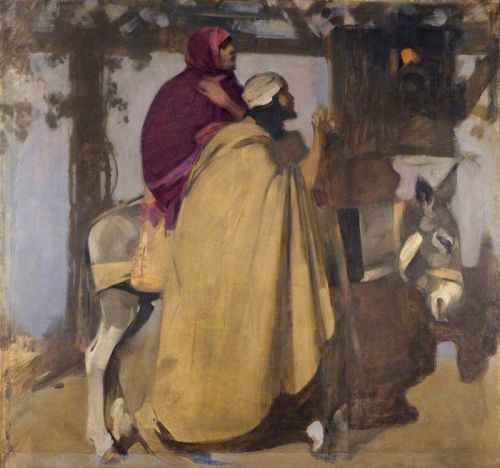
Image found at patheos.com

No Room at the Inn | Thomas Merton


 I know–Christmas 2022 hasn’t yet arrived.
Still, this quotation from Thomas Merton strikes a chord in me,
given the current state of our growing disunion.
~~~

Two years ago I received an email from a friend of many years. Among other things, he passed along the ‘poem’ below, even though it wasn’t written as a poem.

The excerpt is from an essay, No Room at the Inn, by Thomas Merton. The essay is included in Raids on the Unspeakable, a selection of essays Merton wrote from 1960 to 1966, during the Viet Nam War. The small collection is published in Canada by Penguin Books Canada, and in New York by New Directions Publishing Corp.

Here’s the excerpt, in poetic form.  

No Room at the Inn

Into this world, this demented inn
in which there is absolutely no room for him at all,
Christ comes uninvited.

But because he cannot be at home in it,
because he is out of place in it,
and yet he must be in it,
His place is with the others for whom
there is no room.

His place is with those who do not belong,
who are rejected by power, because
they are regarded as weak,
those who are discredited,
who are denied status of persons,
who are tortured, bombed and exterminated.

With those for whom there is no room,
Christ is present in this world.

Here’s the rub. I say I’m following Jesus. Am I ready for this? Do I really want to be known as ‘one of them’? 

Praying we’ll find strength and grace in the coming year to join those shut out from the inns of this world.
Elouise

© Elouise Renich Fraser, 27 December 2020, reposted 10 December 2022
Image found at pinterest.com

The Life we have is very great – revisited

Here’s a second look at Emily Dickinson’s poem about Life, Infinity, and the Human Heart. A good poem for today when we’re missing family members or friends for any reason, plus Covid-19, political standoffs, hate crimes, or the harsh reality of wildfires, avalanches and hurricanes. My lightly edited comments follow.

The Life we have is very great.
The Life that we shall see
Surpasses it, we know, because
It is Infinity.
But when all Space has been beheld
And all Dominion shown
The smallest Human Heart’s extent
Reduces it to none.

c. 1870

Emily Dickinson Poems, Edited by Brenda Hillman
Shambhala Pocket Classics, Shambhala 1995

It doesn’t matter how many worlds we discover beyond this world. It doesn’t matter how far the distance is from here to there and beyond. It doesn’t even matter that the universe is still expanding.

None of this, as surpassingly great or expansive as it may be, holds a candle to the smallest of human hearts.

According to Emily, the Life we now have is ‘very great.’ The Life we’ll have beyond this Life is even greater. Yet it’s infinitesimal compared to what our hearts can see and grasp right now.

Emily describes the heart’s capacity to love Life. Especially when we can’t see those we love. She suggests that the expansiveness of one small human heart outshines infinity itself.

Yes, it’s fascinating to explore the universe, what may lie beyond it and how it’s ordered. Yet what we discover externally will never match the capacity of one small human heart to connect with another human heart.

It doesn’t matter whether that heart is what we call dead or alive, here or there, or somewhere in between. Nor do we need to understand exactly what Space encompasses, how it is governed, or where Infinity resides.

This isn’t about measuring or mapping Life beyond our present Life. Or discovering where those we love now reside.

It’s about connections. All it takes is one small human heart to leap beyond unmapped, immeasurable boundaries, expanding outward in a heartbeat to enfold the hearts of those we love. No matter where they or we may be.

© Elouise Renich Fraser, 28 May 2017, lightly edited and reposted 10 December 2020
Image taken from Hubble Spacecraft, found at nasa.gov

What next? | Dear Friends

Dear Friends,

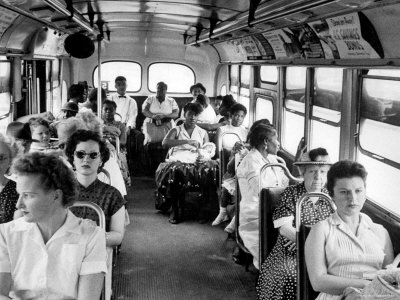
As some of you know, I’m a survivor of childhood PTSD. My father’s behavior toward me was the most difficult part of my growing-up years. It cost time, money and effort to become the woman I am today.

Yet I still haven’t faced what it means to be a white woman right now. Specifically, this particular white woman whose childhood set the table for racial blindness. It’s ironic. Nearly every day of my life from age 7 ½ to 14 I rode through colored town, and witnessed the realities of colored life in the Deep South.

My father’s approach to Deep South manners amounted to ‘be polite, smile a lot, and just keep going.’ Don’t ask questions, don’t debate anything, and remember you’re the eldest daughter of the white preacher who speaks from time to time at the Colored Community House.

Still, I was inquisitive. I remember asking my father more than once why things were this way. I’d lived most of my early life on the West Coast. I don’t remember seeing black people in Seattle or in Southern California.

According to my father, it all came down to the way colored people ‘like’ to live. Or what they found ‘most comfortable.’ Or how much money they made, or how they spent it. That was their choice.

Every school day during my grade school years, my father or a neighbor drove us through colored town on our way to and from school in the city. Colored town was about a quarter of a mile from our house.

Yet my father never talked with us about why colored town was there in the first place, why most of the houses needed repair, or what this meant in the larger picture of the Deep South. Perhaps he’d never looked into it.

I’ve decided I can’t avoid looking into it. Not as an academic exercise, but to face what happened before, during and after Jim Crow years, and how I’m now part of the problem.

Thanks for reading. This is a busy month for everyone, so I appreciate your visits even more than usual!

Gratefully,
Elouise

© Elouise Renich Fraser, 8 December 2020
Photo of segregated city bus in the 1950s found at aapf.org

James Baldwin | The Fire Next Time

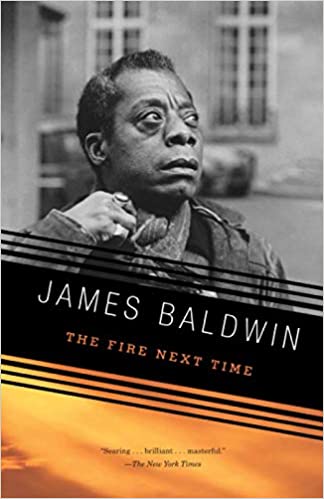
In the mid-1960s I first read James Baldwin’s The Fire Next Time, a collection of two published pieces. Each deals with how to survive as a black person in the USA. The first is a painfully realistic letter to James Baldwin’s nephew. The second describes Baldwin’s own struggle as a black Christian, beginning at age 14.

Now, at the end of 2020, I’m reading Baldwin’s small book again. Sadly, most white citizens of the USA still haven’t figured out how to do the right thing by our black citizens.

Instead, we’ve formed factions for which we ‘need’ an enemy (who isn’t necessarily our enemy). Something or someone to squabble about. A diversion from painful realities. Sadly it seems to offer a way of winning, even though we’re all losing.

Remember divide and conquer? As children, we played it all the time.

Sadly, people in power love to see us fighting each other instead of fighting against an unjust system in which some human beings continue to pay an unjust price. Given our history, it seems white citizens would rather fight each other than deal with injustice to people of color.

Early in his second essay, Down at the Cross, James Baldwin describes our perennial problem. I’ve highlighted the line that caught my attention.

There appears to be a vast amount of confusion on this point, but I do not know many Negroes who are eager to be “accepted” by white people, still less to be loved by them; they, the blacks, simply don’t wish to be beaten over the head by the whites every instant of our brief passage on this planet. White people in this country will have quite enough to do in learning how to accept and love themselves and each other, and when they have achieved this—which will not be tomorrow and may very well be never—the Negro problem will no longer exist, for it will no longer be needed.

The Fire Next Time, pp 21-22;
First published by The Dial Press, NY, 1963
Vintage International Edition first published 1993

If this is the biggest question we white citizens face, it doesn’t matter which way we voted. What matters is whether we can learn to “accept and love ourselves and each other.”

We don’t need our perennial “Negro problem” in order to feel good about ourselves. Why not? Because this never was a “Negro problem.” It’s been a White problem from the very beginning.

Highly recommended, even if you read it way back when.
Elouise

© Elouise Renich Fraser, 3 December 2020
Book cover image found at amazon.com

Advent haiku and more

a day
unlike all others
wakes unannounced

I first posted this piece three years ago. The last three years brought major changes for all of us. With a few edits, here’s what I said then, and need to hear again today.

Writing haiku is an exercise in listening. Slowly. Without preconceptions. Without urgency. Without wondering when the alarm will go off to jolt me into action.

I readily admit that being retired is an advantage. Yet my internal life doesn’t always remember what it means to be retired. Much less where to focus long, patient listening that does more than take me in circles.

Three years ago, an on-line retreat invited me to write one haiku a day not just during Advent, but for the next six months. As a daily exercise it put the brakes on my urge to do something. It turned my attention toward nature and our Creator, and invited me to make new connections.

The haiku above suggests life is a daily gift to each of us from our Creator. A page-turner. An open, still-being-written adventure lived one day at a time. A puzzler without answers or clues at the back of the book. One of a kind.

Today, thanks to Covid-19, I’m enjoying Sabbath rest and the first day of Advent at home. I pray each of you takes time to listen with your heart and rest in the one-of-a-kind person you are.

Elouise

© Elouise Renich Fraser, 3 December 2017, reposted 29 November 2020
Photo found at pinterest.com, Sunrise in North Dakota

Token presence and absent voices

Token presence rarely hides
absent voices in weighty matters
of life and death

Games rigged from the start
of nothing new are as deadly
as no token at all

Yet who am I to question
privileged presence in
the land of the free and the brave?

Yes, I’m a white woman.

And yet…I know the haunting feeling of being chosen at least partly because we ‘need’ a woman (of any color) in order to validate our committee, our faculty, our administration. Just think of how this will impact our promotional material! All for the price of less than a white male.

Potential money makers. That’s what women were and too often still are. A way of showing the world our school, our company, our church is doing the right thing. Put another way, you can trust us with your daughters of any color.

I don’t mean to sound cynical. I mean to be clear. Especially now, in this transition from Trump to Biden. Tokenism still happens every day at every level of hiring and top-level appointments. Especially here in the USA, land of the “free” and home of the “brave.”

We live with the sad and sorry outcomes of decisions made and unmade in light of political, personal, and financial considerations. It isn’t just the White House. It’s also businesses, local churches, hospitals, educational institutions, community leaders, and who gets to drive the garbage truck and who doesn’t.

After all, we don’t like it when things get overly-complicated or contentious. Especially in our own small worlds. I’m praying our new administration won’t fear complex, contentious discussion that broadens our small worlds, and brings us closer to other worlds.

Elouise

© Elouise Renich Fraser, 28 November 2020
Image found at medium.com

Caged Bird | Maya Angelou

From the introduction: “…This poem deserves to be read slowly and carefully. In what it implies about the difference between the caged bird and a free bird, it becomes one of Angelou’s most complex and most important poems.” My comments follow.

Caged Bird

A free bird leaps
on the back of the wind
and floats downstream
till the current ends
and dips his wing
in the orange sun rays
and dares to claim the sky.

But a bird that stalks
down his narrow cage
can seldom see through
his bars of rage
his wings are clipped and
his feet are tied
so he opens his throat to sing.

The caged bird sings
with a fearful trill
of things unknown
but longed for still
and his tune is heard
on the distant hill
for the caged bird
sings of freedom.

The free bird thinks of another breeze
and the trade winds soft through the sighing trees
and the fat worms waiting on a dawn-bright lawn
and he names the sky his own.

But a caged bird stands on the grave of dreams
his shadow shouts on a nightmare scream
his wings are clipped and his feet are tied
so he opens his throat to sing.

The caged bird sings
with a fearful trill
of things unknown
but longed for still
and his tune is heard
on the distant hill
for the caged bird
sings of freedom.

© 1995 by Maya Angelou
Published by Sterling Children’s Books in 2013
Maya Angelou, Poetry for Young People, p. 34

Tomorrow we celebrate Thanksgiving, a national holiday. It encourages us to eat a lot of food, connect with our families, and think highly of our nation. This includes being grateful for the peaceful Pilgrims, the nice Indians who shared the first feast, and freedom ringing from every mountainside.

Yet what about the slave trade that began in this part of the world in the 1500s? What about seen and unseen iron bars, clipped wings and tied feet?

I’ve always felt reluctant about Thanksgiving. It comes close to my birthday. Sometimes the two got lumped together, with my birthday losing out to the Thanksgiving feast. Still, there was good food on the table, and my father’s prayers always spoke highly of our wonderful country and its many freedoms.

I love this nation. Yet I don’t know what to do with myself as an ‘uncaged bird.’

I’ve always felt socially awkward, not fully at ease in large groups or crowds. Perhaps my feelings aren’t off-tune, given our largely unknown, unowned and unexamined history. To say nothing of caged birds still singing of freedom they don’t have.

Elouise

© Elouise Renich Fraser, 25 November 2020
Image found at KLTV.com

The Cross and the Lynching Tree

breathless morning sky
fiery orange shades of red
light pierces darkness

Often we live and die in self-imposed darkness. Not the dark of night, but the darkness of our understanding, our motives and our ignorance.

For several weeks I’ve been reading James Cones’ latest book, The Cross and the Lynching Tree. It’s a tough read. Cone challenges my white understanding of the role too many Christian churches and politicians have played in the history of lynching.

When I grew up, Jesus’ death was all about appeasing God’s anger for our sin. Dying as an innocent on an ordinary criminal’s cross was payment for our sin. Yes, we deserve to die, but Jesus died for all of us, so that God’s anger toward us wouldn’t be our undoing.

If, however, Jesus’ death was a lynching, what does that mean for Christianity in the USA?

According to our history of lynching, white Christians have managed to do to black women, men, children and unborn babies what Roman and Jewish leaders did to Jesus of Nazareth. Yes, it was death on a Roman cross/tree. Yes, it was death on a White cross/tree.

Now, in our supposedly more enlightened age, we think we’re beyond lynching. After all, Jim Crow style lynching is illegal.

Is it? Really? Look around. We’ve developed neat, more anonymous ways of doing the deed. Out of sight and out of mind, except for the occasional uproar over what’s been happening for decades.

White fear and a deeply ingrained false sense of superiority lie at the heart of our White problem. It isn’t about God’s anger at sin, so-called “Christian” values, or even our own wellbeing.

Each morning, like clockwork, we’re invited to let light pierce the darkness of our understanding. It doesn’t take much light. Just a candle here and there in a window will do. That, plus time to appreciate the light we’re offered each day, and a trustworthy guide to prick our consciences and challenge our sight.

Thanks for listening.
Elouise

© Elouise Renich Fraser, 23 November 2020
Photo found at unsplash.com