Telling the Truth

connecting the dots of my life

Category: Spiritual Formation

Why I can’t stop staring | Psalm 23

I’ve never been here
though I know it exists
somewhere beyond
my power to make it happen
a table is ready and waiting
in the presence of my enemies
an oasis in the Sahara
awaits my arrival with
more than enough oil
to anoint my head and
water to quench my thirst

I’ve been thinking about Psalm 23 this week. Especially the part about the faithful shepherd preparing a table before me in the presence of my enemies. I usually focus on the part about my enemies (not necessarily the Shepherd’s enemies).

This time I’m thinking about the table. Maybe it’s like the oasis pictured above, Guelta d’Archei, in the Sahara Desert in Chad. If you’d like to see more photos, click on the link.

This remarkable permanent pool of water is in one of the driest places on earth, hidden and shaded beneath giant towers of sandstone. Its immediate eco-system includes a reliable source of water that serves as a convenient outhouse for camels. Green algae feasts on black dung deposited by camels, creating black water. Fish thrive in this environment by eating the algae which seems to enjoy a kind of eternal life, thanks to the camels. And then there are Nile crocodiles that love the algae-hungry fish!

What could be more inviting than this reliable table in what seems a God-forsaken desert? I can’t stop staring. Perhaps what looks strange and forbidding in my life is actually a table set by my shepherd. All I have to do is show up.

You prepare a table before me in the presence of my enemies….

©Elouise Renich Fraser,18 August 2018
Photos found at amusingplanet.com

My Daughter My Teacher

‘My daughter my teacher’
The phrase arrives unbidden
Turning it over I find
What was denied
What was forbidden
What was scorned
Though I searched for it with all my heart

What does it mean
To grow up female
Loved
Free of being shamed
Free of control and contempt
That sucks joy and creativity
Out of airways
Leaving a void gasping
Not outgrown or filled
Without pain
And the horror of knowing
It didn’t have to be like this
And it was

Our daughter has been a free, creative spirit from the beginning. I can’t count how many times I’ve said, “I don’t know how this happened.”

How could it be that this painfully shame-driven introverted woman mothered this free introverted spirit who follows her heart no matter what others think?

From the beginning, without shame, she wrote what she heard, saw and felt. She still composes and performs music that come from places I’ve never been—literally, or in my heart.

The truth is simple. I never gave her any of that. That was and is her gift. Her voice. Her creativity. Her vision. Her truth.

And yet, I did give her something. I gave her some of what I was never given. I think it came from my fierce determination to make space for her to be herself and our daughter. All at the same time.

This makes my heart happy and brings a smile to my face. It helps me see some of what I missed growing up. It also gives me a different mirror to consult. The mirror of my mothering. Even though I felt like a bumbling pseudo-mother from time to time.

Thanks for listening!
Elouise

©Elouise Renich Fraser, 17 August 2018
Photo found at katiedissertation.weebly.com

Politics on my Mind

I woke up today with politics on my mind. Actually, with Psalm 23, Isaiah 53, Psalm 1, and Martin Luther’s theology of the cross on my mind.

It started when I went to sleep last night with a problem on my mind.

  • How am I to live as a citizen of the USA in a world that feels increasingly hostile, thanks to things happening right here in the USA, not simply ‘over there.’

Yet my problem isn’t the USA. This isn’t about my country right or wrong. It’s not even about this or that political party right or wrong. It’s about me as a follower of Jesus.

So here’s where I am this morning.

Psalm 23 reminds me that my Creator is my shepherd—one of the lowly, despised, mocked ‘lowlife’ who remains focused and loyal to the flock no matter what. Through thick and thin. Trusting. What a foolish thing to do, right? We all know the enemy is lurking.

Martin Luther’s theology of the cross reminds me that the cross is not a beautiful piece of art or jewelry. It’s real. It’s bloody. It’s lonely. It’s brutal. And it happened to the best of persons. Only by way of crucifixion do we see the cost, determination, love and steely focus of this man Jesus of Nazareth. The embodiment of a despised, loyal yet betrayed shepherd. Not simply betrayed by Judas, but by every one of his hand-picked disciples.

Isaiah 53 reminds me that all of us despised him, turned on him, esteemed him not. Especially when the going got rough. And he opened not his mouth. What a coward, some would say.

Psalm 1 reminds me that I’m not necessarily one of the trees planted by rivers of water. I’m also tempted to join up with the wicked. This isn’t a sad psalm. It’s cautionary. It lets me know my path isn’t automatically the path of the righteous. Especially if I call myself a follower of Jesus. It challenges me to stay rooted near a living stream of water. Especially but not only in times of drought.

We’re in a drought. The USA as I experience it is a strange land becoming stranger by the minute. Not because of immigrants or white supremacists, but because of deeply rooted polarization that tears people, families and communities apart.

So here’s where that leaves me, with some degree of certainty.

  • Following Trump, the Democrats, the Republicans, the Independents, the Green Party, the flag, the Constitution or any other national symbol or institution will not save us in the end. Nor will it move us forward.
  • Moving forward begins in our hearts. We need each other, battered and broken. Maybe all that means at first is learning to resolve problems in our increasingly isolated communities, families, and houses of worship.
  • And what are the problems? For me they have nothing to do with national or international politics, and everything to do with learning the hard way (by making mistakes and starting over) what it means to honor other human beings within our current circles of friends, strangers and acquaintances. Loving our neighbors doesn’t happen overnight.

It’s time for humility, not glory. Especially if we’re afraid for our reputations or even our lives. Like it or not, we’re already at risk of worse than social disapproval or being voted out of our favorite clubs.

©Elouise Renich Fraser, 14 August 2018

Misformed and misinformed

Misformed and misinformed
She emerges from childhood
Before its wonders take root

Sheltered from life and herself
Dim vision narrows down
Lest warm rays of truth find her
Huddled in unsafe cellars
Waiting for life to begin
Before it ends

The poem is about me and it’s not only about me.

Yesterday I listened to No Place to Run, a radio rebroadcast of an investigative report into foster care in the USA. The report focused on two young women in Texas. Their stories were eerily similar. I’ve heard similar stories about foster care here in Pennsylvania.

Each young woman (one still a child) was placed in a foster care setting. Both ended up on the streets, abandoned by systems that failed them. And both were betrayed by a political machinery determined to avoid or ignore the need to fund competent, monitored, successful foster care.

I applaud foster care parents who put their hearts and their energy into caring for foster children. I also applaud lawyers, judges and politicians determined to make a difference now, not later, with systems that work for the benefit of foster children and young people.

At the end of the day, however, I wonder whether I’m ready for the full truth about this shadow world. Especially since I’m routinely horrified at the latest revelations, already dressed up for public consumption.

©Elouise Renich Fraser, 13 August 2018
Art found at http://www.revealnews.org

Suffering

Dorothee Soelle, German poet and theologian, wrote the following poem during the Vietnam War era. The poem, titled “Travel Notes,” has seven parts. Below is the first part, followed by my comments.

Hospital in Haiphong

Doan is three years old
in his head a fragment
of that handy bomb
that leaves buildings undamaged
never puts a factory out of production
doesn’t even harm bridges

Doan is three years old
in that handy bomb
are millions of tiny fragments
just for doan
meant for his feet
designed for liver and lung

Doan is three years old
his mother is gone
the president of the united dead
sent her an invitation
to a high standard of living and a lasting peace
he sent a handy bomb

Doan can’t write yet
so I’m writing this letter
to the workers in st paul Minnesota
asking if they couldn’t make
a toy boat out of plastic
instead of bombs because
doan is only three years old

Dorothee Soelle, from Revolutionary Patience, pp 71-72
English translation published by Orbis Books 1977
First published in German by Wolfgang Fietkau Verlag, Berlin 1969 and 1974

I discovered Dorothee Soelle’s writing in the late 1970s when I was studying theology in graduate school. As one of only several well-known women theologians (also a poet), she made her mark by teaching, publishing, and practicing what she preached.

All poems in Revolutionary Patience  are about the Vietnam era. So is one of her best-known books, Suffering. It’s her cry against apathy toward sufferers, and against views of God that accept suffering as ordained by God. She discusses the nature of suffering, how to recognize it, and how to listen in person to people who suffer. The goal isn’t to fix them, but to support their empowerment as change agents.

The most crucial skill Soelle  describes is silence. Listening without an agenda. A skill anyone can use with a child or adult so traumatized that at first he or she has no words. Sometimes it takes a long time to find the words.

When I read Soelle’s writing today I think of myself and every child, teenager, woman or man marked by childhood trauma. I ask myself whether I’ve yet ‘arrived.’ Or am I stuck somewhere, still under the unseen yet keenly felt power wielded by perpetrators or by their stand-ins?

The poem above also reminds me of migrant children caught in the web of our recent national and international humanitarian disaster. They and their families are already marked for more suffering. Not because God wanted it that way, and not because they deserved it.

I wonder how much we’ve learned from the Vietnam era. Do we know how to deal with suffering that’s taken place on our own soil since the beginning of our nation? Especially suffering hidden beneath piles of bureaucratic red tape, political expediency, finger-pointing, inattention, and rewritten history.

©Elouise Renich Fraser, 8 April 2018
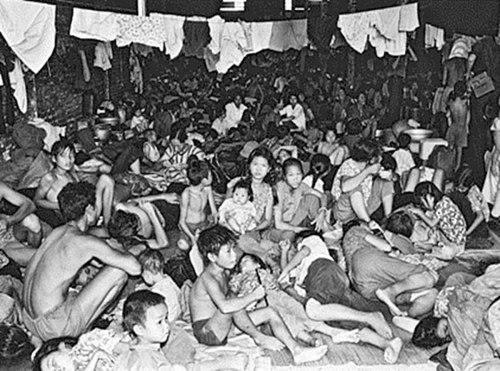
Photo of Vietnam Refugees at Guam found at afsa.org

Alive and kicking

Heat blasts my cold skin
Cicadas blast my eardrums
Hot sun beams relentlessly
Plays hide and seek beneath
Green trees gasping for air

Climbing the baby hill
My heart speaks to me
Sensations from the past
Flood memory banks
All is well that ends well

Park maintenance crew
Arrives pulling a trailer
Full of noise makers
They greet me politely
I nod and return the favor

Just yesterday I froze in church
From the crown of my head
To the soles of my feet
Air conditioning for the young
Of which I am not one

Warmed by my husband’s body
Cheered by a hot sermon
More than satisfied with a crumb
Dipped in grape juice
I return to my seat

Grateful I’m still alive and kicking
This hot summer day in August
Out and about to survey
The landscape and forms of life
In my corner of the world

© Elouise Renich Fraser, 6 August 2018
Photo found at flickr.com

The air of early August

Sights and sounds of life
Fill this morning’s dense humid air
Gray and white clouds sail across blue sky

Gentle breezes persist
Carrying the voices of children
On a mission in the park
Earnestly they discuss strategies
For climbing the maple tree
Towering above them

A woman heavy with child
Drops off a friend heavy with back pack
And her young toddler eager
To climb steps on the playground gym
Preparing for those Mt. Everest trees
Waiting on the perimeter

All of us serenaded
By a chorus of birds and cicadas
Rising and falling in concert
On the air of early August

Just a few observations from my morning walk. Plus a downloaded photo of a butterfly bush plus butterfly. I walk by butterfly bushes nearly every day. Lots of lovely blossoms, but not many butterflies yet.

Being a sometimes teary sort, I’ll admit to getting the sniffles when I saw children playing in the park. A reminder of how quickly life comes and goes, taking us with it.

I don’t know if there’s a secret to living with joy and gratitude. I am, however, certain butterflies and children can show me the way when I’m willing to have a childlike heart. Which is all I’m asked to have in the presence of the One who knows me best.

Elouise

©Elouise Renich Fraser, 3 August 2018
Photo found at almanac.com

Dealing with Apathy | Dear Mr. Trump

On August 1 I wrote the post below. It’s in the form of a letter to Mr. Trump.

Then I decided not to hit Publish. Why? Because I began hearing a small, nagging voice: It won’t make any difference anyway. Why bother?

So I didn’t trash it. I kept it, and looked at it yesterday. Still no joy in posting this. So I didn’t.

Yet if I’m not clear and open about what I’m experiencing as a citizen of the USA, I’ll completely lose my nerve. The unthinkable will merge into the thinkable even when it isn’t. Or worse, I’ll just give up and fall into that bottomless pit called Apathy.

I’m not one to let things go. Especially when they’re important to me. So I’m posting this for my sake. It’s also my way of standing with others still figuring out their own journeys through this alien landscape, uncertain what’s coming next.

As a follower of Jesus Christ, my hope is not now and will never be built upon Mr. Trump’s performance–past, present or future. Or on the performance of anyone else in any administration, national, public or local.

____

Dear Mr. Trump,

I see you’re distressed yet again about Robert Mueller’s ongoing, legally-authorized investigation. Yet again, you’re asking the Attorney General of the USA to halt Mueller’s probe.

I also observe that you don’t enjoy being an onlooker who is unhappy with the way someone else is doing his or her job. Perhaps you’re also afraid of what this might mean for you or someone close to you somewhere down in the road.

In any case, I respectfully remind you that every day we wake up, every American–whether she or he voted for you or not–must live with the reality of your administration.

Please demonstrate your trust for the man you hand-picked to be Attorney General of the USA, and let our justice system do its work without interference from the top.

Respectfully,

Elouise Renich Fraser
Citizen of the USA

©Elouise Renich Fraser, 1 August 2018 and 3 August 2018

Doing it My Way

Well, here I am a week later, learning to focus on thing I know I can enjoy right now. No matter what comes next.

Several days ago I decided to  list many items as I could think of. Not a bucket list of things to do before I die, but a list of things I want to enjoy as much as possible right now.

I won’t bore you with the full list, which is still growing. I do want you to see, however, that I’m in full Do It My Way mode! Sometimes I laugh out loud when I’m reviewing the growing list. And sometimes I tear up.

So here goes–a selection, beginning with the first item that popped into my head.

  1. Cooking for myself, My Way! Possibly the most important item on my list. The thought of handing over my diet to rank amateurs or know-it-alls is unthinkable.
  2. Cleaning out my dresser drawers, closets and a few other hiding places. Why? Because I don’t want ANYBODY to see what’s there, unless it counts as Something I Cannot Do Without.
  3. Dressing myself each day all by myself, in clothes that are comfortable and attractive to me (not necessarily to you).
  4. Taking care of ALL personal hygiene needs. You might try imagining what it’s like to be happy doing these things….
  5. Getting out of bed at night to look at the moon, the planets and the stars
  6. Reading poetry written by others and by me
  7. Writing poetry
  8. Having a sense of where I am and what time it is, and enjoying the rhythms of each day
  9. Feeling connected to items in our home–where they came from and why they’re important to me
  10. Recognizing myself in the mirror
  11. Knowing how to call 911 in an emergency
  12. Remembering and recognizing the faces of my family members and friends

Small things that make up my life. Things I can enjoy, appreciate and take note of every day. Not because disaster might come in a certain shape, but because life itself is precious, and all I can count on is what I have today.

Thanks for reading!
Elouise

©Elouise Renich Fraser, 31 July 2018
Image found at grandmalin.wordpress.com

I have not told my garden yet

This poem from Emily Dickinson caught my eye this week. I found it in a volume of her poems for young people. Nonetheless, I heard it as an adult poem about adult pain. My comments follow the poem.

I have not told my garden yet,
Lest that should conquer me;
I have not quite the strength now
To break it to the bee.

I will not name it in the street,
For shops would stare, that I,
So shy, so very ignorant,
Should have the face to die.

The hillsides must not know it,
Where I have rambled so,
Nor tell the loving forests
The day that I shall go,

Nor lisp it at the table,
Nor heedless by the way
Hint that within the riddle
One will walk to-day!

Emily Dickinson: Poetry for Young People, edited by Frances Schoonmaker Bolin, illustrated by Chi Chung. Published by Sterling Publishing Co. (2008)

This poem is about death: Emily’s preoccupation with death, and her own death. Whether final or as daily reality. Each stanza adds depth to her poetic riddle.

Stanza 1. Emily thinks about her garden, the place that brings her happiness and peace. It seems she’s afraid she might not survive breaking the news, though we’re not yet certain what the news is. It’s clear this won’t be easy or happy news. Not for the garden, the bee, or her.

Stanza 2. Emily thinks about village shops that stare at her when she’s out and about. There she’s known as shy and perhaps ignorant. She has no intention of letting the shops know her plans. They wouldn’t believe that she, of all people, would have “the face to die.”

I take this “face to die” as setting her face toward death, which she names in the last line of the stanza. She faces death with determination, perhaps the way Jesus ‘set his face’ toward Jerusalem—the city in which he would die.

For Emily, it doesn’t matter what the shops or shoppers might think about her. She’s stronger than she’s given credit for. Indirectly, she’s saying they don’t know her at all. So why should she tell them anything at all about her “face to die.”

Stanza 3. Emily now thinks about the hillsides and the forests. She loves both settings yet determines to keep them in the dark. It seems that if she doesn’t tell the hillsides about it, they won’t tell the forests. Perhaps they’ll think she doesn’t love them anymore? Or perhaps the hillsides and forests will die of sorrow?

The verb ‘rambled’ has more than one meaning. It could mean rambling around in the woods, as well as the rambling of Emily’s voice speaking freely to the trees and hillsides. Not to ramble anymore would be a great loss for them and for her. Here she can speak out loud freely and directly. Yet she isn’t going to tell them the day she’ll “go.”

Stanza 4. Finally, Emily has no intention of talking about this at “the table,” which I take to be her family circle. Not even in what we might call baby talk that’s less than clear. She’s also determined not to suggest that “within the riddle” is a hint that “One will walk to-day!”

The last stanza seems to have two meanings: one about her family circle; the other about the poem itself. Which has me wondering whether this is ‘only’ a riddle, or a veiled clue to her unhappiness and desire, if not clear intention, to “walk to-day.” To die to her family and her beloved garden, and never return. A form of death no matter how you read the poem.

I don’t know whether Emily wrote this poem before or after she wrote I Years had been from Home. I do know these are the words of a woman in distress who chooses to tell the truth but tell it slant.

Yes, my heart goes out to her. Emily has a level of courage I haven’t often seen or heard in this life.

Thanks for visiting and reading, and leaving your own interpretive comments or questions if you’d like.

©Elouise Renich Fraser, 29 July 2018
Photo found at correntewire.com