Telling the Truth

connecting the dots of my life

Category: Spiritual Formation

rising far above

rising far above
earth’s chilling chaos
the sun smiles warmly. . .

inviting me to bask in its light
instead of teetering on the brink
almost but not quite addicted
to insurgent adrenalin
coursing through veins and heart

chaos begets chaos of similar
proportions while inhumanity
goes for the jugular of decency
draining me of common bonds
erased by more urgent notifications

arriving by the millisecond
I emit gasps of horror about
this or that gross inhumanity
perpetrated against him or her
or us or them here or over there

breakdowns firings and hackings
poisonings fake smiles and killings
threaten to deliver our undone humanity
to the evil we deplore yet cannot
banish from titillated eyes and ears

rising far above
earth’s chilling chaos
the sun smiles warmly. . .
inviting me to bask
in its healing light

©Elouise Renich Fraser, 19 March 2018
Photo by David Henke, found at suburbanphiladelphiarealestatenews.com
Sunrise over the Delaware River on Easter Sunday 2011

the red cardinal

the red cardinal
sings his bright clear spring song
perched on bare branches

When I published my first post, Dear Dad, on 27 Dec 2013, my voice was anything but bright and clear. Singing was definitely out of the question. As a survivor of childhood PTSD, I used an elaborate strategy of calculated silence and half-truth.

How much did I owe the world? How much did I owe my family? How much did I owe the church? My father was a clergyman. Revered, respected, loved and sought after by people with sorrows such as mine.

But I wasn’t one of his followers. I was the first-born of four daughters. I had to watch my tongue constantly. Smile when expected. Stifle tears. Do as I was told. Set an example. And take the beatings like the contrite spirit I was not.

Breaking my silence of decades took decades. It started when I was in my 40s, with trips to Al-Anon meetings for five years. There I learned to relax and share things I’d never told anyone. Then I worked with an intern therapist who helped me complete a genogram (family tree, with notes). Finally, in the early 1990s, I began working with a psychotherapist with whom I’m still connected.

I put in hours and years of work. Did tons of homework. Cried buckets of tears. Filled unnumbered journals with dreams and personal entries.

Yet my recovery isn’t measured in months, years or numbers of pages written in journals. It’s measured in my voice. At first feeble, halting, self-conscious and terrified. Beginning with my husband and immediate family, then with my sisters and parents, slowly but surely with several trusted friends, and finally, a few years before I began blogging, with my large extended family on my father’s side.

My voice is the measure of my recovery.

Regardless of the weather, the political climate, or my health, the question is the same: How free am I to tell the truth? That’s the thermometer that matters.

I’ve always cared about issues that have to do with women. I used to think that getting a decent academic position would somehow ‘prove’ my worth. Or set me free. Especially if I was granted tenure.

Well, that wasn’t my riddle to solve. My riddle was my voice.

I began blogging because I knew it would challenge me to tell the truth freely, with words chosen by me, not by someone else.

So the little red cardinal outside my window caught my attention. The ground was covered with snow, and the laurel bush had been beaten down by more than one Nor’easter. Yet the little red cardinal was singing his heart out. Freely. Telling his truth about life and announcing his territory and the hope of spring.

Though I’m a follower of Jesus, I don’t believe this makes my life easier. In fact, I’d suggest it makes it more difficult because it means both living and telling the truth. Especially when it’s most unwelcome or unexpected.

Many thanks to Candice for this topic! Though I’ve already written elsewhere about this blog, this is another way of looking at it. Equally true and challenging.

© Elouise Renich Fraser, 17 March 2018
Cardinal duet found on YouTube

Attic Memories

The attic is bare, and our downstairs spaces are now crowded with boxed books, old photos, cards, letters and files. They’ve invaded the basement and every room below the attic. All this because it’s time to give the attic a new life. After a bit of dry wall repair, painting, carpeting, and a handrail on the attic stairs.

D began the project weeks ago, sorting things out. Keep, toss, or give away. Especially books. Academic books occupied at least 75% of the attic. In rows, like a library. His and mine going back to our college years. Scholarly, earnest, serious books we used as students, professors or administrators.

During the last two days I spent most of my time in the attic, going through my piles of accumulated evidence and memorabilia from teaching, travel and family life.

Here are things that made me teary, exhausted or both.

  • Seeing how many places D and I visited for vacations or professional trips. Takeaway: Marrying D was a great way to see and hear about the world.
  • How many postcards I’ve purchased as a way to bring some of our travels home. Though they’re small, they remind me of more than appears on the postcards. Keepers.
  • Reminders of my large extended Renich family. Sadly, I don’t anticipate more official Renich family reunions. I loved looking through old reunion photos and family newsletters. More keepers.
  • My long emails to Diane when I visited Kenya for the first time (1997). I was terrified Diane might die (of ALS) while I was gone. I also wanted to take her with me in my emails. I wanted her to see in her sharp mind’s eye exactly what I was seeing. Irreplaceable.
  • How many recorded notes I kept over the years. Formal and informal. Back then it was about having a written record of appointments, meetings, interviews and important events. I didn’t trust my memory. But I did trust my bankruptcy court note-taking skills. It also helped me keep my listening and observational skills sharp. No, I didn’t keep all the notes. And yes, it gave me little pangs when I let most of them go.
  • I was astonished (if not exhausted) at how many students touched my life. And the wild, wide diversity of countries and cultures they brought into the classroom. Not in an online setting, but in person. Many struggling with English as a second language. Many going through life crises and changes in professional status. Too many now gone from this life. And many I probably wouldn’t recognize if I saw them today.

Despite the emotional and physical exhaustion of the last few days, I’m grateful for this look back into a world I won’t experience again. Sometimes it’s difficult being on the outside. Still, I don’t want to go back. I love life as it is—even though it’s not always neat and tidy.

©Elouise Renich Fraser, 16 March 2018
Photos taken by DAFraser

Women against Women

Quaker Woman Preaching in New Amsterdam

It’s the late 1970s in Nashville, Tennessee. I’m a religion student at Vanderbilt University, studying for my Ph.D. The pastor of my United Presbyterian church has asked me to preach on Women’s Day. It’s my first sermon ever, and he wants me to preach about women’s issues and women’s liberation.

I worked hard putting together a lively sermon, then shook in my trousers as I stood in the pulpit and delivered the goods. Because there were a number of ‘liberated’ women in the congregation, it never occurred to me that I would get any kickback.

Indeed, comments and hugs after the service reassured me that all was well.

I was wrong. One of my best female supporters was seething with rage. She was older than I, highly educated and married to a professor. She didn’t hesitate to speak her mind to our pastor and to me.

My sermon sounded angry, and I wore trousers in the pulpit. I also think she might have liked to preach a sermon herself. Not only was she highly educated, she’d been a member of the church longer than I. Why had I, a relative newcomer, been singled out?

Fast forward to my first year of teaching at the seminary. It’s spring 1984. I’m in Philadelphia, teaching at a multiracial, multicultural seminary that has over 30 percent women students. I’ve been invited to speak to the Women’s Auxiliary, a group of faithful, diligent, smart women who support the seminary in dozens of ways, including fundraising efforts.

We met in a parlor-like room. The group included many pastor’s wives who had been around the seminary for years. I’d been asked to talk about myself and how I see women fitting into the work and mission of the seminary.

When I finished, we had time for discussion. Though most of our conversation was constructive and positive, I’ll never forget one woman’s painful, angry comments.

Here I was, younger than she, teaching at the seminary. And here was the seminary supporting women for ordination. And here was the Field Education Office, wanting to send a young woman to do her field education work under the supervision of her husband.

And here was this older woman, educated, experienced and clear about her role at the church as the ‘first lady.’ In fact, she believed she could have been a pastor. She was probably correct.

Nonetheless, she didn’t want seminary women working with her husband, taking over the place that rightfully belonged to her as his spouse. She didn’t trust women, including the women at the seminary. Over the years she had found a way to make space for herself in ministry without the “Rev.” and all the trappings that go with that. I’ve sometimes wondered whether she trusted her husband, the pastor.

I’ve seen this anger many times in older, well-educated, even brilliant women who for many reasons never followed their dreams. How sad when we make it women against women instead of holding each other and weeping for what we’ve all lost.

The valley of the shadow of death runs deep through the history of women against women. And still threatens to undo us.

©Elouise Renich Fraser, 13 March 2018
Image  found at marybarrettdyer.blogspot.com

warming to the sun

I

warming to the sun
thick snow relaxes
its grip on winter

II

listening to silence
broken by heartbeats
I hear God calling

III

when least expected
the tired old dam bursts
sweeping me away

What is this strange season? Just when I think I’ve got it, I have nothing. Nothing but unformed words that want to be written.

No great prospects for anything in print. Nothing but words that point in a direction I know rings true, but cannot capture.

Elusive as air, what I want to say comes and goes through my heart. Scattered clouds of connections and insights of a semi-experienced warrior feeling her way along.

I trust my heart and my fingers to find my way in this uncharted wilderness. Breathing deeply, I relax my mind and body’s fierce grip on wornout habits of self-preservation.

©Elouise Renich Fraser, 12 March 2018
Image found at walldevil.com

For all the women I have loved

During the last few months I’ve been going through old teaching and administrative files, carbon copies of reference letters I wrote decades ago, boxes of notes and cards you sent to me, and old directories with head shots of students, faculty, and church members. More than once I’ve been reduced to tears.

Several years ago I made a list of women whose lives made a difference in my life. It was so long I had to stop.

This is ironic, since most of my life I’ve been beholden to men. They were or might one day become my gatekeepers. It was important to treat them well and with due deference. Most were white. A precious few were interested in my future instead of their own and how I would help them get there.

Yet I was born into and grew up surrounded by women who cared for me no matter what. They didn’t all have motherly skills, but each had something to give me. Something to pass along that would help me grow—if I could only relax into the role of learner.

Today’s post is for all the women who were and are my shining stars —

  • my sisters, daughter, daughter-in-law, granddaughters
  • my mother, cousins, aunts, grandmothers and great-grandmother
  • classmates, playmates, teachers and faculty colleagues
  • committee members, informal kitchen cabinet members
  • therapists, doctors, nurses and external consultants
  • accomplices in strategic disobedience and brilliant projects
  • pastors, church friends, workplace mentors, friendly enemies
  • puzzling combatants, bright stars, struggling survivors
  • angry recipients of insults and injury
  • new mothers fighting isolation and depression
  • aspiring preachers and teachers finding strong voices
  • devastated applicants turned away due to marital status or fear
  • determined women moving ahead against all odds
  • heartbroken wives whose husbands just walked out the door
  • heartbroken mothers who just lost a child or baby or husband
  • tearful survivors of trauma in need of help
  • closeted lovers of women not sure where to turn for help
  • gifted women passed by in favor of an average male applicant
  • poets, writers, musicians, preachers and teachers
  • drama queens, dreamers and world-changers

Like a galaxy of stars, you are brilliant in my life. Scarcely a day goes by without one of you showing up in my heart. I’m so glad I kept all those notes, cards and sometimes silly photos. Reminders that the history we made, no matter how small it seems today, still matters.

With respect, love and prayers for history-making women everywhere,
Elouise

©Elouise Renich Fraser, 9 March 2018
Photo found at galeri.uludagsozluk.com

misaligned | Int’l Women’s Day

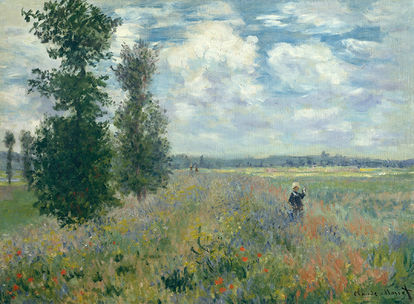
Claude Monet, Poppy Fields near Argenteuil
in the waiting room
perfectly aligned paintings
greet the misaligned

I’m back at the physical therapy center, sitting in the waiting room. Directly across from me, above a row of chairs, hang two huge paintings. Doubtless chosen for their ability to calm and reassure patients bearing all kinds of physical misalignments. Most are women.

The paintings are meticulously hung and feature lovely outdoor scenes. Expansive, bucolic and natural without being overly sentimental. Unobstrusive  gentle colors and bright sunshiny days.

Nothing to rattle our nerves or make us wonder about untold stories or what might happen next. No storms brewing in the background. No signs of aging structures or broken-down bridges. All is serene.

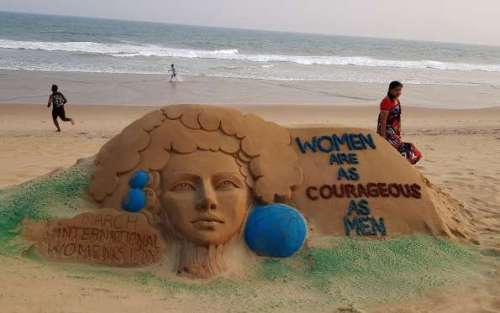
The haiku, written several weeks ago, came to mind this morning as I scrolled through photos celebrating International Women’s Day. If even a few of these photos were hung on walls in our public spaces, what would happen? Here are three that caught my eye.

Bhubaneswar, India – Sand Sculpture by Manas Sahoo

Thane, India – Fashion Show by Acid Attack Survivors

Dhaka, Bangladesh – March in support of Int’l Women’s Day 

Never underestimate the power of women. Especially when we’re in one accord on just one thing we all know we need. Equal status as human beings.

This means equal status in a society that honors each woman and girl as a full human being, regardless of color, country of origin, economic or social class, religion, or marital status. Not a fraction of a human being, but 100 percent human. Welcomed into every room in the house without having to wear masks, special clothes, smiles or makeup on our faces, or anything that signals we are less valued than men or boys.

© Elouise Renich Fraser, 8 March 2018
Monet painting found at quadrosetelas.com.br
International Women’s Day photos found at Getty Images

The Afflicted

~~~Simone Weil in Marseilles, early 1940s

This quote from Simone Weil got my attention this morning. Especially in these days when we’re exhorted to reach out to each other. It all depends….

The capacity to pay attention to an afflicted person is something very rare, very difficult; it is nearly a miracle. It is a miracle. Nearly all those who believe they have this capacity do not. Warmth, movements of the heart, and pity are not sufficient.

Simone Weil, Waiting for God

Are we ready for affliction? Ready to experience it? Prepared to live and die with it?

I’m talking primarily, but not only about we the white people of the USA, narrowly defined by political and religious affiliations. Are we ready?

Or are we still hanging onto our bootstraps mentality. Proud, tall and lily-white. Still finding it difficult if not impossible to attend to the afflictions of strangers or even acquaintances.

Perhaps we’re afraid we’ll look into the mirror of their afflictions and discover our own afflictions. Or worse–the source of their afflictions, carried in us like a deadly live virus all dressed up in fancy clothes.

During this period of Lent, the afflictions of Jesus show us the truth about ourselves. He was afflicted, and though we may have felt sorry for him, we wrote him off.

Isaiah 53:3 (New Revised Standard Version)

He was despised and rejected by others;
a man of suffering and acquainted
with infirmity;
and as one from whom others hide
their faces
he was despised, and we held him of
no account.

Perhaps the true leaders of tomorrow will be the afflicted. Those of no account. Even though they have experience, skills and knowledge we’ve discounted for generations. Strangers who have survived among us for decades with affliction as their constant companion. Even in so-called safe spaces.

As a follower of Jesus, I have one Savior. I am also, however, surrounded by a great cloud of witnesses I haven’t heeded. Virtual strangers. Women, men and children whose everyday lives are layered with affliction.

What does it mean to give an afflicted person my full attention? Have I ever done this?

Questions like these are on my mind as we witness the painful removal of legal requirements, funding sources, and small islands of hope and trust that helped level the playing field for the last several decades.

This strange never-never land may not end well. Nonetheless, I want to end with a bang, not a whimper.

©Elouise Renich Fraser, 6 March 2018
Photo found at http://www.nybooks.com

wild nor’easter

wild nor’easter
whiplashes its way
through the night

And we aren’t even at the center of the storm. Fury comes to mind. Along with chaos, heavy wet snow, traffic at a near standstill, unpredictable wind gusts and icy cold. Our  generator has run since about 6pm last night. The sun is out and the damage is visible. Not much in our yard, but a mid-size tree fell during the night, roots and all, across our neighbor’s driveway. It was chaotic.

I can’t help thinking about our President and the current state of our disunion. Chaotic. I know…some think chaos is inevitably linked to creativity. Perhaps it is.

I think of it as a sign of breakdown that may or may not end well. Especially when chaos comes to dominate the multiple pronouncements, tweets, behaviors, faces and voices of POTUS. It’s so all-encompassing that I’m tempted to expect and demand nothing better. Or adjust to it as the new normal.

Many years ago, for three seemingly endless years, I had a Dean who thrived on chaos. The kind he created around himself and across the seminary daily. I remember vividly the day I figured out how to comport myself in his presence.

  • Say as little as possible.
  • Don’t answer questions about any of my colleagues.
  • Stick to the point and get out the door as quickly as possible.

That day I knew exactly who was in his office before I went in for my appointment. It was someone I worked with often, and depended upon as a faculty colleague. Almost as soon as I sat down across from the Dean’s desk, he began asking questions about the colleague who had just left the room. I refused to answer, and got my agenda on the table.

I also knew that the moment the next person walked through the door, the questions would be about me. Indeed, he found ways of gathering bits of information and turning them to his own benefit. I knew I was on his hit list, as were several other colleagues.

There had been a warning sign I missed the very first day I met him. I was on the search committee tasked with finding candidates to be our next dean. He was one of several we interviewed in person.

He didn’t know me prior to that day. Yet the moment he walked into the committee room he broke out into a great big smile, came straight over to shake my hand and tell me how much he had heard about me and how much he was looking forward to meeting me. Indeed. Had I only realized….I’d just met another version of divide and conquer.

Through a series of unexpected events, he became our Dean and left us broken and divided as a faculty, not sure what had just hit us. We were reluctant to talk with each other about it until he was gone and we knew we were in safe space away from the seminary.

I credit our interim Dean for calling us together in a hospitable setting. Many, including me, carried unexpressed shame, anger and tears that broke out when we met to process what had happened.

Never again. Chaos as a management technique was like living hell. I’d rather endure a fierce Nor’easter any day or night.

©Elouise Renich Fraser, 3 March 2018
Photo found at news.wgbh.org – January 2018 Nor’easter off the East coast of the USA

The Divide and Conquer Club


Thanks for visiting and commenting on Misfit and Misbehaving. And a big thank you to John in Australia who linked his blog to the post.

My grade-school experience began in my home. My father was the consummate divide and conquer ruler of the household. He made the rules. He called us out on the rules. He was the judge, jury and executioner of punishment. Four daughters. No sons.

My father ran a full-circle, all services provided under one roof enterprise. His best ally was my mother who couldn’t afford to go against him. She was already a wounded warrior—not just because of polio and its aftermath, but because of her own childhood deprivations and humiliations.

We four daughters learned early to survive by way of dividing and conquering. All we had to do was join forces against one of us. It worked wonders. The other way we survived was by not talking to each other about what was going on in our family. It was against Daddy’s Rules. No secrets. No chatter at night after lights out. No comparing notes or comforting each other. No plans to go against Daddy’s Rules.

What happened in my grade school classroom was a version of what I already knew. Only this time it was in a setting I perceived as safe. So much for safety.

The tactics of divide and conquer are so familiar we scarcely perceive them. Whether consciously or not, they cause division and divert attention from what’s really going on. Thus the divider has things his or her way.

Without knowing it, the girls in my classroom were reinforcing values of the upper class. Clarifying the dividing line between us and them. That may sound simple, but the other side of divide and conquer isn’t all that complicated once we understand how people abuse power and to what ends.

I’ve also experienced this in churches and in academic settings. It happens everywhere, often in ways that seem innocuous or even praiseworthy.

In the USA today, I see this tactic as a deadly weapon of non-warfare. No one wields it so skillfully right now as POTUS—with the possible exception of Russia.

But the subject I care most about is women. Women of all colors and nationalities have experienced the tactics of divide and conquer in the home and in workplaces, churches, organizations, academia, the government, human trafficking, prisons, retirement homes, and any other setting in which women work or live.

This constant division serves the interests of white male supremacy, not the interests of women no matter how fancy the rhetoric sounds. It’s no accident that the USA is steadily falling behind other nations when it comes to women having access to all levels of government, healthcare, and other vital services.

It pays, it seems, to keep women in their place. Especially if we do this by promoting them. Feeding them a little of what they want and watching them fight over it, while withholding equal and proportional participation in deciding what that is.

Not every male is a white supremacist. However, without women banding together across significant divisions, all the men in the world with good and noble intentions will never save us. We must speak and act for and with each other.

©Elouise Renich Fraser, 2 March 2018
Cartoon found at mikenormaneconomics.blogspot.com