Telling the Truth

connecting the dots of my life

Category: Writing

The Shape of Forgiveness | Part 1

My deceased father, an ordained clergyman, has been on my mind for the last several weeks. Especially the way his behavior toward me still affects my life.

I began blogging over three years ago because I was ready to break my silence. I wanted to tell the truth. Not just the truth about what happened to and within me back then, but the way it shaped the woman I’ve become.

If you haven’t read my earliest posts, I invite you read these, published over three years ago: Dear Dad and Rituals of Submission: Part 1 and Part 2.

Forgiveness has also been on my mind in the last few weeks. The topic almost always comes up when I describe my life as a child and young teenager.

My friends are concerned for me. It’s important, even necessary that I forgive my father. The sooner the better.

  • For some, this is the key to God forgiving me. Indeed, if I cannot forgive another human being, why should God forgive me?
  • For others, it’s important so I can ‘move on’ with my life. This means not getting stuck dwelling on this negative part of my life. Or at least not making it the leading theme of what is, after all, ‘my’ life. Even though it’s impossible for me to conceive of ‘my’ life without multiple connections with my father.
  • For friends who aren’t wired the way I am (an INFJ from way back and very happy, thank you!), forgiveness seems a reasonable exercise that would break the power of the past over me. By putting ‘his’ voice in one column, and ‘mine’ in another, I would simply clarify the truth and get on with my life. Almost like starting over with a blank slate. It sounds lovely; yet it isn’t true to reality as I experience it.

I appreciate each outlook. Yet I still get hooked by self-destructive attitudes and behaviors that arise daily.

  • My responses to these situations are rooted in my father’s attitudes and behaviors toward me.
  • Yet they seem to be my own beliefs and assumptions about myself.

Finally, I often wonder whether I can or need to forgive myself. If so, what would that look like?

As I see it, forgiveness isn’t a spiritual, intellectual, or strategic decision made once for all. It’s about my whole being and will take a lifetime. I face multiple opportunities each day to let go of my sometimes frantic desire for security and survival, affection and esteem, power and control, and my desire to change a situation.

A broken clay pot can’t be made whole by gluing it back together. No amount of glue will make it new. It’s still a damaged, cracked clay pot. The only way to repair the damage is to return the pot to the furnace, melt it down, and tenderly begin reshaping it. Not as an act of terror—though the process is terrifying—but as an act of love, acceptance and healing.

Time doesn’t heal all wounds. What might healing look like, and what kind of forgiveness would it take?

Thanks for reading, listening with your hearts, and commenting if you’d like.

To be continued….

© Elouise Renich Fraser, 1 April 2017
Image with quote found at wordsofbalance.com
My Horrible Night

Last night I was restless, unable to fall asleep for too many hours. So I got up for the 5th time that night, went into my office, opened my journal and wrote whatever came into my head. No, I won’t bore you with all of it. The excerpts below capture what was going on in my head and heart.

First time in months that I’ve had this much trouble going to sleep. . . .Not sure what to think or feel.

~~I let go my desire for security and survival.
~~I let go my desire for esteem and affection.
~~I let go my desire for power and control.
~~I let go my desire to change the situation.

I welcome this wakefulness; I consent to it; I’m listening to it.

It’s a reminder of how unpredictable and uncontrollable my life is. A reminder that even with all my good efforts, things don’t always go smoothly. A reminder of what it feels like to have too much cortisol going through my body at this time of night. . . .

My day didn’t have much rest. Lots of time spent on writing, food preparation, shopping for food, an outdoor walk, supper and a movie we watched early in the evening….

No lying down for a little nap, and no time out until late for reading or practicing centering prayer. I think my body and soul feel neglected – perhaps tired of being put on hold in favor of the next blog post, news item or internet search….

I want to learn to pour compassion, not contempt, on all my pride – as a writer, as a professional, as a together lady – a self-contained choir of one….My world seems very small, even though my external connections are many.

I want to be in the choir. Not to be famous, but to enjoy the ride! To feed my soul, my heart, my ears! There’s so much beauty in Your world. I want to be there in it, whatever form it takes….

I know You love me and are surrounding me even in my discomfort and restlessness. …

Be in my sleep and in my wakefulness –
Surround me with Your presence and peace.
Now and forevermore –
Amen

I’m happy to say I fell asleep right away.

The line about pouring compassion, not contempt, on all my pride ran through my mind all day. God doesn’t pour contempt on me or my pride. So why would I pour contempt on my pride, much less anyone else’s pride?

I don’t know how other people came to be as they are. More important, I like myself better when I practice compassionate self-care. Without being too proud to ask for help, of course.

© Elouise Renich Fraser, 31 March 2017

The treasure we are

….when our hearts are free. Take a look and a listen. My comments  follow.

What would it take for me to be so free and focused? There’s no magic formula for what this pastor and his choir accomplished. What mattered was hard work, determination, shared vision, faithful allies and free spirits. Plus a Visionary Shepard who showed the way, encouraged, directed, reminded members of the goal, and participated in every painful, joyful step. Without apology, reticence, or pretense.

And what about us? There aren’t any short cuts. No magic wands. No overnight miracles. Just tons of practice plus the vision of becoming the treasures we are. Not alone, but alongside our Visionary Shepard. Each of us embodied treasure poured out freely, regardless of the high cost. Which, it seems, is full investment in a process that’s already taking us places we never dreamed we would go.

© Elouise Renich Fraser, 30 March 2017
Clip from Britain’s Got Talent, found on YouTube

Response to WordPress Daily Prompt: Fortune

Defending My Space

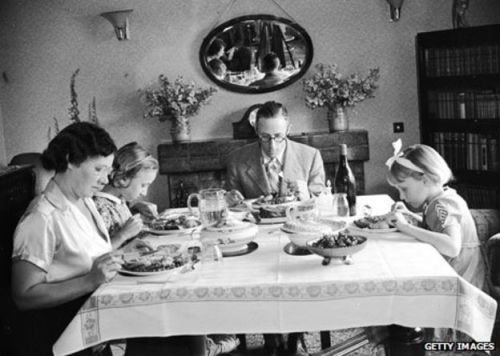
I’m about eight years old. I’m sitting at the dinner table, just around the corner from my father. The table is set, the food is spread before us, and we’re all in our seats waiting to begin. We haven’t yet asked the blessing. I’m playing with my dinner fork, just to the left of my plate. I’ve moved it a few inches away from my plate.

My father’s voice interrupts me. “Elouise, put the fork back where it belongs.”

I move it to the right, in the direction of my plate. “Elouise, put the fork back where it belongs.”

I move it slightly closer. My father’s voice remains firm and controlled. “Elouise, put the fork back where it belongs.”

By now my sisters are watching to see what will become of me. My mother is silent. This has become an event. Slowly I raise my hand to my fork and move it ever so slightly closer to my plate.

My father persists. So do I. Many repetitions later he’s satisfied; the fork has been returned to its proper place.

He proceeds with the blessing. He doesn’t know what I know: the fork is ever so slightly to the left of its proper place.

My father’s mission as a parent was to train us to keep the rules. My mission as his child was to break and keep the rules simultaneously.

Back then, perseverance meant getting through another day, using whatever survival skills lay close at hand.

If my father was persistent, I would be more persistent. If outward rebellions were too costly, I would invent creatively invisible yet superbly effective inward rebellions. If I was ordered to sit down and stop talking, I could continue standing and talking on the inside for as long as it took to comfort myself.

Indeed, this was the better way. In the private spaces of my mind no one could put me down, refuse to listen to me or try to break my will. In a family system intent on turning out obedient daughters, I survived by being secretly disobedient.

This memory from the 1950s, published nearly 20 years ago, is as vivid today as it was then.

The territory I defended was interior. I applaud the little girl who figured out how to do this. Nonetheless, my efforts were costly. They required constant vigilance, no matter where I was.

Abuse of power destroys safe space. It expects and demands behaviors, words, looks on faces, subtle and open signs of unquestioning and subservient submission.

What does it take to create and maintain safe space? Not just in our marriages and families, but in neighborhoods, nations, churches and schools? And how does my personal history connect with the racial history of the USA?

© Elouise Renich Fraser, 29 March 2017
Photo of 1938 family dinner found at bbc.com
Story excerpted from my book, Confessions of a Beginning Theologian (InterVarsity Press 1998)
Response to WordPress Daily Prompt: Territory

Some keep the Sabbath going to Church —

This poem from Emily Dickinson makes me smile every time I read it. My comments follow.

Some keep the Sabbath going to Church –
I keep it, staying at Home –
With a Bobolink for a Chorister –
And an Orchard, for a Dome –

Some keep the Sabbath in Surplice –
I just wear my Wings –
And instead of tolling the Bell, for Church,
Our little Sexton – sings.

God preaches, a noted Clergyman –
And the sermon is never long,
So instead of getting to Heaven, at last –
I’m going, all along.

c. 1860

Emily Dickinson Poems, Edited by Brenda Hillman
Shambhala Pocket Classics, Shambhala 1995

From about 1860 until her death in 1886, Emily lived as a recluse, writing and serving as a caretaker for her family and servants. She left her family’s house only rarely. Today’s poem comes near the beginning of this prolific period of her life.

Imagine Emily looking around, seeing and hearing life in a great outdoor Orchard Dome. Perhaps leafy branches overhead? Like a cathedral dome, this one echoes with music–birdsong, a bell tolling and a soloist. And then there’s that noted Clergyman God, whose sermons are never long. Emily doesn’t need special Sunday clothes. She just dons her Wings and joins the chorus! Is she an angel? I doubt it. I think she’s probably a little bird. Perhaps the Bobolink?

The contrast is clear. Unlike others who keep the Sabbath by going to Church, Emily keeps it by staying at Home. Is this by choice, or due to the circumstances of her life? Probably by choice, temperament and the circumstances of her life.

In any case, Emily isn’t explaining or defending herself. Instead, she imagines a great advantage in her situation. She also suggests there’s more to Sabbath than meets the eye when we confine it to one day out of seven days. In fact, her situation is far better than the one-day-a-week slow track to Heaven.

Emily isn’t arguing a point of theology. Nor is she explaining why she isn’t showing up in church every Sabbath.

Rather, she celebrates God’s presence in the created world, and the delightful participation of all creatures great and small. As she sees it, she’s going to church daily in God’s outdoor cathedral! A mysterious world of truth that invites her to draw nearer to Heaven. Unlike the slow trackers, she doesn’t have to wait until the end to get to Heaven “at last.” She’s going there every day!

For me, this poem is about more than sunny days and a beautiful orchard. It’s also about more than Emily’s religious practices. I hear an invitation to view every day as a day of rest. A Sabbath. Why? Because Heaven is reaching out, wanting to connect with me every day. Not simply one day a week.

As for my part, I don’t need special clothes. I just don my Wings, retreat to the orchard, listen expectantly for nature’s music, join in when I feel like it, and listen to a short sermon from God. I, too, could be going to Heaven all along — with Emily! Even though I may never leave the house.

© Elouise Renich Fraser, 25 March 2017
Photo found at midewinrestoration.net

A Day! Help! Help!

I think Emily wrote this little gem just for today. Read on. My comments follow.

A Day! Help! Help! Another Day!
Your prayers, oh Passer by!
From such a common ball as this
Might date a Victory!
From marshallings as simple
The flags of nations swang.
Steady – my soul: What issues
Upon thine arrow hang!

c. 1858

Emily Dickinson Poems, Edited by Brenda Hillman
Shambhala Pocket Classics, Shambhala 1995

Emily Dickinson wrote this poem in the years leading up to the Civil War (April 12, 1861-May 9, 1865). I can’t help making a connection to what’s happening now in our country.

The short poem grabs my attention. There’s no such thing as an ordinary day. Like an arrow poised to fly through the air, each day arrives full of potential for Victory. Which I take to be a Victory for good. The good of all who dwell on ‘such a common ball as this.’

Common ball, you say? Doesn’t that mean a formal occasion focused on gorgeous apparel and elegant dancing? The kind of show that delineates the rich from the poor, the ins from the outs, the titled from the untitled?

Perhaps, but I can’t help noticing these are the years leading up to the Civil War, also known as the War Between the States. Or the North against the South, or vice versa.

And so I vote for the ball being this terrestrial ball. The planet on which we live. Or even better, this great dance of life to which all are both invited and entitled. A dance choreographed by our Creator, the true Host of the Party.

For me, the question is simple: Will I participate as a full partner? Or will I be relegated to the kitchen, the stables, the dungeon, or any other situation that keeps me in ‘my place.’

“Your prayers, oh Passer by!” Will each and all of us win together? Or will business return to business as usual?

I pray your day might be dated a Victory that bodes good for us all. No matter how insignificant your Victory seems to you.

© Elouise Renich Fraser, 24 March 2017
Response to WordPress Daily Prompt: Ordinary

Racial History and Denial

It began with conversation on a call-in National Public Radio show, “Indivisible Radio.” The topic was racism and protest. The conversation explored public protests. Why protest? Does it matter? Aren’t there so many protests now that it’s just a fad, if not a huge cacophony of meaningless sound?

One caller, a younger African American, described his personal commitment to ongoing protest. It was his way of life. His occupation. Though he didn’t give his age, he was part of the younger generation of black men whose lives are in danger every day.

The topic turned to the effectiveness of these protests. When you protest, what are you trying to accomplish? Do you think you can bring about change in the system or in the people on the other side of the protest?

He thought for a few seconds and then responded. “I don’t know if I can change them. I don’t want them to change me!”

He further explained that protest is his way of holding a moral position on behalf of change—for the longterm. If he became ‘one of them,’ they would win, and the long-term prospects for change would diminish. For the next generations, not for himself.

There’s much truth in this man’s wisdom. In my observation, most protests are attempts to change or control someone or something. Or they’re expressions of fear.

So what does this have to do with symptoms, much less racial history and denial?

Clearly, the proliferation of protest in the USA is a symptom of something. Or of many ‘somethings.’ For me, given the current state of our disunion in the USA, I believe it’s at least a symptom of denial.

We aren’t just in denial about what’s happening to our country, neighborhoods and presidency today. We’re in denial of our history as a nation.

History comes home to roost, especially when denied. Of many strands in our national history, I believe denial of our racial history is biting us, hobbling us in ways we don’t understand, putting it in our faces, doing whatever it can to get our attention. Individually and collectively.

We ignore it to our peril. This symptom isn’t going away. It cannot be dealt with quietly or in secret.

So I’ll be posting my thoughts on this from time to time, whether the WordPress Daily Prompt gives me a way in or not!

Thanks for listening and thinking about this with me. Especially if you care about our future as a nation among nations.

© Elouise Renich Fraser, 23 March 2017
Cartoon found at quotesgram.com
Response to WordPress Daily Prompt: Symptom

my heart skips a beat

my heart skips a beat
poised atop blossoming stems
ready to take flight
anticipation quickens
for this I was created

***

Turning words loose to go where they will
Clear about my identity and to Whom I owe my life
Introverted and grateful for it
Highly sensitive to winds of change
Sailing updrafts and downdrafts
Gliding and plunging
through the inexplicable logic of this universe
known only to my Creator
Taking an uncharted ride to places unknown
Giving wings to words

© Elouise Renich Fraser, 22 March 2017
Photo credit: DAFraser, April 2015
Longwood Meadow Garden, PA
Response to WordPress Daily Prompt: Acceptance

Crazy Happy Lady

For several weeks I’ve been thinking about end of life issues, wondering what my daily ‘plan’ is for getting from here to there. How will I order my life each day? I don’t own the time my Creator has entrusted to me. So how will I invest it?

Whatever chaos is, it’s the way I’ve experienced most of my life. A chaos of competing priorities, demands, expectations (yours and mine), rules and regulations, political realities….

I’ve spent years trying to get through and beyond chaos. Yet here’s what happened this past weekend.

From my journal:

It’s 3:30pm, Saturday afternoon. I’m not exercising in the house, not cleaning up the kitchen, not vacuuming, not playing music, not reading a book, not writing a poem, not going through files and piles, or anything else except this—showing up and writing this journal entry.

How I feel right now: weary, unmotivated, discouraged, somber….terrible. Wasting time. Trying to practice centering prayer yet falling asleep. Watching time slip away.

Do I enjoy this? I don’t think so, but sometimes I wonder. Perhaps this is more enjoyable to me than changing my habits.

…My most lethal enemy seems to be lethargy. A kind of glue that keeps me from having an active agenda of things I love to do.

My mind goes through tricks like these:

  • If I read a novel, I’m wasting time. If I play the piano, I’m wasting time. Can’t I see how much work needs to be done in the kitchen, the house, the attic, my office?
  • If I walk in the house or ride on my recumbent bike or bounce on the rebounder, it isn’t ‘real’ exercise—so why bother?

There’s a crazy logic here—if I do this, I won’t be able to do that. (Or it won’t count anyway.)

And then there are all those other good things I’m not doing that haunt me—

  • Sending notes and cards to friends who need encouragement
  • Vacuuming the house
  • Cleaning the curtains and windows
  • Weeding out unneeded kitchen utensils
  • Taking things to the Salvation Army or some other charity

Like I said in my last entry, I don’t have a plan for organizing my life. It seems all I do is make sure my food needs are met, wash laundry when absolutely necessary, rest and sleep enough, and do other maintenance work that demands my attention.

Later that same day (Saturday evening now), I was back to my journal. Here’s what finally broke through the chaos and lethargy and made me crazy happy.

From my evening journal:

The best part of today: posting this morning and getting tomorrow’s post ready to go. I can’t begin to express how important blogging has become for my growth and enjoyment. I’d even put it on the same level as walking out of doors. Even ahead of playing the piano…and reading.

Which led to my Crazy Happy Lady List of Priorities – things that top my list of things I love to do just for myself.

  1. Writing – if not for my blog, in my journal
  2. Walking – outside if possible, with no agenda but enjoying nature
  3. Music – playing the piano or listening to music I love
  4. Reading – poetry, novels, books that help me navigate my life
  5. Meditating — wherever I am, day and night

As for other activities,

  • As little as possible
  • As efficiently as possible
  • On an as-needed basis

Thanks for listening, and Happy Spring!

© Elouise Renich Fraser, 20 March 2017
Elegant Photo of Woman Writer found at salon.com
Response to WordPress Daily Prompt: Label

Strange Visitors


Unplanned events
Crash into my life
Force change and create confusion

Chaos
Leers at me
Foils attempts to ‘sort things out’

Indecision
Haunts my behavior
Especially on days without sunshine

Lethargy
Creeps from head to toe
Lulls me into dreary gray oblivion

Dare I welcome
These strangers in
For tea and conversation?

I fight the urge
To show them the door
As though they didn’t exist

I want them to disappear
Like the unrealities
I want them to be

***

As a girl child I was instructed at home, in school and in church to avoid or get rid of all things negative. That included lying, cheating, pouting, complaining to my parents or fighting with my sisters.

Though this was supposed to make me good and happy, this negative approach seemed to border on magical thinking.

Avoid this or stop doing that, and you’ll win the Good Girl Lottery! It might not always be fun right now, but it will be spectacular later on—especially after you die and wake up in heaven.

And yet, with all that goodness drummed into me, I wasn’t protected then or now from difficult situations. Instead, my upbringing instilled voices and unhelpful habits that drive my behavior more than I like to admit. They kept me from exploring and celebrating my voice, and the woman I was becoming then and now.

I’m just beginning to recognize the way these drivers work in me, and let them go. They’re named in the litany I wrote about here:

  • My desire for security and survival
  • My desire for esteem and affection
  • My desire for power and control
  • My desire to change the situation

Saying I’m letting go is relatively easy. Living it out is difficult. It’s difficult to let go of what I’m not willing to understand. I want to welcome these desires as the realities they are, capable of supporting life or of putting it at risk. I don’t want to slam the door in their faces. They might be my best coaches—or at least helpful visitors I dare not silence or ignore.

So how do I welcome these strangers and listen to them? How and why did they become powerful and controlling in me? Who put their insistent, insinuating voices in me, and why? And how does this affect my responses to unplanned events, chaos, indecision and lethargy?

More fodder for self-reflection during and beyond this Lent season. Thanks for reading!

Elouise

© Elouise Renich Fraser, 18 March 2017
Photo found at islamforchristians.com