Telling the Truth

connecting the dots of my life

Category: Writing

Amsterdam – Street Scenes | Viking Cruise

p1140309

Busy! Sensory overload! Unplanned chaos. Tourist magnet. Not for all the right reasons, I’m sorry to say. This post is just a taste of what kept us awake the afternoon we arrived in Amsterdam. Our guide kept us moving, and we did our best to keep up with him.

The top photo captures the reality of modernity (big bold red public buses), and of time-honored tradition (bikes — the subject of my last Amsterdam post). Pedestrians beware!

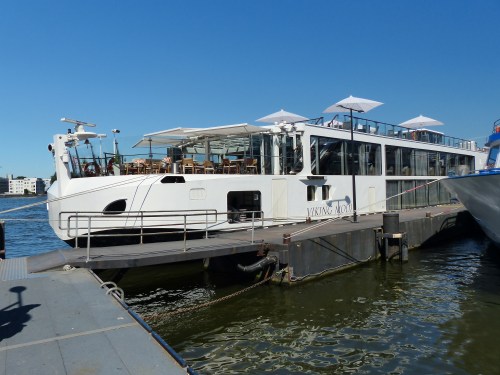
Here’s what we saw when we left the cruise ship with our trusty guide.
What do you notice?

p1140293

I love the guys fishing on the pier
right in the middle of it all.

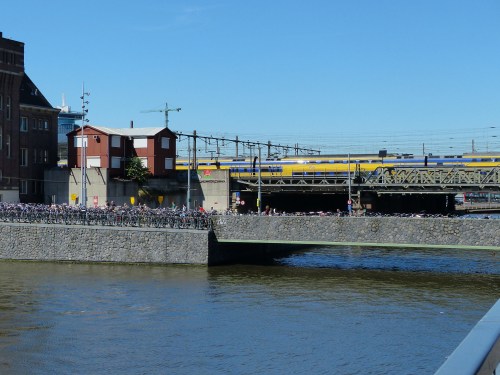
Our first landmark was a huge, modern transportation center.
I’m glad I didn’t have to figure out which way to go.
Note traffic lanes for various types of transportation
including pedestrians.

p1140311

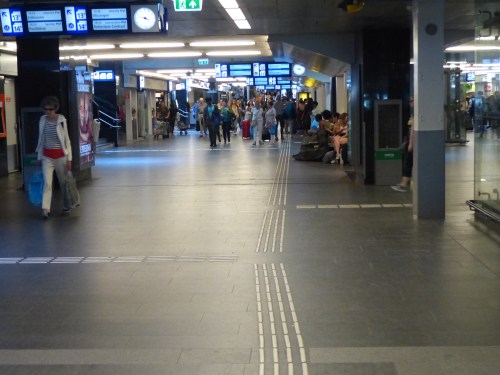
Here we’re in the belly of the building.
Note directional signs.
Sorry you can’t hear the sound effects. Think noise. Lots of it.
p1140316

When we came out the other side,
we began our tour near the red light district.
Not a comforting sight.
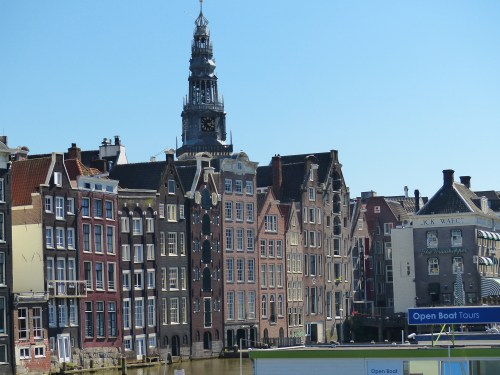
Note the cathedral tower on the right side of the photo.
We’re looking at the back side of the district.

p1140317

The next three photos give a better perspective —
without so many people in the way.
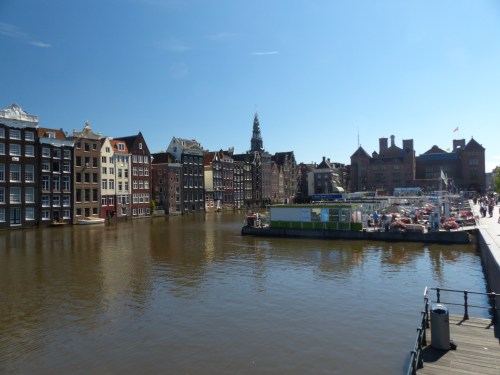
Notice the water level that’s steadily rising,
sagging architecture and uneven walls on many old buildings,
boats ready for nighttime cruises by windows
that showcase women for commercial sex,
and the cathedral tower in the background.
p1140341

p1140342

p1140344

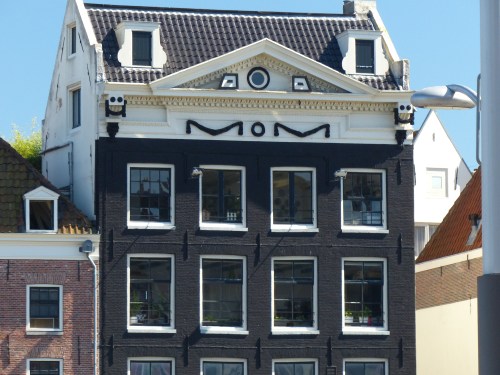
Here’s one last look at one of the buildings on the canal.
It’s visible in the first photo of the red light district.
You can see why it caught my eye.
p1140338
Wednesday of this week, January 11, was
*International Human Trafficking Awareness Day, a day to raise awareness
and honor those who offer alternatives to
women, children and men exploited for commercial sex.
I couldn’t help thinking about these photos.

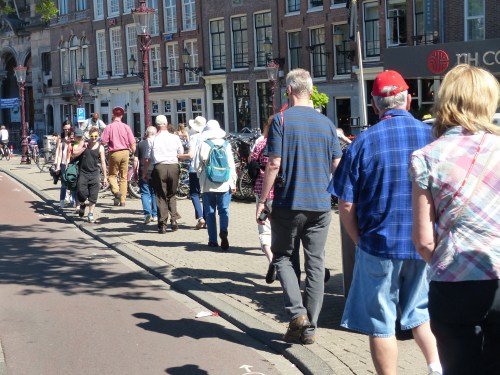
Here we are, moving on behind our trusty guide.
Do you like my backpack?
Don’t miss the clutter of bikes just to our right
and the bikers ahead of us on the sidewalk.
Being a pedestrian isn’t for sissies!
p1140349

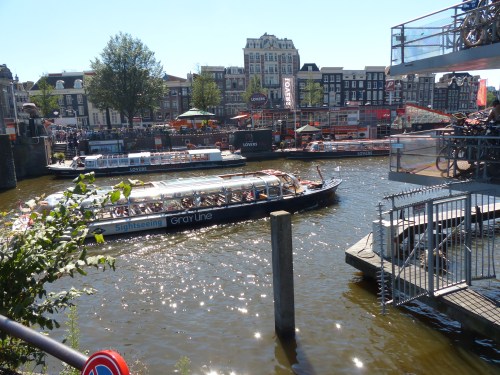
We’re headed to an area that draws hoards of tourists and shoppers.
Here’s a taste what’s coming in the next exciting installment.
p1140324

To be continued….

© Elouise Renich Fraser, 12 January 2017
Photo credit: DAFraser, Amsterdam, July 2016

*To find out more about human trafficking, click here.
The Rift

It isn’t new. It’s older than our nation. It dogs us like the monster it is. Yet we say we don’t see it, or things have gotten better, or it’s the way things were meant to be.

The rift is bolder and more brazen today than at any time in my lifetime. It runs like a fault line beneath everything we say, do, feel and think about in our relationships with each other.

It isn’t the only fault line. And, as I said at the top, it isn’t new. It’s simply in our faces—even though many seem not to see it.

Not seeing it is part of the problem. Sometimes people say to me, ‘Oh—I don’t see gender any more. I just see people!’ How odd.

But this rift isn’t about gender. It’s about something that affects each of us in this country. It doesn’t matter which gender we’re born into, or whether we seek to change our gender or not.

I hear it often these days: ‘Oh—I don’t see color anymore. I’m color-blind!’ As though being blind were the solution. Or even making black or brown one ‘color’ among all the rest.

In this country we have an ill-kept secret. We are racist to the core. I am racist to the core. This is true even though we have varying degrees of consciousness and commitment to rectifying injustices perpetrated on our black neighbors and fellow-citizens.

It didn’t happen yesterday. It happened the moment we began building our nation on the backs of slave labor. Yes, we’ve used white slave labor also, and are still addicted to that. Witness our below-living standard wages in many states and businesses.

But the case of imported slave labor has its own history—which is foundational to our nation’s history. It includes what’s happening today in our school systems, prisons, courts and neighborhoods.

It’s no longer enough to say ‘I’m against racism.’ Or ‘this company, university, state, nation or political party is against racism in all its forms.’

The question is more basic than that: Are we committed in our homes and in our places of business to dismantling racism? Are we engaging our brothers and sisters in conversation, letting them lead us to take strategic action together to replace policies and procedures that enable racism?

This is personal and institutional work. Not an overnight fix, or an easy answer to a survey question. It asks us to stand up and be counted on the side of dismantling racism—not just saying we’re ‘antiracist.’

Eloquent statements or sermons, and ever-so-large protests aren’t working. We seem to be at a stalemate.

In fact, we seem to be going backwards. We’ve developed and largely accepted a devious approach to being color-blind. We lock people up in prisons, restrict them to certain parts of our cities, towns, businesses and school systems, and lower the impact of their votes in state and national elections.

Out of sight, out of mind? An increasingly uneven playing field? This isn’t a proud legacy. It’s a judgment and a strategy against all of us.

© Elouise Renich Fraser, 10 January 2017
Response to WordPress Daily Prompt: Uneven

Shine on!

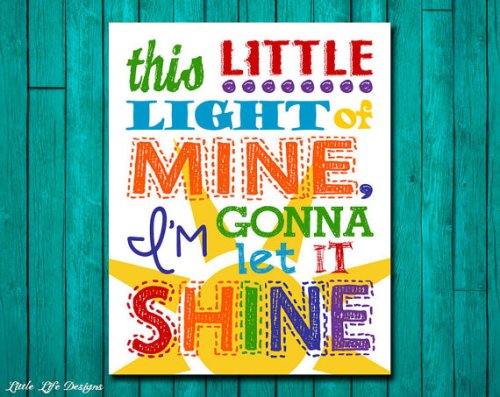
this-little-light-of-mine-2

Do you remember this old song? It went on forever.

This little light of mine, I’m gonna let it shine! ….
Shine all over the neighborhood; I’m gonna let it shine! ….
Shine all over the whole wide world; I’m gonna let it shine! ….
Don’t let Satan blow it out; I’m gonna let it shine! ….
Let it shine ‘til Jesus comes; I’m gonna let it shine! ….

Here, brother
Here, sister
Here’s a little light
Just for you
From me

Who are you?
What do you want?
Did I ask for your help?
Why should I trust you?
Why are you doing this?

Why indeed.

Our little childhood song made it all sound easy. Just shine your little light, Elouise! Small deeds of kindness and compassion. That’s all it takes. Just get out there with your little light and Shine On. Make a difference!

I laugh now—though it isn’t funny at all. In seminary we regularly reminded each other that we weren’t put on this earth as little messiahs. As though we’re sent to make all things new or solve every problem and climb every mountain.

No, we’re mere human beings. Quite wonderful, actually. Just like everyone else. Needy, limited, proud, hungry, beautiful, happy, angry, outraged, duped, out of touch and in denial. Plus a whole lot more.

I’m not against shining our little lights. In fact, I believe it’s the only way we can together make a difference. But there’s the rub.

What does ‘together’ mean? My little childhood song was heavy on each of us doing his or her thing. This usually meant obeying our parents, being nice to people who didn’t treat us nicely, and being sure to tell people about Jesus.

The song also seemed to suggest I should already know what to do when, and would be able to carry it out. Well…not only do I not know what’s best for other people, I often freeze in my boots when it comes to actually doing something.

Hence the need for togetherness. The kind many have experienced in successful 12-step programs. This means meeting regularly with like-minded people, radical surrender to a higher power, and unblinking willingness to face our shortcomings and failures and try again.

No miracles guaranteed. But I’m a witness to the power this way of life has to bring people together. Especially those of us who’ve tried to go it alone and failed, or who live in fear that we’ll be exposed for the failures we believe we are.

Why shine on? Because it lets someone know that you’re there for them, if only for a moment. It also acknowledges your need for others in your life. Not as decorations, but as welcome travel companions—if only for a moment.

That’s what today’s word brought to my mind. That, and the ways you shine in my life.

© Elouise Renich Fraser, 10 January 2017
Image from pinterest.com
Response to WordPress Daily Prompt: Shine

“Hope” is the thing with feathers —

emily-dickinson-hope-is-the-thing-with-feathers-pinterest

Emily’s poem for today is a gem. A gift for anyone who feels distressed about the state of this world or what lies ahead in 2017. My comments follow.

“Hope” is the thing with feathers –
That perches in the soul –
And sings the tune without the words –
And never stops – at all –

And sweetest – in the Gale – is heard –
And sore must be the storm –
That could abash the little Bird
That kept so many warm –

I’ve heard it in the chillest land –
And on the strangest Sea –
Yet, never, in Extremity,
It asked a crumb – of Me.

c. 1861

Emily Dickinson Poems, Edited by Brenda Hillman
Shambhala Pocket Classics, Shambhala 1995

I hear Emily saying something like this.

  • I can’t manufacture Hope on my own or even with my friends. Sometimes people exhort me to have hope. I can’t. It’s already there. Like a little bird perched in my soul. Singing its heart out nonstop, without words or a sheet of music in front of it. Am I listening?
  • Hope isn’t linked to the time of day or night. Or to the weather and what the outlook is for tomorrow. It’s there regardless of circumstances, singing its ‘tune without the words.’ Sweet, strong, welcome, heartwarming and life affirming.
  • It seems nothing can shame or humiliate this little thing with feathers. It doesn’t shut up and it doesn’t go slinking off in defeat or humiliation. It sings out with sweet clarity, especially when things look most hopeless.
  • Hope keeps our spirits alive, ‘warm’ even in the ‘chillest land.’ It doesn’t offer us a plan of action or a map that will get us through hard times. Neither does it pretend times aren’t hard. Instead, it accompanies us through the hard times, lifting its voice in a way that lifts our spirits.
  • Best of all, Hope is a gift. It doesn’t ask anything of us, even when things get really rough. Not a crumb, not a dime. In fact, should we decide things are hopeless, I think Emily’s little Bird would just keep singing its heart out on our behalf. It doesn’t even demand that we listen.

One more thought. Whatever Hope is, it isn’t denial. In fact, I think Emily’s poem doesn’t work if Hope is supposed to erase or numb reality. Nor is Hope a crutch to get us from here to there with empty smiles pasted on our faces.

I believe Hope can open our eyes to see possibilities precisely where and when we least expect them. Often with people we least expected to meet or invite into our lives. Little Birds have exceptional eyes, not just exceptional songs.

My prayer today is that we’ll listen to Hope and be alert for unexpected possibilities, especially in what seem to be gale-force winds already on the rise.

© Elouise Renich Fraser, 7 January 2017
Image found at pinterest.com

Floating…

snowfall-islamabad

It happened overnight
Small bits of snowy white
Floating from heaven
Kissed this earth to sleep

Without wild winds
Or drifting piles
It spread its glowing comforter
Then tiptoed off to bed

***

© Elouise Renich Fraser, 6 Jan 2017
Image found at wallpapersafari.com
Response to WordPress Daily Prompt: Float

Amsterdam – Bikes | Viking Cruise

p1140360

Last summer D and I, together with our daughter and son-in-law, enjoyed a two-week cruise down the Rhine, Main and Danube rivers. From Amsterdam to Budapest. We came back loaded with photos. I’ll be sharing some from time to time, partly as a cheery way to get through the winter! But also because it was a great adventure. Today’s photos focus on bikes.

We arrived in Amsterdam on an overnight flight from Philadelphia and were taken by bus to the cruise ship.

p1140306

After a light breakfast/lunch buffet, a friendly, energetic guide kept us awake by trotting us around the city. Watch out for the bikes (and for cars and buses, of course)! No crossing the street unless the light is green.

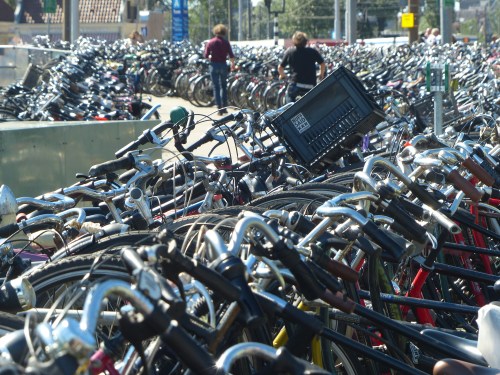
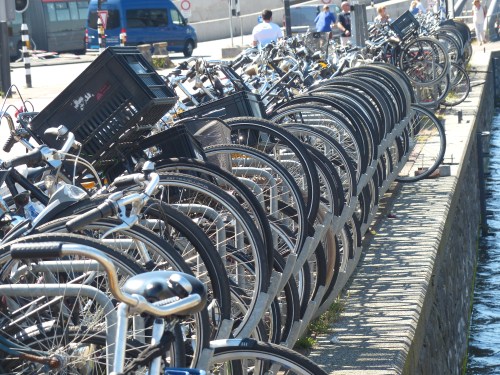
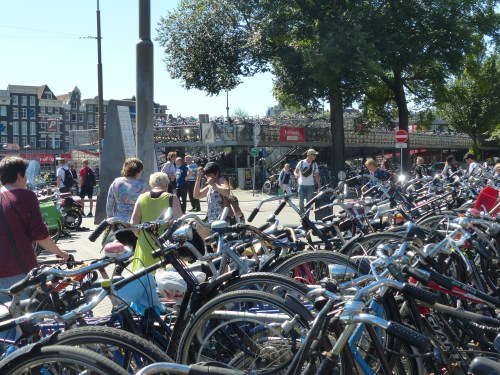
Bikes flew by (too fast to photo) and were parked everywhere. Note locks and chains.

p1140355

p1140358

p1140307
Our guide explained that old bikes are preferable to new bikes. They’re not as likely to be ripped off piece by piece, and are easier to replace. In addition, owners don’t always remember where they left their bikes. Hence a variety of sometimes eccentric add-ons or colors to give your wheels higher visibility.

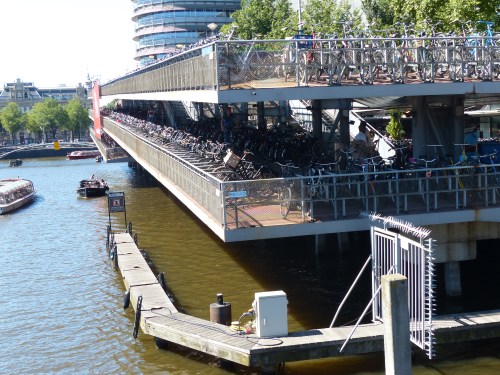
As you can see, bikers can park virtually anywhere. However, the most impressive place to park is at the huge bike garage near the transportation hub of the city. If you can just remember where you left your bike. 

p1140323
p1140325
p1140322

To be continued from time to time. Stay tuned!

© Elouise Renich Fraser, 4 January 2017
Photo credit: DAFraser, July 2016 in Amsterdam

Crossings of No Return

Crossings….

The word resonates with finality
Hints of danger and uncertainty
Sorrow and desperation
Weary clothes and
Hungry faces

One foot in front of the other
Backs burdened with life’s necessities
Bodies and bellies heavy
With tomorrow’s children
Silently pleading

They say our world is disappearing
Melting and boiling away before our eyes
Erupting into a chaotic crisis
Unknown in modern times
Are we ready for this crossing?

I can’t help wondering what lies ahead for this world and for us as citizens of this world. Our insular, isolated, boundaried ways of life don’t work well anymore, and our ways of governing seem to have reached their own point of no return.

Years ago I crossed a line of no return. I chose to be a follower of Jesus Christ. I don’t believe there’s a magic wand answer for any of this world’s upheavals. Yet I do believe we see a direction in the life, ministry and death of Jesus Christ. Not the superstar, but the human being sent to this earth to live and to die as one of us and as God’s beloved son.

Jesus made a crossing of no return when he came to live with and among us. He wasn’t president, emperor or chief. Nor was he a privileged member of the religious or political elite, or a child of God immune to human emotions and agony.

His life was short. Yet in his short life I find a direction that hasn’t changed even with our current global upheavals. Taking my cues from Jesus, I’m to love God, my neighbors and myself. Acknowledge my human limitations and need for others. Be ready to accept and offer hospitality from and to strangers. Bear the cost and share the compassion of being a follower of Jesus Christ.

Do I feel strong? Rarely. Do I feel ready? Rarely. Do I feel like giving up? Sometimes. Yet the steady, courageous, compassionate and steel-eyed clarity I see in narratives about Jesus’ life on this earth remains my True North. The one point on my compass that won’t change no matter what it takes to get from here to there.

What does this look like day by day? It’s all in my outlook. Each encounter might become an opportunity to ask for help or to offer help as I’m able and ready to identify myself as a follower of Jesus Christ. Most important, I’m not a savior. I’m another human being who won’t make it in this life on her own.

© Elouise Renich Fraser, 4 January 2017
Response to WordPress Daily Prompt: Crossing

I Years had been from Home

dickinsonhomestead_oct2004

~~Dickinson Homestead, Amherst, Massachusetts

In this narrative poem, Emily Dickinson seems to have a real destination in mind. Yet she focuses almost entirely on her internal fears and consternation. What’s going on? My comments follow.

I Years had been from Home
And now before the Door
I dared not enter, lest a Face
I never saw before

Stare stolid into mine
And ask my Business there –
“My Business but a Life I left
Was such remaining there?”

I leaned upon the Awe –
I lingered with Before –
The Second like an Ocean rolled
And broke against my ear –

I laughed a crumbling Laugh
That I could fear a Door
Who Consternation compassed
And never winced before.

I fitted to the Latch
My Hand, with trembling care
Lest back the awful Door should spring
And leave me in the Floor –

Then moved my Fingers off
As cautiously as Glass
And held my ears, and like a Thief
Fled gasping from the House –

c. 1872
from an 1862 version

Emily Dickinson Poems, Edited by Brenda Hillman
Shambhala Pocket Classics, Shambhala 1995

Emily doesn’t tell us precisely why she’s going Home. She’s been away for Years, and seems to have left something there–“a Life I left.” What might that mean? Perhaps she means she’s moved on and doesn’t want to become entangled in her old life. Or maybe she’s looking for something missing. I don’t know. She doesn’t get that far.

Instead, she describes the gripping, painful internal storm that erupts as she approaches the front door, prepared to ask her leading question. It’s as though she suddenly realizes the importance of this event—what it might cost her. Perhaps this wasn’t such a good idea.

Emily’s poem reminded me of an experience I had several years ago. Though the circumstances differ, the experience raised similar feelings in me.

I was in Savannah for Dad’s memorial service. That afternoon a number of family members drove out of the city to my favorite childhood home, the scene of happy and unhappy memories. The old colonial-style house looked out over a tide-water river that still beckons to me.

Hoping for a glimpse inside the house, a few of my younger relatives went up to knock on the door and ring the bell. My heart froze with a feeling I can’t even name. What would I say if someone came to the door? I felt fear, confusion and consternation.

No one came to the door. I breathed a sigh of relief, yet still felt strange until we got in our cars and drove away. Though I loved seeing the river and the outside yard, I had no desire to meet the new owners or see the inside of this house. It contained too many convoluted memories and secrets.

Emily begins by calling her destination Home. By the time we get to the end of the poem, this Home has become a House. No longer the place it was, and not a place she needs to revisit.

The ending might sound comical if it weren’t for the magnitude of her fear. Fear, it seems, that she or her life  might get high jacked in the process. And so she flees like a thief.

I’m left wondering whether something was stolen from Emily in that House she first called Home. Or perhaps she left that life behind and doesn’t want to lose the life she now has. Either way, I applaud her courage.

© Elouise Renich Fraser, 2 January 2017
Photo of Dickinson Homestead found at wickipedia.org

Interior space

Interior space
Unsettled body
Dreams bizarre
Young men
Novices
Uncertain
What to do next
I don’t know
Who to trust
Flying this plane
Murky fog
Lingers
Gives cover
The solace
Of not knowing
Slow drip
Of rain drizzles
Hazy unclear
What comes next
Is this the end
Or am I
Being born
Yet again?

No way I could capture this dream in prose. The sad overflow of a toss-and-turn night? No apologies. Glad to be awake and alive.

Maybe a weather front ambushed me. Or too much happiness yesterday. Whatever. The up-and-downness of recovery took a little dip. Trying to find my balance.

In my bizarre dream the little plane lurched out of the clouds without warning and landed on a beach in Florida. Sunny sky, gorgeous water rolling in, crowds of ice and snow refugees arriving, basking in the sun in the middle of winter. All a bit surreal.

Happy New Year, Day 2!

© Elouise Renich Fraser, 2 January 2017
Response to WordPress Daily Prompt: Interior

shimmering hope

p1140493

shimmering hope sprung
eons ago lies dormant
frozen underfoot
trampled beneath scornful words
it wonders and waits

***

A little poem for you, my friends,
with prayers for a Meaningful New Year of growth,
unexpected beauty, strength of character,
and creative resourcefulness when things don’t go exactly as planned!

© Elouise Renich Fraser, 31 December 2016
Photo credit: DAFraser, July 2016
Kinderdijk, South Holland – wild flowers beside the river path

Response to WordPress Daily Prompt: Hopeful