Telling the Truth

connecting the dots of my life

Tag: Courage

Interrupt and Replace

I woke up this morning feeling down, weary and discouraged. ‘Dis-couraged.’ An interesting word. It means I had courage ‘back there,’ and now I perceive a deficit. How can this be?

If I go back to my childhood and teenage years, I know when dis-couragement happened and why I need to attend to it, lest I lose my voice or become an enabler.

As a young girl I knew when the flames started licking around my legs, weakening my focus and my courage. Back then I persistently carried focus and courage into every punishing situation inflicted upon me. First by my father, and later by men with power to inflict punishment on me as a professional. It’s called bully behavior.

One gift of being a childhood survivor with PTSD is the ability to feel when certain dynamics are in the air. Dynamics neither we nor the person in control are necessarily able to change.

The behavior we’ve seen thus far from our new president is the behavior we’ll most likely see for the next years of his tenure. We already saw it in the presidential election cycle. Nothing has changed except this: the power of the office of President of the United States of America now protects him.

So here I am today, feeling dis-couraged by the events of this past week.

What can I do to change things? I can’t change or replace him. Nor can I change or replace myself.

Back to my father. As a child I was powerless. There was no way I could replace him with a different father. Nor could I interrupt his agenda for me. Especially when he determined I needed to be punished.

I’m an adult now. I’ve done my homework. I’ve learned not just to interrupt and replace the internal voices that mess with me, but the voice of my father talking about himself. He died in 2010.

Now there’s Mr. Trump. I want to interrupt him. The presidency isn’t all about him. Nor is it a platform for bully-talk toward and about others. One painful example will do: his language and behavior toward women who are, apparently, there to serve the desires of his heart.

So how can I do my bit to interrupt Mr. Trump’s monologue and replace it with contrasting voices? Not in debate form, but as a proactive, fearless way to change the conversation, the topic, and the outcomes. The Women’s March is an example of other mass interruptions that changed the topic, the political conversation, and the outcomes.

I want to be part of a movement to interrupt political bully talk and replace it with dialogues that make a difference. I’d love to hear what you’re thinking about. Or how your courage is holding up.

Thanks for listening!

Elouise

© Elouise Renich Fraser, 30 January 2017
Response to WordPress Daily Prompt: Replacement

I Years had been from Home

dickinsonhomestead_oct2004

~~Dickinson Homestead, Amherst, Massachusetts

In this narrative poem, Emily Dickinson seems to have a real destination in mind. Yet she focuses almost entirely on her internal fears and consternation. What’s going on? My comments follow.

I Years had been from Home
And now before the Door
I dared not enter, lest a Face
I never saw before

Stare stolid into mine
And ask my Business there –
“My Business but a Life I left
Was such remaining there?”

I leaned upon the Awe –
I lingered with Before –
The Second like an Ocean rolled
And broke against my ear –

I laughed a crumbling Laugh
That I could fear a Door
Who Consternation compassed
And never winced before.

I fitted to the Latch
My Hand, with trembling care
Lest back the awful Door should spring
And leave me in the Floor –

Then moved my Fingers off
As cautiously as Glass
And held my ears, and like a Thief
Fled gasping from the House –

c. 1872
from an 1862 version

Emily Dickinson Poems, Edited by Brenda Hillman
Shambhala Pocket Classics, Shambhala 1995

Emily doesn’t tell us precisely why she’s going Home. She’s been away for Years, and seems to have left something there–“a Life I left.” What might that mean? Perhaps she means she’s moved on and doesn’t want to become entangled in her old life. Or maybe she’s looking for something missing. I don’t know. She doesn’t get that far.

Instead, she describes the gripping, painful internal storm that erupts as she approaches the front door, prepared to ask her leading question. It’s as though she suddenly realizes the importance of this event—what it might cost her. Perhaps this wasn’t such a good idea.

Emily’s poem reminded me of an experience I had several years ago. Though the circumstances differ, the experience raised similar feelings in me.

I was in Savannah for Dad’s memorial service. That afternoon a number of family members drove out of the city to my favorite childhood home, the scene of happy and unhappy memories. The old colonial-style house looked out over a tide-water river that still beckons to me.

Hoping for a glimpse inside the house, a few of my younger relatives went up to knock on the door and ring the bell. My heart froze with a feeling I can’t even name. What would I say if someone came to the door? I felt fear, confusion and consternation.

No one came to the door. I breathed a sigh of relief, yet still felt strange until we got in our cars and drove away. Though I loved seeing the river and the outside yard, I had no desire to meet the new owners or see the inside of this house. It contained too many convoluted memories and secrets.

Emily begins by calling her destination Home. By the time we get to the end of the poem, this Home has become a House. No longer the place it was, and not a place she needs to revisit.

The ending might sound comical if it weren’t for the magnitude of her fear. Fear, it seems, that she or her life  might get high jacked in the process. And so she flees like a thief.

I’m left wondering whether something was stolen from Emily in that House she first called Home. Or perhaps she left that life behind and doesn’t want to lose the life she now has. Either way, I applaud her courage.

© Elouise Renich Fraser, 2 January 2017
Photo of Dickinson Homestead found at wickipedia.org

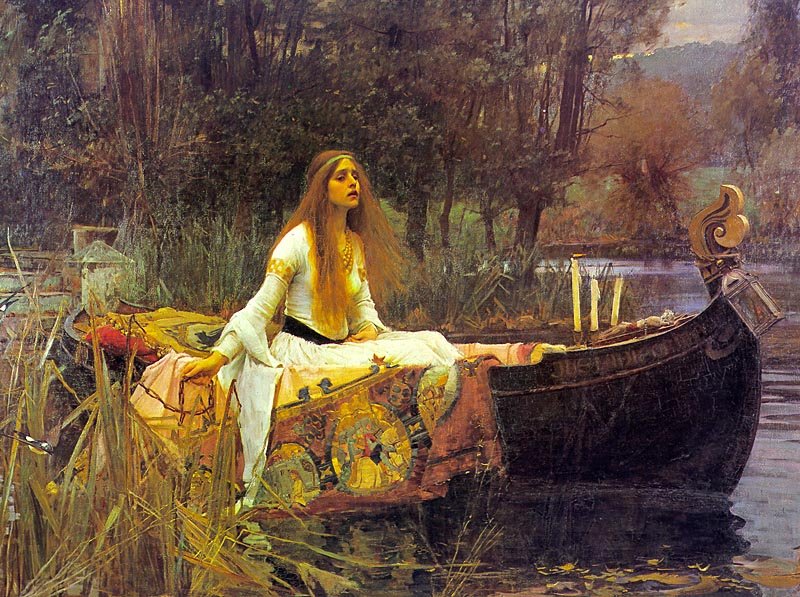
The Lady of Shalott and I | Story #2

The Lady of Shallott

Painting by John William Waterhouse (1849-1917), Tate Gallery, London

In 1983 I began teaching theology at a seminary in the Philadelphia area. Though my office was small, it had a window and built-in bookshelves on almost every wall. The other wall slanted in at the top–taking up precious space and head-room. Read the rest of this entry »

My heart still pounds | Part 3 of 3

What happened next
When I finished reading my statement, I felt exposed, apprehensive, and relieved that I’d finally put my thoughts together and said them out loud. Read the rest of this entry »

A Toast to Mom

My Number One Surprise this past year?  Coming to terms with my mother’s role in my life.  For years I’ve harbored cold resentment toward her.  Much more than I have toward my father.  Yet in this first year of blogging, I’ve done an about-face.

Here’s a dream I had about her in August 2012.  In the dream Mom is an attractive, even endearing figure.  Where did this come from?   I’m still not sure, but here it is, followed by some of my reflections.

17 August 2012

I’m in a rink-like area with other women.  A woman in the rink is telling us about the new surface that’s just been completed.  It’s so smooth that no ice or roller skates are required.  Just regular flat shoes.  Several women are trying it out.

I’ve just arrived, and know my mother is nearby.  I call out for her to come and see.  The minute she hears how it works she gets in the rink and takes off in a graceful glide around the far end of the rink.  She does a beautiful leap, turn, and ballet-like move, lands smoothly, and keeps going.

She’s smiling, happy and totally healed in her body.  Her hair is cut short.  It’s dark auburn, wavy, and lovely.  She’s wearing a skating/ballet-like outfit with a short full skirt that floats into the air as she leaps and comes back down.  She looks youthful and mature—perhaps in her late 20s or early 30s.  She’s beautiful and obviously accomplished.  I feel proud that she’s out there doing her thing.

Live in my own world

Is this Mom?

When I wake up from the dream I feel surprised, happy and sad all at the same time.  I recall a fragment of another dream I had several days earlier.  I’m in a room.  I don’t know where.  I’m standing behind a woman seated in a chair.  Her back is toward me, and she’s leaning over something she is creating—a work of art?  I’m not sure.

My attention goes to her beautiful hair—just like the hair I see on my mother in the skating rink dream.  However, in this earlier dream I don’t recognize the woman right away as my mother.  I know I’ve seen hair like that before, and when I look at the sliver of profile on the right side of her face, I’m surprised and delighted to see this is my mother.  She seems totally at ease with herself and focused on what she’s doing, even though others are in the room.

I don’t recall many pre-polio dreams about Mom or about her looking this young, content, rested, and energetic.  When she married my father, she seemed to accept the world she entered.  Yet my writing project highlights not simply how damaging that world was to me, but how damaging it was to her.  Yes, she was my father’s collaborator.

If, however, I put her role in the context of human trafficking, she becomes a victim collaborator—like other women victims who earn the trust of their male ‘owners.’ It seems they survive by denying human bonds of affection or compassion for the victims over whom they are given limited power.

In Our Backyard by Nita Belles includes a chilling story that suggests this.  A daughter and then her mother get lured into human trafficking via a modeling agency.  The mother eventually becomes trusted enough to pave the way for new recruits, and is allowed limited ‘freedom’ to carry out tasks on behalf of her traffickers.  One day, this mother sees an opportunity to escape, and takes her daughter along.

It seems only a mother would remain connected enough by human bonds to even dare this—risking her own freedom and life by bringing her daughter along.  Ironically, however, this tiny crack in their prison was made possible by first demonstrating she could and would treat her daughter no differently than she treated all the other young women.

Though my mother collaborated with my father, she retained her capacity to relate to me, especially after I was married.  I’ve often regretted that she died before my father.  Perhaps a bit of my stumbling courage when I confronted my father openly in 1993 gave her permission to own her own humanity and womanhood.

A New Year’s toast to Mom:  My Number One Creative Ally!

© Elouise Renich Fraser, 28 December 2014

Why Look Back?

Isn’t it time to get on with it?  Let the past be the past?  I understand these questions.  I know the feeling.  If I open up that can of worms it will devour me!  And cause anguish to other people.

Henri Nouwen opens the first section of his small book, The Living Reminder, with this story about Elie Wiesel. Read the rest of this entry »

My First Boss | Part 2 of 2

There’s more than meets the eye in my new work setting.  Though I’m a newcomer, the Boss already has a Miss Renich game he’s determined to play.  I’m an unwilling target and participant.

What’s the name of his game?
Any of the following will do: Read the rest of this entry »

Can we talk? – Part 1 | Dear Diane

Houston, March 1999.  A small family gathering in memory of Mother’s death in February.  Several next-generation cousins are there.  We watch a video of the memorial service for Mother.  Death is in the air and on my mind.  Not simply Mother’s death, but Diane’s and mine.  Did Diane’s ALS break Mother’s heart? Read the rest of this entry »

she sits silent

she sits silent
focused and determined
not to eat

A Short Story

Suppertime, early in the 1950s
Sister #3 sits in her high chair Read the rest of this entry »