Telling the Truth

connecting the dots of my life

Tag: Gratitude

Playing my card – a poem

,
Is being born female a scar?
A blemish a blot an
unfortunate role of the dice?
Something to disguise or
hope might fade over time?

Mind your scar dear
You wouldn’t want to be
laughed at, jeered at, taken
for granted or trashed

Here love let me help you make
the most of your scar perhaps
then they won’t notice it so much

Who knows
you might even win adulation
and a real man if you play
your scar card just right

Remember you’re in this
for the long haul so buck up
and smile like a million dollars
someday you’ll be rewarded for
your dumbed down version of
the woman every man wants

Not to worry there’s still plenty
of time to make your mark you
just need to keep at it no cracks
in the façade

Don’t get me wrong dear I’m not
saying you haven’t been doing it
the right way

It’s just that the cracks in your
scar are showing and we wouldn’t
want you to bleed all over the place
and your clothes

So you’ll just have to stop picking
at it and let it heal the way it’s
supposed to heal all flat and flawless and
invisible just like you

This is my attempt to capture the ethos that informed my growing-up years, as seen today through my adult eyes. I would be less than truthful if I said this kind of approach wasn’t also part of my professional life. It was. Gratefully, by then I had a company of women and some men who helped me make it through. Not as a scar on the face of humanity, and not all flat, flawless and invisible.

© Elouise Renich Fraser, 5 January 2018
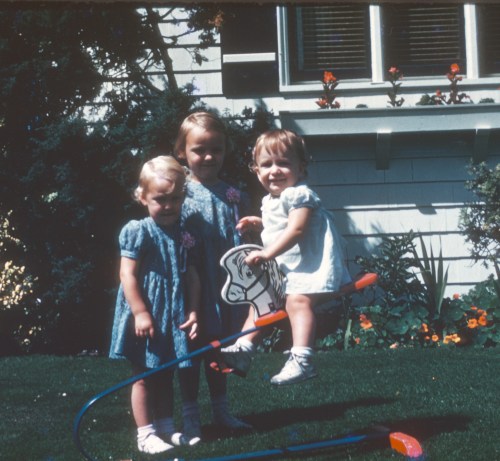
Photo taken by my father in 1947 — Seattle, Washington, with Daughter #2 (of 4) and a young friend

my icicle

winter chill
creeps through sunlit air –
icicle sparkles

There’s only one icicle. It hangs outside my bathroom window. Lonely? Maybe. Definitely an outlier, since we haven’t had a decent ice storm yet, and our gutters are almost clean.

So there it hangs, too cold to melt, though it shrinks a bit every day. Yesterday we had another deep freeze day—with more on the way.

So what’s a lone icicle to do? Nothing. Just hang there and let the sun do its work—casting rainbow colors, glistening, showing off flaws that look like the work of a master sculptor. No dripping. Just hanging there, shrinking a bit every day. Disappearing.

I don’t often emote over icicles hanging from our gutters. They’re usually growing longer by the day, sometimes too heavy to let nature take its course. So D grabs an old ax handle we keep by the front door, throws open the windows, and whacks them to the ground.

But not this little baby. It’s there just for me. A mirror of sorts. I’m too cold to melt quickly. I’m shrinking a bit every day. And it seems I’m going nowhere for now. So there’s nothing to do but hang there in all my glory, catching and reflecting every little gleam of light that comes my way.

I had a small epiphany this week. I’ve heard a lot in the last years about just ‘being’ instead of ‘doing.’ A wonderfully freeing concept–until you can’t ‘do’ so much anymore. Yet God wants me to show up every day. Just as I am. No more and no less.

So what does it mean for me to show up right now? Sometimes the most obvious things escape me. But this week I finally got it. I show up by writing! It’s so simple. I don’t have to write something in particular, but whatever comes to mind as I hang there just under the gutter. Cold, shiny, changing every day, ready to reflect rainbow colors or nothing more than the morning sky and clouds.

© Elouise Renich Fraser, 28 December 2017
Photo taken by me with my iPad – sunrise, 26 December 2017

The Work of Christmas | Howard Thurman

This week I received a lovely Christmas note with a poem by Howard Thurman on the front. Howard Thurman (1899 – 1981), was a key figure in the life of the USA during the 20th century. Thurman was an author, philosopher, theologian, educator and civil rights leader. He was also an early leader and mentor in the nonviolence movement that shaped and included Martin Luther King, Jr.

Here is Thurman’s poem, followed by a few comments.

When the song of the angels is stilled,
When the star in the sky is gone,
When the kings and princes are home,
When the shepherds are back with their flock,
The work of Christmas begins:
To find the lost,
To heal the broken,
To feed the hungry,
To release the prisoner,
To rebuild the nations,
To bring peace among all,
To make music in the heart.

Howard Thurman, from The Mood of Christmas, p. 23
Published and copyrighted by Friends United Press, 1985

The work of Christmas isn’t about enjoying or returning gifts we received, feeling good about giving money to charities, getting on with the thankless work of putting away the decorations until next year, or writing thank you notes. In fact, it isn’t even about telling everyone the story of Christmas.

Rather, it’s about embodying it. Being and becoming the good news announced with the birth of Jesus Christ.

  • We, the lost now found, are to find other lost women, men and children. We the broken, the hungry, the prisoners, the residents of war-torn nations, the restless, the aggrieved, the disappeared—we are to pass along what we have received. A reason to hope, and a measure of peace in the midst of strife.

This isn’t about hoarding things for ourselves. It’s about making haste to share peace and hope that passes all understanding. Not with stingy hearts, but extravagantly. Making music in our hearts that spills over into our relationships and communities. Not always happy music, but music that tells the truth, especially when the truth isn’t pretty.

I’m praying I’ll find renewed peace and hope for myself, along with you, and new ways to do the work of Christmas in this coming year.

© Elouise Renich Fraser, 23 December 2017
Image found at examiner.com.au

A Christmas Card for You | Photos

A few days ago D and I took an eagerly anticipated day off to visit Longwood Gardens. The theme for this year was a French Christmas. Classy and elegant. The pond photo at the top, taken in the conservatory, makes the statement boldly and creatively. Those are thousands of cranberries and green apples floating in the pond. The light buff in the center foreground would be walnuts painted gold!

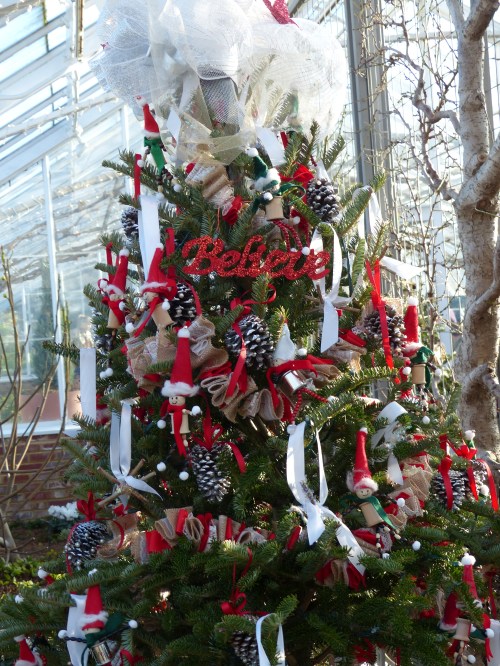
Directly behind the pond, you  can see three wreaths hanging just outside the conservatory’s formal parlor. Here’s the central wreath, followed by a photo of the Christmas tree in the parlor. The wreath contains cranberries, green apples, small shiny ornamental balls and sprayed bronze leaves.

Turning around, we head back into the central Conservatory atrium decorated with poinsettia trees and plants, and a few grapefruit trees with their own decorations hanging heavy.

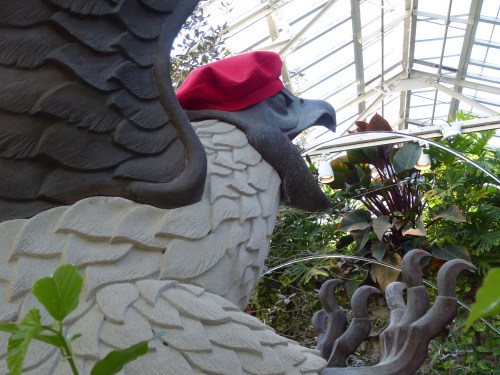
We also checked out the Children’s Garden, where we found a clever tribute to French style sitting atop a gargoyle-like spitting fountain! It’s paired here with an elegant French-inspired Christmas tree ornament.

In the Palm Room we found a lovely orchid Christmas tree with tiny white lights, clear beaded ornaments and shiny silver globes reflecting their surroundings. Then we headed for the children’s trees, decorated by children from area schools. The example below is particularly exuberant, a nice contrast to the more sedate yet glamorous orchid tree.

Finally, would you believe a succulent Christmas tree? The second photo shows some detail. A spectacular feat of design and innovative construction.

For all my wonderful visitors and followers, I wish you a blessed Christmas, and a New Year of personal peace and contentment. Plus time to enjoy small things that make all the difference.

I’ll continue posting as I’m able in the next week — with time off for family, friends, and self-reflection.

Elouise

© Elouise Renich Fraser, 21 December 2017
Photos taken by DAFraser at Longwood Gardens

This isn’t what I expected

I wrote the free-verse poem below last night after writing a long journal entry about the current state of my life. The poem is an open letter to my Creator. An attempt to lay it out just as it is, given unexpected health events of the last few years that seem to have hemmed me in.

This isn’t what I expected
This endless run of days and nights
Wondering why this and not that

Retirement was a golden orb
A sparkling promise that kept me going
Until I couldn’t go any longer

There’s so much to love about it
That it feels like betrayal to say this:
I don’t feel retired; I feel disappeared.

Disappeared from what’s happening
Disappeared from minds and memories
Disappeared from action, whatever it is today

I wake each morning wondering
What will be the meaning of this day?
What will it add up to when the sun goes down?

Writing is a gift and blessing I gladly receive
Not going to work each day is also a blessing
Until I no longer have any ‘real work’

No need to be somewhere at a certain time
No collaboration about things that make a difference
Or participation in discussion about things that matter

And there’s the rub—this strange reality of just being
Instead of measuring myself by what I do
Or how many people are counting on me to ‘be there’

Is it really enough to take care of this tired old body
With its growing list of limitations and special needs?
Is this the meaning of my life at this time?

Please advise.
Elouise

P.S. to my Dear Readers: I’m grateful beyond words for your presence in my life. Blogging is my lifeline. I can’t imagine the last several years without it. Thank you for being here—many of you from the beginning. I pray you’re finding hope and peace this Advent season, no matter what your current circumstances may be.

© Elouise Renich Fraser, 9 December 2017
Image found at rccbonsecours.com

yesterday’s ghosts

yesterday’s ghosts
stir in their graves
dismembered

They want to shame and blame me. Turn me into the problem I am not. Make it my fault. Or the fault of my overactive emotions or hormones run wild.

And the tears. If I would just stop getting all emotional about it. It’s over and done with, Sister. Get used to it. This is the way of the world. If you don’t like the heat, don’t stand so close to the fire.

I’m proud to be a thriving survivor. Like other women and men, I’ve been sexually harassed, humiliated and punished physically, verbally and emotionally. Sadly, the patterns of my childhood and youth didn’t stop when I became an adult woman — a supposedly mature, thoughtful, educated, gifted, responsible, compassionate, dependable, reliable woman, true to her word.

My recent nightmare with its scoffer’s row of men intent on intimidating me brought it all back. As did my recent review of private journal entries from my years as a seminary professor and dean. To say nothing of public figures coming forward to talk about their experiences.

Where will this lead? Is it simply the media event of the year? I pray it is not.

My father set the stage early in my life. He was the boss. I was not. He wore his medals proudly: Male, Ordained, Father, The Boss.

Instead of learning to stand on my own two feet without apology, I was subjected to formation in unquestioning submission to men (unless they were obviously ‘bad’ men), submission to my teachers, submission to my employers, submission to the governing powers, and submission to God as a disobedient, rebellious, stubborn and angry little girl.

My father also formed me in the sick opposites of these submissions. These included lack of respect for my female body, female voice, thoughts, instincts, intuitions, emotions, and my identity as God’s beloved daughter child. They also included formation in going along to get along.

  • Smiling whether I wanted to or not
  • Being polite instead of truthful
  • Not hurting other people’s feelings
  • Not embarrassing myself or others in public
  • Doing as I was told, without asking questions or grimacing

Today I’m holding out for women and men who won’t allow their ghosts to rest in peace until justice is done. Not for us, but for all the children of this world, especially those without safe allies. Otherwise, this will indeed become a passing fad–for all but the powerful few.

I’m in this  for the long haul. How about you?

Elouise

© Elouise Renich Fraser, 7 December 2017
Image found at raisingintuitivechildren.com

Advent haiku and more

a day
unlike all others
wakes unannounced

During this Advent season I’m participating in an on-line retreat. An opportunity to slow down, listen with my heart, notice what’s happening in my body, and rest in the person I’ve become after all these years.

Writing haiku is an exercise in listening. Slowly. Without preconceptions. Without urgency. Without wondering when the alarm will go off to jolt me into action.

I readily admit that being retired is an advantage. Yet my internal life doesn’t always remember what it means to be retired. Much less where to focus long, patient listening that does more than take me in circles.

The on-line retreat invites me to write one haiku a day not just during Advent, but for the next six months. As a daily exercise it puts the brakes on my urge to do something. It turns my attention toward nature and our Creator, and invites me to make connections.

The haiku above suggests life is a daily gift from my Creator. A page-turner. An open, still-being-written adventure lived one day at a time. A puzzler without answers or clues at the back of the book. One of a kind.

Today I’m enjoying Sabbath rest at home—taking care of a head cold that began Thanksgiving Day. Wishing for each of you quiet time to listen with your heart and rest in the one-of-a-kind person you are.

Elouise

© Elouise Renich Fraser, 3 December 2017
Photo found at pinterest.com, Sunrise in North Dakota

Surely goodness and mercy….

Tomorrow is Thanksgiving Day; yesterday’s post is still on my mind. I’m grateful for the poem that was in me, grateful for words to tell you about this episode in my professional life, and grateful to be who I was and still am. A tough old cookie. A highly sensitive and intuitive wise woman. A thriver. A persistent woman who won’t sit down and shut up. Or stand up and perform on command.

I didn’t get here by myself. I got here thanks to scores of women and men who saw in me more than I could see in myself. I also got here thanks to my Creator, my true Parent from the beginning, walking with me and watching my back.

Following a well-earned sabbatical leave and peaceful summer break, I was on my way to the seminary for the first day of fall term. Several students who protested against me a year earlier were likely to show up in my required course.

To say I was anxious would be an understatement. Yet here’s what happened next, as described in the semi-memoir I began writing during my sabbatical.

I stopped at a traffic light and waited for it to change. Two older men, perhaps in their seventies, were coming down the sidewalk, facing me. They were out for an early-morning walk. They moved along quickly, talking and laughing. The sun was up. It was a gorgeous day.

As they came closer, I noticed they were holding hands. This seemed rather unusual. But it was also wonderful. My mind turned to friendships among older men. I wondered how long these men had known each other and whether they walked together every day.

Suddenly, without any signal and without breaking their stride, they left the sidewalk and began walking through a large parking lot. They seemed to be of one will. As they angled away from the sidewalk, I saw it for the first time—the short leather strap they were holding between them. One of them was blind.

In a flash my eyes filled with tears. I saw myself walking blindly into this class. Seeing some things, but not everything. Knowing someone with sight beyond my sight was beside me. All I had to do was follow God’s lead, keep holding on to the strap and keep putting one foot in front of the other.

Elouise Renich Fraser, excerpt from Confessions of a Beginning Theologian, p. 132, Intervarsity Press 1998

“Surely goodness and mercy shall follow me all the days of my life….”

Happy Thanksgiving, everyone!
Elouise

© Elouise Renich Fraser, 22 November 2017
Photo of shepherd boy playing flute to sheep found at nikisawyer.com

Daily Prompt: Mercy

Perhaps on a rare day

Things fall apart
Perhaps on a rare day
They will fall together

Shadows sift through memories
Find her wandering alone
Lost in a forest of horrors
Body parts scattered around
Remains of anonymous whisperers
Still echoing through trees

There’s more than one way
To take a body apart in darkness
Her heart pounds in her chest
She wonders where this will end
All is not necessarily well that ends

Resisting the urge to run
She faces accusers now residing
Within her body of rearranged parts
That don’t remember where they belong
Or where they were going
Before tongues began wagging
Slicing their way through air
Intent on silencing her voice forever

This happened in the early 1990s. I was a tenured full professor. The course was required for all MDiv (Master of Divinity) students. It was the first course I’d taught in which women, men of color, and international students outnumbered white men.

I never saw it coming. The day after I turned in all grades for fall term, the dean asked to see me. At the meeting he gave me the news. During the semester, about half the students from this course had lodged serious concerns with him and with the president about me. More than once.

The seminary president wanted a meeting with me and with the dean to talk about these concerns. No, I could not meet with these students before or after this meeting. No, I could not have a list of names because the students feared retribution. Nor could I have a list of their concerns. Most students who signed the formal complaint were white men; some were men of color; some were women.

I agreed to the meeting only if I had time to review the list of complaints, and only if I could bring a senior colleague—an African American woman of great wisdom and experience.

My requests were resisted. Nonetheless, I persisted, and the meeting took place. It lasted one and a half hours. I felt trapped in someone else’s muck and mire.

Before the meeting, I’d studied the three pages of typed, detailed notes the dean had taken during meetings with students. According to the students, I was sadly deficient in three areas: my theology, my teaching style, and my character. Each area included excruciating detail. I did not recognize myself.

The dean and president denied my request for a meeting with at least some of the students. I was never told who they were. With the exception of a brave few, they remained nameless. Some were doubtless in my later courses.

I wasn’t disciplined. I was, however, broken in spirit, and grateful for my upcoming spring term sabbatical. I was also grateful for my female college who met with me following the meeting to talk about what had just happened and what I’d learned that would help me in the future.

My recent nightmare stirred all this up. The poem is about me. It’s sent out with prayers for all children, young people, adult women and men who endure daily dismemberment and humiliation, seen and unseen.

© Elouise Renich Fraser, 21 November 2017
Photo of Deep Forest found at mybligr.com

Daily Prompt: Sludge

Thank you, Anita Hill

In October 1991 I listened to your courageous testimony about Clarence Thomas. Your words took me back to my first boss. It was 1960. I’d just graduated from high school and was now a clerk in a bankruptcy court. We called the boss ‘Judge,’ though he was actually a referee in bankruptcy. He’d held this governmental appointment for years. He was about 60 years old; I was 16.

By 1991 I’d told only my husband the truth about my first boss. From the beginning, the Judge was on a mission to take me down a notch or two by way of sexual innuendo and outright inappropriate behavior toward me. He knew I was under-age, that my father was an ordained minister, and that I was a Christian. He said he was a Christian, too, and reminded me from time to time of his church membership.

I didn’t know what hit me. I got through three summers plus one full year, thanks to the friendship of other women working in the office, and the kindness of a few male attorneys who knew the Judge and witnessed some of his behavior toward me.

Back then the term ‘sexual harassment’ hadn’t been invented, or connected to Abuse of Power as an issue in the workplace. In addition, my childhood home where I still lived didn’t offer a safe place to talk about anything related to sex.

Flash forward to October 1991, and your testimony before the Senate Committee. I owe you a huge debt of gratitude for at least two things.

  • First, your personal account was the first I’d ever heard from a professional woman talking about repeated sexual innuendo and inappropriate behavior in the work place.
  • Second, your courage gave me courage to begin talking about this without fear or shame.

I’m sad this happened to you. I’m sad things happened to me. I’m sad things like this still happen every day to others.

Am I angry? Yes, I am. Angry that even in today’s reports from powerful women about powerful men, we’re still using the language of “if this is true.” Which conveniently overlooks the power imbalance that was in place when the alleged behavior happened. To say nothing of optics and the appearance of evil that seems now to be embraced, not avoided. Embraced, and laughed at in a zillion cartoonish ways.

We are not the world’s latest sleazy entertainment opportunity. We are women with every right to stand up and tell the truth about what happened and didn’t happen to us. And why it must stop now if we’re ever to be Great. Not again, but for the first time ever.

May God grant us serenity to accept what we cannot change, courage to change the things we can, and wisdom to know the difference.

Thank you for showing me how this is done. Not just then, but throughout your professional career.

Respectfully,
Elouise Renich Fraser

For a 2016 PBS News Hour video discussion between Gwen Ifill and Anita Hill, click here. It’s outstanding.

©Elouise Renich Fraser, 13 November 2017
Photo found at gq.com