Telling the Truth

connecting the dots of my life

Tag: Safety

My Daughter My Teacher

‘My daughter my teacher’
The phrase arrives unbidden
Turning it over I find
What was denied
What was forbidden
What was scorned
Though I searched for it with all my heart

What does it mean
To grow up female
Loved
Free of being shamed
Free of control and contempt
That sucks joy and creativity
Out of airways
Leaving a void gasping
Not outgrown or filled
Without pain
And the horror of knowing
It didn’t have to be like this
And it was

Our daughter has been a free, creative spirit from the beginning. I can’t count how many times I’ve said, “I don’t know how this happened.”

How could it be that this painfully shame-driven introverted woman mothered this free introverted spirit who follows her heart no matter what others think?

From the beginning, without shame, she wrote what she heard, saw and felt. She still composes and performs music that come from places I’ve never been—literally, or in my heart.

The truth is simple. I never gave her any of that. That was and is her gift. Her voice. Her creativity. Her vision. Her truth.

And yet, I did give her something. I gave her some of what I was never given. I think it came from my fierce determination to make space for her to be herself and our daughter. All at the same time.

This makes my heart happy and brings a smile to my face. It helps me see some of what I missed growing up. It also gives me a different mirror to consult. The mirror of my mothering. Even though I felt like a bumbling pseudo-mother from time to time.

Thanks for listening!
Elouise

©Elouise Renich Fraser, 17 August 2018
Photo found at katiedissertation.weebly.com

Small things fall to the ground

Small things
Fall to the ground
Combs and toy cars
Toothpaste and tuna
Rosaries and animal crackers
The sound of life denied
Drops into ground
Reverberating
With dashed hopes of migrants
Halted at the border
Of the promised land
Caught in webs of fear
And red tape
Studiously practiced
Perfected and delivered
By bureaucratic officials
Carrying in their pockets
Items deemed unnecessary
For human life from
The south side
Of the border

It might be easier if this were an isolated event or period of in our history. However….

In one way or another, the USA has practiced the fine art of dehumanizing perceived threats from the day the fathers and mothers of this nation set foot on its soil. The trail of destruction runs wide and deep like a river of blood through the Grand Canyon of our collective history.

Like an evil tide, forces of greed, pride and fear have overtaken and eroded the beaches of our shared life, fashioning mansions of sand and wreaking environmental havoc along our eastern and western coasts, and in our interior.

So now we’ve turned our attention to the southern border. As though sealing this up will remedy what we helped break into isolated bits and pieces now destined to remain fixed in concrete for the foreseeable future.

Thankfully, unnumbered children, women and men of good will, including courageous politicians, have stepped up to help ease the wounds. Not just those we perpetrate on migrants, but on each other. These human angels have been here from the beginning. They deserve our thanks and our support, especially now.

Here’s a link to Charity Navigator with  lists of trust-worthy groups that help immigrants and refugees. Take a look. They’ve done their homework.

Praying you have a life-renewing weekend and Sabbath rest.
Elouise

©Elouise Renich Fraser, 6 July 2018
Photo found at censored.today

Voices long silent

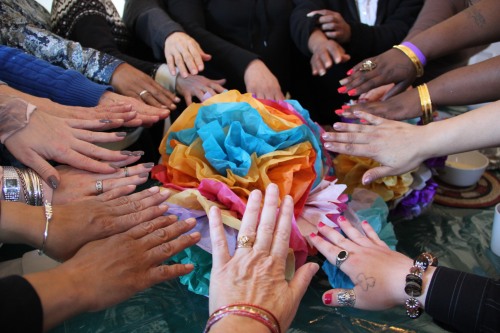
Dawn's Place circle of friends making paper flowers february 2014

Voices long silent
Spill over each other
Dying to be heard

Sisters on a mission
To recover lost youth
Find each other instead

Secrets never shared
Comfort never given
Tears never cried
Sink into the ground
Of love-starved hearts

How many of us are there? Blood relatives or total strangers, it doesn’t matter. The more I read and hear about the untold lives of women, the more horrified I am at the way we’ve been silenced. I also wonder how long we’ve taken it out on each other?

Starving for sisterly conversation. That’s how I grew up. Silence was enforced and reinforced a thousand ways. Not just at home but in church, in school and in every social or public setting of my life. Even, strangely, in settings that seemed to be made up of women only.

As a child and teenager I was surrounded by a seen and unseen assemblage of rules, shaming rituals and periodic public displays of what happens to strong women. Especially women who speak their minds and make trouble for the rest of us.

Fast forward, and it feels too familiar. Not so much from the bottom up as from the top down. It doesn’t take many men and like-minded women to turn the tide. Especially when women can easily be publicly shamed, if not ruined, in this age of social media.

Many, if not most of us are starving for love. Not for glory or fame, but for safety, acceptance and affection. We’re dying for a listening ear. At least one other woman who will confirm our experience. Laugh and weep with us. Comfort and support us. Especially now, when female life around the world is still fragile, no matter how many grand laws are on the books. Including right here at home in these United States of America.

I know. There are all kinds of barriers and circumstances that seem to discourage this. Yet a smile and a warm hello might be that last drop that turns the tide for another woman. I’d even suggest it’s a way of knocking on a door. Especially in a country gone sour on social niceties.

With hope and persistence,
Elouise

©Elouise Renich Fraser, 8 June 2018
Photo: Women at Dawn’s Place, a therapeutic residential program for women

A vexing situation – Sexuality 4

When I interviewed for a faculty appointment at the seminary in 1983, no one asked about my sexuality or sexual history. I was married and had two children. I was an active member of the Presbyterian Church. I was interested in women’s studies and issues of importance to women, and as a theological student I had a good record and outstanding references. Besides, my guest lecture was well received.

Years later, I’m the dean, responsible for having a confidential conversation with each final candidate about sexuality and other topics. This includes conversation about the now-official standard of the seminary on human sexuality and moral conduct, questions they might have about this area, and questions I was expected to ask them. Which I did.

In order to help us through this sometimes awkward conversation, I used a one-page handout excerpted from a 1996 memo to the faculty. It was about the new board-approved policy on human sexuality and moral conduct. I sent it in advance to our final candidates, with other material about the seminary.

If the candidate was already inclined in the direction of the seminary’s policy, there was no hesitation. However, if the candidate had questions, it was sometimes awkward. Not just for them, but for me.

I couldn’t pretend that living with this policy wasn’t important. To my surprise, some were reassured by my history with students struggling with sexual issues. The same was true about ways I dealt with classroom presentations and dynamics. There might be room for them here, and it wouldn’t be easy. Especially in the classroom.

The new policy, nearly 10 years in the making, included a statement about behavior, and two implications for faculty.

  • Regarding behavior, those who affirm and practice forms of sexual intimacy contrary to the seminary’s guidelines will not be admitted as students, or employed at the seminary. A further sentence, for the benefit of faculty members hired earlier than 1996 said, “This item is in reference to all decisions subsequent to the adoption of this policy.”

Regarding faculty, there were two stated implications.

  • First, we were to make sure seminarians dealt with the range of positions about current moral issues the Church faced. These included human sexuality and moral conduct.
  • Second, in our teaching we couldn’t argue against the seminary’s policy about sexuality (whether heterosexual or homosexual). We could, however, tell students about our own struggles regarding human sexuality and moral conduct, including our present understanding of difficult issues related to sexuality. Nonetheless, we could not “undermine or invalidate” the seminary’s policy. Furthermore, when speaking publicly or privately on behalf of the seminary, we were to articulate clearly and uphold the seminary’s policy.

The first implication was fairly straightforward. The second, however, felt late and one-sided. I’d learned the hard way which questions I could and could not answer in large required courses. Now, however, any sign that I was still ‘struggling’ with these issues sounded to some like the equivalent of teaching against the seminary. The only safe professors were those in full and complete agreement with the policy as stated.

I keep wondering what I would do differently if I were being interviewed today for the same faculty position.

Thanks so much for reading, and for your comments along the way. One more post coming (I think)!

©Elouise Renich Fraser, 6 April 2018

A vexing situation – Sexuality 3

It’s now 1986. I’ve been an assistant professor of theology for three years. A new academic dean has just arrived, as have recent newspaper articles about one of our recent graduates. She had been one of our more conservative students, and was now an ordained pastor.

According to newspaper accounts, our graduate, happily married with two sons, left her conservative denomination to become pastor of a church for gay men and lesbian women. She had become disenchanted by her denomination’s anti-gay/lesbian rhetoric as well as concrete actions taken against homosexual women and men. I applauded her courage, as did some of my colleagues.

Our new dean circulated to the faculty a copy of the newspaper account along with a brief memo letting us know we would be talking about this. In the account, our former student identified herself as a graduate of our seminary.

Thus began a long conversation in the faculty that ended after nearly 10 years of anguished discussion about what we as a seminary should do. Not about this one graduate, but about gay men and lesbian women who might be already enrolled or applying for admission to our seminary. And about what faculty could or could not teach in the classroom.

The seminary hadn’t made attitudes or beliefs about homosexuality (or heterosexuality) an official requirement for admission in the past, so why did we need to clarify our ‘standing’ at this time? And why, given the recent history of the seminary’s heterosexual president, as well as hints of stories that might be told about one or two male professors of the past, were we suddenly consumed by angst about homosexuality? Wasn’t heterosexuality of equal weight and importance?

During my first three years at the seminary I became known, along with several colleagues, as a ‘safe’ person to talk with about matters of sexuality. Especially homosexuality. That meant I knew how to listen, how to be supportive without being directive, and how to help seminarians think about options. It didn’t take many conversations to realize I had no clue about the inner and family lives of gay and lesbian seminarians.

Some, now full adults, had never come out of the closet with their families, much less their friends. The thought of appearing before a board or session of a church to be interviewed for ordination was terrifying. Some ordination exams were public. Open to members from other congregations. Questions could be asked by anyone in the room, including questions about candidates’ personal lives.

I attended scores of these public exams. Nothing was more brutal than knowing ‘visitors’ from other churches could sway the outcome of an exam. The sessions sometimes functioned as semi-political social and theological warfare. If that sounds harsh, so be it. The possible consequences for the woman or man standing up front were harsh. Especially if the moderator wasn’t skilled and politically savvy.

Finally, in 1996, the seminary published internally a new policy on human sexuality and moral conduct. It included implications for present and future members of the seminary community and for faculty members in their responsibility as teachers.

I like clarity. I like knowing what’s expected of me. Yet this new policy sent a double message.

To be continued.

©Elouise Renich Fraser, 4 April 2018

A vexing situation – Sexuality 2

Almost all my life I’ve been aware of sexuality, especially my own. Since my birth in 1943, I’ve been a member or participant of multiple religious communities that have talked about sexuality only when necessary. Usually when cultural pressures seemed to endanger ‘our’ young people.

I don’t remember sermons or safe conversations about everyday situations such as how to have a safe conversation with someone whose heart is aching or carrying a heavy secret. Nor have I had much training in how to watch or change my behavior so that I’m as clear and safe as possible when it comes to my sexuality.

For me, this unspoken agreement not to talk openly about sexuality made things worse. Especially after I arrived at the seminary in 1983, one of a small number of female faculty members. I felt alone and confused, left to figure things out by myself.

So here I am, a new assistant professor at a theologically conservative seminary with socially responsible roots and programs, along with a still-fresh wound from the former president. My new colleagues and students have their luggage from the past, and I have mine.

Perhaps the approach of ‘Don’t ask, don’t tell’ was the seminary’s way of allowing us to feel safe. Which, of course, many of us did not.

The first three years of my appointment I was exhausted, confused, anxious and fearful. Not because of what I knew, but because of how much I didn’t know. Not chiefly about how to teach or how to deal with classroom situations (though that was no cakewalk), but about being an academic advisor to each of my assigned advisees.

They appeared at my door, several times a year. Women and men with multiple issues about scheduling, grade point averages, work load, childcare, job requirements, immigration requirements, culture shock and yes, secrets. Heavy, untold stories about past history, realities about current history, sometimes things they’d locked away in a closet as though that would take care of it.

I think back to those three years as my Apprenticeship in Real Life. Classroom dynamics were nothing compared to the atmosphere in my office when an advisee or other student decided to tell me a secret about his or her sexuality. My job was to respond appropriately and with integrity.

Did I stumble around? Absolutely. Was I confident? NO! Did I have all the answers to life’s burning questions? No. Did I make mistakes? Yes, I did. And I learned a lot.

The most painful thing I learned was that my own sexual issues from childhood were still haunting me. Things I thought I’d left behind were suddenly right there in front of me or inside me. They demanded a hearing, even though I was there to listen and offer guidance to others.

I didn’t know it then, but I was beginning a personal curriculum that eventually humanized me. My closely guarded secrets about childhood and teenage years as well as secrets about my adult years weren’t the end of the world. They were keys to joining the human race, especially in the one area of my life I couldn’t understand no matter how much I tried to normalize it.

And I wasn’t there yet. In fact, things became more difficult after my first three years of teaching.

To be continued.

© Elouise Renich Fraser, 27 March 2018

The Divide and Conquer Club


Thanks for visiting and commenting on Misfit and Misbehaving. And a big thank you to John in Australia who linked his blog to the post.

My grade-school experience began in my home. My father was the consummate divide and conquer ruler of the household. He made the rules. He called us out on the rules. He was the judge, jury and executioner of punishment. Four daughters. No sons.

My father ran a full-circle, all services provided under one roof enterprise. His best ally was my mother who couldn’t afford to go against him. She was already a wounded warrior—not just because of polio and its aftermath, but because of her own childhood deprivations and humiliations.

We four daughters learned early to survive by way of dividing and conquering. All we had to do was join forces against one of us. It worked wonders. The other way we survived was by not talking to each other about what was going on in our family. It was against Daddy’s Rules. No secrets. No chatter at night after lights out. No comparing notes or comforting each other. No plans to go against Daddy’s Rules.

What happened in my grade school classroom was a version of what I already knew. Only this time it was in a setting I perceived as safe. So much for safety.

The tactics of divide and conquer are so familiar we scarcely perceive them. Whether consciously or not, they cause division and divert attention from what’s really going on. Thus the divider has things his or her way.

Without knowing it, the girls in my classroom were reinforcing values of the upper class. Clarifying the dividing line between us and them. That may sound simple, but the other side of divide and conquer isn’t all that complicated once we understand how people abuse power and to what ends.

I’ve also experienced this in churches and in academic settings. It happens everywhere, often in ways that seem innocuous or even praiseworthy.

In the USA today, I see this tactic as a deadly weapon of non-warfare. No one wields it so skillfully right now as POTUS—with the possible exception of Russia.

But the subject I care most about is women. Women of all colors and nationalities have experienced the tactics of divide and conquer in the home and in workplaces, churches, organizations, academia, the government, human trafficking, prisons, retirement homes, and any other setting in which women work or live.

This constant division serves the interests of white male supremacy, not the interests of women no matter how fancy the rhetoric sounds. It’s no accident that the USA is steadily falling behind other nations when it comes to women having access to all levels of government, healthcare, and other vital services.

It pays, it seems, to keep women in their place. Especially if we do this by promoting them. Feeding them a little of what they want and watching them fight over it, while withholding equal and proportional participation in deciding what that is.

Not every male is a white supremacist. However, without women banding together across significant divisions, all the men in the world with good and noble intentions will never save us. We must speak and act for and with each other.

©Elouise Renich Fraser, 2 March 2018
Cartoon found at mikenormaneconomics.blogspot.com

the artist’s dream

the artist’s dream
takes an unlikely turn
into the desert

I’ve loved this painting ever since I first saw a version of it. I was shopping for discounted Christmas cards, and found a box full of blank Christmas cards with the sphinx, Mary and the Christ child. It’s still the most beautiful Christmas card I’ve ever seen.

I also love the larger painting. Joseph sprawls exhausted on the ground, head pillowed by a stone. His faithful donkey nibbles at blades of grass, and a small fire burns steady into the clear night air.

Perhaps Joseph is the artist dreaming this vision of unexpected beauty. Or perhaps Mary is dreaming it. Or even the Christ child–for whose life these young parents are fleeing their hometown. Refugees in the desert. Alone but not alone. On the way to Egypt. Taking nothing but themselves. Watched over by a power greater than themselves.

© Elouise Renich Fraser, 5 February 2017
Image of artwork found at wickipedia.com – Rest on the Flight into Egypt 1879, by Luc-Olivier Merson

Haunted by unlived history

A couple of weeks ago I uncovered buried treasure. I’d stashed it away in a large envelope of notes I typed and wrote out in the early 1990s. The notes were about boys and men who made an unforgettable impression on me from childhood until the early 1990s.

This wasn’t simply a list of names. It was an itemized, annotated, categorized and coded treasure trove of information and reflection under several headings. Men I hardly knew, plus the real world of men I knew all too well.

I didn’t write this out on a whim. It was part of a therapy exercise for survivors of child sexual abuse. A way of getting to know myself better—by way of reflection on men who made an impression on me.

But before getting into that, I want to tell you about something else.

Several days ago I read about the way our parents’ unlived lives make an impact on us. Especially on our internal lives. This means that even though I appear normal on the outside, I can quickly numb out, withdraw, or shut down internally when I’m uncomfortable in a relationship. In fact, I’m skilled at this, even though it’s also a source of anguish.

The next morning I woke up and almost immediately burst into tears. My mother’s unlived life included her unlived life with me. I have no memories at all of my mother hugging, cuddling or touching me affectionately. She was industrious, resourceful, creative, and an attentive caretaker when I was sick. She was not, however, spontaneously or overtly affectionate.

My body and spirit grew up craving affection. I can’t count how many times my mother bent over to kiss me goodnight and kissed the air above my cheek instead. It still gnaws at me. A gaping hole in my heart that makes me wonder whether I was really loved.

I wasn’t simply running away from my father’s unsafe touch and punishing, overbearing, demeaning ways. I was also starving for my mother’s touch, affection, guidance and wisdom. I needed a safe haven in which I didn’t have to impress anyone, or get sick so I could be comforted.

Behind my history lies my mother’s history with her mother, my Grandma Z. One of my mother’s sad mantras was “I never had a mother.” She was correct. Grandma Z ran away with another man and divorced her first husband when my mother was very young.

My mother grew up without being cuddled, hugged or celebrated by her mother. Grandma Z favored her younger son, and treated my mother more like a toy doll. A plaything to dress up and display proudly. Not a little girl to listen to, love, comfort or encourage.

So there I was years later, a young woman. Uneasy in my body and spirit. Needy and pushing away at the same time. Haunted by my mother’s inability to affirm my body and my spirit. I didn’t think anyone would want to marry me. I also thought that having a man love me would heal my heartaches and take away the pain.

To be continued….

© Elouise Renich Fraser, 27 January 2018
Photo taken when I was 9 months old, 1 month before my father returned from the TB sanatorium; July 1944 in Charlotte, NC