Telling the Truth

connecting the dots of my life

Tag: the human condition

Who has not found the Heaven — below —

Wouldn’t you love to find heaven on earth? If so, Emily Dickinson’s little poem offers food for thought. My comments follow.

Who has not found the Heaven – below –
Will fail of it above –
For Angels rent the House next ours,
Wherever we remove –

Emily Dickinson, Poem #1543
Found on Wikisource.org

When I went looking for this poem, I found a second version. One of the pitfalls of having poems published is dealing with editors who think they have a better way of saying things. In general, Emily’s cryptic, almost abrupt speech and layout betrays her hand.

Just for comparison, here’s the edited version that’s out there. All cleaned up and, from my perspective, changed in its meaning.

Who has not found the heaven below
Will fail of it above.
God’s residence is next to mine,
His furniture is love.

Found in Emily Dickinson, Collected Poems, published by Courage Books 1991

Sweet, but not what Emily wrote.

In the poem at the top, Emily says the key to finding Heaven lies with us, not with God or even with Angels. Not because they don’t exist, but because it all depends on our ability to recognize them. Not high above this earth, but right beside us, no matter where we are.

Emily suggests that each of our neighbors has the capacity to point us toward Heaven. It isn’t because they have deep theological insights, or preach sermons or make statements about heaven. Nor is it because they’re perfect, glow in the dark, or have wings and shining robes.

Rather, it’s because from time to time they bring a bit of heaven into our lives. Just when we most need it. It doesn’t matter what they believe or don’t believe about angels. What matters is that they bring a bit of heaven into our lives. Just when we most need it, even though we don’t always like to admit we’re needy.

This little poem seems to put us on notice. Emily isn’t asking us to become Angels. She’s asking us to keep our eyes open for Angels. They may show up on our doorsteps when we least expect them. Not from Heaven, but from “the House next to ours.”

This life offers preparation for something beyond our current sight. Not doctrinal proof of Heaven or of Angels. Rather, a whisper, a suggestion, a hint of reality that visits us from time to time. Especially when we’re in need, whether we realize it or not.

Sometimes it isn’t easy to accept help from Angels who aren’t wearing brilliant robes or sprouting wings from their shoulders. They might look like the people next door, or just around the corner, or standing next to us in the checkout line at the grocery store. We may have decided they couldn’t possibly be angels.

Yet there they are, momentary messengers from God who let us know we’re not alone. With their words and deeds they show us a bit of what Heaven looks like on this earth. All so that we’ll recognize it “above.”

Have you been visited lately by an Angel?

© Elouise Renich Fraser, 16 September 2017
Painting: Granville Redmond (1871-1935), A Sunset Sacrament
Found at parabola-magazine-tumblr.com

before the sun goes down

unexpected tears sting my eyes
as I walk through the churchyard
my spirit inhales the bittersweet taste of home
beneath this sanctuary of towering trees
standing watch over silent gravestones

parents hurry past me
toward the grade school open house
across the street
oblivious to the invitation to stop
and rest a while before the sun goes down

yesterday evening, on my way home

© Elouise Renich Fraser, 15 September 2017
Photo taken by DAFraser from our home, November 2014
Daily Prompt: Finite

Old photos never die

They just fade away….

One moment captured forever
silent witness to hopes and dreams
never realized

This is my parents’ formal wedding portrait taken 75 years ago today, 13 September 1942 in Charlotte, North Carolina.

shattered lives
fall apart unplanned
two people bound to each other

I often wonder how my parents felt when they looked back at this lovely photo. They look happy, wealthy (they were not), supremely ready for whatever came next (they were not).

Within months, my father was diagnosed with tuberculosis and put into a sanatorium full of other TB patients. If he wanted to get well, he had to remain bed-bound for months, visitors strictly limited and regulated. If he didn’t keep the rules, all bets were off. His roommate couldn’t take the pressure of lying there. He died of TB. My father took a lesson from him and lay there, resolved.

In the meantime, I was born in November 1943, several months after my father went off to live in the sanatorium. He came home when I was 10 months old. A stranger to me, as I was to him. I was not the son he wanted.

My mother walked to the hospital when she went into labor, and then cared for me with the help of a family in the portrait above. We were living in their house at that time. The Hancox family included Mom’s maid of honor (“Aunt” Wyn), her flower girl (Wyn’s only child), and the man who gave Mom away, “Uncle” Ed. He’s standing just behind Mom and Aunt Wyn.

My maternal grandfather did not approve of this marriage and chose not to attend. He lived in California. I don’t remember the name of the man who served as my father’s best man.

My parents married with the blessing of a mission agency that would, if all went well, send them to Africa. While out speaking on behalf of this agency, my father came down with TB, which put in jeopardy the great plan to go to Africa. Five years and three babies later, my mother contracted polio–most likely from our new sister who was only 6 months old.

That was the end of being missionaries. I don’t think it was the end of mother’s world. She had her hands full.

It was, however, the end of my father’s hope of being somebody who mattered, especially in the church. He grieved this missed opportunity all his life. Which isn’t to say he would have made an outstanding missionary.

My mother, a polio survivor, musician and committed extrovert, did her best to care for four daughters in near-poverty circumstances. When it came to talking about regrets, she would have none of it, even though she lived with constant physical pain.

I love looking at the photo above. It shows my parents at their best. Looking out, as we all do, on what we hope will be a bright tomorrow. I’m grateful to have this marker of their happiness.

© Elouise Renich Fraser, 13 September 2017
My Parents’ formal wedding portrait, 13 September 1942

Response to WordPress Daily Prompt: Penchant

We never know how high we are

Dear Emily,
I have one small suggestion to make about your poem below. Please add ‘or queen’ to your last line. Just in case that’s not possible, I’m going to do it for you every time I read it. You’ll find my comments below your lovely poem.
Respectfully,
Elouise

We never know how high we are
Till we are called to rise;
And then, if we are true to plan,
Our statures touch the skies –

The heroism we recite
Would be a daily thing
Did not ourselves the cubits warp
For fear to be a king –

Poem #1176, written about 1870
Found on Poets.org

Dear Friend of this World,
I’m sending you this little poem today from Emily Dickinson. Maybe you never heard of her. I think she was a bit shy and bashful. You know, like many of us who don’t want to become a public ‘thing,’ even though we do enjoy being noticed and appreciated.

I think that deep down, Emily wanted us to know about her little poem. Or at least to notice it. So please read it over, and over again. Once is good, five times is better.

Do you know how important your words and deeds are? Perhaps you’re tempted to water them down by over-thinking. Or you get stuck in fear. Especially fear of failure, or fear of going against expectations–your own or those of others. I do.

Sometimes I wonder whether Emily understood her own queenly power.

If you have any doubt about yourself, look and listen to what you already do every day. Just getting up in the morning is a big deal. Or smiling and offering to help a friend or stranger. Or doing what you know will honor your body and spirit or someone else’s.

The way I see it, God gave us our selves, each other, and this world with its unnumbered inhabitants as our earthly home. We’re the only caretakers God has on this earth. We’re a big deal, individually and together.

In fact, God loves nothing more than watching us step up to our full kingly and queenly stature. Especially despite our worst fears, and without expectation of payment, reward or even a ‘thank you.’ Sometimes it takes an emergency to jumpstart our royal blood. But we don’t want to wait for that, do we?

Thank you most kindly for visiting and reading.
Elouise 

© Elouise Renich Fraser, 12 September 2017
Image found at pinterest

Response to WordPress Daily Prompt: Disobey

Considering Loss on the Eve of Our Wedding Anniversary

Wedding Day, 11 September 1965
11 September 1965

Fear of loneliness
Drifts in and out unbidden

Heavy eyelids droop
Head hangs low over keyboard

Tangled thoughts intrude
Try to distract me as though
I were the intruder

I am not.

Pulling myself together
I rouse myself to the occasion
Reaching for stars and light
I do not own.

What if he dies first?
What if I die first?

I don’t know.

So what do I know?
Only this –
That if he dies first, I will grieve.

And what will be the shape of that grief?
A hole that stretches from here to eternity
An unreachable planet long ago and faraway
A place I can no longer visit
An ocean of heaving sobs
Seaweeds of bitter regret and sweet longing
Washing up on the shore of each long day and night

On Monday David and I will celebrate our 52nd wedding anniversary. I thought I knew a thing or two about love the day we married. I did not. Nor will I know all about love the day one of us dies.

The older I get, the more precious each day becomes. I remember dreading retirement. Not simply because I would miss my colleagues and students, but because I would be spending much more time with D. More than I’d spent with him most of our married life.

Could we live with each other in the same house, including the same kitchen, every day? Would we get bored out of our gourds without deadlines and meetings and endless reports? Would one of us decide to find a part-time job just to get away from it all?

Happily, we’ve survived so far, including Kitchen Wars. But that would be another story.

I’ve had death on my mind in the last weeks, given events here and around the world. Death is about more than statistics, more than a moving memorial service, more than a huge display of candles and flowers. More than a gut-wrenching news story of the moment.

Somewhere, each moment of every day, someone is grieving. I want to honor the value of just one person’s life and the value of grief. The kind that can soften us, making us more human than we were before.

It looks like Monday, our anniversary day, will be a beautiful Longwood Garden day. Maybe another walk in the Meadow? We’ll see.

Thanks for reading!
Elouise

© Elouise Renich Fraser, 9 September 2017
Response to WordPress Daily Prompt: Overcome

We don’t marry disaster

We don’t marry disaster
It marries us
Unrelenting drought
Genocidal ethnic cleansing
Polio and opioid epidemics
Avalanches of pain and anguish
Wild fires breathing fury
Hurricanes and floods of destruction
Nature’s fury turned inward
Human fury turned outward
Multiplied exponentially

See the pictures in my scrapbook?
Like pages of a newspaper
Good news one day
Disaster the next
See that man who’s smiling?
That beautiful woman over there?
Those precious children looking your way?
The young people who think no one is looking?
There they were just yesterday
And now…..

What’s to become of us?
The ‘us’ that doesn’t exist anymore
Families torn apart
Friends for life now foes forever
Enemies within and without
In whom do we trust?
In whom do we place our hope?
False saviors arise from glowing ashes
Snake oil dealers hawk their sleazy wares

I get up in the morning
And look outside, up toward the heavens
Where the bright face of a newly waning moon
Reflects the light of a new day just dawning.
Two birds swoop silently together into an oak tree
High overhead a silver airplane leaves a misty trail
Fluffy clouds drift beneath a deep blue sky
Signs of hope and reason enough to get up
And live yet another day in my small corner
Of this world filled with small people,
Large hearts and infectious smiles.

© Elouise Renich Fraser, 8 September 2017
Response to WordPress Daily Prompts: Finite; Crescendo

He fumbles at your Soul

Hurricane Harvey’s recent visit brought me back to this poem from Emily Dickinson. My comments follow.

He fumbles at your Soul
As Players at the Keys
Before they drop full Music on –
He stuns you by degrees –
Prepares your Brittle Nature
For the Ethereal Blow
By fainter Hammers – further heard –
Then nearer – Then so slow
Your Breath has time to straighten –
Your Brain – to bubble Cool –
Deals – One – imperial – Thunderbolt –
That scalps your naked Soul –

When Winds take Forests in their Paws –
The Universe – is still –

c. 1861

Emily Dickinson Poems, Edited by Brenda Hillman
Shambhala Pocket Classics, Shambhala 1995

A disclaimer: I don’t think this poem from Emily is to be figured out. It resists. Emphatically.

Yet after more than a year of pondering it and the events of the last weeks, I’m ready to comment on it. Strangely, I’m sticking with my first impressions.

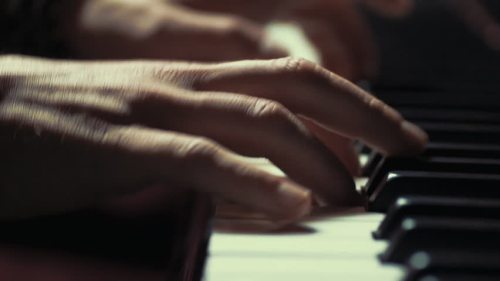
I’m a musician. A pianist. This poem is about music and a lot more. Not everyday music, but music that happens rarely in a lifetime.

I hear Emily describing a pianist, the power of music in the hands of a gifted performer, and the effect on the listener. This isn’t just any music, but the kind that begins innocently enough and ends with power that stuns the soul into silence. Not applause, but silence.

Some musicians were masters at this. Chopin comes to mind. I’m thinking about what’s called ‘the Raindrop Prelude.’ You can watch and hear Vladimir Horowitz perform it here. It doesn’t follow the flow of Emily’s poem precisely, but the opening raindrop notes, repeated throughout, set the stage for what’s coming. In the finale, Chopin doesn’t end with a flourish, but with a gradual distancing of the storm, raindrops still falling and fading into the distance.

I hear Emily describing the music of Nature. The kind that begins with the far-away sound of approaching thunder, and the first erratic fall of rain. Hammers, set in motion by fingers hitting piano keys, strike strings hidden from view. We hear the storm approaching. Sometimes waning, yet always moving our way.

The music draws us in, adding voices and turns of phrase, shifting and turning from here to there, sometimes lulling the listener into a reverie. Then, without warning, like the closing bars of Beethoven’s Pathetique, comes that unanticipated bolt of thunderous lightning followed by utter silence. You can watch and hear Daniel Barenboim’s performance here.

After that, nothing else matters. The music/storm has undone you. Totally. Silence is the only appropriate response. All the standup applause and shouts for more mean nothing. The finale already said everything.

Emily believed in God, and seems to have had a healthy on-again, off-again relationship with God. She also believed in the power of nature to reveal truth about us and about God. I wonder what Emily would make of Hurricane Harvey and its aftermath.

I can’t help noticing that the Winds in Emily’s poem take Forests in their Paws, not in their teeth or claws. Perhaps there’s an invitation to see more than cruel destruction here, or a vengeful God who is somehow punishing us.

Maybe God wants our attention, and is offering us another chance to attend to each other. Strangers as well as friends and family. Costly? Yes. No matter how you look at it. Pain free? Never.

© Elouise Renich Fraser, 6 September 2017
Photo found at Shutterstock

Response to WordPress Daily Prompt: Anticipate

What’s on my heart today

Self-contempt feeds on every critique
positive or negative,
savors and loathes it simultaneously,
then dishes it up in return
or swallows it
disguised as something I deserve or need.

Maybe I’m wrong, but I see us as a society increasingly filled with self-loathing. One give-away is contempt for others. So easy to deliver, even though every dose administered to someone else could be a sign of self-contempt.

Which came first, the chicken or the egg? I don’t know. I do know we seem increasingly addicted to harsh criticism. Sometimes it’s blatant. Often, however, it’s disguised as humor.

Perhaps humor is our favored remedy for damage done to us every time we’ve been treated with contempt. Especially by people with greater authority, power, stature or privileges than our own.

Sometimes it seems my entire life is about recovery from self-contempt. One thing I know: I won’t solve the ache in me by holding others in contempt. The only thing that helps is to look in the mirror when I feel contemptuous, or give contempt free rein with my sharp tongue.

  • Where did that come from?
  • Why does it seem to give me satisfaction?
  • Whose voice is that, anyway?
  • Where have I heard those words before?
  • What does my wounded spirit need from me right now?

The temptation to be contemptuous of others is powerful. Make a snider remark than he or she did! Get known as someone great who commands the stage of contemptuous put-downs! Alternatively, learn to deliver contempt thinly disguised as ‘constructive criticism’ or ‘feedback.’

Well, that’s not the best thing about today. But it’s what’s on my heart right now. The best thing would be the sun shining outside, the too-early fall respite from hot weather, and you showing up today! Thanks for reading.

© Elouise Renich Fraser, 1 September 2017
Response to WordPress Daily Prompt: Critical

The high cost of loving

Just when I think
I’ve memorized
Every line in your face
Death rewrites it

My heart stops beating
Memory fails
A lump in its throat

© Elouise Renich Fraser, 31 August 2017
Response to WordPress Daily Prompt: Memorize

Besotted with Strangers?

Wandering from our roots
We forget the manner of our lives
Those who took us in
When we were strangers
To ourselves and others

We drown in a wilderness
Of our calculated making
Locking doors and barring windows
Buying and carrying weapons
Determined to remain standing

Waves of anger and cries for mercy
Go unheeded in this dry land
Now inundated with people
Desperate for affirmation
A threat to our ways of life

I wonder. Is it time to become besotted with Strangers?

Perhaps we could begin with the Strangers we’ve become to ourselves and others. We might even use Strangerhood as the defining description of our ‘neighborhoods’ including towns, governing bodies, reservations, prisons, churches, schools, businesses, families and cities.

A childhood Christmas carol came to mind this morning. It celebrates a dear little stranger born in a manger. The Christ child. Helpless, unknown, without rank or title, an at-risk baby, poor in wealth and status.

At every turn he welcomed and received strangers into his life. Including religious leaders who often sought to entrap him, officials and citizens who criminalized him, and his motley crew of fearful disciples who abandoned him at the end.

We aren’t the Christ child. We can, however, ask for grace and courage to reflect the truth of his life. Not for our own health and wealth, but because it offers a way to become neighbors to ourselves and others. Especially those we now see as strangers in ‘our’ land, or strangers to ‘our’ way of life or beliefs or political alignments.

Every human disaster is a reminder that we need each other. Especially those others who threaten or disrupt our tidy ways of seeing ourselves and them.

Your thoughts and comments are most welcome. Thanks for listening!
Elouise 

© Elouise Renich Fraser, 30 August 2017
Response to WordPress Daily Prompt: Enamored