Telling the Truth

connecting the dots of my life

Captured on Camera | Photos

FRASER_S_0025

A serious consultation on Grandpa’s wheat ranch in Oregon, Summer 1973

I’m almost embarrassed to admit this. Poring through old photos of our young children evokes feelings similar to my feelings when they were born. Read the rest of this entry »

“Yestereve, Death came. . .”

With others, my mind and heart have been caught up in recent events that involved unscheduled, sudden death for many human beings. I’ve been thinking about this post and decided to feature it today–for all of us mortals who can be certain of one thing: Death is our common lot. Are we ready? Is God ready? Am I?

Elouise's avatarTelling the Truth

This week I’ve been thinking about death, including my own.  My mother and one of my three sisters, Diane, died in February.  Mom died in 1999 from complications following a stroke.  Diane died in 2006 after living with ALS for ten years.  Both were polio survivors of a 1949 polio epidemic.  Their death anniversaries are within a few days of each other.

When George MacDonald wrote the two sonnet-prayers below, he had death on his mind.  His coming death–whenever that might be.  He had already lost four of his eleven children to death.  My comments are at the end.

January 27 and 28

Yestereve, Death came, and knocked at my thin door.
I from my window looked: the thing I saw,
The shape uncouth, I had not seen before.
I was disturbed—with fear, in sooth, not awe;
Whereof ashamed, I instantly did rouse
My will to seek thee–only to fear the more:
Alas!  I could not find thee…

View original post 296 more words

Going to Seminary | Part 4

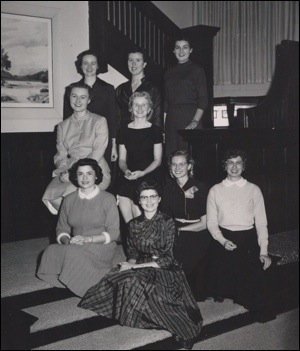
Fuller, Slessor Hall Residents 1959

Fuller Seminary’s Slessor Hall Residents in 1959;
Meeting place for our women’s support group in 1973.

It’s fall 1973. I’ve arrived at a propitious moment! The women’s movement is alive and well. Women are enrolling in seminary programs, many in the professional Master of Divinity (MDiv) program. Read the rest of this entry »

Joy and Delight | Photos

P1110813
How’s this for a bit of color? On my birthday D and I hiked in the Longwood Gardens Meadow and visited the annual Chrysanthemum Festival in the Conservatory at Longwood Gardens.

The top photo shows Read the rest of this entry »

Going to Seminary | Part 3


70's Elouise

Fuller Seminary Student ID Photo, Fall 1973

It’s fall term, 1973. I look calm and reasonably mature. Inside, I’m a boiling cauldron of fear and anxiety.

I don’t belong here!
I’m too old.
I’m the mother of two young children.
Don’t ask me why I decided to come to seminary.
I don’t have an answer.

I feel apologetic about taking up anyone’s time. Read the rest of this entry »

unread mysteries all of us

unread mysteries all of us,
tantalizing and elusive

Several days ago I read a beautiful, evocative poem Read the rest of this entry »

The soul’s nest | From an Old Soul

July 22 – 23, Diary of an Old Soul

Sometimes, perhaps, the spiritual blood runs slow,
And soft along the veins of will doth flow,
Seeking God’s arteries from which it came.
Or does the ethereal, creative flame
Turn back upon itself, and latent grow?—
It matters not what figure or what name,
If thou art in me, and I am not to blame.

In such God-silence, the soul’s nest, so long
As all is still, no flutter and no song,
Is safe. But if my soul begin to act
Without some waking to the eternal fact
That my dear life is hid with Christ in God—
I think and move a creature of earth’s clod,
Stand on the finite, act upon the wrong.

George MacDonald, Diary of an Old Soul
Augsburg Fortress Press 1994

Soul-weariness. I know it well. A kind of spiritual torpor. Listlessness. Is it sloth? Maybe. I’m not sure. It creates hunger in me. Hunger to trace down the source of this lassitude, this inability to move within my spirit for or against anything.

Sometimes I try to ‘make it happen.’ Searching for anything that will jolt my connection with God and with others. Wake me up. Give me a reason to live, a reason to write, a sense of contentment or even happiness.

I know my life is ‘hid with Christ in God,’ but it’s hidden so well that I can’t seem to find it right now. Is this depression? World-weariness? Older age seeping into my veins? Molasses running cool instead of warm?

Where’s the fire I long to feel? Am I burning out? Are my best days behind me? Is it going to be like this forever?

I can think of a thousand ways of describing it. But none of it takes me anywhere.

All I know is that God dwells in me no matter how I feel right now. I don’t blame God, and I can’t blame myself. This is just the way it is right now. Like it or not.

In fact, this is a pretty restful place. “God-silence.” A bit like Sabbath rest. Is God resting too? I like the idea of being a little bird in God’s nest. I like being here, not worrying about where the worms are coming from for my next meal, or what I’ll do today. God seems to be taking care of that…so far. I think I’ll take a little nap.

On the other hand, I wonder what it would be like to leave the nest.

I have an idea! I could practice my flutters for a few days, and learn to sing a little bird song! I’m sure God wouldn’t mind if I take a tiny solo flight to spread cheer and good will. It would really perk me up to know I’m making a difference!

What did you just say? I shouldn’t do this? I don’t belong to myself? My life isn’t my own? And if I do something impulsive like this, I’m just “a creature of earth’s clod?” Made out of a lifeless lump of clay? About to crash-land?

What do you know about it? Who do you think you are? God?

© Elouise Renich Fraser, 28 November 2015

What I never wrote to my father

Dear Dad, thenextfamily.com


When it came to disciplining his daughters, my father often referred to several verses in the King James Version of the Bible.

I love the King James Version (KJV). All my scripture memory work was in its now unfamiliar language. To my ears it’s still beautiful, though somewhat dated, and evokes awe in its choice of pronouns and verbs (thee, thou, goest, comest). Once memorized, it flows easily by heart.

Yet it has limitations. In addition, the language chosen by the 54+ men who translated it between 1604 and 1611 is often stark.

When it came to dealing with me, one of my father’s key verses was Proverbs 16:18 (KJV):

Pride goeth before destruction, and an haughty spirit before a fall.

My father believed he was responsible for beating pride out of me. From his perspective, my anger proved I was a prideful little girl intent on getting my superior way. According to him I thought I knew better than he when it came to punishment, rules or decisions.

If I didn’t comply with his will, another proverb told him what to do. I’ve changed the personal pronouns. Proverbs 23:13-14 (KJV) says,

Withhold not correction from the child:
for if thou beatest her with the rod, she shall not die.
Thou shalt beat her with the rod, and shalt deliver her soul from hell.

Before you get angry with my father, think about this: Like many other parents, he passed on what his father did to him. I can’t exonerate him. He  did what he did. He was responsible for what he did; I was not. I do, however, have compassion for him. I know from experience how difficult it is to raise children.

Last week I was reading the Good News Version (TEV) of the same verses in Proverbs 23:13-14:

Don’t hesitate to discipline children.
A good spanking won’t kill them.
As a matter of fact, it may save their lives.

I would still suggest that even a “good spanking” can kill a child’s spirit. Do you or I know a child’s inner spirit? Do you know the spirit this child may be too terrified to show because right now because the main agenda is to grit her teeth and get through whatever you or I decide to do to her vulnerable body?

What is a “good spanking” anyway? Sometimes I needed discipline. Yet I never needed the kind of corporal punishment I received. Corporal humiliation is never a “good spanking.” It’s humiliation of the weak by the powerful. An abuse of power.

Whatever this “good spanking” is about, it isn’t about humiliating a child’s body or spirit. If the point of the proverb is to say parents mustn’t hold back when it comes to disciplining their children, that can be done in other ways.

Here’s how I see it. As an adult, I’m responsible for welcoming children and young teenagers into my life. They’re strangers I’m privileged to get to know and learn to discipline appropriately. It isn’t always easy. Yet hospitality offers me another way to relate to them and to myself.

  • Hospitality welcomes children and young people God sends into my life.
  • Hospitality isn’t overbearing and doesn’t make quick assumptions.
  • Hospitality asks questions and listens.
  • Hospitality gets interested in what children and young people think and feel.
  • Hospitality doesn’t pry or spy on others.
  • Hospitality listens, affirms, and collaborates to solve problems.
  • Hospitality isn’t rude, bossy, impatient or quick to take offense.
  • Hospitality creates and maintains reasonable, healthy boundaries.

I think hospitality is a form of love. I love my father.

Here’s what I never wrote to my father:

Dear Dad,
Please treat me as a human being created in the image of God. That’s all I want. I don’t want to fight with you or disappoint you. I want to be myself and count on you to help me without humiliating me. I want to be proud of myself and proud of you.
Your first-born daughter,
Elouise

© Elouise Renich Fraser, 27 November 2015
Image from thenextfamily.com

Let’s go see the meadow! | Photos

P1110755

~~~My favorite! A Longwood Meadow bird house hat in late autumn finery.

Is Longwood Gardens addictive? Maybe. No matter. It’s a healthy addiction! Especially on a chilly, breezy, bright sunny day that just happened to be my birthday. Here’s a tiny peek at what we saw Read the rest of this entry »

Going to Seminary | Part 2

FTS Women, Color, T-Women-Collage-min

~~~Women students, staff and faculty at Fuller Seminary through the years

I thought it would be easy to move into my new Going to Seminary series. But it isn’t. Why? I think because this wasn’t an easy or seamless transition in my life.

Compared with getting married, this felt like an earthquake. A seismic shift. I didn’t understand this back then. Today I understand at least the following.

Being a Faculty Wife was a fairly low-profile role. Even though people were suspicious about women with minds and lives of their own, they were still courteous and polite to women who ‘knew their place.’

As long as I kept my head down, took care of our children and showed up at the Bible College to contribute my musical skills and presence, things went smoothly enough.

Nonetheless, sometimes I felt lost and misunderstood. Especially when I described to friends how I felt about not-so-public parts of my life. It seems I didn’t fit the pattern.

But then again, I never did fit the pattern. My father knew this and did his best to change me.

My family upbringing prepared me to survive and even flourish in the Deep South 1960s culture of the Bible College. It was all about being a proper lady, whether as a student or later as a Faculty Wife. I knew how to play the game and succeed, at least on the outside.

Now it’s 1973 and I’m on my way to seminary in California. I don’t have the home team advantage, and the seminary doesn’t have second-class expectations for women. When it comes to academic work, I have to pull my own weight.

When I take a course, D won’t take it for me. He won’t write or edit my papers. He won’t think for me.

This is a seismic shift, though I didn’t appreciate that back then. Gone is the world that groomed me to marry a good Christian man and follow him to the ends of the earth, bearing all the children he might want to beget.

Now I must stand on my own two feet and do my full share of caring for the children, cooking, and housecleaning. I must earn my own grades, write my own papers, make my own oral presentations and take my own exams.

At the Bible College, theology and Biblical studies were supposedly the domain of men like my father. Though women weren’t unwelcome intruders, they were foreigners from another planet.

Women belonged in clearly defined domestic roles, supporting their men who were doing the really important thinking and doing. If married women absolutely had to work outside the home, fine. Just don’t let it interfere with domestic duties.

At the Bible College, most men had no problem with women studying the Bible. Nonetheless, if women had questions about the Bible or theology, they should ask their husbands or their male pastors or professors. Why should they need to bother their pretty little heads with anything difficult or contentious?

As one of my theology professors at Bible College announced: “The next topic is for men; you women can ‘go pick daisies’ if you’d like.”

That didn’t mean we could leave the room; it meant we didn’t have to understand the next topic or take extensive notes about it. We could think about whatever we wished during the next half hour or so. It shouldn’t be of concern to us. The topic? The end of the world (Eschatology)!

When I was accepted into the MA in Bible and Theology, I was elated and terrified. Nine years had passed since I graduated from the Bible College. I was about 10 years older than many if not most other students in my courses. I was also the mother of two young children.

The stakes were high, no matter what I did or didn’t do with this degree. No wonder I was anxious and self-conscious. My life was about to change.

To be continued….

© Elouise Renich Fraser, 23 November 2015
Collage image thanks to http://www.fullermag.fuller.edu