Telling the Truth

connecting the dots of my life

The Gift of Time | from Diane

A Gift for You

This children’s sermon isn’t just for children. It’s for all of us from Diane, my Sister #3. She gave this children’s sermon in August 1990. In fall 1996, just six years later, Diane was diagnosed with ALS. She lived with ALS for ten years and died in 2006.

Without knowing it yet, Diane describes one of the biggest challenges of her life–the number of days she has left on this earth, brought into stark focus by ALS, a terminal disease.   Read the rest of this entry »

Alas, my tent! | From an Old Soul

Announcement for my Dear Readers: This is the first of a series. No, I haven’t given up my other series (Early Marriage and whatever comes next). I’m just searching for a sane way of planning my blogging life. So beginning today, I’ll post regular (not daily) comments on George MacDonald’s sonnets for the month of July, as found in his Diary of an Old Soul. Read the rest of this entry »

Early Marriage | Photos 1968-69

FRASER_S_0085

Christmas in Savannah, 1968

Time for another show and tell! I’ve gone through hundreds of old photos lately, and have a few choice shots to show you. I promise not to do this every time you turn around. I also promise to do it again…. Read the rest of this entry »

Early Marriage | Part 23

FRASER_S_0144B

Elouise, Student Nurse, Son and Volunteer

The birth of our son marked a sudden break with the relatively carefree life we’d had up until now. Nonetheless, I would do it all over again.

The moment we arrived at the hospital, they plopped me into a wheelchair and whisked me off to the large, communal labor room. Goodbye D! See you later! Read the rest of this entry »

Early Marriage | Part 22

FRASER_S_0146

~~~Our son, born in Boston, August 1998

July to August, 1968. I watch and feel my protruding belly take prodding kicks at all hours of the day and night from this unknown-gender life inside me. It’s almost impossible to get comfortable lying down. Or sitting down. Or standing up from sitting down. I have to pee every time I turn around. The Boston heat is sweltering.

I go to the Boston Lying In Hospital Clinic regularly, watch my weight and diet like a hawk, and arrange for a 6-week leave in August and September from my position as organist/choir mistress at the First United Presbyterian Church of Cambridge. I also arrange to work in the dean’s office at the Harvard Law School until two weeks before the due date.

D and I need to move out of Mr. Griswold’s house by Christmas. We know we’ll have an apartment, thanks to friends moving out in the fall. We’re at the top of the waiting list, though they’re not sure when they’ll move out, or how much furniture and baby equipment they’ll take with them.

Even though I’m the oldest of four daughters and have experience taking care of my sisters, I’m anxious! Not so much about giving birth as about the kind of mother I’ll be. Will I know what to do and when to do it? Will D be able to help me, or will I be pretty much on my own?

And then there are D’s fears. He’s been a child of divorce since he was 3 ½ years old. He didn’t see his father often; his single mother raised him the majority of the time. What does it mean for him to be a father?

I’m a worrier from way back. My intuition, experience and observation of friends tell me this could be the end of life as I know it. I fear that once again I’ll lose my identity as Elouise. Instead of being Mrs. D, I’ll become Mom. Generic Mom. The kind people tell bad jokes about or worship as though Moms were at least near-perfect.

Money, time, health (mine and Baby’s), David’s studies, my need for a life of my own. All this and more weighs on me. It feels like getting married without being ready. Maybe a bit like driving without a license, training program or instruction book. We already have Dr. Spock’s latest edition, but I haven’t read it yet.

In the end, these unknowns softened us, even though we were both anxious. It was like getting married. We didn’t have a clue what was coming next, yet we were committed to getting through it together.

I don’t think my experience was strange or unusual. Yet that didn’t make it easier. Just the thought, much less the reality of being responsible for the life and wellbeing of a helpless baby was enough to set me off.

There’s grace in not knowing too much about what’s coming down the road. Or about what you’ve already met up with down that road back there called Childhood. I was clueless about my past—not about what happened, but about how it had shaped me.

Not knowing this may have been a disadvantage. But it may also have been a gift. I didn’t feel pre-programmed to become a certain kind of parent, as though history would inexorably repeat itself.

I’d always thought the process of giving birth would be the most difficult part of all. It wasn’t easy, but it wasn’t the nightmare I expected. Becoming a parent was much scarier and way too real. No going back. We’re it! Coming, ready or not!

At first it was stranger than strange. Yet from the moment our son was born, something began happening in us. It happened when we held him and fed him. Watched him breathe in and out. Counted his tiny fingers and toes and responded to his cries and baby talk.

He was part of the family now, and we were at least ready enough.

To be continued….

© Elouise Renich Fraser, 8 July 2015
Photo credit: DAFraser, August 1968

afternoon sun

P1060811

afternoon sun
dances with hearts of
tender young leaves

* * * Read the rest of this entry »

For Children Only, from Diane

1958 Victory Drive, Diane, Judy and neighbor3

Neighbor, Diane and Sister #4, Summer 1958

Many of you know that Diane, my Sister #3, lived with ALS for ten years before her death in 2006. I’ve already completed a series of Dear Diane letters as part of this blog. I did it because I was starving for sisterly conversation. The kind not allowed in our house with four daughters and no brothers.

I’ve missed that interaction with Diane, and have wondered how to fill the void. I believe her voice is important. She has a strong and somewhat different angle on Telling the Truth.

Near the end of her life, Diane gave me access to most of her writing. I haven’t begun to uncover all the gems—and may never be able to do that.

However, along with her writing, she gave me a set of cassette tapes. You know. The old-fashioned kind.

The tapes were recorded at her church every Sunday. On several Sundays, when the pastor was away, Diane was the minister for the day. That meant she welcomed people, gave the pastoral prayer, and, most fun for her, gave the children’s sermon. At her church they called it ‘Down Front Time.’

The church is large and well-attended. Their sanctuary has a semi-circular seating area. The large, curving platform holds the choir, organ and piano, and seating for ministers and the pastor, with plenty of room to spare. Steps curve from one end of the platform to the other.

When children are invited to Down Front Time, they come and sit with the pastor or minister on the platform steps. Whoever leads Down Front Time always has a bag. The children know there’s a mysterious object in the bag–the key to the topic for the day. There’s also a bit of friendly banter, sometimes for the benefit of adult children in the congregation.

I transcribed most of Diane’s Down Front Times a few years ago, but haven’t been sure how I might feature them. I’ve decided to make use of them via excerpts that get to the heart of each children’s sermon. Possibly one a week as I did with her Word for the Ones I Love.

Diane loved children and they loved her. Her quirky sense of humor and down-to-earth approach to life pulled them right in, along with all the adults listening in.

From this distance, what catches my attention most is that Diane is talking to herself, not just to the children. She’s doing her own spiritual formation work in front of them—with the simplest or strangest of objects. Yet the content isn’t simple or strange. It’s the content of life—all the things that matter most, reframed and restated for young children.

I want to be a young child listening to her along with you. So look for this soon. I’m already working on the first of her Down Front Times.

© Elouise Renich Fraser, 7 July 2015
Photo credit: JERenich, Summer 1958, Savannah, GA

The Daily Scene from My Desk | Marriage

It’s 3:45pm. I’m at my computer in my office. D is at his computer in his office. Adjacent offices. I’ll let you decide who’s who. Read the rest of this entry »

Early Marriage | Part 21

1968 Jun David and Elouise waiting for babyC

~~~Seven months pregnant, June 1968

I’m pregnant! Also self-conscious, excited, apprehensive, disbelieving, elated and more.

There’s no denying it: D and I have been ‘doing it’! Doing it?

I’ll never forget a conversation with my 18-year old daughter. Read the rest of this entry »

Saying Goodbye to Mom | Memories

1996, Diane on bench, Montgomery house

Diane at our old house on the river, 1996

Regrets. This one grabbed my attention after I’d written my piece about Mom and Arnica Ointment. It all began in 1998 with a telephone call to let me know Mom had just had a stroke. The news immediately set off a firestorm of self-recrimination in me. Here’s why.

In late 1998, two months before Mom’s stroke, she and Dad flew to Houston to visit Diane and her family. I’d flown to Houston two days earlier–the first time I’d visited Diane since she had gone on a ventilator.

Even though I’d been there before, I wasn’t ready for the sound of this monster machine pumping, wheezing and making noise night and day. Add to that the agony of never hearing Diane’s voice again.

Two days later I drove to the airport to pick up our parents. Mom was in a wheelchair. She was wearing a new, unobtrusive microphone that picked up and projected her weak voice. Suitcases were piled high on a cart. Some filled with equipment to ease Mom’s increasing difficulties with post-polio syndrome.

Mom and Dad’s visit with Diane was painfully difficult. They didn’t seem to know how to relate to her, given dramatic changes in Diane’s ability to communicate.

Two years earlier in March 1996, Diane, her husband and daughter drove to Savannah for a small family reunion. We all knew Diane had ALS, and that this was her last trip to Savannah.

There were awkward moments, especially when Mom choked more than once while trying to swallow food. We all knew Mom wasn’t well. Nonetheless, the visit was happy, a nostalgic stroll down memory lane.

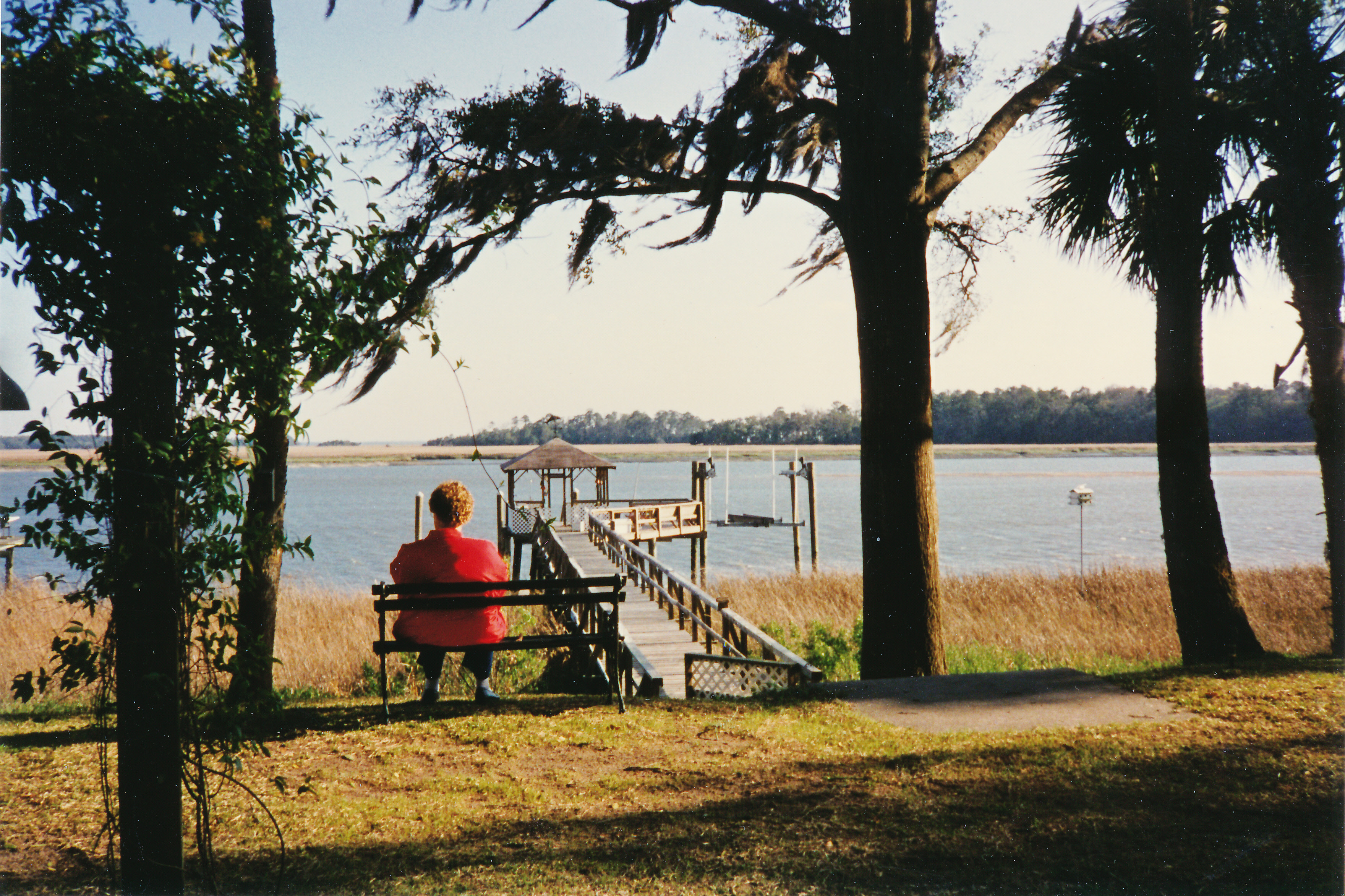
We drove downtown to see the old grade school we sisters attended, and where Mom taught kindergarten. We also drove out to our old house on the river, seen in the photo above, sandbar peeking through at low tide.

Diane’s body already showed limitations from ALS. Yet they were nothing compared to what she now lived with, just over two years later.

Here are a few excerpts from my Houston journal that describe what I observed in my parents in late 1998.

Silence and sadness and inability to speak. . . .Very uncomfortable to watch. . . .Neither of them [my parents] knowing what to say or how to act. Awkward.

The air was heavy with longing and with stunned silence. Not knowing what to do or how to relate. Sometimes projecting onto Diane thoughts and feelings that seemed to keep them from admitting their own sense of grief and helplessness.

I tried to help bridge the gap, but it didn’t work. I felt stuck. Unable to move things forward. Nothing about this visit felt normal—even though we were all dealing with the new normal.

My parents were there for five days. On the sixth day, Diane’s daughter and I drove them to the airport. I wasn’t sure how I would tell them goodbye. A lot of old buttons got pushed in me during this visit, and I was relieved that they were returning home.

Still, the thought of my parents negotiating the airport alone weighed heavily on my mind. I was about to suggest we park and go in with them when Mom spoke up. She said she didn’t want us to go in with them because she didn’t like goodbyes.

So we dropped them off at the curbside check-in and left them there. Two very frail human beings. As we drove away I had second thoughts.

Two months later I got the call about Mom’s stroke. I’d talked on the phone with her once since the Houston trip. It was my last verbal conversation with Mom.

For years I blamed myself for not parking and going into the terminal. Strangely, it seems Mom’s stroke and my arnica ointment helped ease the way for both of us–even though it was late.

Perhaps that’s how I discovered what I wanted to say to her, and how. Still, I prefer earlier goodbyes. And fewer regrets.

© Elouise Renich Fraser, 6 July 2015
Photo credit: DAFraser, March 1996