Telling the Truth

connecting the dots of my life

Weariness

Cape May Warbler

Weariness
Floods my body

Lethargy tells
Me to stop now
Before I collapse
Without anything
Coherent on this
Page of my life
Waiting to be
Lived

I hear birds
Outside the window
Their insistent beautiful
Songs float through
Early morning air
Searching for a
Place to land

Half asleep
My mind floats at will
Reassuring me
That all will be well
That is well

I want to believe
Yet cannot stop pondering
The fate of all that
Is not well now
And forever

I don’t think I’m hitting rock bottom. I am, however, weary in body and spirit. Sometimes I’m standing still. Going nowhere. Other times I’m on a roller coaster swinging wildly between slow, difficult climbs uphill, and furious descents to whatever awaits me.

My mind tries naming things I’ve accomplished this day, this week, this month, this year. Yet the litany of things done doesn’t relieve the anguish of this heavy, relentless tug at my body and spirit.

We here in the USA are in a mess. We don’t know how to get out of it. Whether we like it or not, it colors every day of our lives.

Nonetheless, I believe our Creator and Redeemer understands the big picture, and invites me to trust that all will be well. One day, one breath, one weariness and one joy at a time.

Elouise

© Elouise Renich Fraser, 7 April 2021
Photo found at birdsandblooms.com
For Horace O. Russell

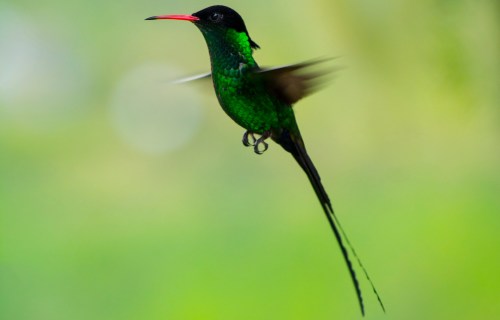
National Bird of Jamaica – the ‘Doctor Bird’ found only in Jamaica

Grief arrived last night
on the other end of a phone call
from a dear friend

Grief not just for us and the family
but for the world our friend knew and loved
from the bottom of his generous heart

Colleague, Brother, Church Historian
Master of all things Jamaican
Wise and Eternally Optimistic

I hang up the phone
and weep for us and for this world
made better by your faithful presence

It’s impossible to capture in words the worldwide reach of our colleague’s life.

Horace O. Russell served the seminary as Dean of the Chapel, and Professor of Historical Theology. I worked with him as a teaching colleague and as an administrator. He was also the retired Senior Pastor of Saints Memorial Baptist Church in the Greater Philadelphia area.

Dr. Russell was Jamaican by birth, and world citizen by choice. He and his gifted British wife made their mark not just on the seminary, but on the church worldwide. Thankfully, his wife and another family member were with him when he left this world.

Today I’ve been thinking about Dr. Russell’s generous, optimistic support for me, and about the senior seminar we co-led more than once.

During these seminars, Dr. Russell sometimes shared case histories he’d written about his pastoral work in Jamaica. They sometimes made life in these United States seem a bit dull.

The actual outcome of each case wasn’t revealed until each student worked with it and shared what she or he would do next, and why. Never a dull moment, and always plenty of surprises at the end. His ability to enlarge our vision was one of his many gifts to the seminary.

Fortunately or unfortunately, Dr. Russell carried a small camera at all times (so it seemed to me). Usually he didn’t wait for people to pose. Informal was the way to go. No matter what we looked like in the photos, he was generous with prints of these historical records. Here’s where we were on this date; this is what we were doing; and this is what we looked like.

Today I’ve been going through my collection of his photos, torn between gratitude and grief. Grateful to know his suffering has ended, and that he was not and is not now alone.

Elouise

© Elouise Renich Fraser, 6 April 2021
Photo of Jamaica’s national bird found at jamaicanconsulate.rs

Life on whose terms?

Falling asleep,
my body cries
for attention
and the comfort
of doing nothing
while awaiting new life
and energy that endures
forever and ever

Listening to the news,
I hear the beginning
of the end in post-Easter air—
especially if Jesus of Nazareth
isn’t allowed to rise from his
unseemly death and confront
our lackluster attempts
to live life on our own terms

I’m struck by how busy things become each year as Easter Sunday approaches. Part of the busyness is about special church services for those able and willing to attend.

But that isn’t what catches my eye. Instead, we have the tug of Easter egg hunts, Easter dinner arrangements, fancy Easter clothes or even mini-vacations that can suck the life blood out of Easter.

I like to enjoy life on my terms. However, Easter challenges me to look beyond myself and my limited resources. I wonder what it would look like for me to keep up with Jesus instead of the current idols of this world?

Thanks for visiting and reading.
Elouise

© Elouise Renich Fraser, 5 April 2021
Image found at anona.com

Easter Lilies and Justice

Easter Lilies

This story still makes me teary. As a nation, we haven’t figured out how to ensure justice for today’s children. Easter offers an opportunity to ponder this tragedy and ask ourselves what we’re doing on behalf of our children. All of them. Diane is Sister #3 in our family. She was born on Easter Sunday in 1949, and died of ALS in February 2006.

Dear Diane,

Easter Sunday always reminds me of you. Not just because you were born on Easter Sunday in 1949, but because the Easter lilies at church always take me back to your funeral service and heaps of Easter lilies around the casket at the front of the church.

Today was no different. I walked in, saw the Easter lilies and tulips, and dissolved into tears as we sang the first hymn. It all came flooding back, along with a story Dad told me when he was in hospice care.

The story was about you and his flower garden in our back yard. Maybe you remember it. That was when we lived on the river. The flower garden had tons of flowers, including Easter lilies and Dianthus, all planted by Dad. He used to say the Dianthus were there because they reminded him of you.

Dianthus

One day Dad noticed that some of his special Easter lilies were missing from his flower garden. When he went back into the house he found them–in flower vases and glass jars here and there!

It didn’t take long to find out you had done this dastardly deed. He said you listened quietly without tears. Then as you turned to walk away you asked, “Where are the flowers for the children?” Cut him to the quick, he said. And I have to admit, he had tears in his eyes as he told the story.

Do you remember that square patch of flowers near the rear of the back yard? It wasn’t very large. Maybe 5 feet wide. It had posts with twine supports for some of the flowers. Most were bright zinnias.

Dad told me, with tears in his eyes, that he planted that flower garden just for the children. We could pick them anytime, as many as we wished. All because you had the guts to ask the most important question of all. “Where are the flowers for the children?”

Today I wonder the same thing. Sadly, we’ve gone downhill when it comes to things for the children. Flowers for the children tend to show up after children or teenagers are killed with guns. Survivors are asking all of us so-called grownups, “Where are the safe places for the children?”

That’s another subject, except for this: It takes guts to stand up and fight for the rights of children and young people. I’m rooting for the children and young people.

Love and hugs, plus Happy Easter and Happy April Birthday—not that you’re counting anymore!
Elouise

©Elouise Renich Fraser, 1 April 2018, adapted from an earlier post, reposted 2 April 2021
Photo credit: wallpapersup.net (Easter Lilies); robsplants.com (Dianthus)

Gethsemane | Mary Oliver

Mary Oliver places this poem just after The Poet Thinks about the Donkey. Clearly an invitation to compare them. My comments follow.

Gethsemane

The grass never sleeps.
Or the roses.
Nor does the lily have a secret eye that shuts until morning.

Jesus said, wait with me. But the disciples slept.

The cricket has such splendid fringe on its feet,
and it sings, have you noticed, with its whole body,
and heaven knows if it ever sleeps.

Jesus said, wait with me. And maybe the stars did, maybe
the wind wound itself into a silver tree, and didn’t move,
maybe
the lake far away, where once he walked as on a
blue pavement,
lay still and waited, wild awake.

Oh the dear bodies, slumped and eye-shut, that could not
keep that vigil, how they must have wept,
so utterly human, knowing this too
must be a part of the story.

© 2006 by Mary Oliver, published by Beacon Press in Thirst, p. 45

This one stings. How many vigils have I slept through? Or how often do I look the other way when injustices are playing out before my eyes.

When I was growing up, I had nothing but scorn for those three sleepy, self-absorbed disciples who couldn’t stay awake and keep watch for their friend Jesus. Surely they believed him. They’d already shown themselves capable of going to extreme lengths on his behalf.

Mark 14:32-42 doesn’t say Peter, James and John were reluctant to stay with him and keep watch. It says they couldn’t keep watch as Jesus asked them to do not once, but three times. Meanwhile, Jesus is left alone to face his coming betrayal.

In contrast, all nature (except human nature) was wide (wild!) awake that night. The only witnesses to Jesus’ agony, betrayal, trial, and eventually death on a cross outside the city of Jerusalem. The same city that welcomed him on the little donkey not a week earlier.

Mary suggests the stars and moon, trees and insects all kept watch that night. I like to think they offered some peace, perhaps even solace as he prayed, weeping and agonizing for all of us and for himself.

In the final stanza Mary offers grace to them, to herself and to us. The three disciples were “dear bodies” and “utterly human.” They weren’t deadly co-conspirators. They were human, just as we are. Weary.

Praying we’ll be as understanding about Jesus’ three companions as we are about ourselves, even as we lament Jesus’ coming betrayal by Judas, also one of his chosen disciples.

Elouise

© Elouise Renich Fraser, 1 April 2021
Painting found at touchstonemag.com

About my book of poems

Dear Friends,

The last few weeks have been hectic. Not with busy work, but with my book of poetry! It’s not yet out there, but forthcoming. Title: Without a Flight Plan.

What I’ve learned:

  1. Writing poetry is easy, compared with preparing it for publication.
  2. Though self-publishing through Lulu is a blessing, it’s also a hassle. Not with them, but with back and forth electronic clarification or correction of anything at all. After proof-reading and fiddling with four trial copies, I’m ready to let it go. But see #3!
  3. Before I sign off on the book, I must supply (for outlets that offer the book) a brief description of what the reader can expect to find in my poetry. Expletive deleted.

Several years ago I decided I would not try to publish a book of my poetry. It felt like a huge interruption and a hassle I didn’t want to invite into my life.

That was then; this is now; and yes, I’ve changed my mind.

Why? Partly due to choices made and not made by our former POTUS. His lack-luster response to Covid-19 will haunt us for years. As will his unprofessional behavior in front of cameras eager to catch every glimmer of the Trump circus.

Still, the bottom line isn’t Trump, it’s how I experienced life during 2020. A great mish-mash of ups and downs, disappointments and unexpected gifts.

When I was teaching seminarians in the 1990s, I had two books published. One (coauthored) was called Making Friends with the Bible. The other, Confessions of a Beginning Theologian, was about how I became and was still becoming a theologian. Both books drew on personal experience and observations. In addition, each was judiciously worded. I didn’t want to upset my father or anyone in authority over me.

In this collection of poems, I don’t hold back or try to dress up what I wish I could say out loud. Even better, I no longer wonder what my father would say if he ever read these poems. Nor do I worry about what family, friends or strangers might think of me. So yes, it’s time to get one more book out there!

Thanks again for visiting, and listening not just to me but to your own heart.

Elouise

© Elouise Renich Fraser, 30 March 2021
Photo taken by DAFraser at Longwood Gardens, March 2016

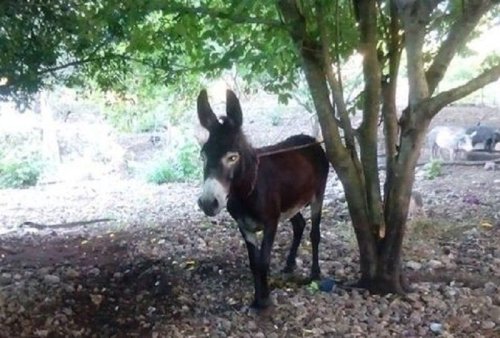
The Poet Thinks about the Donkey | Mary Oliver

Here’s a thought-provoking Palm Sunday poem from Mary Oliver. My comments follow.

~~~~~

The Poet Thinks about the Donkey

On the outskirts of Jerusalem
the donkey waited.
Not especially brave, or filled with understanding,
he stood and waited.

How horses, turned out into the meadows,
    leap with delight!
How doves, released from their cages,
    clatter away, splashed with sunlight!

But the donkey, tied to a tree as usual, waited.
Then he let himself be led away.
Then he let the stranger mount.

Never had he seen such crowds!
And I wonder if he at all imagined what was to happen.
Still, he was what he had always been: small, dark, obedient.

I hope, finally, he felt brave.
I hope, finally, he loved the man who rode so lightly upon him,
as he lifted one dusty hoof and stepped, as he had to, forward.

© 2006 by Mary Oliver, published by Beacon Press in Thirst, p. 44

~~~~~

I love Mary Oliver’s focus on the donkey. He isn’t just a convenient prop, needed for this so-called ‘triumphal’ march into Jerusalem. Nor is he a famous, beautiful or even clean donkey. He likely has no idea how to race around meadows with horses, leaping with sheer joy. Nor does he know how to fly into the sunlight alongside released doves.

All he knows is how to stand, wait, and do what needs to be done. Which, on this day, means carrying on his small back the hope of all Jerusalem. Well…almost all Jerusalem. Cheers and jeers sometimes sound all too similar.

Was he brave? Probably not. Nor could he have been all cleaned up, given the inevitable dust of the earth hanging in the air. To say nothing of noise and pushing and shoving to get a look at this strange parade.

No problem. His calling on that day was to walk forward without coaxing or threatening, carrying the hope of all the world on his small, dark obedient back. Bravely he moved forward through a noisy crowd, one dusty hoof after the other, without turning back, running away, or refusing to move at all.

Where does Mary Oliver’s poem find you on this Palm Sunday? And what does it mean to be brave in the face of tragedy and undeclared war rolling out in front of all our eyes?

Thanks for your visit today. I pray each of us will find courage to do what we’re made to do: love our Maker with all our hearts, and our neighbors as ourselves.
Elouise

© Elouise Renich Fraser, 27 March 2021
Image found at threadreaderapp.com

What’s a senior citizen to do?

Wheels rush downhill
Splashing through
Early Spring water

My mind travels
Backward through time
Now gone forever

Last night our cat
Conquered and ate
Yet another mouse

All except his head
And tail and a few entrails
Yet to be identified

It’s downhill all the way
No chance to return
To the beginning

I thought I would fear
This end of life scenario
Hurtling toward me

And yet…

I’m caught between the joys and agonies of this life.
Right now the agonies seem to be outpacing the joys.
Even so, I want to live forever, joys and sorrows included.

So what’s a senior citizen to do?

Keep my head above water and my eyes wide open; support the next generations; and have my pen ready to capture truth in words I didn’t know were in me.

On balance, after removing D from the equation, blogging saved my life. It gave me a life I never dreamed I would have, and friends I never thought I would meet.

Thanks for stopping by. Your visits and comments give me hope for this tired old world. The same world for which Jesus of Nazareth lived and died.

Elouise

© Elouise Renich Fraser, 24 March 2021
Image found at steemit.com

Peace | Dorothee Soelle

Last night we lost yet more citizens to a so-called ‘lone gunman.’ This time in Boulder, Colorado. Today I woke up thinking about one of Dorothee Soelle’s poems from the Vietnam War era. The war lasted officially from 1 November 1955 to 30 April 1975. My comments follow.

Peace

1

Asked to write a poem about peace
I feel shame for those who ask
do they live on a different planet
what are their hopes
and for whom

Gases meant for rice farmers
have been tested
they can be harmless
if the humidity and the wind
are right

So I’d suggest
we talk about the wind

2

Speaking of the wind
it can be lenient
rice plants can be merciful
sometimes
how friendly the jungle rain is
it delays attacks
and the twenty-fourth of december
lowers the casualty count
all these things provide cover
for st sebastian
for peace

3

He’s leaning against a tree
the wood has been sold
the land leased
the water poisoned
the rain kills birds
somebody takes aim at him
he raises his arms against the black wood
it is not finished

Dorothee Soelle, Revolutionary Patience, pp. 33-34
English translation © 1977 by Orbis Books

Sometime during the night yet another citizen of the USA walked into yet another public business and committed mayhem. This time in Boulder, Colorado. We miss the point if we think this was a lone male. No matter what prompted his actions, he is one of millions of men and women in the USA outfitted for killing with firearms, without warning.

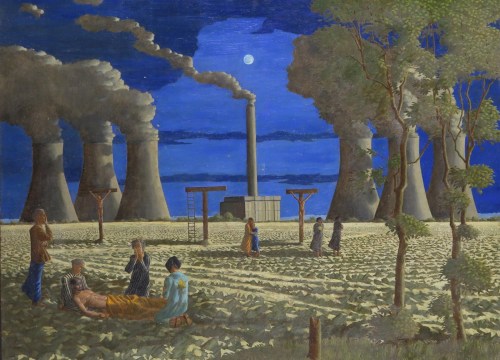
And here we are in Lent. How ironic. Dorothee Soelle is correct: The death of one man (in this case, St. Sebastian) did not end the killing. Nor did the death of Jesus of Nazareth end the enmity burning like fire in the veins of many who see no way out except to take aim and fire.

“Surely he has born our griefs, and carried our sorrows….” (Isaiah 53:4, King James Version)

May God have mercy on us all.

© Elouise Renich Fraser, 23 March 2021
Image of painting by Roger Wagner found at mutualart.com

The Fist | Mary Oliver

Thank you, Mary Oliver, for yet another challenging poem. I imagine you watching us, willing us to do better. My comments follow your poem.

The Fist

There are days
when the sun goes down
like a fist,
though of course

if you see anything
in the heavens
in this way
you had better get

your eyes checked
or, better still,
your diminished spirit.
The heavens

have no fist,
or wouldn’t they have been
shaking it
for a thousand years now,

and even
longer than that,
at the dull, brutish
ways of mankind—

heaven’s own
creation?
Instead: such patience!
Such willingness

to let us continue!
To hear,
little by little,
the voices—

only, so far, in
pockets of the world—
suggesting
the possibilities

of peace?
Keep looking.
Behold, how the fist opens
with invitation.

© 2006 by Mary Oliver, poem found on pp. 46-47 of Thirst,
Published by Beacon Press

Dear Mary Oliver,

I don’t know where to begin. Things are such a mess down here since you left. And still the sun goes down, often in blazes of glory that fade and then, right on time, return the next day.

Never resting, really. Just moving on to circle this war-weary earth every 24 hours so everyone knows we haven’t been left to our own devices, or shut down due to human failure.

As if it weren’t amazing enough to see the sun setting, songbirds join in the morning sunrise chorus. Especially in spring when their hormones seem to go wild with passion. Or at least the urge to procreate.

This morning I watched with disbelief as a fat red robin jumped into a pan of freezing cold water and splashed away before running off to pursue a female robin. Just two minutes later, a small gray junco did the same thing even though, as you know, they don’t procreate here in Pennsylvania. Are they crazy? Do they know something I don’t know, sitting behind my kitchen window, shivering?

There’s so much we don’t know right now. Why did this person got Covid and die while that person didn’t? Or why did my friend die who didn’t have Covid at all?

When I was growing up, they said most brutish behaviors were about lack of self-control. Today I’d say most of our crazy choices seem to be about fear. Not fear of Covid, but fear of having our “rights” taken away. I’m sorry to say we don’t seem to be softening as a nation, cleaning up our brutish ways, or finding our places in this strange world.

Wouldn’t it be wonderful if we could all accept the sun’s invitation? I imagine us jumping into the cold water together to clean our tired bodies and revive our aching souls.

I hope you’re doing well today. And please, pray for us as you’re able.

Your admirer,
Elouise

© Elouise Renich Fraser, 22 March 2021
Sun setting over a city found at wallpaperaccess.com