Telling the Truth

connecting the dots of my life

Category: Death and Dying

How are you?


Photo taken on our last visit to Longwood Gardens, October 2019

It’s been so long
Since I laid eyes on you
Or heard the sound of
Your voice or felt the warmth
Of your body unfiltered
Through electronic wavelengths
From other planets
Unreachable if not lost
In some black hole

How are you? I
Can’t help asking everyone
In particular plus anyone
Caught in webs of good
And evil intentions
Now unraveling and
Morphing into something
Worse than promises
Of our certain liberation

And how am I?
I was never one to enjoy
Unproven fictions now seeping
Through locked doors
Demanding allegiance whether
Justified or not as promising
Moments shatter into shards
Of competing universes
Threatening to undo us

Just in case: Three questions for me, should I be called to serve on a jury anytime soon:

Do I wear a facemask in public?
Yes. I value my life and yours.

Am I prepared to die?
I’d like to think I am, but I’m not sure.

Does the current situation give me hope?
No. My hope does not rest on the current situation.

Not-so-random thoughts passing through my mind these days. I pray each of you is grounded in what matters most these days. And don’t forget to enjoy nature’s bounty!

Elouise

© Elouise Renich Fraser, 18 May 2020
Photo taken by DAFraser on October 2019, Longwood Gardens

Missing in action

Searching for myself
In this other-worldly place
My mind wanders
Down one path
and up another
Without a map
Or proper clothes
For a fading woman
Whose goal is
To get through today
Intact

Yesterday’s dreams
Sleep fitfully
In another time and space
Missing in action

I haven’t posted for several days, in part because of a few nagging health issues that required attention.

The biggest hurdle, though, has been coming to terms with my present reality. First, as a senior citizen with chronic pre-existing health conditions. And second, as a citizen of the USA, with the reality of Covid-19 as presided over (or not) by Mr. Trump.

The question I asked several weeks ago still nags at me. What will I do if I develop signs of Covid-19? What do I want, and what do I not want?

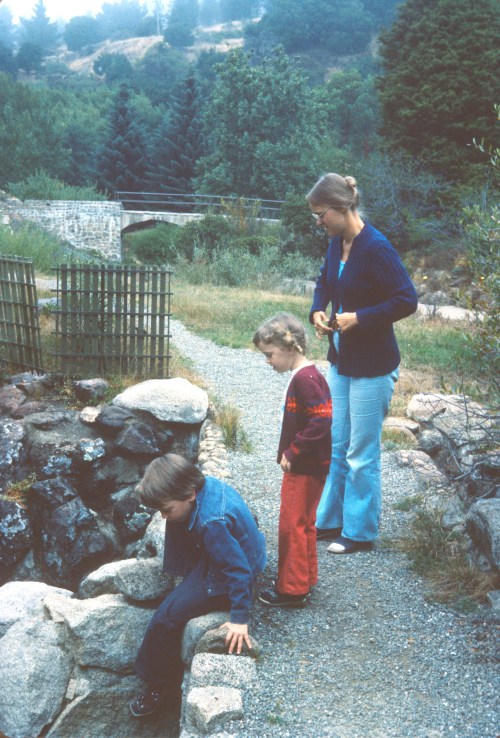
Last week I looked through old photos of my life with D and our family. I thought about what I want and do not want, should I need to be quarantined. I also consulted with a trusted friend who is going through a similar discernment.

In short, what I wrote in my Living Will eight years ago isn’t going to work for Covid-19. So I’m starting over.

I’ve decided to use Five Wishes as my framework this time. In large part because they offer a framework for talking about this with family members. I don’t want to be intubated, or moved to a hospital. What would that mean? Are we up for this?

In some ways, I’d rather stay lost in my old photos. They bring me laughter and joy. They remind me that I’ve lived a life I never thought I would have, and visited or lived in places I never expected to see. I want to be anchored to that reality instead of trying to figure out how I’ll stay alive for as long as possible.

A life isn’t made up of years. It’s made up of small and large moments. A mosaic, not a graph or timeline. D took the photo above in January 1976, the year I graduated from seminary. One small piece of our mosaic.

Elouise

© Elouise Renich Fraser, 12 May 2020
Photo taken by DAFraser in southern California, January 1976
 

Love Sorrow | Mary Oliver

This poem from Mary Oliver struck a chord in me. Partly due to the current pandemic, with its waves of sorrow. But also because of my personal history. My comments follow.

Love sorrow. She is yours now, and you must
take care of what has been
given. Brush her hair, help her
into her little coat, hold her hand,
especially when crossing a street. For, think,

what if you should lose her? Then you would be
sorrow yourself; her drawn face, her sleeplessness
would be yours. Take care, touch
her forehead that she feel herself not so

utterly alone. And smile, that she does not
altogether forget the world before the lesson.
Have patience in abundance. And do not
ever lie or ever leave her even for a moment

by herself, which is to say, possibly, again,
abandoned. She is strange, mute, difficult,
sometimes unmanageable but, remember, she is a child.
And amazing things can happen. And you may see,

as the two of you go
walking together in the morning light, how
little by little she relaxes; she looks about her;
she begins to grow.

© 2008 by Mary Oliver
Published by Beacon Press in Red Bird, a collection of poems
“Love Sorrow” is on p. 64

Dear Mary,

Your poem about loving sorrow brought back memories of my childhood and adult life. Especially things taken or withheld from me before I understood they were mine. Plus bits and pieces I lost or gave away throughout my life.

Sorrow, especially if it showed, was an indulgence I needed to give up. Or get over. What’s done is done. It won’t do to make my friends uneasy, or get into trouble with adults who wanted me to be someone else. I learned early to swallow or deny sorrow. Especially in public.

I think you would be horrified though not surprised at the world as it is today. We’re drowning in sorrow and anger, trying to figure out how this tsunami pandemic caught us so unprepared for death and dying, as well as living mindfully.

I don’t want to drown. I want to live and grow, especially now as time is running out.

Thank you for showing me how to befriend my sorrow. How to welcome her into my life, and learn to live with her as the child she is. And how to watch her begin to relax and grow into a strangely wonderful companion.

With gratitude and admiration,
Elouise

© Elouise Renich Fraser, 7 May 2020
Image found at 123rf.com

Crossings of No Return – revisited

Has everything changed with Covid-19? This post from January 2017 reminds me that some things never change.

Crossings….

The word resonates with finality
Hints of danger and uncertainty
Sorrow and desperation
Weary clothes and
Hungry faces

One foot in front of the other
Backs burdened with life’s necessities
Bodies and bellies heavy
With tomorrow’s children
Silently pleading

They say our world is disappearing
Melting and boiling away before our eyes
Erupting into a chaotic crisis
Unknown in modern times
Are we ready for this crossing?

What lies ahead for this world and for us as citizens of this world? Our insular, isolated, boundaried ways of life don’t work well anymore, and our ways of governing seem to have reached their own point of no return.

Years ago I crossed a line of no return. I chose to be a follower of Jesus Christ. I don’t believe there’s a magic wand answer for any of this world’s upheavals. Yet I do believe we see a direction in the life, ministry and death of Jesus Christ. Not the superstar, but the human being sent to this earth to live and to die as one of us and as God’s beloved son.

Jesus made a crossing of no return when he came to live with and among us. He wasn’t president, emperor or chief. Nor was he a privileged member of the religious or political elite, or a child of God immune to human emotions and agony.

His life was short. Yet in his short life I find a direction that hasn’t changed even with our current global upheavals. Taking my cues from Jesus, I’m to love God, my neighbors and myself. Acknowledge my human limitations and need for others. Be ready to accept and offer hospitality from and to strangers. Bear the cost and share the compassion of being a follower of Jesus Christ.

Do I feel strong? Rarely. Do I feel ready? Rarely. Do I feel like giving up? Sometimes. Yet the steady, courageous, compassionate and steel-eyed clarity I see in narratives about Jesus’ life on this earth remains my True North. The one point on my compass that won’t change no matter what it takes to get from here to there.

© Elouise Renich Fraser, 4 January 2017, lightly edited and reposted on 5 May 2020
Photo of South American immigrants found at nytimes.com

broken bodies

into dawn silence
the lone catbird signs softly
as earth holds its breath
remembr’ing bodies broken
released into waiting arms

Yesterday was communion Sunday–via virtual church on YouTube. “This is my body broken for you.”

We can’t turn the deaths of broken Covid-19 bodies into beautiful ceremonies. Still, there’s something to be said for the way this earth welcomes our broken bodies without judgment. Death can’t be glorified. It can, however, be seen as the beginning of something else. Often as release from what has become unbearable.

I hope a catbird sings soft songs for me when my time comes. I also pray this Monday finds you grateful to be alive, and ready for whatever comes next.

Elouise

© Elouise Renich Fraser, 4 May 2020
Photo found at birdatlas.bc.ca

Of The Empire | Mary Oliver

This morning, in response to my post yesterday, I had an email from a friend. She sent a link to an essay by Susan M. Shaw, I’ll get to hope. For now, I need to sit in the ashes and mourn.  Dr. Shaw doesn’t spare our feelings. Nor does she minimize Mr. Trump’s role. Instead, she focuses on how we’ve colluded to bring ourselves to this point in history. I highly recommend it.

In her essay, Dr, Shaw includes a prose poem by Mary Oliver. It was new to me, and right on target. I found it helpful as a roll call of how we in this nation got from there to here.

Of The Empire

We will be known as a culture that feared death
and adored power, that tried to vanquish insecurity
for the few and cared little for the penury of the
many. We will be known as a culture that taught
and rewarded the amassing of things, that spoke
little if at all about the quality of life for
people (other people), for dogs, for rivers. All
the world, in our eyes, they will say, was a
commodity. And they will say that this structure
was held together politically, which it was, and
they will say also that our politics was no more
than an apparatus to accommodate the feelings of
the heart, and that the heart, in those days,
was small, and hard, and full of meanness.

© 2008 by Mary Oliver
From her 2008 collection, Red Bird, p. 46
Published by Beacon Press 2008

I wonder what Mary Oliver would say to us today. Wishing for you some reasonably quiet time today to mourn, and ponder our culpability in this mess.

Elouise

© Elouise Renich Fraser, 30 April 2020
Image found at onthecommons.org

What’s on my mind these days

Without answers, here’s what I’m wondering about these days when it comes to Mr. Trump.

  • How and why did we come to this sad bargain that turned a self-proclaimed genius loose on us and on the rest of the world?
  • Why do I find myself wishing for his demise sooner, not later?
  • How, if ever, can I forgive the folly of this self-proclaimed genius who ignores expert advice, and leads his followers down paths of destruction?
  • As a follower of Jesus, how am I to pray for or against this leader motivated by greed, contempt and self-righteousness?
  • And what does it mean to follow Jesus when many who claim to follow Jesus think this means following Mr. Trump, or at least overlooking his lies and greed?

Everything isn’t about POTUS. It’s also, in a different way, about us. However, my blood runs cold when ‘common people’ are forgotten pawns in a deadly game of Chess held together by a made-up patchwork of throw-away lies, neglect, and innuendo.

Covid-19 didn’t change things. It made them impossible to ignore.

© Elouise Renich Fraser, 29 April 2020
Image found at pinterest.com

Beautiful Music Monday

Conductor Emeritus Kenneth Jennings (1925-2015) leads over 900 choir alumni during the 100th Anniversary Celebration of the St. Olaf Choir in June of 2011.

Most of you probably know this hymn as “Fairest Lord Jesus.” It was my father’s favorite hymn, known to him by its older name, “Beautiful Savior.”

When I’m dying, I want music to carry me away. Then I want to join the choir. I want to sing music like this. Music that makes all things and all voices beautiful. I want tears to flow. Mine. The way they did this morning when I listened to this on You Tube.

I don’t understand why hymns like this reach so deeply into me. But there it is. And here we are today, surrounded by deaths of many kinds. Bodily and spiritual death. Death of hope and trust. Never easy, especially when it seems to be piling on without mercy.

I hope you enjoy listening to this amazing choir following the lead of their beloved conductor Emeritus, Kenneth Jennings. Like angels, they’re singing together on key, accompanied only by each other, following their leader. A force together that they could never be on their own.

Here are the lyrics as sung by the choir, following their opening wordless rendition of the tune.

Fair are the meadows, Fairer the woodlands,
Robed in flow’rs of blooming spring;
Jesus is fairer, Jesus is purer;
He makes our sorr’wing spirit sing.

Beautiful Savior, Lord of the nations,
Son of God and Son of Man!
Glory and honor, Praise, adoration,
Now and forevermore be Thine!

I pray you’ll find beauty and music in the week ahead.
Elouise

© Elouise Renich Fraser, 27 April 2020
St. Olaf Choir Alumni’s rendition of Beautiful Savior found at YouTube.com

outside my window

outside my window
a song sparrow feasts on buds
dodging lazy rain

this morning he sings
during the dawn song hour
or is it a half

cracking closed eyelids
I calm my breath and feign sleep
during his encore

Yesterday was a full stop. Time out to see what doing “nothing in particular” felt like. This included not listening to news during the day.

Overall, it was wonderful. Especially our longer than usual late afternoon walk in damp, cloudy, beautiful spring weather. The birds were out in droves, singing and calling out their territorial warnings. Near the end, a red-tail hawk flew by, cruising through tree-tops.

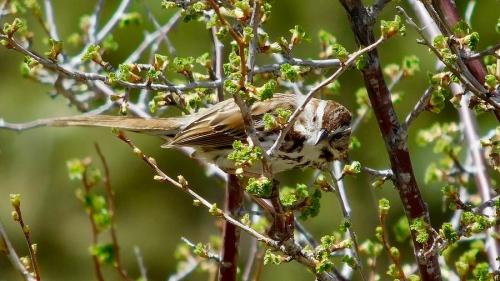
When we got back from our walk, the little song sparrow was feasting on tiny flower buds just outside my office window. He and his mate have a nest in a large shrub beside our house. Hearing them sing, and listening to the little ones learning to sing is a gift.

As we left for our walk, our neighbor and one of his young children were out for a walk around the yard. His wife is a medical doctor, on the faculty of one of Philadelphia’s teaching hospitals. She’s been on Covid-19 duty for weeks. I wish for her and her family a day to walk through the neighborhood, doing nothing. And a morning to lie in bed listening to the birds.

The stark contrasts between what we’re all experiencing during this pandemic are troubling. We aren’t in a rosy situation. We’re at the edge of a precipice, wondering who or what will be there when we fall. Will anyone care enough to pick us up? And will there be any birds or music to comfort us?

Which pandemic are you experiencing?

Elouise

© Elouise Renich Fraser, 24 April 2020
Photo of Song Sparrow taken by Dan Miller, found at pixels.com

The Wind took up the Northern Things | Covid-19

Emily Dickinson’s poem rings eerily true, given the current pandemic. How will we pick up our pieces? What, if anything, will we have learned about ourselves? And how many of us will be present and accounted for?

Winds of change overtake us every day. Natural and unnatural disasters intrude. Emily Dickinson invites us to take a closer look. My comments follow.

The Wind took up the Northern Things
And piled them in the south –
Then gave the East unto the West
And opening his mouth

The four Divisions of the Earth
Did make as to devour
While everything to corners slunk
Behind the awful power –

The Wind – unto his Chambers went
And nature ventured out –
Her subjects scattered into place
Her systems ranged about

Again the smoke from Dwellings rose
The Day abroad was heard –
How intimate, a Tempest past
The Transport of the Bird –

c. 1868

Emily Dickinson Poems, Edited by Brenda Hillman
Shambhala Pocket Classics, Shambhala 1995

The calm before a storm is nothing compared to the calm after a storm. Wind, dust, earthquakes, locusts, famine, fire, floods. Devastating, destructive, unpredictable. Then it’s over. Deadly silent. Until nature ventures out, surveys the damage and begins reclaiming her rhythms, colors, textures and stunning beauty.

There’s nothing romantic about the destructive forces of nature. No one who has survived their fury can forget the terror. Or the people, animals, natural resources and futures gone or changed forever.

Nonetheless, I hear Emily inviting us to consider the other side of the storm. What happens following unpredictable upheaval? What happens when everything is different and nothing can be taken for granted?

Healing and rebirth don’t happen overnight. Nature will take its time just as it always has. We can count on her subjects and systems doing their thing, even though everything will be different, changed in some way.

As for us, life changes immediately in the aftermath of major upheaval. Belongings and people we took for granted or undervalued yesterday are suddenly precious. Whether missing or found against all odds, each person and each item becomes the subject of conversation, tears and thoughts shared around fireplaces. Personal and intimate.

This everyday hearth fire, unlike a firestorm, warms our hearts. We’re not alone. A bird sings. Was it blown here by the storm? I don’t know. Still, its simple song says I’m not forgotten, even though my small world just got turned upside down.

I hear in Emily’s poem an invitation to think about the value of human life as well as the value of our planet. Both seem under siege right now. Not just by politicians or corporations, but by people such as you and I. I don’t have answers. I do, however, have hope that we’ll wake up before it’s too late.

© Elouise Renich Fraser, 26 June 2017, reposted 22 April 2020
Photo of recent storm damage in the South found at washingtonpost.com