Telling the Truth

connecting the dots of my life

Category: Writing

The Dean and I | Part 11

Griswold Letter to ERF

Do words in old letters ever die? Here’s Mr. Griswold’s thank-you letter about my work in the dean’s office at Harvard Law School. Click on the letter to enlarge it.

When it arrived in 1967, I showed it to David and put it away. Our first baby was almost ready to be delivered. Besides, Read the rest of this entry »

The Dean and I | Part 10

Anthony's Pier 4, boston-waterfront-anthonys-pier-4_2
Anthony’s Pier 4 Restaurant, Boston Waterfront
(now closed)

Spring 1968.  Mr. Griswold asks D and me to house-sit for him for up to one year. I tell Mr. Griswold I’m pregnant, thinking he might change his mind. He doesn’t. In fact, would D and I be able to move in by early June?

D and I talk it over. We also talk with friends from New Zealand. They plan to return to New Zealand with their baby right after Christmas. We’re at the top of the list for their spacious apartment near the university. Good news, since Mr. Griswold isn’t sure how long he’ll need to have us house-sitting.

Yes, D and I can move in by early June. Mr. Griswold invites us to supper so they can show us the house. Nothing fancy. No need to dress up. Yes, I’m nervous! Is this really happening?

I’ve met Harriet Ford Griswold before, but usually at official social events. She asks about Diane’s and Mom’s polio histories, and tells us her polio history. She’s a woman of great courage.

The house is set up so Mrs. HFG can be as independent as possible. A cook helps with dinner, and a cleaning woman comes every so often. The rest of the time Mrs. HFG is on her own. Even when Mr. G is present she doesn’t expect or want him to do what she can do. She goes into detail about how she gets along by herself most of the time. I wonder whether she’s lonely.

The house is in a residential area, sits on a hill overlooking Boston, and has a yard full of trees. Most impressive, it has a small enclosed elevator for Mrs. HFG. There’s an old piano I’m welcome to play, though hasn’t been tuned for years.

Beyond that, there’s a ground level back door entrance, and doors throughout most of the house are wide enough for a wheelchair. Mr. G keeps the thermostat well below 65° Fahrenheit at night. I think he expects us to conserve energy. Which we do.

The move is easy. We pack our clothes and kitchen, box the books, throw everything into the back of our VW squareback and drive off.

Back at the office
My co-workers know I’m pregnant, and that D and I are going to house-sit. I have my ‘interview’ with the future interim dean. He sees no reason to let me go, and tells me to stay on as long as I’m able. I’m relieved.

In May, Mr. Griswold takes our office staff out to lunch, with spouses or special friends. We drive to Anthony’s Pier 4 Seafood Restaurant, a favorite with everybody. We have one last lobster feast (pick your own lobster from the tank as you come in), and tell stories about working with Mr. Griswold.

It’s the end of an era. Mr. Griswold is retiring, and the university is going to build a modern law school building, just behind Langdell Hall. The law library will stay in Langdell Hall. The offices we’re in will become part of the new library, but not until I’m gone. I love Langdell Hall.

I continue working until two weeks before my due date in late August. No health problems. Just Boston heat and time out as needed to put up my legs, relax, drink water and make trips to the ladies’ room.

In early August, EW hosts a raucous farewell celebration and baby shower for me at her home. Her round dinner table is filled with friends from work, plus D and a few other spouses. Mr. Griswold is already busy in Washington, D.C.

A few days after the farewell party I receive a hand-written letter from Mr. Griswold. It’s on his new letterhead: The Solicitor General, Washington. Erwin N. Griswold.

I read it several times, stunned by what he says. I show it to D, then put it away. It’s a treasure I don’t know how to unpack just yet. I don’t look at it again for years.

I’m less than one week from delivering our first child.

© Elouise Renich Fraser, 14 April 2015
Photo credit: http://www.webtravelguide.com

looking up

looking up
I see you writing
inky words
on yellowed paper
lost memories
shades of the woman
I was then

* * *

© Elouise Renich Fraser, 14 April 2015

The Dean and I | Part 9

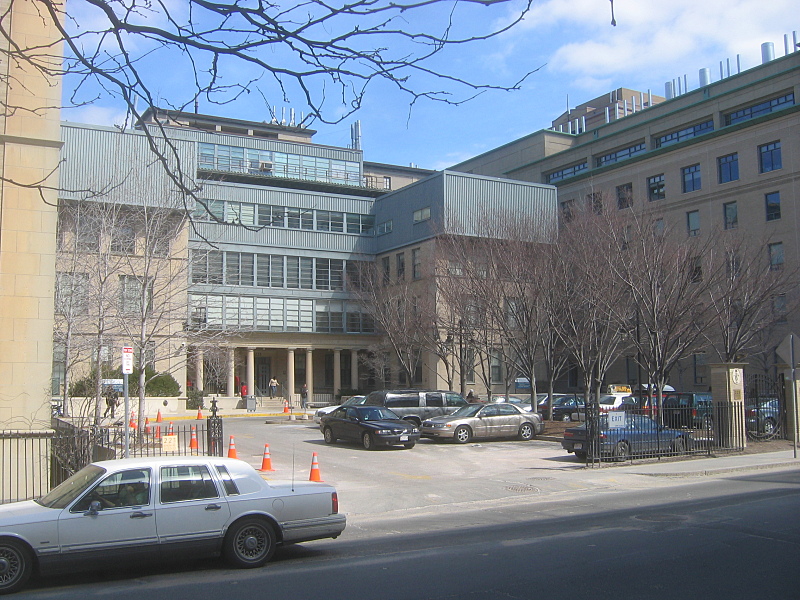
Boston Lying-in Hospital, wickipedia.orgBoston Lying-In Hospital for Women (center building),
part of Brigham and Women’s Hospital

It’s early Spring 1968. I’m back at work, and my lips are sealed. No talk about being pregnant. No need. Not yet.

But I do need affordable maternity care. The university refers me to a downtown clinic Read the rest of this entry »

Sister Kenny’s Battle

Polio, Photo, Elizabeth_Kenny_NYWTSElizabeth Kenny (1880-1952)

Few women have battled the medical establishment with such flair and so little respect as Sister Kenny.

Born in New South Wales, Australia, Elizabeth Kenney’s father was from Ireland; her mother was native born. Kenny began educating herself as a nurse while recovering from a broken wrist. Her resources included books on anatomy and a model skeleton from her physician who later became a friend and mentor, Dr. McDonnell.

Kenny didn’t have a nursing degree. Nor did she give herself the title ‘Sister.’ Early on she volunteered at a small maternity hospital. Later, she began visiting patients who needed and requested medical help. She charged nothing, and got around on horseback.

In 1915, during World War I, Kenny enlisted as a staff nurse in the Australian Army Nurse Corps, thanks to a letter from Dr. McDonnell.  In 1917 she was promoted to Sister—the equivalent of first lieutenant or chief nurse.

Though he was skeptical at first, Sister Kenny credits Dr. McDonnell with her controversial approach to treating polio patients. When faced with seemingly hopeless cases he told her, ‘Treat the symptoms!’ So she did, with some initial success. But there was a problem. She got the rejects, the patients doctors couldn’t help.

To be fully effective, Sister Kenny needed access to patients during the early, acute stage of polio as well as throughout convalescence. Conventional methods weren’t working. In fact, they made things worse.

The battle was on, first with Australian doctors. Later with doctors from the USA and other countries. By what right does this woman tell us what we should do? Does she have a medical degree? Is she a ‘proper’ nurse? And doesn’t she know how to treat the medical profession with respect?

Here’s what Sister Kenny was fighting against and for.

Conventional Methods
Strict immobilization, often strapped to plank-like devices
with straps, limbs in splints or metal braces (calipers).
No movement at all until the acute stage has passed.

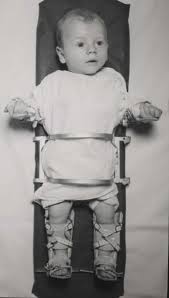
Polio, Toronto 1937, BradfordFrameHSC-AR1937-800

Polio, Baby, Bradford frame images

Sister Kenny’s Method
Hot, moist compresses to ease painful muscle spasms,
and gentle exercise of paralyzed muscles.
No immobilization!
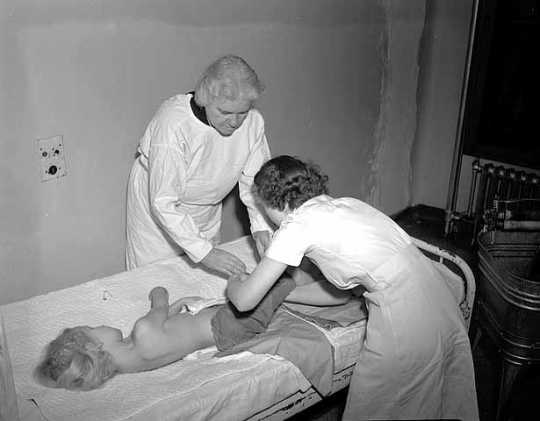
Polio, Sr. Kenney examining child,7%20Examining%20%20a%20Child

Sister Kenny is on the far side.

Nothing about this battle was easy. Here’s a colorful excerpt from the Australian Dictionary of Biography (Volume 9, 1983).

In 1932 Sister Kenny established a backyard clinic at Townsville to treat long-term poliomyelitis victims and cerebral palsy patients with hot baths, foments, passive movements, the discarding of braces and calipers and the encouragement of active movements. At a government-sponsored demonstration in Brisbane doctors and masseurs ridiculed her. . . .Thus began a long controversy at a time when there was no vaccination for poliomyelitis. The strong-willed Kenny, with an obsessional belief in her theory and methods, was opposed by a conservative medical profession whom she mercilessly slated and who considered her recommendation to discard immobilization to be criminal. Despite almost total opposition, parental and political pressure with some medical backing resulted in action by the Queensland government. . . .In 1934 clinics to treat long-term poliomyelitis cases were established in Townsville and later in Brisbane. The Brisbane clinic immediately attracted interstate and overseas patients. Kenny clinics in other Queensland cities and interstate followed.

In the USA, physicians who supported Sister Kenny were sometimes shunned. Yet slowly and surely, the tide shifted. A 1942 TIME magazine article reported that an “amazing 80-percent recovery rate through her methods ‘forced [the doctors] to recognize her unorthodox work.’”

To be fair, Sister Kenny’s method didn’t lead to recovery. There was no cure. Her method did, however, offer demonstrably better outcomes than conventional methods. Here’s a summary of positive outcomes from a 1943 article in the Journal of Bone and Joint Surgery.

Patients receiving the Kenny treatment are more comfortable, have better general health and nutrition, are more receptive to muscle training, have a superior morale, require a shorter period of bed rest and hospital care, and seem to have less residual paralysis and deformity than patients treated by older conventional methods. The Kenney treatment is the method of choice for the acute state of infantile paralysis [one form of polio].

Speaking as a citizen of the USA, Thank you Sister Kenny, and Thank You, Australia! Yes, Kenny faced strong opposition in Australia. Yet six doctors in Brisbane signed an endorsement on her behalf, and the Queensland government paid the fare for her first trip to the USA in 1940. If it seems her life reads like a movie script, it is.

Polio, Sr Kenny and Judy Garland,out6

Sister Kenny in Hollywood (1943)
Rosalind Russell (star), Mary McCarthy (writer), Sister Elizabeth Kenny

Sister Kenney is buried next to her mother in the cemetery in Nobby. A small museum there is dedicated to the memory of this daughter of Australia, “a very noble lady.”
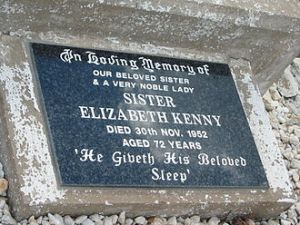
Polio, 330px-Headstone_SisterElizabethKennyHeadstone

Headstone in Nobby Cemetery

 * * *

Special thanks to my Australian blogging friend, suchled, for suggesting I write this piece. My mother and my sister Diane (polio survivors) received versions of Sister Kenny’s methods during the acute stage of their illnesses in 1949. The methods didn’t help Diane; they greatly improved my mother’s ability to recover muscle strength.

Resources included articles by Ross Patrick in the Australian Dictionary of Biography, by Miki Fairley at http://www.oandp.com, and an article on Sister Kenny at Wickipedia.

© Elouise Renich Fraser, 11 April 2015
Photo credits: wickipedia.org (Elizabeth Kenny, headstone);
http://www.healthheritageresearch.com (conventional methods);
http://www.mnopedia.org (Sister Kenny’s method);
http://www.oandp.com (Sister Kenny in Hollywood)

My Real Neat Blog

real-neat-blog-award1

Thanks to two of my esteemed followers, I’ve been nominated for a Real Neat Blog Award not once, but two times within the last 24 hours! How neat it that? Read the rest of this entry »

The Dean and I | Part 8

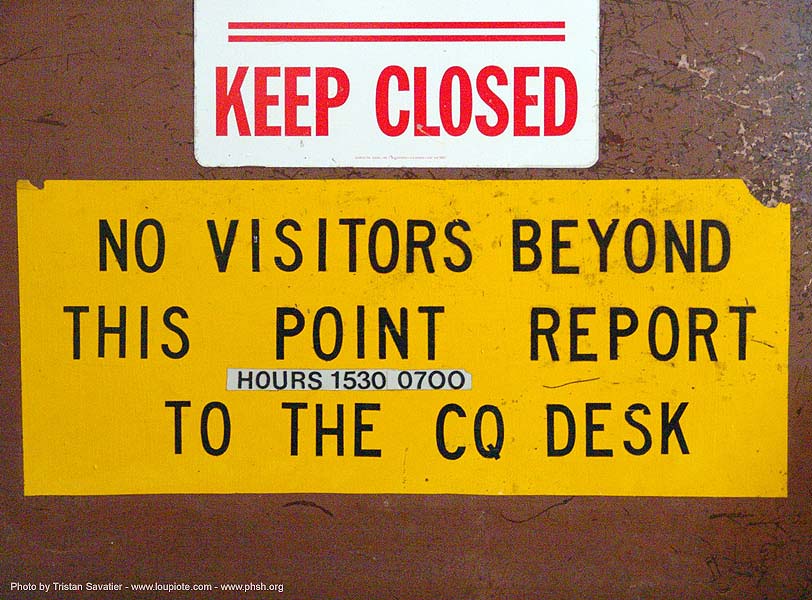
no-visitors-abandoned-hospital-presidio-san-francisco-phsh

It’s December 1967. I’ve worked for Mr. Griswold for just over two years. Right now I’m in the hospital on the university campus. Miserable and getting worse. Read the rest of this entry »

Just Yesterday

Just yesterday
I saw them
One hundred white crosses
Shoulder to shoulder
Rows of them planted
Right there in that yard
Beside the Armenian church Read the rest of this entry »

The Dean and I | Part 7

Fundraising Image

Meet my two part-time colleagues in the dean’s office. Without them, I might not have had a job. Their jobs were about money. Lots of it. Read the rest of this entry »

The Dean and I | Part 6

Things don’t always go smoothly at the office. Here’s an example of something that didn’t go smoothly for me. It may seem small and inconsequential. But most big things in my life started out small.  Read the rest of this entry »