Telling the Truth

connecting the dots of my life

Tag: Childhood

Shaming and Punishing Women

One of my longtime followers, Fran Macilvey, left the following request in response to my recent post, Voices long silent.

I’d like to hear more about your view on “….shaming rituals and periodic public displays of what happens to strong women…” because I’m sure it doesn’t just happen to women, and I’m curious to consider why we do it. What are we frightened of? Disapproval??

I don’t pretend to have all the answers, especially about how things like this happen to men. At the same time, from my childhood on it seemed women and girls had to be kept in their places. My personal fear wasn’t disapproval. It was harsh punishment. Not just as a child, but even as a professional. It was important to ‘walk the line’ and remember that I was not in charge. Today I might simply walk out. But that freedom didn’t happen overnight.

In a recent telephone conversation with one of my sisters, we talked about ways young boys shamed us at school when we were in the 5th grade. Our father also shamed us at home every time one of us was beaten. I was the prime example of what would happen to my three younger sisters if they dared to live ‘outside’ the lines of what my father considered proper behavior for females.

So we shared our experiences in the 5th grade. Both involved shaming by a male classmate. There was no one safe to talk with us. Not at school, and not at home. Each of us lived with the burden of believing we were the problem. The truth, however, is that our young, developing female bodies were the problem. Not to us, but to the boys who tormented us.

Silence about things like this, when carried for decades and magnified by repeated body shaming is like carrying a dead weight in one’s body and soul. Still, the only safe way to get through was to keep our young mouths shut and just keep going.

I can’t begin to describe the feeling of release I felt because my sister and I had finally dared tell each other about this insult to our souls and bodies.

Then there’s the companion side of this dilemma. Often when women stand up and report harassing behavior, they become the subject of investigation. Maybe it was your clothes, your tone of voice, the look in your eyes, the perfume you wore to work today. Hence the silence of women afraid to report abuse of any kind on the job, at home, in schools and universities, in churches, or even in friendship circles.

I’m not saying all women are as pure as the driven snow. Instead, I’m saying that experiences like this need to be unpacked. Perhaps we can change our behavior. Not because what we’re doing is ‘wrong,’ but because it isn’t putting our own safety first. Often we need trusted friends and qualified psychotherapists to walk with us.

Reading books about how to survive various forms of shaming or PTSD isn’t a bad thing to do. We can learn a lot. Yet there’s that internal stuff that isn’t going to go away because we read a book. Sometimes we need a safe person to hear us out and help us examine our feelings and behaviors without blame or judgment.

©Elouise Renich Fraser, 9 June 2018

Yesterday’s children

Yesterday’s children
Peer back through
Clouded windows of
Earth-worn eyes
Sparkling with tears
Seeing and remembering
Laughing at foolishness

Wistful longing knocks
On the garden gate
Where today’s children
Peer through iron bars
Eager to become
The adults they imagine
Themselves to be

© Elouise Renich Fraser, 5 June 2018
Image found at gardenateaseshops.com

Easter Lilies and Justice

Easter Lilies

Dear Diane,

Easter Sunday always reminds me of you. Not just because you were born on Easter Sunday in 1949, but because the Easter lilies at church always take me back to your funeral service and heaps of Easter lilies around the casket at the front of the church.

Today was no different. I walked in, saw the Easter lilies and tulips, and dissolved into tears as we sang the first hymn. It all came flooding back, along with a story Dad told me when he was in hospice care.

The story was about you and his flower garden in our back yard. Maybe you remember it. That was when we lived on the river. The flower garden had tons of flowers, including Easter lilies and Dianthus, all planted by Dad. He used to say the Dianthus were there because they reminded him of you.

Dianthus

One day Dad noticed that some of his special Easter lilies were missing from his flower garden. When he went back into the house he found them–in flower vases and glass jars here and there!

It didn’t take long to find out you had done this dastardly deed. He said you listened quietly without tears. Then as you turned to walk away you asked, “Where are the flowers for the children?” Cut him to the quick, he said. And I have to admit, he had tears in his eyes as he told the story.

Do you remember that square patch of flowers near the rear of the back yard? It wasn’t very large. Maybe 5 feet wide. It had posts with twine supports for some of the flowers. Most were bright zinnias.

Dad told me, with tears in his eyes, that he planted that flower garden just for the children. We could pick them anytime, as many as we wished. All because you had the guts to ask the most important question of all. “Where are the flowers for the children?”

Today I wonder the same thing. Sadly, we’ve gone downhill when it comes to things for the children. Flowers for the children tend to show up after children or teenagers are killed with guns. Survivors are asking all of us so-called grownups, “Where are the safe places for the children?”

That’s another subject, except for this: It takes guts to stand up and fight for the rights of children and young people. I’m rooting for the children and young people.

Love and hugs, plus Happy Easter and Happy April Birthday—not that you’re counting anymore!
Elouise

©Elouise Renich Fraser, 1 April 2018, adapted from an earlier post
Photo credit: wallpapersup.net (Easter Lilies); robsplants.com (Dianthus)

the red cardinal

the red cardinal
sings his bright clear spring song
perched on bare branches

When I published my first post, Dear Dad, on 27 Dec 2013, my voice was anything but bright and clear. Singing was definitely out of the question. As a survivor of childhood PTSD, I used an elaborate strategy of calculated silence and half-truth.

How much did I owe the world? How much did I owe my family? How much did I owe the church? My father was a clergyman. Revered, respected, loved and sought after by people with sorrows such as mine.

But I wasn’t one of his followers. I was the first-born of four daughters. I had to watch my tongue constantly. Smile when expected. Stifle tears. Do as I was told. Set an example. And take the beatings like the contrite spirit I was not.

Breaking my silence of decades took decades. It started when I was in my 40s, with trips to Al-Anon meetings for five years. There I learned to relax and share things I’d never told anyone. Then I worked with an intern therapist who helped me complete a genogram (family tree, with notes). Finally, in the early 1990s, I began working with a psychotherapist with whom I’m still connected.

I put in hours and years of work. Did tons of homework. Cried buckets of tears. Filled unnumbered journals with dreams and personal entries.

Yet my recovery isn’t measured in months, years or numbers of pages written in journals. It’s measured in my voice. At first feeble, halting, self-conscious and terrified. Beginning with my husband and immediate family, then with my sisters and parents, slowly but surely with several trusted friends, and finally, a few years before I began blogging, with my large extended family on my father’s side.

My voice is the measure of my recovery.

Regardless of the weather, the political climate, or my health, the question is the same: How free am I to tell the truth? That’s the thermometer that matters.

I’ve always cared about issues that have to do with women. I used to think that getting a decent academic position would somehow ‘prove’ my worth. Or set me free. Especially if I was granted tenure.

Well, that wasn’t my riddle to solve. My riddle was my voice.

I began blogging because I knew it would challenge me to tell the truth freely, with words chosen by me, not by someone else.

So the little red cardinal outside my window caught my attention. The ground was covered with snow, and the laurel bush had been beaten down by more than one Nor’easter. Yet the little red cardinal was singing his heart out. Freely. Telling his truth about life and announcing his territory and the hope of spring.

Though I’m a follower of Jesus, I don’t believe this makes my life easier. In fact, I’d suggest it makes it more difficult because it means both living and telling the truth. Especially when it’s most unwelcome or unexpected.

Many thanks to Candice for this topic! Though I’ve already written elsewhere about this blog, this is another way of looking at it. Equally true and challenging.

© Elouise Renich Fraser, 17 March 2018
Cardinal duet found on YouTube

The Divide and Conquer Club


Thanks for visiting and commenting on Misfit and Misbehaving. And a big thank you to John in Australia who linked his blog to the post.

My grade-school experience began in my home. My father was the consummate divide and conquer ruler of the household. He made the rules. He called us out on the rules. He was the judge, jury and executioner of punishment. Four daughters. No sons.

My father ran a full-circle, all services provided under one roof enterprise. His best ally was my mother who couldn’t afford to go against him. She was already a wounded warrior—not just because of polio and its aftermath, but because of her own childhood deprivations and humiliations.

We four daughters learned early to survive by way of dividing and conquering. All we had to do was join forces against one of us. It worked wonders. The other way we survived was by not talking to each other about what was going on in our family. It was against Daddy’s Rules. No secrets. No chatter at night after lights out. No comparing notes or comforting each other. No plans to go against Daddy’s Rules.

What happened in my grade school classroom was a version of what I already knew. Only this time it was in a setting I perceived as safe. So much for safety.

The tactics of divide and conquer are so familiar we scarcely perceive them. Whether consciously or not, they cause division and divert attention from what’s really going on. Thus the divider has things his or her way.

Without knowing it, the girls in my classroom were reinforcing values of the upper class. Clarifying the dividing line between us and them. That may sound simple, but the other side of divide and conquer isn’t all that complicated once we understand how people abuse power and to what ends.

I’ve also experienced this in churches and in academic settings. It happens everywhere, often in ways that seem innocuous or even praiseworthy.

In the USA today, I see this tactic as a deadly weapon of non-warfare. No one wields it so skillfully right now as POTUS—with the possible exception of Russia.

But the subject I care most about is women. Women of all colors and nationalities have experienced the tactics of divide and conquer in the home and in workplaces, churches, organizations, academia, the government, human trafficking, prisons, retirement homes, and any other setting in which women work or live.

This constant division serves the interests of white male supremacy, not the interests of women no matter how fancy the rhetoric sounds. It’s no accident that the USA is steadily falling behind other nations when it comes to women having access to all levels of government, healthcare, and other vital services.

It pays, it seems, to keep women in their place. Especially if we do this by promoting them. Feeding them a little of what they want and watching them fight over it, while withholding equal and proportional participation in deciding what that is.

Not every male is a white supremacist. However, without women banding together across significant divisions, all the men in the world with good and noble intentions will never save us. We must speak and act for and with each other.

©Elouise Renich Fraser, 2 March 2018
Cartoon found at mikenormaneconomics.blogspot.com

Haunted by unlived history

A couple of weeks ago I uncovered buried treasure. I’d stashed it away in a large envelope of notes I typed and wrote out in the early 1990s. The notes were about boys and men who made an unforgettable impression on me from childhood until the early 1990s.

This wasn’t simply a list of names. It was an itemized, annotated, categorized and coded treasure trove of information and reflection under several headings. Men I hardly knew, plus the real world of men I knew all too well.

I didn’t write this out on a whim. It was part of a therapy exercise for survivors of child sexual abuse. A way of getting to know myself better—by way of reflection on men who made an impression on me.

But before getting into that, I want to tell you about something else.

Several days ago I read about the way our parents’ unlived lives make an impact on us. Especially on our internal lives. This means that even though I appear normal on the outside, I can quickly numb out, withdraw, or shut down internally when I’m uncomfortable in a relationship. In fact, I’m skilled at this, even though it’s also a source of anguish.

The next morning I woke up and almost immediately burst into tears. My mother’s unlived life included her unlived life with me. I have no memories at all of my mother hugging, cuddling or touching me affectionately. She was industrious, resourceful, creative, and an attentive caretaker when I was sick. She was not, however, spontaneously or overtly affectionate.

My body and spirit grew up craving affection. I can’t count how many times my mother bent over to kiss me goodnight and kissed the air above my cheek instead. It still gnaws at me. A gaping hole in my heart that makes me wonder whether I was really loved.

I wasn’t simply running away from my father’s unsafe touch and punishing, overbearing, demeaning ways. I was also starving for my mother’s touch, affection, guidance and wisdom. I needed a safe haven in which I didn’t have to impress anyone, or get sick so I could be comforted.

Behind my history lies my mother’s history with her mother, my Grandma Z. One of my mother’s sad mantras was “I never had a mother.” She was correct. Grandma Z ran away with another man and divorced her first husband when my mother was very young.

My mother grew up without being cuddled, hugged or celebrated by her mother. Grandma Z favored her younger son, and treated my mother more like a toy doll. A plaything to dress up and display proudly. Not a little girl to listen to, love, comfort or encourage.

So there I was years later, a young woman. Uneasy in my body and spirit. Needy and pushing away at the same time. Haunted by my mother’s inability to affirm my body and my spirit. I didn’t think anyone would want to marry me. I also thought that having a man love me would heal my heartaches and take away the pain.

To be continued….

© Elouise Renich Fraser, 27 January 2018
Photo taken when I was 9 months old, 1 month before my father returned from the TB sanatorium; July 1944 in Charlotte, NC

buried

buried
beneath snow
life sleeps

Is there an angel in your life? Someone who was there for you at the very beginning when you were most vulnerable? Someone who gave you a gift you didn’t know you had until very late in life?

When I was born, my father had already been flat on his back for 8 months in a TB sanatorium. He came home weak and alive when I was 10 months old. If you’ve read my earlier posts, you’ll know my ordained clergy father was no angel in my life. For a quick summary, read Why I haven’t buried God.

When I was born, my mother was living with a young couple and their 8-year old daughter. Hence I lived the first 10 months of life surrounded by my mother and friends who thought I was God’s gift to each of them.

When my father came home from the sanatorium, things changed quickly. Dad was never one to take his duty lightly. It didn’t take long to change the atmosphere, beginning with a push and shove about whether Uncle Ed was my father or not. And, of course, who was now in charge of our little family. My mother or my father. I believe my mother lost dearly in that transaction. As did I.

Eight months after my father’s homecoming, we moved from Charlotte, North Carolina to Seattle, Washington. I took with me the seed of that elusive thing called resiliency. They say some children have it and some don’t.

In my case, I believe that seed was planted in me the first 10 months of my life. By my mother, Auntie Wyn and Uncle Ed, and their only child Grace. They loved and played with me, fed, encouraged and doted on me. I was the most beautiful baby in the entire world. And I got to hear my mother playing the piano, nurturing in me another invisible seed of resiliency.

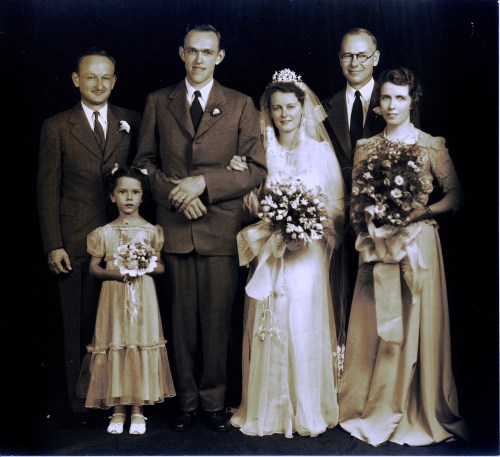
See the lovely photo at the top? All the important people (except me, of course) are there. My parents are already surrounded by my surrogate family: Auntie Wyn was mother’s maid of honor; Uncle Ed (with glasses) gave my mother away; Grace was my mother’s flower girl.

Perhaps the bond between my mother and me is stronger and deeper than I ever realized.

© Elouise Renich Fraser, 23 January 2018
Photo of my parents’ wedding in September 1942, Charlotte, North Carolina

kneeling for justice

hot sun focuses
with laser-beam precision
on one fallen leaf
illuminating darkness
barely hidden beneath rot

I’m a white woman with a history of being beaten and humiliated. A history I can pretend to ignore if I so choose. In fact, many people I’ve met in my adult life would prefer it that way. It’s easier for everyone if I’m an exception to the rule.

The rule, of course, would be that good girls are rewarded. I don’t buy it. In my experience, good girls rarely find their voices or their strength. They’re too busy trying to please or appease whoever is just above them on the food chain. Or the love chain. Or the work chain. Or the social chain. Need I go on?

Fallen leaves. We love to sing their praises, especially in autumn.

Yesterday evening I went out for my evening walk. The air was exceedingly hot, dry and heavy. Not a cool downdraft anywhere. Walking my favorite paths was like pushing through desert heat. Beautiful in its way, yet almost unbearable.

The search for justice is like slogging through a wasteland of dry leaves falling prematurely from still-green trees. They’re just dead leaves. No problem. A dime a dozen. There must be something wrong with them.

The analogy isn’t perfect. Yet my hat goes off to brothers and sisters who dare kneel for justice denied.

Kneeling wasn’t a safe action in my girlhood, unless it was to pray alone before God who never abandoned me. As an adult white woman I choose to kneel today with those who focus light yet again on what has long been barely hidden beneath rot. Wherever it resides.

© Elouise Renich Fraser, 26 September 2017
Daily Prompt: Focused

fraught labor of love

fraught labor of love
priceless heart wrenching venture
no promise of gain
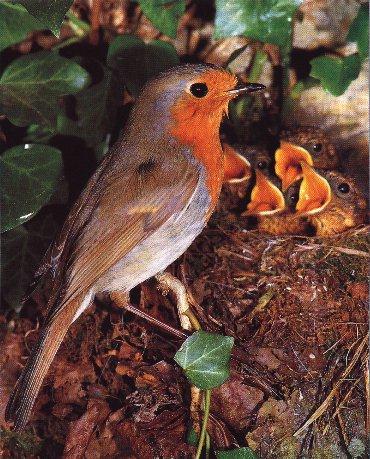
beyond a nest of birdlings
precious precarious joy

Last week was the first week of school around here. On Friday evening D and I were walking past the grade school near our house. Only one car remained in the faculty parking lot.

A woman carrying a large bag and other take-home items left the building and walked toward the car. She looked a bit weary, though not unhappy. I greeted her and said something about hoping she enjoyed the long holiday weekend.

She smiled, laughed, and said something like this, “You know, I’ve got the best job in the world! It just takes a while to get ready for the next day.”

I couldn’t have related more, told her so, and turned to walk on with D.

On a whim, I turned and asked about her best job in the world. I’d assumed she was an administrator type. I was more than surprised when she replied, all smiles, “I teach kindergarten and I just love it!”

So why was she leaving so late? She’d just finished setting up her classroom for the next day of school!

I love children. And I loved teaching adults. I would not, however, be the best mama or papa bird to deal with an overcrowded nest of small, vulnerable, hungry, eager, noisy, precious birdlings.

So here’s to a Happy Labor Day! Especially for all educators who love caring for and about our children.
Elouise

© Elouise Renich Fraser, 4 September 2017
Photo found at animal.memozee.com
Response to WordPress Daily Prompts: Priceless; Educate

Smell of fear

Smell of fear
Binds her tongue
Without
And within
Residue
Of storms
Long past
Hovering
Just beyond
Eyesight
Deep within
Her psyche
Spawning fear
Of her powerful
Voice locked
In neutral
Going nowhere

I always die a little when I speak in public. It doesn’t matter how confident or calm I sound on the outside. I shake on the inside, sometimes trembling physically when I’m finished. If fear were a fragrance, I would reek of it.

I’ve always chalked this up to being an introvert with thin skin. Afraid of what people will think of me and my ideas. Especially when I’m speaking in a religious setting.

Little wonder. My thinking and writing about God, the world and Christian faith aren’t always considered acceptable, much less mainstream by either more conservative or more liberal listeners.

Nonetheless, I think this fear runs deeper.

This weekend I had a small dialogue with myself about my voice. Especially my writing voice. I love it. Often, looking back at old posts, I’m moved to tears.

Nonetheless, I’ve been dragging my feet on the idea I floated well over a month ago. Dragging my feet while pretending to move ahead. Hoping to generate enough energy to begin working on an e-book of selected postings.

This past weekend, I hit pay dirt. Here’s what I wrote in my journal on Friday and Saturday evenings, lightly edited for clarity.

Friday evening, after lots of agonized words about getting nowhere.

Right now this is an undocumented project. Notes, but no measurable, incremental steps recorded….I say I don’t have to do this, yet I want to do it! What’s holding me back? I want to know. I feel a little stuck and frightened. Of what? I don’t know. Am I afraid of my own voice?

Then Saturday evening:

Yes! I’m stuck and I’m frightened of my own voice…Today I read through about 15 of my most liked poems and chose one to reblog—the Amy post about being weary of my life—her lament that’s so like mine. “You are about my bed.” Where I’m lying—stuck and frightened of my own voice.

I accept this truth and want to welcome it as a stranger…rather than denying its existence, and thus denying the dormant power of my voice….Was this one reason my father tried to beat my voice out of me??? Did he see something I couldn’t see? Something that frightened or threatened him and his voice? “You are about my bed.”

And Sunday evening:

Yes! I have a powerful voice, and have had all my life.

I’m sure I’ll learn more along the way. But this is where I find myself today, Monday.

Thanks for listening and reading!

Elouise 

© Elouise Renich Fraser, 24 July 2017
Response to WordPress Daily Prompts: Fragrance; Dormant