Telling the Truth

connecting the dots of my life

Tag: COVID-19

outside my window

outside my window
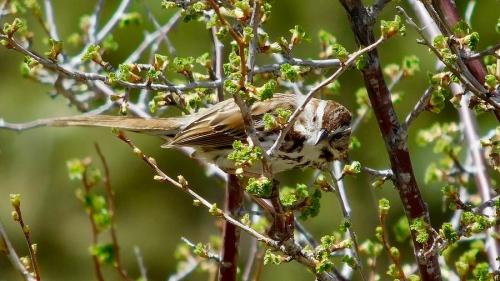
a song sparrow feasts on buds
dodging lazy rain

this morning he sings
during the dawn song hour
or is it a half

cracking closed eyelids
I calm my breath and feign sleep
during his encore

Yesterday was a full stop. Time out to see what doing “nothing in particular” felt like. This included not listening to news during the day.

Overall, it was wonderful. Especially our longer than usual late afternoon walk in damp, cloudy, beautiful spring weather. The birds were out in droves, singing and calling out their territorial warnings. Near the end, a red-tail hawk flew by, cruising through tree-tops.

When we got back from our walk, the little song sparrow was feasting on tiny flower buds just outside my office window. He and his mate have a nest in a large shrub beside our house. Hearing them sing, and listening to the little ones learning to sing is a gift.

As we left for our walk, our neighbor and one of his young children were out for a walk around the yard. His wife is a medical doctor, on the faculty of one of Philadelphia’s teaching hospitals. She’s been on Covid-19 duty for weeks. I wish for her and her family a day to walk through the neighborhood, doing nothing. And a morning to lie in bed listening to the birds.

The stark contrasts between what we’re all experiencing during this pandemic are troubling. We aren’t in a rosy situation. We’re at the edge of a precipice, wondering who or what will be there when we fall. Will anyone care enough to pick us up? And will there be any birds or music to comfort us?

Which pandemic are you experiencing?

Elouise

© Elouise Renich Fraser, 24 April 2020
Photo of Song Sparrow taken by Dan Miller, found at pixels.com


Heavy | Mary Oliver

Here’s a lovely, if difficult poem from Mary Oliver. It’s about death. It’s also about learning to be a survivor. I’m posting the poem as a tribute to Diane (Sister #3), born on this day, Easter Sunday 1949 (leap year). Diane died in February 2006 after living more than ten years with ALS. My comments follow.

Heavy

That time
I thought I could not
go any closer to grief
without dying

I went closer,
and I did not die.
Surely God
had His hand in this,

as well as friends.
Still, I was bent,
and my laughter,
as the poet said,

was nowhere to be found.
Then said my friend Daniel
(brave even among lions),
“It’s not the weight you carry

but how you carry it—
books, bricks, grief—
it’s all in the way
you embrace it, balance it, carry it

when you cannot, and would not,
put it down.”
So I went practicing.
Have you noticed?

Have you heard
the laughter
that comes, now and again,
out of my startled mouth?

How I linger to admire, admire, admire
The things of this world
That are kind, and maybe

also troubled—
roses in the wind,
the sea geese on the steep waves,
a love
to which there is no reply?

© 2006 by Mary Oliver
Thirst, pp.53-54
Published by Beacon Press

Dying isn’t for the weak; neither is surviving. Not as victims of cruel fate or the current pandemic.

In the end, we often don’t have any choice but to live with what we’ve been given. True, we might prefer to die. But Mary challenges us to welcome grief and the opportunity to let it shape our lives for the better, without destroying them.

I also hear Mary inviting us to give ourselves time. Enough time to be surprised at ourselves when laughter and joy sneak in unannounced.

In her case, Mary unexpectedly discovers herself seeing nature differently. Not just as shows of beauty, but as survivors. Like us, the roses and sea geese also live out their love of life in the midst of harsh winds or steep waves.

What could be more invitational and healing that that? Not as a pill we take, but a possibility we choose to embrace.

Elouise

© Elouise Renich Fraser, 17 April 2020
Roses in the Wind painted by Anne Costello
Found at saatchiart.com

Cast onshore

Cast onshore
Of a deserted island
Shaking water
From my eyes
Seeing nothing
And nobody
As unanticipated
I wonder aloud
Who am I
And why am I here
Now and not then
When all seemed well
that ended well

All talk of getting back to business rings hollow.

  • Will we ever leave or re-enter our homes again without going through new rituals of warfare?
  • And how will we grieve what is  gone forever after the enemy is subdued?
  • Or ensure that the world is now a safer place for all survivors?

Just a few questions going through my mind these days. They pop up most often after I’ve talked on the phone with one of my family members. Especially those who are younger than I, which would be almost all of them.

Right now it takes hope, courage and determination to get out of bed each morning. Especially given conflict about how to handle this pandemic, and what it will take to resume some semblance of everyday life.

In the meantime, to answer the question of my poem, I believe I’m here to pay attention. Especially now. Eyes wide open. Doing what I can to make life a less lonely or frightening for those most endangered, including myself.

Praying your day is filled with bits of light from unexpected sources!
Elouise

© Elouise Renich Fraser, 16 April 2020
Photo found at nationalgeographic.com.au

Empty words

How quickly things fall apart
Cloaked in bravado and mis-speak –
Brash promises shatter beneath the weight
Of human ineptitude and fierce
Reality on the ground

And yet

Each day the drone goes on
For hours weighty with words
Full of fury plus silence about
What really matters most in this
Nation dying for straight answers

Yet again

Another wandering bombardment
Of jumbled prevarications interrupts
Painting the most upbeat scenarios
We can’t possibly believe —
Empty words drunk on themselves

No, I don’t listen to or watch the “daily briefings” from the White House anymore. They sound more like run-on election-rally speeches (without the hoopla of the crowds), than steady, well-informed updates on COVID-19 and what we can or must do to protect ourselves and others.

The poem is an effort to capture what I’ve seen and heard for myself. Living 76 years has its rewards. One is a long memory of times when our Presidents (of both parties) stepped up to the microphone and helped us join hands as a nation during times of disaster.

No, none of our Presidents has been perfect. Some have been corrupt. Yet on the whole, none in my memory has been as egregiously uncaring about the majority population of this nation as Mr. Trump. His behavior right now is not helpful, not healing, and not encouraging for the short or long-term future.

© Elouise Renich Fraser, 9 April 2020
Photo of White House Press Briefing Podium found at politico.com

I wonder if when Years have piled | Emily Dickinson

Here’s an older post that’s relevant to our current situation. When the pandemic is over, what will we do with all that Grief and Pain?

I don’t wear a crucifix around my neck, yet I find myself in the company of those who, like Emily Dickinson, can’t escape Grief. It doesn’t matter how many years have lapsed. My comments follow her poem.

I wonder if when Years have piled –
Some Thousands – on the Harm –
That hurt them early – such a lapse
Could give them any Balm –

Or would they go on aching still
Through Centuries of Nerve –
Enlightened to a larger Pain –
In Contrast with the Love –

The Grieved – are many – I am told –
There is the various Cause –
Death – is but one –and comes but once –
And only nails the eyes –

There’s Grief of Want – and Grief of Cold –
A sort they call “Despair’ –
There’s Banishment from native Eyes –
In sight of Native Air –

And though I may not guess the kind –
Correctly – yet to me
A piercing Comfort it affords
In passing Calvary –

To note the fashions – of the Cross –
And how they’re mostly worn –
Still fascinated to presume
That Some – are like My Own –

c. 1862

Emily Dickinson Poems, Edited by Brenda Hillman
Shambhala Pocket Classics, Shambhala 1995

Emily begins by wondering whether Harm that has Years “piled on” it might be like a Balm. Perhaps like piling ice or heat on an injury? Some would say time heals all wounds.

Does it? Perhaps the passing of Time simply multiplies the Pain of this Harm. Especially in contrast to Love lost, withheld or betrayed.

Emily does a brief roll call of various kinds of Grief. She names Death first, yet doesn’t dwell on it since once it arrives, it simply “nails the eyes” shut. She may have in mind the person who dies, not the survivors.

She then points to other forms of Grief. They’re examples of the barely recognized yet obvious Grief humans carry every day. She names Grief of Want, of Cold, and of Despair. This is the kind of Grief that doesn’t nail the eyes shut. It’s the Grief of being invisible, shunned, ignored, banished from sight in full view of others. Not allowed to breathe air that supposedly belongs to everyone. Native Air that makes one a ‘real’ person.

In the last two stanzas, Emily imagines Grief as a crucifix, a fashion item. Something like a personal Calvary. She observes an assortment of styles and ways of wearing them.

I imagine some are barely obvious; others weigh the bearer down like a heavy wooden cross. Some are flaunted like medals of honor; others hidden beneath bravado or bullying. Yet each is real, whether acknowledged or not.

Emily finds ‘a piercing Comfort’ in her observations. Perhaps she isn’t as alone as she sometimes feels. Perhaps some Crosses are like her own.

When I was growing up, no one told me that grief could be an asset. It was something I would eventually get over. Not a strange gift that could connect me with others.

I don’t want to know everything about each person I meet. I do, however, need to take into account the reality of human grief. There’s nothing so isolating as having one’s grief overlooked or ignored. Or making it a personal problem to solve or get over–as quickly as possible.

Jesus bore our griefs and carried our sorrows. Surely as his followers we can do a bit of this for each other, if not for ourselves.

© Elouise Renich Fraser, 12 August 2017
Image found at wallcrossesandmore.com

In April | Rainer Maria Rilke

Here’s a small poem packed with beauty and hope. An invitation to pay attention to what’s happening right before our eyes. It’s Spring here in the USA. Time for reminders of new life in the midst of huge loss, suffering and anguish.

As most of you know, we’re in for a tough two weeks or more. It’s easy to get drawn into the drama around COVID-19. Easy, and not very uplifting.

Each morning I receive a poem in my mailbox. Here’s today’s poem, with a bit of hope for each of us.

In April, by Rainer Maria Rilke

Again the woods are odorous, the lark
Lifts on upsoaring wings the heaven gray
That hung above the tree-tops, veiled and dark,
Where branches bare disclosed the empty day.
After long rainy afternoons an hour
Comes with its shafts of golden light and flings
Them at the windows in a radiant shower,
And rain drops beat the panes like timorous wings.
Then all is still. The stones are crooned to sleep
By the soft sound of rain that slowly dies;
And cradled in the branches, hidden deep
In each bright bud, a slumbering silence lies.

This poem is in the public domain.
Published in Poem-a-Day on April 5, 2020, by the Academy of American Poets.

Praying you’ll experience a calm heart this week, and enjoy the beginning of Spring (or Fall). I fell off the wagon a bit this past week. Too much attention to news outlets, and not enough to nature and my own beautiful, grown-up self.

Elouise

© Elouise Renich Fraser, 5 April 2020
Photo found at worldbirdphotos.com

Wayward sheep and frolicking lambs

Equanimity —
They say it’s
Calm composure
Regardless

Drowning in pain
Ecstatic with joy
Beginning a journey
Relaxing into dusk
Fighting for my life
Bearing life in me

I want to stand
before You
With calm composure
Because You alone
Are my advocate
The gracious Shepherd
Of wayward sheep
And frolicking lambs

Dear Shepherd of sheep and lambs,

Is it well with You today?

It’s easy for me to experience equanimity when the sun is shining. Right now it’s gorgeous. Bright, warm and inviting.

Yesterday was a drippy mess of clouds and chilly air. Music helped. So did writing. And making a big pot of soup. Yet in the end, even this can’t last forever.

I wonder what You did when things didn’t seem to go as planned? I already know You prayed a lot. What else did You do as You approached death?

You see, I don’t want to die. I don’t think You did, either. Even before the birth of COVID-19 (such a cold name for this vicious virus), I didn’t want to die.

Before You were so rudely arrested, were Your tears a sign of calm composure? I wonder if equanimity in the face of death is overrated. Not necessarily bad, but overrated. So many people are dying ‘early’ these days.

Please advise.
Elouise

© Elouise Renich Fraser, 1 April 2020
Photo found at edgarsmission.org.au

The Life we have is very great

Here’s a second look at Emily Dickinson’s poem about Life, Infinity, and the Human Heart. A good poem for today when we’re missing family members or friends for any reason, plus Covid-19, political standoffs, hate crimes, or the harsh reality of wildfires, avalanches and hurricanes. My comments follow.

The Life we have is very great.
The Life that we shall see
Surpasses it, we know, because
It is Infinity.
But when all Space has been beheld
And all Dominion shown
The smallest Human Heart’s extent
Reduces it to none.

c. 1870

Emily Dickinson Poems, Edited by Brenda Hillman
Shambhala Pocket Classics, Shambhala 1995

It doesn’t matter how many worlds we discover beyond this world. It doesn’t matter how far the distance is from here to there and beyond. It doesn’t even matter that the universe is still expanding.

None of this, as surpassingly great or expansive as it may be, holds a candle to the smallest of human hearts.

According to Emily, the Life we now have is ‘very great.’ The Life we’ll have beyond this Life is even greater. Yet it’s infinitesimal compared to what our hearts can see and grasp right now.

Emily describes the heart’s capacity to love Life. Especially when we can’t see those we love. She suggests that the expansiveness of one small human heart outshines infinity itself.

Yes, it’s fascinating to explore the universe, what may lie beyond it and how it’s ordered. Yet what we discover externally will never match the capacity of one small human heart to connect with another human heart.

It doesn’t matter whether that heart is what we call dead or alive, here or there, or somewhere in between. Nor do we need to understand exactly what Space encompasses, how it is governed, or where Infinity resides.

This isn’t about measuring or mapping Life beyond our present Life. Or discovering where those we love now reside.

It’s about connections. All it takes is one small human heart to leap beyond unmapped, immeasurable boundaries, expanding outward in a heartbeat to enfold the hearts of those we love. No matter where they or we may be.

© Elouise Renich Fraser, first posted 28 May 2017, lightly edited and reposted 10 December 2020
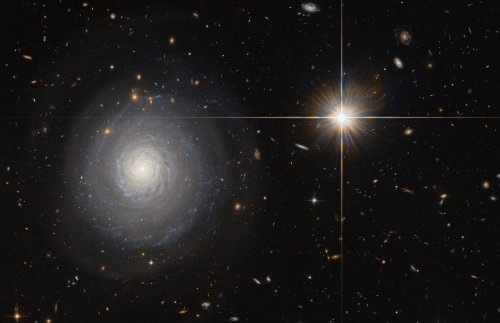
Image taken from Hubble Spacecraft, found at nasa.gov