Telling the Truth

connecting the dots of my life

Tag: Life and Death

strange and stranger
The last two weeks have been strange and stranger. This morning I set aside time to review instructions for an appointment to get yet another unhealthy bit of my skin removed. The amount of paperwork I just tried to wade through was ridiculous. Legalese from beginning to end.

It reminded me yet again that our health-care system has become a bastion of data (often not correctly entered). It has also become a frighteningly verbose machine responsible for staving off legal challenges that might properly be brought against medical facilities or personnel.

If it’s so dysfunctional for me, it must be totally dysfunctional for thousands of citizens or visitors in this so-called “land of the free and home of the brave.” I say the brave people are those who, against all odds, just keep going. Health care or no health care.

We’re not the nation we’ve been told we are. Nor is our data safe in so-called ‘secure’ records that could be highjacked in a heartbeat. Sadly,  many informal health-giving personal connections we used to have are fraying, some beyond repair.

In the midst of this, POTUS is showing up again behind his Covid-19 pulpit in the White House. His latest campaign strategy. I’d rather hear from Governors of states dealing with tough facts and truth about Covid-19, whether their citizens agree or not. It’s sad when a disbeliever in Covid dies of Covid. Yet it happens every day, and too many still think this is much ado about nothing. Fake Covid-19.

D is driving me into downtown Philly on Friday to get this bit of skin removed and analyzed further. Am I apprehensive? Yes and no. I’m not happy about having this procedure yet again. Still, I know and trust this doctor. My worst apprehensions are about navigating the medical center in downtown Philly–getting in and getting out. As quickly as possible. With my trusty chauffeur at the wheel!

Right now I’m going to get my disgustingly healthy smoothie lunch together, and think about doing a proper (or improper!) post for tomorrow.

Cheers for showing up and reading!
Elouise

© Elouise Renich Fraser, 22 July 2020
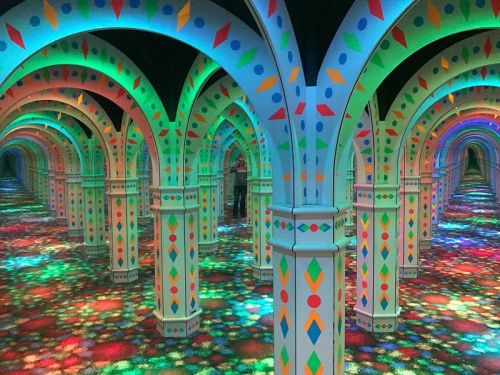
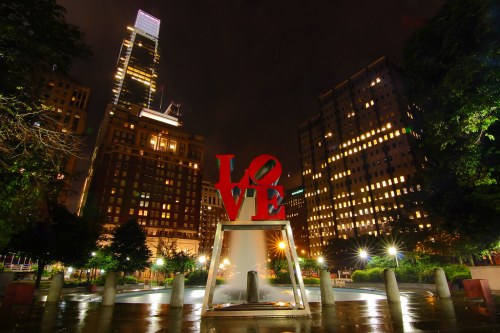
Photo of Love Park in Philadelphia found at flickr.com
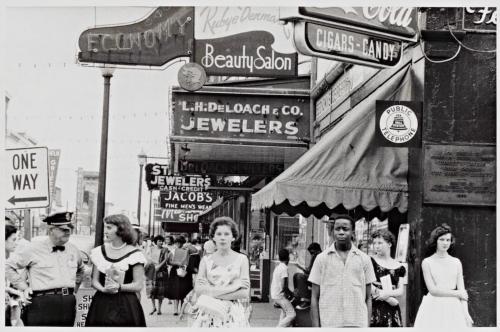
A matter of life and death

Downtown Savannah, Georgia, 1955
Note the historical marker on the far right of the photo

I’ve been thinking about the life and death of John Lewis. My generation paralleled his generation. Yet my life in the Deep South during the 1950s and 60s was light years from his life. It didn’t matter that I saw and heard about the Deep South every day. What mattered was the bubble in which I was raised.

In a nutshell: I didn’t have a clue how much I didn’t know, even though it was in plain view.

Back then, our family had room for many colored people. As a child, I assumed they were our friends. Still, our family was almost always in the mode of ‘helping’ them. Or joining them at special events at which my father sometimes preached. We daughters sat with our mother in reserved seats on the front row, always decked out in our Sunday best.

We also led regular, less formal Bible clubs for children in our rural setting and in Yamacraw Village. The Village was built on what had been a Yamacraw Indian settlement. Now it served colored people on the west side of Savannah.

The Bible clubs were also our family’s way of ‘helping.’ Plenty of fun, lots of singing (I often played the piano), a Bible lesson from my father, Bible verses to memorize, and snacks at the end. I always knew we ‘poor’ white people were more fortunate than they, and assumed they needed us.

Looking back, my family offered me only one role during my growing-up years in Savannah: a friendly helper. I didn’t have the means or courage to change what often felt unfair and even embarrassing.

Alongside family activities, I attended school. Beginning in grade school, we studied the glorified white history of Georgia. Especially the “Civil” War/War between the States. This continued through high school. Sometimes, especially in grade school, we celebrated heroes. A few were colored; most were white. Christopher Columbus was the greatest national hero. The slave trade remained shrouded in mystery, though Savannah was one of the largest East Coast importers of slaves, and exporters of cotton.

Praying you’re as well as you can be right now, and surrounded by activities that bring you joy, comfort, hope, and a challenge or two.

Elouise

© Elouise Renich Fraser, 20 July 2020
Photo of Downtown Savannah, Georgia (1955) found at reddit.com

Thank you, John Lewis

Today has been more than a bit somber. My most recent burning memory of Representative John Lewis is his sterling leadership during last fall’s Congressional impeachment investigation of Donald Trump. The 5-minute video above shows him supporting further impeachment investigation.

And now Mr. Lewis is gone. He was the last Black leader living who participated in the 1963 March on Washington, shortly before the 1963 Civil Rights Act became the law of the land. In his speech (below) he clarifies his opposition to the legislation.

The young Lewis is speaking to citizens gathered in Washington to demand racial justice. John Kennedy was President. As you can hear, John Lewis wasn’t one to tone things down. He speaks without apology, and without pretending the proposed legislation was what Black people needed. He was correct.

This nation has lost one of its true patriots. If you’d like to read and hear more, Vox has posted six speeches (including the two above) that capture John Lewis’ remarkable service to this country. You can find them here.

© Elouise Renich Fraser, 18 July 2018
Videos found on YouTube 

Lost in a maze of hallways

In August 2015 I wrote and never posted this poem. Prompted by a dream, it describes my inner sense of disorientation as a new blogger. I wanted and needed to tell the truth. Still, I was uncertain how to proceed, how to find my way home to myself.

Today, as a citizen of the USA, I’m in another maze of hallways. I’m not in a dream. I’m disoriented. Wondering where the exit might be. Not just for me, but for all of us. Our nation is in turmoil, anguish and pain. Denial won’t work. Neither will a constant diet of diversionary tactics, or fake promises about tomorrow.

I’m wide awake lost in a maze of hallways
filled with small shops and out-of-sight
merchandise if only I will give up my
determination to find the exit and go home.

The young man with me seems happy to
be there smiling at me while dragging
his feet and holding me back with his
nonchalant air of everything’s fine just fine.

It is not fine. I know it. I feel it. I keep
looking around searching for the way out
I know this mall. I’ve been here before.
What happened to all the old landmarks?

Doors are locked. Other doors open onto
new hallways filled with glittering shops
and female shopkeepers smiling and asking
for my attention and presence. Won’t I stay?

I seek help from a woman standing in the
doorway of a small shop. She assures me
I’m not lost and will find the exit if I keep going
Her words soothe but fail to help me.

I wake up troubled not anxious yet
eager to know the meaning of this
frustratingly endless dream lost
in a maze of diversions going nowhere

So what about today? In my real world? So far: A walk with D through the neighborhood, writing, pondering challenging material about white racism in USA churches, along with a Psalm of Lament. On the whole I’m feeling grounded, and grateful for friends and family members. Which includes Smudge, of course!

Elouise

© Elouise Renich Fraser, 3 August 2015; posted on 15 July 2020
Image found at pinterest.com

Everything isn’t always beautiful

This morning I’ve been thinking about Mary Oliver’s poem, Everlasting. On first reading, it may seem Mary is accepting and putting a positive spin on everything. Making things pretty.

Yes, there’s always hope for something better. Nonetheless, Mary focuses intently on what’s in front of her. Nothing is too fleeting or small to notice.

Much, if not most of her poetry captures the small details and stories of nature’s wonders. Yet she also describes the horror and ugliness of human behavior. Some of it shows up in nature as well, putting beauty at risk.

I picture her with a ‘camera’ (her ever-present writing notebook), in which she records everything she observes. The good, the beautiful, the bad, the unexpected and the ugly. She doesn’t flinch or soften the blow of reality.

Mary challenges me most when she lets her unvarnished truth go public. Truth about herself, her family, her father (A Bitterness), and small scenarios playing out in predatory behaviors in the non-human world (Small Bodies).

Beginning with me, there’s so much we humans hide, or carefully dress up to mask our neediness. Mary invites us to find ourselves in the midst of whatever we’re dealing with or see in the mirror. Sometimes it’s a real mirror. Other times, it can be the mirror of Mary’s poetry. Or the morning news. Or an unplanned trip to the doctor.

Hoping your day is thoughtful and rewarding, no matter the cost.

Elouise

© Elouise Renich Fraser, 13 July 2020
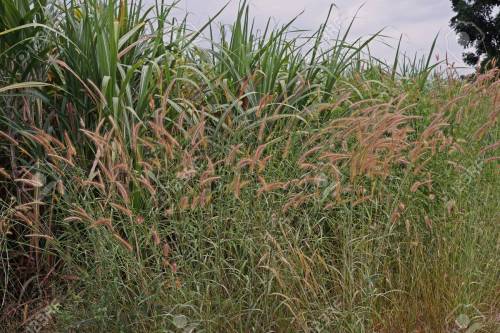
Invasive Mission Grass image found at 123RF.com

What we need to hear

Maybe I’m the only one. The only white PTSD survivor who didn’t get it. Do I feel humiliated by this? No. Chagrined? Yes. Yet above all, I’m challenged to find out more.

Here’s what I didn’t and still don’t get.

I know this is hard for many enlightened and well-meaning Christians to hear, but here’s the truth: If you are white, you have no clue as to the PTSD-like realities black people in this country face every single day. —James Ellis III

It’s one thing to accept this as information. On the other hand, are we willing to let this sink into our understanding of the way things play out here in the USA? Not just in public places, but in white (often lightly colored) churches?

The quote above challenges me to learn more about “PTSD-like realities” black people face daily here in the USA. The easiest connection (for me) is to think about post-Viet Nam War veterans with PTSD who showed up in my theology classes in the 1980s. Yet even that isn’t the same as what’s happening today on our streets. Neither is my own history with childhood PTSD.

One quote doesn’t explain everything. But that isn’t James Ellis III’s point. His point is that we white, so-called “enlightened and well-meaning Christians” have a hard time hearing and accepting truth about Black Lives.

How tragic if we fail. Not because we didn’t try, but because we don’t like hearing bad or disturbing news about ourselves. It’s easier to push it off on the government, or ‘those white people’ over there, or even on Black citizens themselves.

James Ellis III’s article, from which the quote above comes, was first published in May 2020. Read it here, if you dare. It’s titled “A Lowdown, Dirty Shame: Ahmaud Arbrey’s Murder and the Unrenounced Racism of White Christians.”

Praying we’ll find our way out of this mess. Not the mess created by our government, but the mess we’ve created for ourselves.

Elouise

© Elouise Renich Fraser, 9 July 2020
Image found at pinterest.com

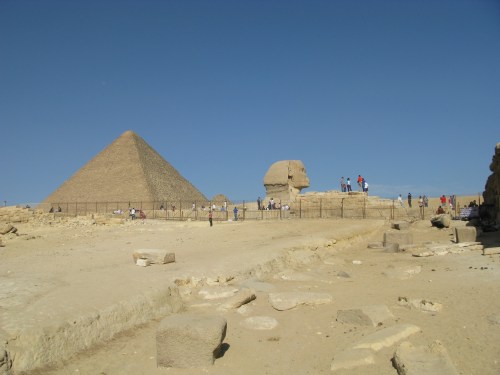
Pyramids and Camels | Photo Memories Revisited

Camel rides and Pyramids

The worlds of 2010 and 2019 are gone. I pray we’re up to the task of making wise, faithful decisions about our lives as world citizens, not isolated human beings. Enjoy the pics! This was one of many great adventures. Getting married 54+ years ago was the first!

It’s a good thing, being married to D. My life might have been dismally dull without his get-up-and-go. He’s no extrovert, mind you. He just has the Travel Bug in him, bigtime. Our trip to Egypt, piggybacked onto a week of D teaching in Cairo, was a Spectacular Adventure.

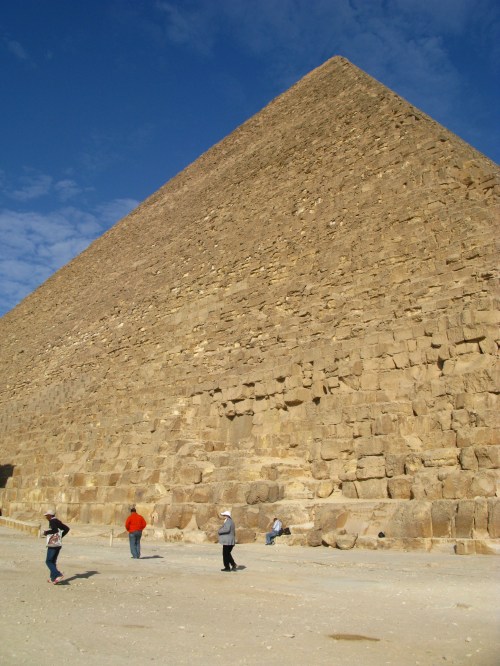
It’s January 2010, just one year before the uprising in Egypt. Our driver and guide picked us up early in the morning. We arrived at the pyramids of Giza before the site was crowded with visitors and vendors.

It’s winter, yet the sun blazes down almost every day like a hot flame. The air temperature begins chilly but often rises into the low 70s.

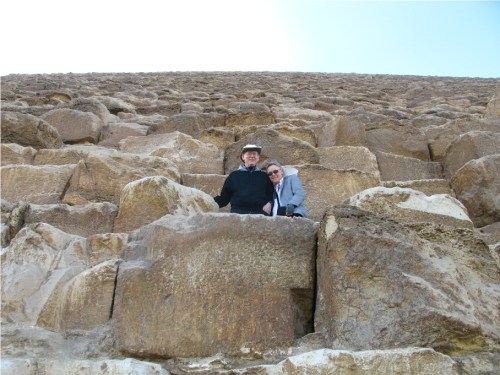
Hence our sun hats and my white sun shirt peeking out from my travel jacket. The jacket is a small men’s silk blazer—a thrift shop find here in Philly. It has ample side pockets (note water bottle peeking out) and vest pockets inside. Best bargain ever! It doesn’t bother me a bit when airport personnel and passengers call me “Sir,” then beg profuse pardons….

Now we’re going to back track a bit. I want you to appreciate how tiny we feel. I’m there in the center, standing at the base of a pyramid.

IMG_3207

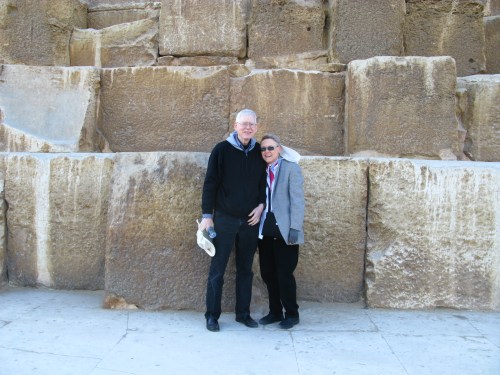
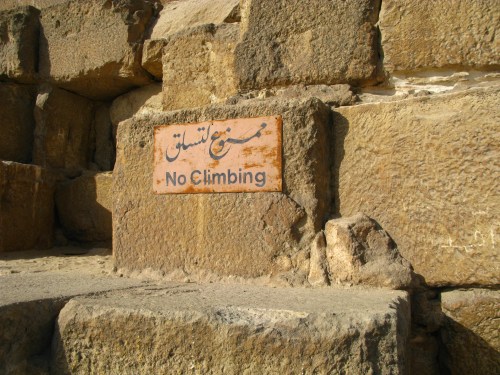
Here are a few pictures of us on and next to the largest pyramid.
Note the size of the building blocks!

IMG_3183

David and Elouise on Giza pyramid

IMG_3195
IMG_3197
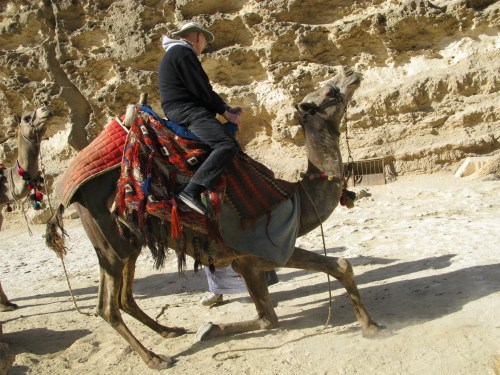
Time to go get on a camel or two! Just for comparison, here’s an expert camel rider. Note his legs resting casually on the back of his camel, his super comfortable clothing and air of confidence. Even his camel looks relaxed, if not smiling. Nothing to it! The rider doesn’t even have foot stirrups.

IMG_3201

So here we are, getting up close and personal with our rented camels. They’re going to take us off on a little trek into the desert. No problem. Our guide will be right there if anything untoward happens. Just relax and do what the patient camel guide tells me to do.

IMG_3244

Whew!

IMG_3248

Do I look like the cat that just swallowed the mouse, or what?
Now it’s D’s turn!!!

IMG_3251

Showoff!
Here we go….off into the desert.

IMG_3254

Note: Without our trusty guide who accompanied us on foot, we wouldn’t have these photos of the two of us. And, I must add, without workouts at Curves my legs would not have been up to the task of keeping me on top of the camel!

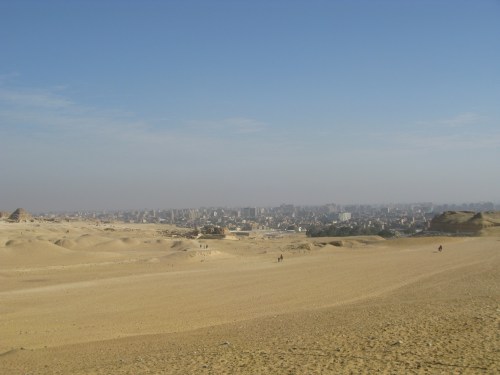
Here’s a bit of what we saw, including a photo of Cairo in the distance.

IMG_3261

IMG_3262

IMG_3287

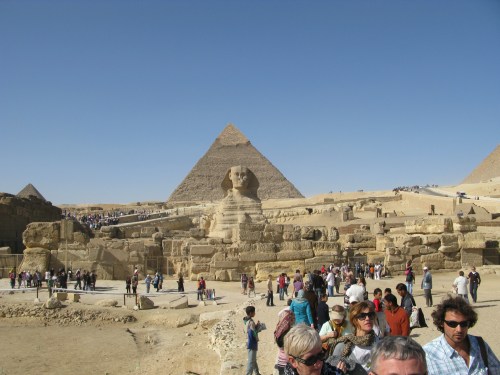
The camel ride ended near the Sphinx.
After spending time there, we said farewell and left.

IMG_3301

This was only one of our Egypt adventures. The others simply added to my sense that I owe Egyptian history, culture and inventions a debt I can never repay.

© Elouise Renich Fraser, 9 February 2016, reposted 8 July 2020
Photo credits: DAFraser and our Egyptian tour guide

Invitation | Mary Oliver

This morning I’m tempted to rush into battle mode. So many things are going so wrong. This poem from Mary Oliver helped restart my day–though I’m still not sure what will come of it. My comments follow.

Invitation

Oh do you have time
to linger
for just a little while
out of your busy

and very important day
for the goldfinches
that have gathered
in a field of thistles

for a musical battle,
to see who can sing
the highest note,
or the lowest,

or the most expressive of mirth,
or the most tender?
Their strong, blunt beaks
drink the air

as they strive
melodiously
not for your sake
and not for mine

and not for the sake  of winning
but for sheer delight and gratitude—
believe us, they say,
it is a serious thing

just to be alive
on this fresh morning
in this broken world.
I beg of you,

do not walk by
without pausing
to attend to this
rather ridiculous performance.

It could mean something.
It could mean everything.
It could be what Rilke meant, when he wrote:
You must change your life.

© 2008 by Mary Oliver; poem found on pp. 18-19 of Red Bird
Published by Beacon Press

The line from Rainer Maria Rilke is found at the end of his poem, Archaic Torso of Apollo. There, as here in Mary Oliver’s poem, we’re offered no clear interpretation of “You must change your life.”

Here’s how I’m thinking about it today:

This shared world, filled with beauty, seems intent on self-destruction. Would we throw it all away by refusing to act, just once, with beauty and courage? Do the unexpected? Change the conversation, or our knee-jerk reactions to things that annoy and offend us?

Perhaps the most courageous thing I can do today is as simple as a smile. Especially in tense or fearful situations. We say a smile is worth a thousand words. It’s what most of us are starving for every day. True, smiles won’t heal or resolve every problem. Nor are all smiles to be trusted.

Still, Mary Oliver challenges us to stop, listen and (I think) smile at these crazy beautiful goldfinches. They just can’t stop singing for sheer delight and gratitude! Trying, perhaps, to tell us something we desperately need to hear from each other?

Thanks for stopping by!
Elouise

© Elouise Renich Fraser, 7 July 2020
American Goldfinch songs found on YouTube

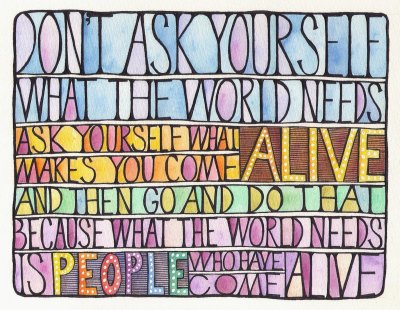
What the world needs | Howard Thurman

Howard Thurman made things straightforward, simple and down to earth. My father did not. I was raised in a Christian culture (presided over by my father) that saw life outside our ‘safe’ space under attack by twin demons: complexity and danger. Especially if life outside made me come alive.

  • Dancing? No way! Definitely the first step toward raucous, immoral behavior.
  • Lipstick? No way! A sure sign of debauchery. (Until it suited my father to make it imperative.)
  • Dating unchurched and thus unreliable (might grope or rape me) males? No way! (Not that dating was high on my list.)

So here I am today. A supposedly grown-up white woman still figuring out how, at this age and under our current circumstances, to go and do what makes me come ALIVE!

All things  considered, I don’t plan on going anywhere for a while. However, reading and writing make me come alive. Along with music and poetry. Talking with my children and grandchildren. Stopping for a street-side chat with neighbors. Hearing from friends all over the world. Playing with Smudge.

Then there are lovely morning walks. I’m just back from one with D, seeing and hearing birds sing at will. No officious patrol cars tracking them down and locking them up for looking suspicious or disturbing the peace.

The end of the matter is this: I’m most alive when I’m an uncaged songbird! I want to spend my short life singing songs of truth, especially when I’m surrounded and it looks like the sky is falling.

These are trying times. It’s the 4th of July. I wish I could say Hurray for the USA! We’ve come a long way baby! Break out the champagne! Let the fire crackers fly through the air!

But I cannot. Why not? Because right now this contentious, at-risk world needs people who have come alive. Women, men and children willing to tell the truth about their lives regardless of the cost. Willing to listen long and hard to songs they’ve never heard before. Willing to look into the eyes of strangers, smile, and say “Good morning! Would you be willing to tell me about your life?”

Hoping you have a thoughtful 4th of July filled with songs and stories you’ve not heard before.

Elouise

© Elouise Renich Fraser, 4 July 2020
Image found at quoteswave.com

James Baldwin on Race Relations

It’s 1943, one of the years Harlem race riots break out. It’s also the day James Baldwin’s father was laid to rest.

In Notes of a Native Son, Baldwin talks about his relationship with his father. The chapter ends with his account of what sparked the 1943 Harlem riots, the nature of the rioting (only in the ghetto, chiefly against white businesses, not white people), and the nature of Black America’s long relationship with White America.

His account of this relationship is telling. Here’s how he describes “the Negro’s real relation to the white American.”

This relation prohibits, simply, anything as uncomplicated and satisfactory as pure hatred. In order really to hate white people, one has to blot so much out of the mind—and the heart—that this hatred itself becomes an exhausting and self-destructive pose. But this does not mean, on the other hand, that love comes easily: the white world is too powerful, too complacent, too ready with gratuitous humiliation, and, above all, too ignorant and too innocent for that. One is absolutely forced to make perpetual qualifications and one’s own reactions are always canceling each other out. It is this, really, which has driven so many people mad, both white and black. One is always in the position of having to decide between amputation and gangrene….The idea of going through life as a cripple is more than one can bear, and equally unbearable is the risk of swelling up slowly, in agony, with poison. And the trouble, finally, is that the risks are real even if the choices do not exist.

In some  ways, this is discouraging. As a white woman, it suggests I’m in bondage to a perpetual dilemma. Even more distressing is the possibility that this was brought on by my need to forget, not see, disremember, dress up in different clothes, and ultimately, dismiss as someone else’s battle or disease to fight.

Nonetheless, I find James Baldwin’s description of the relationship between Black and White Americans/America compelling. I’ve often heard Black women and men say they know us (White people) better than we know ourselves. I believe them, though they may not know me personally.

Put another way, I can’t count on being White-but-not-really due to my years of serving at a multiracial, multiethnic, multinational seminary. Instead, I can only be the White woman I am, a beginner every day of my life.

Elouise

© Elouise Renich Fraser, 30 June 2020
Moon Over Harlem painting by
William Henry Johnson found at americanart.si.edu