Telling the Truth

connecting the dots of my life

Tag: Relationships

Women against Women

Quaker Woman Preaching in New Amsterdam

It’s the late 1970s in Nashville, Tennessee. I’m a religion student at Vanderbilt University, studying for my Ph.D. The pastor of my United Presbyterian church has asked me to preach on Women’s Day. It’s my first sermon ever, and he wants me to preach about women’s issues and women’s liberation.

I worked hard putting together a lively sermon, then shook in my trousers as I stood in the pulpit and delivered the goods. Because there were a number of ‘liberated’ women in the congregation, it never occurred to me that I would get any kickback.

Indeed, comments and hugs after the service reassured me that all was well.

I was wrong. One of my best female supporters was seething with rage. She was older than I, highly educated and married to a professor. She didn’t hesitate to speak her mind to our pastor and to me.

My sermon sounded angry, and I wore trousers in the pulpit. I also think she might have liked to preach a sermon herself. Not only was she highly educated, she’d been a member of the church longer than I. Why had I, a relative newcomer, been singled out?

Fast forward to my first year of teaching at the seminary. It’s spring 1984. I’m in Philadelphia, teaching at a multiracial, multicultural seminary that has over 30 percent women students. I’ve been invited to speak to the Women’s Auxiliary, a group of faithful, diligent, smart women who support the seminary in dozens of ways, including fundraising efforts.

We met in a parlor-like room. The group included many pastor’s wives who had been around the seminary for years. I’d been asked to talk about myself and how I see women fitting into the work and mission of the seminary.

When I finished, we had time for discussion. Though most of our conversation was constructive and positive, I’ll never forget one woman’s painful, angry comments.

Here I was, younger than she, teaching at the seminary. And here was the seminary supporting women for ordination. And here was the Field Education Office, wanting to send a young woman to do her field education work under the supervision of her husband.

And here was this older woman, educated, experienced and clear about her role at the church as the ‘first lady.’ In fact, she believed she could have been a pastor. She was probably correct.

Nonetheless, she didn’t want seminary women working with her husband, taking over the place that rightfully belonged to her as his spouse. She didn’t trust women, including the women at the seminary. Over the years she had found a way to make space for herself in ministry without the “Rev.” and all the trappings that go with that. I’ve sometimes wondered whether she trusted her husband, the pastor.

I’ve seen this anger many times in older, well-educated, even brilliant women who for many reasons never followed their dreams. How sad when we make it women against women instead of holding each other and weeping for what we’ve all lost.

The valley of the shadow of death runs deep through the history of women against women. And still threatens to undo us.

©Elouise Renich Fraser, 13 March 2018
Image  found at marybarrettdyer.blogspot.com

For all the women I have loved

During the last few months I’ve been going through old teaching and administrative files, carbon copies of reference letters I wrote decades ago, boxes of notes and cards you sent to me, and old directories with head shots of students, faculty, and church members. More than once I’ve been reduced to tears.

Several years ago I made a list of women whose lives made a difference in my life. It was so long I had to stop.

This is ironic, since most of my life I’ve been beholden to men. They were or might one day become my gatekeepers. It was important to treat them well and with due deference. Most were white. A precious few were interested in my future instead of their own and how I would help them get there.

Yet I was born into and grew up surrounded by women who cared for me no matter what. They didn’t all have motherly skills, but each had something to give me. Something to pass along that would help me grow—if I could only relax into the role of learner.

Today’s post is for all the women who were and are my shining stars —

  • my sisters, daughter, daughter-in-law, granddaughters
  • my mother, cousins, aunts, grandmothers and great-grandmother
  • classmates, playmates, teachers and faculty colleagues
  • committee members, informal kitchen cabinet members
  • therapists, doctors, nurses and external consultants
  • accomplices in strategic disobedience and brilliant projects
  • pastors, church friends, workplace mentors, friendly enemies
  • puzzling combatants, bright stars, struggling survivors
  • angry recipients of insults and injury
  • new mothers fighting isolation and depression
  • aspiring preachers and teachers finding strong voices
  • devastated applicants turned away due to marital status or fear
  • determined women moving ahead against all odds
  • heartbroken wives whose husbands just walked out the door
  • heartbroken mothers who just lost a child or baby or husband
  • tearful survivors of trauma in need of help
  • closeted lovers of women not sure where to turn for help
  • gifted women passed by in favor of an average male applicant
  • poets, writers, musicians, preachers and teachers
  • drama queens, dreamers and world-changers

Like a galaxy of stars, you are brilliant in my life. Scarcely a day goes by without one of you showing up in my heart. I’m so glad I kept all those notes, cards and sometimes silly photos. Reminders that the history we made, no matter how small it seems today, still matters.

With respect, love and prayers for history-making women everywhere,
Elouise

©Elouise Renich Fraser, 9 March 2018
Photo found at galeri.uludagsozluk.com

Misfit and Misbehaving

It’s the early 1950s. I’m about 11 years old. I’ve just taken my assigned seat in my 6th grade classroom at a private church school. I look around the room and it hits me in the eyes.

All but three girls are wearing matching white skirts with a bold flower pattern around the hem of each skirt. The flower pattern is in five rainbow colors with not one, but two skirts in each color. My two best girlfriends are wearing blue flowered skirts.

Our teacher, clearly caught off guard, says there must have been a fire sale on this particular pattern. The skirts are homemade. Obviously this was a planned event.

I’m mortified. Why didn’t I know about this? My mother is one of the best seamstresses around, and could have whipped one up for me. I try to make it OK in my mind. Especially since only three girls in the class aren’t wearing the uniform. The other two are the least popular girls in the class. Surely there was a mistake.

My two best girlfriends try to make it OK. I wasn’t left out because they didn’t like me. It was because the club had decided there could only be pairs, and I was the odd girl out. Besides, I was at least a year younger than they.

Which wasn’t the full story. Along with the other two misfits, I was a scholarship student. My parents couldn’t afford to pay tuition. It didn’t matter that I was bright, intelligent, interesting, faithful, truthful or any of that.

Things got worse during recess. The club had designated certain parts of the public park (a lovely downtown square in Savannah, Georgia) as their special places. They had rules about who could play with whom during the first part of recess, and where they would meet for regular club meetings during recess.

The following day was a ‘regular’ day which meant the club didn’t wear skirt uniforms to class. My friends talked the club into letting me join as a substitute club member. I would have to have a blue-flowered skirt. However, I could take part in activities in the park only if one of my two friends was absent that day. And I would have to vote the way my friend would have voted. That way the voting wouldn’t be off-balance.

Long story short: My mother agreed to make a skirt, but couldn’t find the same flower pattern. I wore my painfully obvious substitute skirt once or twice before the club disbanded.

In the end, this episode wasn’t about how smart, friendly or truthful I was. It was about white money and white family history. Which is to say the white Protestant pecking order and the subservient pedigree of white hens.

What I now understand:

  • It’s important to divide white women from each other as early as possible.
  • This will serve the goals of white male supremacy.
  • The tactics of divide and conquer are cheap, easy and effective in almost any setting.

Tomorrow is the beginning of Women’s History Month. I wonder how willing I am to refuse being divided in order to change history?

© Elouise Renich Fraser, 28 February 2018
1950s young teen fashion images found at pinterest.com

Don’t call me Sweetie

This morning I’m feeling backlash. Not from out there, but from inside. A reminder that I’ve moved into a new chapter of my life. It’s time to state yet again, for myself, who I am and who I am not.

Here’s my older version, written in response to my father’s insistence that I was less than this:

I am a mature, responsible adult woman.

Here’s my updated version, written last night. Longer, and in your face because that’s where I am right now. Strong, not all sweet and charming.

I am a mature, responsible, intelligent,
wise and sensitive adult woman of a certain age.
My name is Warrior or Elouise —
not Sweetie, not Cutie, not Little Old Anything,
not Over the Hill and
not Out of Order.

Finally, here’s my well-loved, frequently used mantra that’s good for all seasons:

I am God’s beloved daughter-child.

You can mess with me, but don’t be surprised if I mess right back at you. Not that I’m an expert on everything. I’m not. I am, however, a Fast Learner with nothing but time to lose. This is, after all, the Last Chapter of my life, and time is running out.

I’ve watched this past year as young women and young men of all colors and ethnicities have stepped up and spoken out on behalf of justice, mercy and sanity.

My generation cut its teeth on issues such as feminism, segregation and Viet Nam. Today’s young adults are dealing with their own laundry list of horrors, some passed on by my generation. For example,

  • random acts of violence against people of color, immigrants and targeted religious believers
  • mass murders in schools, towns and cities across the USA
  • the breakdown in local and national legislatures over how to protect the most vulnerable among us
  • sexual abuse run rampant for generations regardless of ethnic, national, economic or leadership status
  • bathroom wars and fears about who can use which facilities, especially but not only in schools
  • the power, abuses and addictive lure of social media and pain killers
  • steady rise in suicides among young people

I want to do what I can to support these young adults. And perhaps learn a thing or two. How? I don’t know. That’s part of the fun. I’m just going to keep writing and listening. And see what happens next.

© Elouise Renich Fraser, 24 February 2018
Photo found at startribune.com, Baltimore

How I’m praying about Mr. Trump

Gingerly. Yet with more conviction than ever.

Everything I see ‘out there’ is a microcosm of my heart. Not always in the same form, but always about the same kinds of issues. My desire to change situations. My need for affirmation and affection. My love of power and control. My constant preoccupation with security and survival. And, I might add, my Greatness.

“Your kingdom come; Your will be done on earth as it is in heaven” was never so difficult to pray as it is right now, given what we see and hear every day. This includes what I see and hear in my own thoughts and feelings.

Whether I look into my heart or see it on TV or on my iPad news feed, I’m reminded daily that I have limited power, control, security, and hope for survival.

My prayers don’t guarantee that justice will be done immediately. They do, however, help me stay focused on what really matters to the Most High God, the Creator of heaven and earth, the One who chose to become one of us. To show us how true leaders lead, and how true followers follow.

Below is a Psalm that clarifies exactly what is both needed and woefully rare in politics today. It also clarifies the outcome for leaders who fail to deliver the itemized goods.

In the Psalm, I take the term ‘god’ to mean rulers and leaders who must answer to the Most High God. I strongly suggest you read it out loud, with anger/distress/disbelief or whatever emotion you are able to draw upon from your own experience of injustice and wickedness.

Whatever you do, don’t try to dress it up all pretty and nice. Or explain it away. It’s truth, not fiction or a make-believe game about another time and place. It’s about now. With plenty of comfort and hard words for each of us.

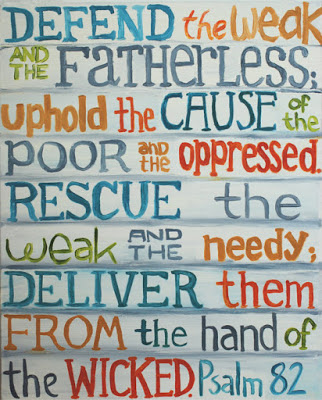
Psalm 82, A psalm of Asaph. (NRSV, small edits by me)

The Most High God presides in the great assembly;
Rendering judgment among the ‘gods’:

“How long will you defend the unjust
And show partiality to the wicked?
Defend the weak and the parentless;
Uphold the cause of the poor and the oppressed.
Rescue the weak and the needy;
Deliver them from the hand of the wicked.

“The ‘gods’ know nothing, they understand nothing,
They walk about in darkness;
All the foundations of the earth are shaken.

“I said, ‘You are ‘gods’;
You are all children of the Most High.’
But you will die like mere mortals;
You will fall like every other ruler.”

Rise up, Most High, judge the earth,
For all the nations are your inheritance.

© Elouise Renich Fraser, 22 February 2018
Image found at www.provencio.com

Dethroned

The winter Olympics are upon us! So just for today, here are a couple of old photos from my past that tell a bit of a story about my family of one father, one mother and four sisters. Nothing profound, unless you’ve been there and understand the dynamics of being dethroned.

First: I’m the oldest, 10 years old judging by the shape of my body parts. An early bloomer as they said back then. Sister #2 is 8 1/2 years old, and Sister #3 (Diane) is 4 years old. Sister #4 is still a baby. And yes, my hair is in rubber-hive curlers. An attempt to make my hair look pretty.

It’s bad enough to be the first-born dethroned three times by the arrival of baby sisters who suddenly grab all the attention. But to be forced to give up my rightful seat on my brand new adult-size bike when I was 10 years old got my goat. Not that I let it show very much in the photo, but I guarantee you, I’m not happy in photo #2.

Nor is Diane, Sister #3, the youngest in the photo. She has totally checked out of the happy sisters mode and is enduring the shame of having been booted from her larger wheels to this ridiculously tiny baby tricycle. I love her for her honesty. She has her hands defiantly clasped in her lap–not on the handlebars as requested by my father. Sister #2 is being as cooperative as possible, having given up her two wheels for three.

And there I am, boiling with indignation on the inside (yes, I remember this well) but ‘calm’ on the outside, while my mother poses for my father on MY new bike! I wonder what was going through her mind?

Small stuff, you say? Not to me. Which is already more than enough said.

For now, Happy Friday and Happy Winter Olympics! May the best women and men win, and those dethroned be gracious and appropriately distressed.

© Elouise Renich Fraser, 9 February 2018
Photos taken by my father, Fall 1953, in our front yard near Savannah, Georgia

There is a pain — so utter —

Emily Dickinson suggests there’s a pain that’s better left lying, almost forgotten. Else it would destroy the victim, one painful piece at a time. My comments follow her poem.

There is a pain – so utter –
It swallows substance up –
Then covers the Abyss with Trance –
So Memory can step
Around – across – upon it –
As one within a Swoon –
Goes safely – where an open eye –
Would drop Him – Bone by Bone.

c. 1862

Emily Dickinson Poems, Edited by Brenda Hillman
Shambhala Pocket Classics, Shambhala 1995

Emily suggests that in spite of extreme pain, we get by thanks to Trance. Like a bandage, Trance covers the wound and the depth of our pain so that Memory can walk safely around or over it. Our eyes are spared the full extent of our pain.

Emily likely has her own pain in mind. In fact, this poem raises again the possibility that someone victimized her when she was a young woman. If so, perhaps her poem is one way of dealing with the horror of seeing (feeling, remembering, reliving) what happened to her. Bone by Bone. One terrifying moment after another. The slow-motion dismemberment of a human spirit, a human being.

Yet this pain is also generic. Not simply something that happened to Emily, but what happens to each of us and all of us. Individually and together. In a thousand permutations.

Perhaps we’re in a Swoon, awake just enough to navigate each day without being brought down by our pain, living in Trance mode. Semi-reality. Semi-truth. Which amounts to untruth, and thus unreality.

I think of the USA and our preference for letting pain lie deep underground while we make our way across and around it. As though it never happened or weren’t that important. Slavery has caused unrecorded, unheard pain to millions. Yet here we are in African American History Month, still unable as a nation, beginning with our leaders, to face this history face-on, with eyes wide open.

We find ways to get by without acknowledging the depth and horror of this and other examples of our national pain. Yet it’s right beneath our feet. Beneath the surface history of our current state of disunion. It seems we’re living in a national epidemic of Trance. We get  by, or so we think, without acknowledging the depth and horror of our pain.

Emily seems to have personal pain in mind. Yet personal pain feeds on and adds to our collective pain. As a nation we like to think we’ve come a long way, and are now beyond the worst. Nonetheless, I see us living the sad and sorry outcomes of unexamined pain lying just beneath the surface of Trance.

© Elouise Renich Fraser, 8 February 2018
Image found at pinterest.com

Living and Loving the Last Chapter

No more unlived history for me. I’m in the last chapter of my life. Which means my last opportunity to live a full life instead of the half-life I’ve often pursued as a good girl/woman.

First, in honor of my mother, I owe myself at least two changes:

  • I must fall in love with myself. For better and for worse; in sickness and in health; for as long as my life shall last; honoring and respecting myself; cherishing my body and honoring my spirit.

I think of it as marrying myself. Loving myself the way God loves me—just as I am. And the way D promised to love me—just as I am. If I can’t do this, my ability to love my neighbors as I love myself is greatly impaired if not dealt the kiss of death.

  • I must relentlessly pursue my dream of being a writer. Not past dreams, but my dream for right now. For this last chapter of my life.

All my adult l life I believed in my skills to help others attain their dreams. I did not believe in my ability to go for large dreams of my own. I was ‘too busy.’ Especially when it came to writing. I was busy giving in to fear, disbelief, and the call of tasks needing to be done.

My mother’s later years included several strange episodes during which she lashed out against my father with language I didn’t know she possessed. To my shock, he backed down. I’m hanging onto those few brilliant moments when I believe my mother put her own well-being and her own wishes first and communicated this in no uncertain terms.

I don’t foresee a fight like this with D. I do, however, foresee standoffs with myself for which I’ll need grit and guts.

Second, I must do for myself what I did for all those 15 boys and men I wanted to impress.

For years, beginning as early as 5th grade, I offered them a list of invaluable services. No cost and no contracts. Why? Because I desperately wanted to feel needed, alive, appreciated, attractive (at least not repulsive), and less lonely.

So what did that look like?

  • A listening ear, empathy and feedback
  • A sounding board for men’s ideas
  • Interest in their lives and their dreams
  • Affection and emotional support
  • Admiration and affirmation of their importance
  • New ideas—mine—free of charge!
  • Proofreading and editing skills
  • Feedback on how to improve their arguments, their writing, their sermons
  • Uncounted smiles and nods of agreement and understanding

In other words, like millions of other women, I gave away what I desperately needed for myself.

Ironically, even though these men affirmed me, I didn’t believe them. Not because they weren’t telling the truth, but because I didn’t believe that in the long-run, what I had to say or write really mattered that much.

Today I’m offering and making available to myself the same tangible and intangible services. Yes, I still have D. His love and loyalty are in place. The missing person in this picture isn’t D. It’s Elouise.

© Elouise Renich Fraser, 8 February 2018
Image found at njculibrary.wordpress.com

Haunted by unlived history, #3

Renich Reunion in Newton, Kansas. I’m in back, just left of center. My first cousins as of July 1958 (more on the way!)

I grew up thinking love would heal everything. I also grew up believing no man in his right mind would ever love me enough to marry me.

I wasn’t a flirt or a party girl. Though I didn’t feel ugly, I didn’t consider myself pretty. I was a quiet and diligent student, a budding musician, intelligent, pleasant, and deeply ashamed.

  • Ashamed of the way my father treated me
  • Ashamed that most people didn’t seem to want me as a close friend
  • Ashamed when teams were chosen and I wasn’t anyone’s first choice. I was better than the last choice, but not by much.

I was also ashamed of our family’s social status. Yes, my father was an ordained pastor. No, he wasn’t a regular, full-time pastor. No, he didn’t have a regular, full-time income.

I sometimes thought about becoming a single missionary like some of the women missionaries I knew. That way I wouldn’t have to bother about all that social stuff. Or men.

But then there were those few boys and men who seemed to like me. Sometimes whether I liked them or not. Maybe the love thing could work for me. Maybe I didn’t have to be single all my life. But aren’t there better choices out there?

This was the beginning of my up and down history of secretly falling in and out of love with men. In no way did I want to appear needy, or look like I was chasing after them.

In the early 1990s, as part of an assignment for survivors of sexual abuse, I made a list of 30 men and boys who made an impression on me from childhood.

Then I began studying the list, looking for patterns. Of the 30 men and boys,

  • 16 were romantically attractive to me
  • 15 were men or boys I wanted to impress in some way
  • 14 were artists, poets, musicians, and/or actors
  • 13 appreciated and loved to listen to my piano playing
  • 12 pursued me (I didn’t pursue them)
  • 12 affirmed me as an individual, not as an object of their self-interest
  • 10 were ordained ministers or leaders
  • 6 were employers/supervisors
  • 6 took advantage of me
  • 4 raised fear in me
  • 4 were pursued by me
  • 4 I disliked intensely
  • 4 were ‘soul mates’
  • 3 overtly punished or humiliated me

Thinking about my relationships with these men and boys helped me make large and small changes in my relationships with men. For example,

  • I changed some unwise habits in order to maintain healthy boundaries as a professional educator and a church member.
  • I learned to recognize and honor my intuition when things didn’t feel quite right.
  • I recognized that being an agreeable, good girl woman was getting me in trouble by feeding unhealthy patterns of overwork and exhaustion. Though I made progress on this one, it wasn’t resolved until I retired in 2011.

I’ve written earlier about not having dreams for myself. Big dreams. The kind that orient life in a clear, even exciting direction. Most of my life I’ve lived by lists. Checking off long to-do lists with no big dream at the end. Just more long lists.

I want something better for myself. Today I hear my history with men fairly screaming something I couldn’t hear back then.

© Elouise Renich Fraser, 1 February 2018
Photo taken in Newton, Kansas, July 1958 – Not yet all my first cousins on my father’s side.

Haunted by unlived history, #2

Wedding Day, 11 September 1965

When I married D I believed I’d found the answer to all my problems. I was ecstatic. Finally I had a life of my own, and a man who would love me and not try to fix me. It might not happen overnight, but eventually I would be my own woman, doing my own thing. And D would love me no matter what.

Two weeks before we married, in 1965, I told D I was afraid he would leave me behind. Here we were, getting ready to marry and move to Boston where he would pursue a graduate degree. But what would I pursue? No, I didn’t have anything in particular I was dreaming about, though someday I might want further education.

In 1973, we ended up in California with two young children, and both of us enrolled in seminary. I was ecstatic. Maybe I would find myself at seminary.

Yet my sense of being on the sidelines of life grew. Especially as D received work-related assignments to travel, while I stayed home caring for our young children and pursuing my seminary studies.

I went through periods of exhaustion, depression, bouts of anger, resentment and resignation. I felt trapped, misunderstood and lonely. Any kind word or smile that came my way, especially from men, was more than welcome, though I felt uneasy about this. Wasn’t I supposed to love D and no one else? And wasn’t his love for me more than enough?

Seamlessly and unknowingly I enacted the script of my mother’s unlived life. Not just a script about still needing love and affection, but a larger script about not having or following my dreams, not believing in or taking care of myself. I was too busy taking care of others.

I didn’t know or believe in myself, or my ability to go after large targets and impossible dreams. When opportunity knocked, my habitual responses were self-defeating.

  • Too busy to take advantage of opportunities
  • Afraid to put myself out there for consideration
  • Disbelief in my demonstrated gifts or potential
  • Feeling less than qualified
  • Changing the subject as quickly as possible
  • Finding out how I might help you follow your dream

I was in trance mode—caught in a waiting-game that feels like being on a train that moves yet never arrives because it has no known station.

I watched and cheered as other women and men pursued their dreams. I wrote hundreds if not thousands of reference letters on behalf of others. Yet never once did I write a letter in support of my dreams. I was living my mother’s unlived life. Doing what I could to support others, and choosing not to pursue anything strictly for myself.

So how does my history with men fit into all this? More to come.

© Elouise Renich Fraser, 31 January 2018
Photo taken at our wedding, 11 September 1965