Telling the Truth

connecting the dots of my life

Tag: the human condition

Thank you, John Lewis

Today has been more than a bit somber. My most recent burning memory of Representative John Lewis is his sterling leadership during last fall’s Congressional impeachment investigation of Donald Trump. The 5-minute video above shows him supporting further impeachment investigation.

And now Mr. Lewis is gone. He was the last Black leader living who participated in the 1963 March on Washington, shortly before the 1963 Civil Rights Act became the law of the land. In his speech (below) he clarifies his opposition to the legislation.

The young Lewis is speaking to citizens gathered in Washington to demand racial justice. John Kennedy was President. As you can hear, John Lewis wasn’t one to tone things down. He speaks without apology, and without pretending the proposed legislation was what Black people needed. He was correct.

This nation has lost one of its true patriots. If you’d like to read and hear more, Vox has posted six speeches (including the two above) that capture John Lewis’ remarkable service to this country. You can find them here.

© Elouise Renich Fraser, 18 July 2018
Videos found on YouTube 

The High Cost of Living in the USA | Part 2 Revisited

This old post gets regular random visits these days. So here it is again, with one exception: The high cost of living in the USA is much higher today than it was two years ago.  

The high cost of living in the USA has fallen on African Americans from the beginning of this nation. The goal has been and still seems to be this: Keep ‘them’ in their places and optimize the gains of those in power. Including the power of those of us who think we have no power.

The high cost didn’t go down when slavery was outlawed. We simply notched it up with lynching, and then discovered mass incarceration. Some argue that mass incarceration is simply the latest way to get cheap labor and ‘disappear’ black or brown Americans without getting into legal trouble.

Are we the land of the free and the home of the brave? Yes and no. Yes if you’re able to reach and maintain inner freedom and courage in the face of overwhelmingly negative odds. Perhaps we’ve looked to the wrong heroes to show us what true freedom and bravery looks like.

More than one of my younger African American male seminarians said he didn’t think he’d live to be an adult. Besides a history of slavery, lynching and entrenched racism, we witness or read about random gun violence every day, entrenched poverty, and limited options regardless of ability. Add to this the availability of drugs and alcohol, and the mistake of being black or brown in public spaces.

In April 2018 a new Memorial to Peace and Justice opened. It makes visible our history of slavery, lynching and now mass incarceration. I want to visit this new Memorial before I die. Why? Because it’s also about part of my heritage.

In summer 1950, my family moved from California to rural Savannah, Georgia, just a short walk from what we called ‘colored town.’ I wasn’t aware of animosity between races. I was, however, painfully aware of economic disparities on display every day. Not just in our rural community, but in the city.

I now know, thanks to this interactive map, that the state of Georgia is #2 in states with the most lynchings on record between 1882 and 1930. From 1877 to 1950, Georgia lynched 586 black men, women and children. How many were lynched in your state?

I’m told I enjoy white privilege. It’s true. When I get up in the morning I don’t have to worry about things like being seen in public as a white woman. For me, this ‘privilege’ is white ignorance or worse. By breathing the air around me, I learned to be blind and unresponsive to what’s right before my eyes.

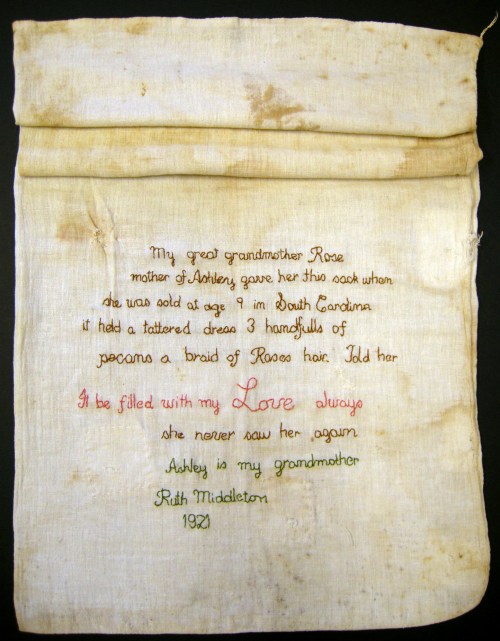
I don’t think the solution to our problem lies in miles of data. I’m rooting for poets, songwriters, storytellers, and truth tellers. Including truth-tellers like those who birthed this new National Memorial.  Plus pieces of lost history embroidered on small bags.

©Elouise Renich Fraser, 23 May 2018, edited and re-posted 17 July 2020
Photo found at Wickipedia; y Shameran81 – Courtesy Middleton Place, CC BY-SA 4.0, https://commons.wikimedia.org/w/index.php?curid=55786120
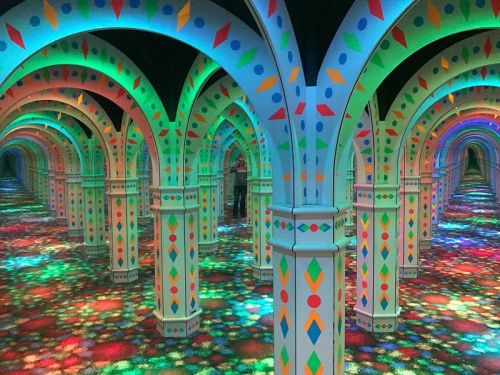
Lost in a maze of hallways

In August 2015 I wrote and never posted this poem. Prompted by a dream, it describes my inner sense of disorientation as a new blogger. I wanted and needed to tell the truth. Still, I was uncertain how to proceed, how to find my way home to myself.

Today, as a citizen of the USA, I’m in another maze of hallways. I’m not in a dream. I’m disoriented. Wondering where the exit might be. Not just for me, but for all of us. Our nation is in turmoil, anguish and pain. Denial won’t work. Neither will a constant diet of diversionary tactics, or fake promises about tomorrow.

I’m wide awake lost in a maze of hallways
filled with small shops and out-of-sight
merchandise if only I will give up my
determination to find the exit and go home.

The young man with me seems happy to
be there smiling at me while dragging
his feet and holding me back with his
nonchalant air of everything’s fine just fine.

It is not fine. I know it. I feel it. I keep
looking around searching for the way out
I know this mall. I’ve been here before.
What happened to all the old landmarks?

Doors are locked. Other doors open onto
new hallways filled with glittering shops
and female shopkeepers smiling and asking
for my attention and presence. Won’t I stay?

I seek help from a woman standing in the
doorway of a small shop. She assures me
I’m not lost and will find the exit if I keep going
Her words soothe but fail to help me.

I wake up troubled not anxious yet
eager to know the meaning of this
frustratingly endless dream lost
in a maze of diversions going nowhere

So what about today? In my real world? So far: A walk with D through the neighborhood, writing, pondering challenging material about white racism in USA churches, along with a Psalm of Lament. On the whole I’m feeling grounded, and grateful for friends and family members. Which includes Smudge, of course!

Elouise

© Elouise Renich Fraser, 3 August 2015; posted on 15 July 2020
Image found at pinterest.com

moss-laden oaks loom | 1950s in the Deep South

moss-laden oaks, magenta azaleas

I posted this poem in 2014. It’s an attempt to capture my first impressions of the Deep South, including strict segregation between Black and White citizens. There were 5 of us in the car (Sister #4 yet to be conceived). We’d just driven from Southern California to rural Georgia, 15 miles outside of Savannah. Another world. One I’d never imagined in my 7 1/2 years of life. 

moss-laden oaks loom
magenta azaleas blaze
deep south path through woods 

* * *

Late summer, 1950

It’s past midnight
I’m asleep with Sisters #2 and #3
Are we almost there?

Mother’s tired voice wakes me up
Nothing but darkness outside
and cobwebby stuff hanging from tree limbs

A log-cabin tavern fades into view
Neon beer ads flicker on parked cars, old trucks
Daddy reluctantly stops for directions

He goes into the tavern.
Are we lost?
No. We just aren’t there yet.

Daddy drives slowly
No street lights no signs
The old road is dark, narrow, mysterious

Mossy oaks loom overhead reflecting
weak rays of yellow light from car headlights
Weary shacks line the road

Unexpectedly we pass grand fenced-in wooded lots with driveways to nowhere
Then modest houses and a few larger houses
The road ends abruptly.

Daddy stops, gets out, peers at the giant mailbox
He turns into the driveway
We’re there.

Deep South
moss-laden oaks, no blazing azaleas
Just heavy humid air, wealth next door to poverty, fiercely guarded secrets

© Elouise Renich Fraser, 10 March 2014, reposted with intro14 July 2020
Google image – Springtime in Savannah, Georgia

Everything isn’t always beautiful

This morning I’ve been thinking about Mary Oliver’s poem, Everlasting. On first reading, it may seem Mary is accepting and putting a positive spin on everything. Making things pretty.

Yes, there’s always hope for something better. Nonetheless, Mary focuses intently on what’s in front of her. Nothing is too fleeting or small to notice.

Much, if not most of her poetry captures the small details and stories of nature’s wonders. Yet she also describes the horror and ugliness of human behavior. Some of it shows up in nature as well, putting beauty at risk.

I picture her with a ‘camera’ (her ever-present writing notebook), in which she records everything she observes. The good, the beautiful, the bad, the unexpected and the ugly. She doesn’t flinch or soften the blow of reality.

Mary challenges me most when she lets her unvarnished truth go public. Truth about herself, her family, her father (A Bitterness), and small scenarios playing out in predatory behaviors in the non-human world (Small Bodies).

Beginning with me, there’s so much we humans hide, or carefully dress up to mask our neediness. Mary invites us to find ourselves in the midst of whatever we’re dealing with or see in the mirror. Sometimes it’s a real mirror. Other times, it can be the mirror of Mary’s poetry. Or the morning news. Or an unplanned trip to the doctor.

Hoping your day is thoughtful and rewarding, no matter the cost.

Elouise

© Elouise Renich Fraser, 13 July 2020
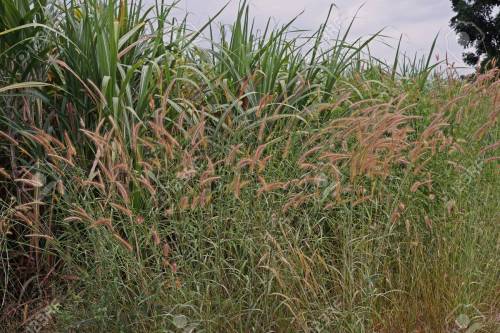
Invasive Mission Grass image found at 123RF.com

What we need to stop doing

This morning I read a hilarious and sobering opinion piece from Damon Young in the NYTimes. It’s titled “Yeah, Let’s Not Talk About Race.” Damon Young offers a strangely funny lament (my choice of words, not his) about what happens when he’s out on his evening walk around the neighborhood.

If you can access this piece, here’s the link. 

Here’s why his piece struck a chord with me. It’s a cry for honesty and for justice. In a nutshell, he’s tired of being expected to listen to uninvited comments from white people who aren’t willing to pay for his time or do their own homework. Especially when he’s out walking at the end of the day.

No, he isn’t mean. He’s just suggesting we might want to back off. Put another way, he’s letting us know we can’t atone for our sins of commission or omission by talking with him. Nor can we receive absolution from him. It doesn’t matter how much we care about him and other black and brown people. Or how eager we are for him to answer our questions for free. Not that he’s looking for our money. He isn’t.

You might say this behavior toward him is the price of being a celebrity. I don’t think so.

Furthermore, we don’t have time to try atoning for our white color by interrupting persons of other colors just to signal  or prove to ourselves (?) that we’re one of the good guys or gals. Or that now we’ve got it, when we don’t.

Seriously, the problem of presumed or arrogated white superiority has been our problem since the founding of this nation. It’s high time we white citizens began addressing it with each other.

I’m not saying a conversation with a black or brown friend or colleague is out of bounds. Still, I want to know I’m having the conversation because I’m a learner, and my friend of any color isn’t afraid to tell me the truth about myself as a white woman.

Happy reading and talking about things that matter!

Elouise

© Elouise Renich Fraser, 11 July 2020
Image found at NYTimes.com

What we need to hear

Maybe I’m the only one. The only white PTSD survivor who didn’t get it. Do I feel humiliated by this? No. Chagrined? Yes. Yet above all, I’m challenged to find out more.

Here’s what I didn’t and still don’t get.

I know this is hard for many enlightened and well-meaning Christians to hear, but here’s the truth: If you are white, you have no clue as to the PTSD-like realities black people in this country face every single day. —James Ellis III

It’s one thing to accept this as information. On the other hand, are we willing to let this sink into our understanding of the way things play out here in the USA? Not just in public places, but in white (often lightly colored) churches?

The quote above challenges me to learn more about “PTSD-like realities” black people face daily here in the USA. The easiest connection (for me) is to think about post-Viet Nam War veterans with PTSD who showed up in my theology classes in the 1980s. Yet even that isn’t the same as what’s happening today on our streets. Neither is my own history with childhood PTSD.

One quote doesn’t explain everything. But that isn’t James Ellis III’s point. His point is that we white, so-called “enlightened and well-meaning Christians” have a hard time hearing and accepting truth about Black Lives.

How tragic if we fail. Not because we didn’t try, but because we don’t like hearing bad or disturbing news about ourselves. It’s easier to push it off on the government, or ‘those white people’ over there, or even on Black citizens themselves.

James Ellis III’s article, from which the quote above comes, was first published in May 2020. Read it here, if you dare. It’s titled “A Lowdown, Dirty Shame: Ahmaud Arbrey’s Murder and the Unrenounced Racism of White Christians.”

Praying we’ll find our way out of this mess. Not the mess created by our government, but the mess we’ve created for ourselves.

Elouise

© Elouise Renich Fraser, 9 July 2020
Image found at pinterest.com

Invitation | Mary Oliver

This morning I’m tempted to rush into battle mode. So many things are going so wrong. This poem from Mary Oliver helped restart my day–though I’m still not sure what will come of it. My comments follow.

Invitation

Oh do you have time
to linger
for just a little while
out of your busy

and very important day
for the goldfinches
that have gathered
in a field of thistles

for a musical battle,
to see who can sing
the highest note,
or the lowest,

or the most expressive of mirth,
or the most tender?
Their strong, blunt beaks
drink the air

as they strive
melodiously
not for your sake
and not for mine

and not for the sake  of winning
but for sheer delight and gratitude—
believe us, they say,
it is a serious thing

just to be alive
on this fresh morning
in this broken world.
I beg of you,

do not walk by
without pausing
to attend to this
rather ridiculous performance.

It could mean something.
It could mean everything.
It could be what Rilke meant, when he wrote:
You must change your life.

© 2008 by Mary Oliver; poem found on pp. 18-19 of Red Bird
Published by Beacon Press

The line from Rainer Maria Rilke is found at the end of his poem, Archaic Torso of Apollo. There, as here in Mary Oliver’s poem, we’re offered no clear interpretation of “You must change your life.”

Here’s how I’m thinking about it today:

This shared world, filled with beauty, seems intent on self-destruction. Would we throw it all away by refusing to act, just once, with beauty and courage? Do the unexpected? Change the conversation, or our knee-jerk reactions to things that annoy and offend us?

Perhaps the most courageous thing I can do today is as simple as a smile. Especially in tense or fearful situations. We say a smile is worth a thousand words. It’s what most of us are starving for every day. True, smiles won’t heal or resolve every problem. Nor are all smiles to be trusted.

Still, Mary Oliver challenges us to stop, listen and (I think) smile at these crazy beautiful goldfinches. They just can’t stop singing for sheer delight and gratitude! Trying, perhaps, to tell us something we desperately need to hear from each other?

Thanks for stopping by!
Elouise

© Elouise Renich Fraser, 7 July 2020
American Goldfinch songs found on YouTube

Living and Dying in Fake History

Lift up your eyes,
not your voices—
Weep with those who weep

Open your ears
to strangers

Resuscitate your heart
grown still and cold from neglect

Or have we already sold our souls
for greenbacks, glory
and false faith in firearms?

Listen

Hear the voice of our Creator
lamenting loudly over
distant hearts
grown accustomed to
the way we thought things were
yet will never be
in this life or the next

I’m in the process of reading several accounts of national history, including church history. Each study corrects fake history written to silence victims, and glorify victors who were as human as we are, and less than pure in their motives. They raise the obvious question: How did we get here centuries and decades later? And what must we do next if we want something better?

Reading won’t magically change the way I am in the world. Hopefully I’ll think more clearly and act with greater intent.

In addition, my soul won’t be in it if I haven’t also lamented loudly, listened silently, asked questions, meditated on what I see and hear, and made changes in my lifestyle.

What’s happening today isn’t just a matter of historical data or who we want to be the next POTUS. It’s about the content of our character, beginning with me and with you. How willing are we to stand up before friend and foe alike, on behalf of new friends and strangers?

Easier said (or written about) than done. But as they say rather glibly these days, “We’re all in this together.” Aren’t we?

Happy Monday, despite the lopsided agonies of Covid-19, the struggle against Black Lives Matter, and the failure of POTUS to lead by example. Which doesn’t let us off the hook.

Elouise

© Elouise Renich Fraser, 6 July 2020
Quote found at azitanahai.com

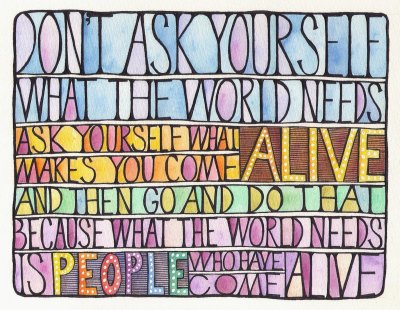
What the world needs | Howard Thurman

Howard Thurman made things straightforward, simple and down to earth. My father did not. I was raised in a Christian culture (presided over by my father) that saw life outside our ‘safe’ space under attack by twin demons: complexity and danger. Especially if life outside made me come alive.

  • Dancing? No way! Definitely the first step toward raucous, immoral behavior.
  • Lipstick? No way! A sure sign of debauchery. (Until it suited my father to make it imperative.)
  • Dating unchurched and thus unreliable (might grope or rape me) males? No way! (Not that dating was high on my list.)

So here I am today. A supposedly grown-up white woman still figuring out how, at this age and under our current circumstances, to go and do what makes me come ALIVE!

All things  considered, I don’t plan on going anywhere for a while. However, reading and writing make me come alive. Along with music and poetry. Talking with my children and grandchildren. Stopping for a street-side chat with neighbors. Hearing from friends all over the world. Playing with Smudge.

Then there are lovely morning walks. I’m just back from one with D, seeing and hearing birds sing at will. No officious patrol cars tracking them down and locking them up for looking suspicious or disturbing the peace.

The end of the matter is this: I’m most alive when I’m an uncaged songbird! I want to spend my short life singing songs of truth, especially when I’m surrounded and it looks like the sky is falling.

These are trying times. It’s the 4th of July. I wish I could say Hurray for the USA! We’ve come a long way baby! Break out the champagne! Let the fire crackers fly through the air!

But I cannot. Why not? Because right now this contentious, at-risk world needs people who have come alive. Women, men and children willing to tell the truth about their lives regardless of the cost. Willing to listen long and hard to songs they’ve never heard before. Willing to look into the eyes of strangers, smile, and say “Good morning! Would you be willing to tell me about your life?”

Hoping you have a thoughtful 4th of July filled with songs and stories you’ve not heard before.

Elouise

© Elouise Renich Fraser, 4 July 2020
Image found at quoteswave.com