Telling the Truth

connecting the dots of my life

Tag: the human condition

It’s difficult to focus on 9/11

Dear Friends,
Today, our 53rd wedding anniversary, is also the 17th anniversary of the World Trade Center attacks in 2001.

At the end of October 2001 the seminary held a community forum in the chapel. I agreed to speak from the platform. I didn’t know where to begin or end. So I began where I was and went from there.

It’s difficult to focus.
Voices and images
clamor for my attention,
my response,
my analysis of what is beyond all reason.

I force myself to stay close to the bone,
close to home, close to my Christian roots.

Death is in the room.
Not a new presence,
not even unexpected.

It, too, clamors for my attention,
masquerading in terrible new configurations.

I don’t want to die,
especially if I must suffer in my death.

From the throne of his cross,
the king of grief cries out….
‘Is it nothing to you, all ye who pass by?’

There is no redemption
apart from suffering and death.
None.

I want to be redeemed.
I do not want to die, or to suffer.
I’m not a very likely candidate for redemption.

Death is relentlessly in this room.
My death.
Your death.
Christ’s death.

Unfinished family business is in this room.
Violent behaviors and attitudes
passed down from father to daughter;
Habits of not telling the truth,
passed down from mother to daughter;
Withholding of love and affection,
Relentless inspection and fault-finding,
Love wanting expression but finding no voice,
Truth wanting expression but finding no listening ear.

Unfinished family business is in the room with death–
A gnawing ache more than my body can bear.

I like to think I’m ready to die.
But I am not.
Nor will I ever be.
Not today, not tomorrow,
Not in a thousand tomorrows.

If I say I am ready to die,
I deceive myself,
and the truth is not in me.

There’s always more work to be done–
Unfinished family business
Unfinished seminary business
Unfinished church and community business
Unfinished personal business

Christ died to relieve me
of the awful, paralyzing expectation
that one of these days
I will finally be ready to die.

Christ finished his work so that
I could leave mine unfinished
without even a moment’s notice.

The Heidelberg Catechism says it all–

What is your only comfort in life and death?

My only comfort, in life and in death, is that I belong–body and soul, in life and in death–not to myself but to my faithful Savior, Jesus Christ, who at the cost of his own blood has fully paid for all my sins and has completely freed me from the dominion of the devil; that he protects me so well that without the will of my Father in heaven not a hair can fall from my head; indeed, that everything must fit his purpose for my salvation.

Therefore, by his Holy Spirit, he also assures me of eternal life, and makes me wholeheartedly willing and ready from now on to live for him.

(from the Heidelberg Catechism, 1563)

© Elouise Renich Fraser, 31 October 2001

* * * * *
Notes:
(1) The forum was held in the seminary chapel; a large wooden cross hung on the wall behind the platform.  Hence the reference to Christ’s death being in the room.
(2) The three lines beginning with “From the throne of his cross” are from John Stainer’s 1887 oratorio, The Crucifixion.

© Elouise Renich Fraser, 11 September 2018

Taking Heart and Courage on Friday

A kind heart
Observant eyes
And empathy
For those you meet

These become you
Daughter of Royalty
Descendant of Eve and Adam
Follower of Jesus the Bold

Look into mirrors
And out of windows
With abandon
Follow your heart

Turn around
Or turn back
Take a side road
Or a trail to nowhere

Ache and cry
Lament loudly
Wonder how long
This too will last

Forget logic
Throw caution
To winds of change
Float on ebb tide

It’s the hour
Of cruel ironies
And the sweetest
Memories

Weedy fuzzy dust
Will be here long
After you are gone
Enjoy the sunset

Bits and pieces
from the scattered run-on journal of my mind
this Friday morning

©Elouise Renich Fraser, 7 September 2018
Photo by Sally Hale Photography, found at flickr.com
Ebb Tide at Jekyll Island, Georgia, USA

The Survivors

From her wheelchair
The frail old woman
Repeats her truth

Over over and over
Eyes bright with recognition
Insist on being heard

He made me alive
He made me safe
He made me alive
He made me safe
(He didn’t kill me.)

Memory frozen with truth
And lies she survived
Trapped in her past
Body drowning yet again
In yesterday’s icy waters
At the hands of the man
Now standing before her
In the dock –
Drowning in truth

I woke up today thinking about this woman and the doctor who experimented on her body, as told in “Ancient History,” an episode of Kavanagh QC.

Both are Jews, deported and taken to the same prison camp. He, a medical doctor, accepts an offer to run horrifying medical experiments on prisoners, or die. She is one of his unfinished experiments, saved in the last days of World War II. At what temperature could a living human being be frozen in water and brought back to life?

There were no winners. There never are. In addition, there’s a strange bond between these two prisoners whose lives are thrown together in a hell-on-earth situation.

This doesn’t mean choices made in hell-on-earth situations don’t matter. They do. But not always in the ways we imagine.

Sometimes they may show the content of our character, other times they might not. They may, in fact, show how terrified and helpless we are at the hands of our tormentors. And how much we want to live and die without being compromised.

©Elouise Renich Fraser, 6 September 2018
Photo of Russian Jews arriving at Auschwitz-Birkenau; found at collections.ushmm.org

Searching for what we’ve lost

Sit with it
Let it sink in
Recall the day and hour
The occasion

Sounds and faces
Sunday meeting clothes
Dressed up but not too much
For his memorial service

It’s already late in the day
Hungry for time
We linger with each other
Searching for what we’ve lost

Are we ready for this
What will we do now
His passing long anticipated
Sinks with the setting sun

How are you
I’m so glad you came today
I thought this nightmare
Would never end

Written after I looked at family pictures from my father’s memorial service. I wanted to distract myself and stop the tears that welled up. Instead, I decided to write it out.

My father’s dying was long and tormented. Chiefly due to his stubborn insistence on doing things his way, even though his body wouldn’t go there anymore. I often wished he had gone first, before my mother. But that didn’t happen. He was 96 years old. I was 66. The year was 2010.

©Elouise Renich Fraser, 30 August 2018 

Relics of my past and present

Every day I’m surrounded by relics of my past that reach into my present. Then there’s the odd relic I buy for myself because I know I need it. Even though I don’t know where it will take me. The photo above shows three of my relics.

The big furry raccoon is a gift from two male seminary students. Unannounced, they came to my faculty office the week of their graduation in 1986/7. Each had taken multiple courses from me. Yet to their sorrow, they had been less than supportive my first semester of teaching. They came bearing a gift of contrition and gratitude. Their way of making amends and reaching out to acknowledge complicity in my first-year trial by fire.

I promptly, there and then, gave this furry beast his name: Klein Calvin. That’s Calvin for  Reformed theologian John Calvin, not Calvin Klein. And Klein for the German word for small. Again, not for the clothing brand Calvin Klein.

Over the years, Klein Calvin has occupied seats of honor in my house. From these exalted seats he has given my grandchildren tons of fun and caused Smudge, our rescued cat, moments of extreme consternation.

The smaller white teddy bear with a heart is also a gift. This time from my theology class in spring 1999. A surprise gift the week I returned to class after time off following my mother’s death. The class hadn’t been particularly easy. These were the years after our new sexuality policy was approved by the Board, giving aid and comfort (in my unchanged opinion) to those who were on the lookout for deviation.

Yet here was this totally unexpected gift, made possible because of human ties that bind us. When I was a child I never owned a real teddy bear. This is my teddy bear. She’s been sitting on the sofa in my office for years. Sometimes hugged close when I’ve felt overwhelmed about not having my mother present to answer at least a thousand questions.

Finally, right there in the middle is my newest cuddly friend. I’ve christened her Baby El. A likeness of me. When she arrived two weeks ago, I wasn’t sure what to do with her.

For now, I’m certain she is not about my father. She’s about me. I want to know myself better and honor myself. Especially, but not only, that little girl who still resides in me. Now woven into every fiber of my being.

If I just think about getting to know myself (and that little girl…), it won’t happen. I need to practice honoring myself for real. And Baby El is my partner in this. She’s real. She’s present. And she always welcomes me with a smile.

Which, by the way, is helping free me from making D into the bad man he is not, or even into a very large version of Baby El.

I used to think I could work it all out in my head or in my writing. Both are important. Yet having a concrete stand-in ally (who represents me) makes all the difference. It doesn’t matter what’s going on in me: shame, fear, the need for comfort, discouragement or wanting someone to share my joy. She’s there for me, and I’m there for her.

I also want you to know how I came to this point. It’s all about a book I just finished. More on that later.

©Elouise Renich Fraser, 29 August 2018
Photo taken by ERFraser, 29 August 2018

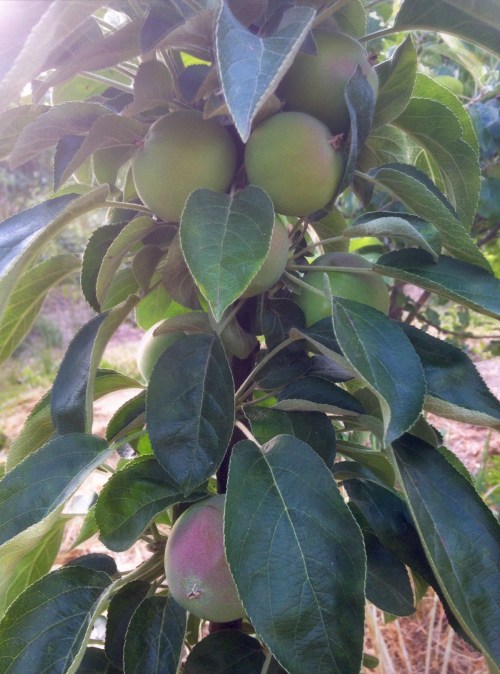
Complicity and Rotten Apples

For decades I’ve listened to well-meaning friends and strangers telling me to get over it. They weren’t always that blunt, but I knew what they meant. Something like this…magnified through my own shame-based filters:

It’s time to move on with your life. We’re tired of hearing about the same old struggle. When are you going to get a life? Can’t you see how easy it is?!

I don’t fault friends or strangers who’ve urged me to move on. They want the best for me. All I have to do is walk away and don’t look back. The way many of them did.

Yet it seems I have nothing to walk toward except more of those heart-breaking, mind-bending head trips I’ve been on all my life.

Besides, it doesn’t matter what others think about me. What do I think about myself?

From grade school on, academic pursuits were my salvation. They kept me busy. They gave me something tangible to hang onto, plus a fleeting sense of self-worth even though I was running away or lost. I’ve known this for years. Nothing new here.

Recently a friend of many years suggested I’m still complicit with my father’s shaming and silencing of my voice. It still eats me up, from the inside out. Like a rotten apple, it tries to spoil the entire barrel.

She was correct. The shamed-based atmosphere in which I grew up now lives in me, passed on by my father. I have no doubt this is a generational gift of poison.

So I’m back to my childhood with this correction: I did not have a childhood. It was stolen from me before I knew what was happening. Instead, I became a substitute mother (to my three sisters), and grew up labeled as a ‘rebellious, stubborn’ eldest daughter who needed to have anger beaten out of her.

Furthermore, though I enjoyed my children as they grew up, joining in their childhood games didn’t give me the childhood I never had.

So…how do I find what I didn’t have, and how do I stop my internal voice that wants to shame me into silence?

Meet Baby Elouise! No, I don’t have a picture. I bought her over a week ago. Why? Because I’m determined to find and take back what was stolen from me.

My job is to love and listen to the little girl and adult woman I am despite all efforts, including my own, to silence or redirect me. Baby Elouise is helping me move in the right direction.

To be continued….

©Elouise Renich Fraser, 28 August 2018
Photo taken by Sherry Fraser Seckington, June 2016 – from their garden

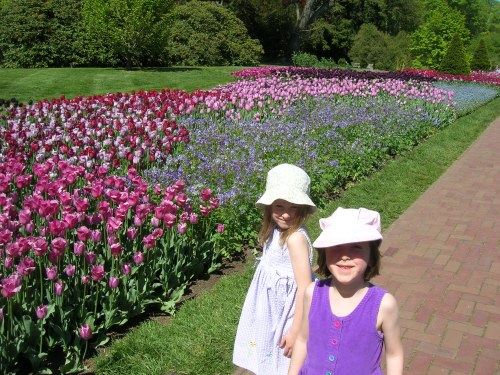
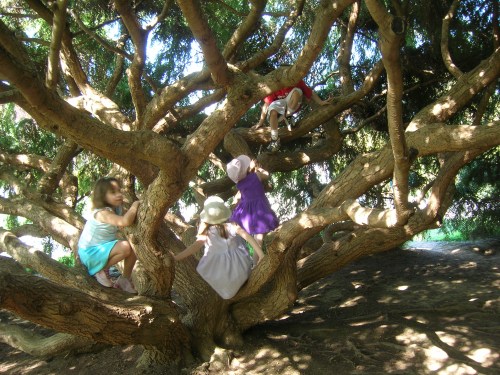
Children at Longwood | Photos

On Saturday afternoon D and I helped celebrate family birthdays–four of them, within the space of one week! Our son (his big 50), twin granddaughters (18 years old, seniors in high school), and daughter-in-law (I’m not telling). Only their young son gets his own special day later this fall (15 years old).

All this family stuff got me a bit nostalgic. Hence these Longwood Garden photos taken in late April 2006. As I recall, this was our granddaughters’ first visit to Longwood. These were also the golden years when I was Queen Elouise and carried a sun parasol to mark my exalted status.

Looking at these photos reminds me of the tough work our son and daughter-in-law did to honor their children’s gifts and personalities. It’s never easy.

Yesterday I heard this on the radio: Having children doesn’t make a man a father. The statement clicked with me instantly. To it, I would add this: Being a ‘father’ or ‘mother’ of the church (as in padre, nun, priest, bishop, archbishop, pastor, youth minister) doesn’t confer or guarantee the ability to relate honorably to children or young people.

In the news last week: the Pennsylvania report about child abuse at the hands of Roman Catholic priests and their superiors. All of it covered up by people and a system that took care of its own. Plus, a few days later, reports about the Pope’s visit to Ireland and the legacy with which that nation’s population lives–as do many others.

I only wish it were possible to track similar behavior in Protestant churches here and elsewhere.

All this and more brought back my relationship with my father. He was an ordained Protestant clergyman, sporadically under the loose oversight of a governing body. I have more work to do.

For today, I commend men and women who work hard at parenting and foster-parenting. Especially when they don’t have many models or cheer leaders when things get more than a bit crazy.

Elouise

©Elouise Renich Fraser, 27 August 2018
Photos taken by DAFraser at Longwood Gardens, April 2006

What I’m FOR today

There’s so much going so wrong today that I decided to make a roll call of what I’m FOR on this remarkable day. Remarkable because I lived to witness it! Including, in my past, this river and dock-life when I was growing up. Plus at least the following other items for which I’m grateful:

  • this beautiful world in places touched by human tragedy
  • family members more distant in miles than ever, yet closer to my heart
  • churches standing up to tough challenges without capitulating to visions of grandeur, glory or isolation
  • real places that offered me refuge and peace when I needed solitude and reassurance that my life matters
  • our son who turns 50 today and reminds me why I risked everything with my parents on the eve of my 50th birthday
  • our daughter who lives on the other side of the USA yet is present to me in ways I was never present to my mother
  • the Carolina Wren, Chickadees and Cardinals singing and chirping, plus the small ground squirrel who sits on our back yard wall surveying his spacious kingdom
  • courageous women, men and children who speak out and work for a better world for all of us
  • my neighbors: Roman Catholic, Muslim, Jew, Protestant, or Nothing at All who greet me, invite me into conversation, groan and smile with me, and offer me tea
  • my dear husband who I sometimes thought might be the wrong man for me, yet has become precious beyond words
  • my local church with its challenging mix of cultures, ethnicity, political persuasions, youth and decrepitude
  • days of such unexpected delight that I don’t want them to end, yet can let go because I love my water-bed and the partner swimming in it with me
  • my body and the way it’s leading me deeper into and out of myself in these last days of summer 2018.

And of course, I’m for you, my wonderful readers–an invisible family loosely held together somewhere out there beyond our control.

Elouise

©Elouise Renich Fraser, 22 August 2018
Photo found at pinterest; Skidaway River, Isle of Hope near Savannah, GA

Why I can’t stop staring | Psalm 23

I’ve never been here
though I know it exists
somewhere beyond
my power to make it happen
a table is ready and waiting
in the presence of my enemies
an oasis in the Sahara
awaits my arrival with
more than enough oil
to anoint my head and
water to quench my thirst

I’ve been thinking about Psalm 23 this week. Especially the part about the faithful shepherd preparing a table before me in the presence of my enemies. I usually focus on the part about my enemies (not necessarily the Shepherd’s enemies).

This time I’m thinking about the table. Maybe it’s like the oasis pictured above, Guelta d’Archei, in the Sahara Desert in Chad. If you’d like to see more photos, click on the link.

This remarkable permanent pool of water is in one of the driest places on earth, hidden and shaded beneath giant towers of sandstone. Its immediate eco-system includes a reliable source of water that serves as a convenient outhouse for camels. Green algae feasts on black dung deposited by camels, creating black water. Fish thrive in this environment by eating the algae which seems to enjoy a kind of eternal life, thanks to the camels. And then there are Nile crocodiles that love the algae-hungry fish!

What could be more inviting than this reliable table in what seems a God-forsaken desert? I can’t stop staring. Perhaps what looks strange and forbidding in my life is actually a table set by my shepherd. All I have to do is show up.

You prepare a table before me in the presence of my enemies….

©Elouise Renich Fraser,18 August 2018
Photos found at amusingplanet.com

My Life had stood – a Loaded Gun –

Here’s an Emily Dickinson poem that’s been widely studied by scholars. I’m still not sure what to make of it. I can, however, connect it to what I’ve experienced in my life. My personal comments follow.

My Life had stood – a Loaded Gun –
In Corners – till a Day
The Owner passed – identified –
And carried Me away –

And We roam in Sovereign Woods –
And now We hunt the Doe –
And every time I speak for Him –
The Mountains straight reply –

And do I smile, such cordial light
Upon the Valley glow –
It is as a Vesuvian face
Had let its pleasure through –-

And when at Night – Our good Day done –
I guard My Master’s Head –
‘Tis better than the Eider-Duck’s
Deep Pillow – to have shared –

To foe of His – I’m deadly foe –
None stir the second time –
On whom I lay a Yellow Eye –
Or an emphatic Thumb –

Though I than He – may longer live
He longer must – than I –
For I have but the power to kill,
Without – the power to die –

c. 1863

Emily Dickinson Poems, Edited by Brenda Hillman
Shambhala Pocket Classics, Shambhala 1995

This poem has kept me coming  back for well over a year. Here are a few thoughts about the poem, which reads more like a small story or long riddle than a philosophical or political point of view.

This poem is at least indirectly about Emily. It’s about her life as a prolific poet, a well-known figure in her setting, and lover of the outdoors. And the reality that she is a woman. My first comment, then, is that she’s contemplating her life as she has experienced it. A loaded gun standing there in the corner–waiting, as something she doesn’t fully own.

The action begins only after the owner appears, identifies himself and carries her away. Not as a person, but as a weapon that will benefit him. It strikes me as sad that the adventure is in the forests, valleys and mountains she loves to roam. We know this from other poems. Yet now her function isn’t to talk to the animals, the trees or the birds, but to do her owner’s bidding. Shoot to kill, on demand. Beginning with a Doe about which we know nothing more.

Emily comments on her new-found ‘half-life’ (my term, not hers). Her Master depends on her to do his bidding. Not some of the time, but spectacularly, all the time. She finds comfort in this new-found power to guard her Master’s head, as well as in the reputation and safety she now enjoys as the rifle/voice of the Master.

It’s a messy situation. We don’t know where Emily stands with all this. In the last stanza she struggles with an unresolved question about power. If her Master dies, what will happen to her? Perhaps she fears she’ll be picked up by someone else and used as his obedient, powerful speaker/killer. Surely she didn’t enjoy killing that Doe.

The poem reminds me of times when so-called Owners used me, beginning with my father. In these situations they used my voice or my words without my permission, to distort truth or amplify their own power. I often wished I could die or disappear.

©Elouise Renich Fraser, 16 August 2018
Photo found at Nature Photography, jonrista.com