Telling the Truth

connecting the dots of my life

Tag: Memories

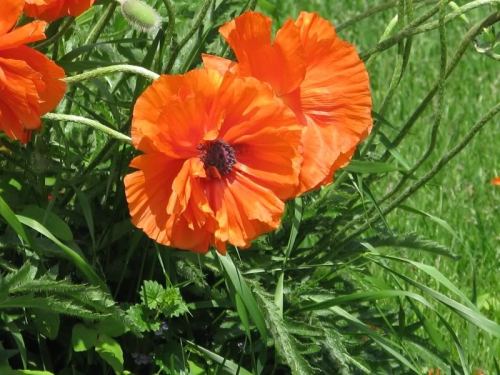
bright ruffled poppies

bright ruffled poppies
dance along the garden wall
bowing and nodding
Here’s to the women in my life who mothered me along the way! You didn’t even know you were doing it. Sometimes I didn’t know, either. I’ll never forget the friend who invited me to a makeup demo. I’ve never been a big makeup fan. It was the devil’s paint when I was growing up–also a sad and sorry sign of being a ‘loose’ woman.

Nonetheless, by the time I got to the seminary as a professor in the early 1980s, I was in dire need of mothering. This little makeup demo was a tiny step that helped give me more confidence than I ever had as a child, teenager, or young adult.

Along with the makeup demo came a little tutorial on colors that would complement my summer beauty! Imagine that…thinking of myself as a ‘summer.’ Even more spectacular, these two little tips became the foundation of everything I wore or gently applied to my face. Colors that actually made me happy to look in the mirror.

Then there was my emotional/physical/spiritual storm during the late 1980s and 1990s. This time it wasn’t about what was on the outside. It was about what was eating me away on the inside. It took a while to get there, but in the early 1990s I met a gifted psychotherapist who actually listened to me and wanted to hear about my life. Without meaning to, she mothered me for decades, and still plays a role in my life. Encouraging me through this last chapter.

I wouldn’t be here at all without my birth mother. She was beautiful on the outside and inside, and her life was fraught from the beginning. Sadly, she never talked much about herself. I think she carried a lot of shame, along with physical pain and the challenge of living with my father for over 60 years. Some of what she wasn’t able to give me, a great host of women have given me in small and large ways. Often when least expected.

For these women, past and present, I’m sending these poppies. Small signs of the beauty to which you introduced me. I see bits and pieces of beauty in life, in nature, in friendships, in myself, and in hard places I thought I would never experience. All because you showed me your beauty from the inside out.

Yesterday afternoon I visited my neighbor’s backyard garden. He had planted a row of oriental poppies against his garden wall. They were magnificent. Hence the haiku and the photos above of gorgeous, crepe-paper-like oriental orange poppies.

Here’s to a Happy Mother’s Day and Year to all Mothers–including those we never expected to cross our paths along the way.

Elouise

©Elouise Renich Fraser, 12 May 2018
Photos found at cbsally.com

A vexing situation – Sexuality 4

When I interviewed for a faculty appointment at the seminary in 1983, no one asked about my sexuality or sexual history. I was married and had two children. I was an active member of the Presbyterian Church. I was interested in women’s studies and issues of importance to women, and as a theological student I had a good record and outstanding references. Besides, my guest lecture was well received.

Years later, I’m the dean, responsible for having a confidential conversation with each final candidate about sexuality and other topics. This includes conversation about the now-official standard of the seminary on human sexuality and moral conduct, questions they might have about this area, and questions I was expected to ask them. Which I did.

In order to help us through this sometimes awkward conversation, I used a one-page handout excerpted from a 1996 memo to the faculty. It was about the new board-approved policy on human sexuality and moral conduct. I sent it in advance to our final candidates, with other material about the seminary.

If the candidate was already inclined in the direction of the seminary’s policy, there was no hesitation. However, if the candidate had questions, it was sometimes awkward. Not just for them, but for me.

I couldn’t pretend that living with this policy wasn’t important. To my surprise, some were reassured by my history with students struggling with sexual issues. The same was true about ways I dealt with classroom presentations and dynamics. There might be room for them here, and it wouldn’t be easy. Especially in the classroom.

The new policy, nearly 10 years in the making, included a statement about behavior, and two implications for faculty.

  • Regarding behavior, those who affirm and practice forms of sexual intimacy contrary to the seminary’s guidelines will not be admitted as students, or employed at the seminary. A further sentence, for the benefit of faculty members hired earlier than 1996 said, “This item is in reference to all decisions subsequent to the adoption of this policy.”

Regarding faculty, there were two stated implications.

  • First, we were to make sure seminarians dealt with the range of positions about current moral issues the Church faced. These included human sexuality and moral conduct.
  • Second, in our teaching we couldn’t argue against the seminary’s policy about sexuality (whether heterosexual or homosexual). We could, however, tell students about our own struggles regarding human sexuality and moral conduct, including our present understanding of difficult issues related to sexuality. Nonetheless, we could not “undermine or invalidate” the seminary’s policy. Furthermore, when speaking publicly or privately on behalf of the seminary, we were to articulate clearly and uphold the seminary’s policy.

The first implication was fairly straightforward. The second, however, felt late and one-sided. I’d learned the hard way which questions I could and could not answer in large required courses. Now, however, any sign that I was still ‘struggling’ with these issues sounded to some like the equivalent of teaching against the seminary. The only safe professors were those in full and complete agreement with the policy as stated.

I keep wondering what I would do differently if I were being interviewed today for the same faculty position.

Thanks so much for reading, and for your comments along the way. One more post coming (I think)!

©Elouise Renich Fraser, 6 April 2018

A vexing situation – Sexuality 3

It’s now 1986. I’ve been an assistant professor of theology for three years. A new academic dean has just arrived, as have recent newspaper articles about one of our recent graduates. She had been one of our more conservative students, and was now an ordained pastor.

According to newspaper accounts, our graduate, happily married with two sons, left her conservative denomination to become pastor of a church for gay men and lesbian women. She had become disenchanted by her denomination’s anti-gay/lesbian rhetoric as well as concrete actions taken against homosexual women and men. I applauded her courage, as did some of my colleagues.

Our new dean circulated to the faculty a copy of the newspaper account along with a brief memo letting us know we would be talking about this. In the account, our former student identified herself as a graduate of our seminary.

Thus began a long conversation in the faculty that ended after nearly 10 years of anguished discussion about what we as a seminary should do. Not about this one graduate, but about gay men and lesbian women who might be already enrolled or applying for admission to our seminary. And about what faculty could or could not teach in the classroom.

The seminary hadn’t made attitudes or beliefs about homosexuality (or heterosexuality) an official requirement for admission in the past, so why did we need to clarify our ‘standing’ at this time? And why, given the recent history of the seminary’s heterosexual president, as well as hints of stories that might be told about one or two male professors of the past, were we suddenly consumed by angst about homosexuality? Wasn’t heterosexuality of equal weight and importance?

During my first three years at the seminary I became known, along with several colleagues, as a ‘safe’ person to talk with about matters of sexuality. Especially homosexuality. That meant I knew how to listen, how to be supportive without being directive, and how to help seminarians think about options. It didn’t take many conversations to realize I had no clue about the inner and family lives of gay and lesbian seminarians.

Some, now full adults, had never come out of the closet with their families, much less their friends. The thought of appearing before a board or session of a church to be interviewed for ordination was terrifying. Some ordination exams were public. Open to members from other congregations. Questions could be asked by anyone in the room, including questions about candidates’ personal lives.

I attended scores of these public exams. Nothing was more brutal than knowing ‘visitors’ from other churches could sway the outcome of an exam. The sessions sometimes functioned as semi-political social and theological warfare. If that sounds harsh, so be it. The possible consequences for the woman or man standing up front were harsh. Especially if the moderator wasn’t skilled and politically savvy.

Finally, in 1996, the seminary published internally a new policy on human sexuality and moral conduct. It included implications for present and future members of the seminary community and for faculty members in their responsibility as teachers.

I like clarity. I like knowing what’s expected of me. Yet this new policy sent a double message.

To be continued.

©Elouise Renich Fraser, 4 April 2018

Easter Lilies and Justice

Easter Lilies

Dear Diane,

Easter Sunday always reminds me of you. Not just because you were born on Easter Sunday in 1949, but because the Easter lilies at church always take me back to your funeral service and heaps of Easter lilies around the casket at the front of the church.

Today was no different. I walked in, saw the Easter lilies and tulips, and dissolved into tears as we sang the first hymn. It all came flooding back, along with a story Dad told me when he was in hospice care.

The story was about you and his flower garden in our back yard. Maybe you remember it. That was when we lived on the river. The flower garden had tons of flowers, including Easter lilies and Dianthus, all planted by Dad. He used to say the Dianthus were there because they reminded him of you.

Dianthus

One day Dad noticed that some of his special Easter lilies were missing from his flower garden. When he went back into the house he found them–in flower vases and glass jars here and there!

It didn’t take long to find out you had done this dastardly deed. He said you listened quietly without tears. Then as you turned to walk away you asked, “Where are the flowers for the children?” Cut him to the quick, he said. And I have to admit, he had tears in his eyes as he told the story.

Do you remember that square patch of flowers near the rear of the back yard? It wasn’t very large. Maybe 5 feet wide. It had posts with twine supports for some of the flowers. Most were bright zinnias.

Dad told me, with tears in his eyes, that he planted that flower garden just for the children. We could pick them anytime, as many as we wished. All because you had the guts to ask the most important question of all. “Where are the flowers for the children?”

Today I wonder the same thing. Sadly, we’ve gone downhill when it comes to things for the children. Flowers for the children tend to show up after children or teenagers are killed with guns. Survivors are asking all of us so-called grownups, “Where are the safe places for the children?”

That’s another subject, except for this: It takes guts to stand up and fight for the rights of children and young people. I’m rooting for the children and young people.

Love and hugs, plus Happy Easter and Happy April Birthday—not that you’re counting anymore!
Elouise

©Elouise Renich Fraser, 1 April 2018, adapted from an earlier post
Photo credit: wallpapersup.net (Easter Lilies); robsplants.com (Dianthus)

A vexing situation – Sexuality 2

Almost all my life I’ve been aware of sexuality, especially my own. Since my birth in 1943, I’ve been a member or participant of multiple religious communities that have talked about sexuality only when necessary. Usually when cultural pressures seemed to endanger ‘our’ young people.

I don’t remember sermons or safe conversations about everyday situations such as how to have a safe conversation with someone whose heart is aching or carrying a heavy secret. Nor have I had much training in how to watch or change my behavior so that I’m as clear and safe as possible when it comes to my sexuality.

For me, this unspoken agreement not to talk openly about sexuality made things worse. Especially after I arrived at the seminary in 1983, one of a small number of female faculty members. I felt alone and confused, left to figure things out by myself.

So here I am, a new assistant professor at a theologically conservative seminary with socially responsible roots and programs, along with a still-fresh wound from the former president. My new colleagues and students have their luggage from the past, and I have mine.

Perhaps the approach of ‘Don’t ask, don’t tell’ was the seminary’s way of allowing us to feel safe. Which, of course, many of us did not.

The first three years of my appointment I was exhausted, confused, anxious and fearful. Not because of what I knew, but because of how much I didn’t know. Not chiefly about how to teach or how to deal with classroom situations (though that was no cakewalk), but about being an academic advisor to each of my assigned advisees.

They appeared at my door, several times a year. Women and men with multiple issues about scheduling, grade point averages, work load, childcare, job requirements, immigration requirements, culture shock and yes, secrets. Heavy, untold stories about past history, realities about current history, sometimes things they’d locked away in a closet as though that would take care of it.

I think back to those three years as my Apprenticeship in Real Life. Classroom dynamics were nothing compared to the atmosphere in my office when an advisee or other student decided to tell me a secret about his or her sexuality. My job was to respond appropriately and with integrity.

Did I stumble around? Absolutely. Was I confident? NO! Did I have all the answers to life’s burning questions? No. Did I make mistakes? Yes, I did. And I learned a lot.

The most painful thing I learned was that my own sexual issues from childhood were still haunting me. Things I thought I’d left behind were suddenly right there in front of me or inside me. They demanded a hearing, even though I was there to listen and offer guidance to others.

I didn’t know it then, but I was beginning a personal curriculum that eventually humanized me. My closely guarded secrets about childhood and teenage years as well as secrets about my adult years weren’t the end of the world. They were keys to joining the human race, especially in the one area of my life I couldn’t understand no matter how much I tried to normalize it.

And I wasn’t there yet. In fact, things became more difficult after my first three years of teaching.

To be continued.

© Elouise Renich Fraser, 27 March 2018

A vexing situation – Sexuality

When I arrived at the seminary in 1983, it didn’t take long to figure this out. The seminary had an unspoken policy when it came to sexual behavior. Don’t ask, don’t tell.

This left me in a quandary. I’ve just walked into a seminary with a still-fresh wound inflicted by the former president. It wasn’t about homosexuality. It was about another sexual preference, though no one in her or his right mind would have called it that back then.

He had an arrangement with a second ‘wife’ with whom he enjoyed getaways for at least a couple of years. It seems no one knew what was going on until one of the seminary’s capable staff members noticed a strange charge to his credit card.

The well-kept secret was out, and his time at the seminary came to an abrupt end. No one was happy about it. He was a highly respected man, well spoken, still in the prime of his life, and one of ‘ours.’ Which means he was a member of the church denomination that had birthed the seminary.

When I was interviewed to become a professor at the seminary, the still-fresh wound was never mentioned.

‘Don’t ask, don’t tell’ already had a life of its own at the seminary. It seemed  to work. The seminary seemed to have good standing with constituents in the area. And if the word got out (which, of course, it did), the seminary had done the right thing. And attention quickly moved on to the bright future ahead now that this sad and unfortunate anomaly had been dealt with.

How did the seminary community process this crisis? I don’t know. I don’t recall much conversation about what had happened or how it might have changed the seminary’s thinking about sexual ethics and the abuse of power.

Doing the right thing when it comes to matters of sexuality is dicey at best. I don’t find the usual assumptions and exhortations from pulpits or other platforms helpful, though I believe we must talk about sexuality openly and honestly.

And there’s the rub. Because sexuality is complex, attempts to be open and honest can quickly devolve. Though we say we want an open conversation, we prefer a controlled environment. Many of us also arrive with our own unexamined baggage or our belief that we’ve got our own sexuality under control.

Trust, already in short supply, can quickly become nonexistent. Sometimes followed by resort to tired stereotypes and untested assumptions about people. It takes great skill and commitment to keep an open conversation open.

It seems we’re allergic to conversations that make us uncomfortable. Not simply as speakers, but as listeners. We prefer boundaries, no matter which side we’re on. Sometimes we argue about boundaries instead of talking about ourselves and our own painfully isolating secrets.

From my perspective, the seminary wasn’t skilled as a community when it came to creating safe space for open and honest dialogue about sexuality. ‘Don’t ask, don’t tell’ was the unofficial, accepted way of dealing with things. This covered the seminary’s past history as well as the past and current histories of students, faculty and staff. Unopened, unexamined pieces of luggage full of confusion and heartache.

To be continued.

©Elouise Renich Fraser, 22 March 2018

Yesterday evening – a prayer of lament

Most evenings I take time to jot down how I’m feeling. Sometimes I’m so weary I can scarcely keep my eyes open.

But yesterday evening was different. I’d spent time that evening going through old files from years of teaching and being a graduate student. Part of me was laughing and enjoying seeing some of the cheeky things I’d written in my younger years. The other part of me kicked in near the end—a little voice that wouldn’t let me go.

So when I sat down in the late evening with my journal, this is what I wrote to God—a prayer of lament, I think.

Oh God, I feel so empty tonight—so out of touch with the woman I am today. It seems my best work and my most memorable efforts are all in the past. Filed away in boxes of paper crammed with words—so many that I scarcely recognize myself back then.

Where did they all go? — Those words, ideas, images, insights, sparkling clear roadmaps to my past life and thinking and feeling.

They seem much more alive and important than anything I might manage to eke out today or tomorrow. Such high hopes and noble ambitions. And now this?

Please look kindly on my confusion through the eyes of Your merciful providence, and give me gratitude.

Then I went to bed and promptly fell asleep. A bit sobered, yet grateful for memories of so many good women and good men. And for the privilege of having touched their lives, and been touched by theirs.

I’m not the woman I thought I was when I arrived at the seminary to study or to teach. Or even when I began this blog.

Today I’m working on a piece for later this week. It’s about one of the most difficult subjects I’ve had to deal with personally and institutionally, as a member of various churches and as professor and dean at the seminary. Sexuality.

Thanks for reading and listening. And for helping grow me into the woman I am today.
Elouise

©Elouise Renich Fraser, 21 March 2018
Photo found at pixabay.com

Women against Women

Quaker Woman Preaching in New Amsterdam

It’s the late 1970s in Nashville, Tennessee. I’m a religion student at Vanderbilt University, studying for my Ph.D. The pastor of my United Presbyterian church has asked me to preach on Women’s Day. It’s my first sermon ever, and he wants me to preach about women’s issues and women’s liberation.

I worked hard putting together a lively sermon, then shook in my trousers as I stood in the pulpit and delivered the goods. Because there were a number of ‘liberated’ women in the congregation, it never occurred to me that I would get any kickback.

Indeed, comments and hugs after the service reassured me that all was well.

I was wrong. One of my best female supporters was seething with rage. She was older than I, highly educated and married to a professor. She didn’t hesitate to speak her mind to our pastor and to me.

My sermon sounded angry, and I wore trousers in the pulpit. I also think she might have liked to preach a sermon herself. Not only was she highly educated, she’d been a member of the church longer than I. Why had I, a relative newcomer, been singled out?

Fast forward to my first year of teaching at the seminary. It’s spring 1984. I’m in Philadelphia, teaching at a multiracial, multicultural seminary that has over 30 percent women students. I’ve been invited to speak to the Women’s Auxiliary, a group of faithful, diligent, smart women who support the seminary in dozens of ways, including fundraising efforts.

We met in a parlor-like room. The group included many pastor’s wives who had been around the seminary for years. I’d been asked to talk about myself and how I see women fitting into the work and mission of the seminary.

When I finished, we had time for discussion. Though most of our conversation was constructive and positive, I’ll never forget one woman’s painful, angry comments.

Here I was, younger than she, teaching at the seminary. And here was the seminary supporting women for ordination. And here was the Field Education Office, wanting to send a young woman to do her field education work under the supervision of her husband.

And here was this older woman, educated, experienced and clear about her role at the church as the ‘first lady.’ In fact, she believed she could have been a pastor. She was probably correct.

Nonetheless, she didn’t want seminary women working with her husband, taking over the place that rightfully belonged to her as his spouse. She didn’t trust women, including the women at the seminary. Over the years she had found a way to make space for herself in ministry without the “Rev.” and all the trappings that go with that. I’ve sometimes wondered whether she trusted her husband, the pastor.

I’ve seen this anger many times in older, well-educated, even brilliant women who for many reasons never followed their dreams. How sad when we make it women against women instead of holding each other and weeping for what we’ve all lost.

The valley of the shadow of death runs deep through the history of women against women. And still threatens to undo us.

©Elouise Renich Fraser, 13 March 2018
Image  found at marybarrettdyer.blogspot.com

For all the women I have loved

During the last few months I’ve been going through old teaching and administrative files, carbon copies of reference letters I wrote decades ago, boxes of notes and cards you sent to me, and old directories with head shots of students, faculty, and church members. More than once I’ve been reduced to tears.

Several years ago I made a list of women whose lives made a difference in my life. It was so long I had to stop.

This is ironic, since most of my life I’ve been beholden to men. They were or might one day become my gatekeepers. It was important to treat them well and with due deference. Most were white. A precious few were interested in my future instead of their own and how I would help them get there.

Yet I was born into and grew up surrounded by women who cared for me no matter what. They didn’t all have motherly skills, but each had something to give me. Something to pass along that would help me grow—if I could only relax into the role of learner.

Today’s post is for all the women who were and are my shining stars —

  • my sisters, daughter, daughter-in-law, granddaughters
  • my mother, cousins, aunts, grandmothers and great-grandmother
  • classmates, playmates, teachers and faculty colleagues
  • committee members, informal kitchen cabinet members
  • therapists, doctors, nurses and external consultants
  • accomplices in strategic disobedience and brilliant projects
  • pastors, church friends, workplace mentors, friendly enemies
  • puzzling combatants, bright stars, struggling survivors
  • angry recipients of insults and injury
  • new mothers fighting isolation and depression
  • aspiring preachers and teachers finding strong voices
  • devastated applicants turned away due to marital status or fear
  • determined women moving ahead against all odds
  • heartbroken wives whose husbands just walked out the door
  • heartbroken mothers who just lost a child or baby or husband
  • tearful survivors of trauma in need of help
  • closeted lovers of women not sure where to turn for help
  • gifted women passed by in favor of an average male applicant
  • poets, writers, musicians, preachers and teachers
  • drama queens, dreamers and world-changers

Like a galaxy of stars, you are brilliant in my life. Scarcely a day goes by without one of you showing up in my heart. I’m so glad I kept all those notes, cards and sometimes silly photos. Reminders that the history we made, no matter how small it seems today, still matters.

With respect, love and prayers for history-making women everywhere,
Elouise

©Elouise Renich Fraser, 9 March 2018
Photo found at galeri.uludagsozluk.com

wild nor’easter

wild nor’easter
whiplashes its way
through the night

And we aren’t even at the center of the storm. Fury comes to mind. Along with chaos, heavy wet snow, traffic at a near standstill, unpredictable wind gusts and icy cold. Our  generator has run since about 6pm last night. The sun is out and the damage is visible. Not much in our yard, but a mid-size tree fell during the night, roots and all, across our neighbor’s driveway. It was chaotic.

I can’t help thinking about our President and the current state of our disunion. Chaotic. I know…some think chaos is inevitably linked to creativity. Perhaps it is.

I think of it as a sign of breakdown that may or may not end well. Especially when chaos comes to dominate the multiple pronouncements, tweets, behaviors, faces and voices of POTUS. It’s so all-encompassing that I’m tempted to expect and demand nothing better. Or adjust to it as the new normal.

Many years ago, for three seemingly endless years, I had a Dean who thrived on chaos. The kind he created around himself and across the seminary daily. I remember vividly the day I figured out how to comport myself in his presence.

  • Say as little as possible.
  • Don’t answer questions about any of my colleagues.
  • Stick to the point and get out the door as quickly as possible.

That day I knew exactly who was in his office before I went in for my appointment. It was someone I worked with often, and depended upon as a faculty colleague. Almost as soon as I sat down across from the Dean’s desk, he began asking questions about the colleague who had just left the room. I refused to answer, and got my agenda on the table.

I also knew that the moment the next person walked through the door, the questions would be about me. Indeed, he found ways of gathering bits of information and turning them to his own benefit. I knew I was on his hit list, as were several other colleagues.

There had been a warning sign I missed the very first day I met him. I was on the search committee tasked with finding candidates to be our next dean. He was one of several we interviewed in person.

He didn’t know me prior to that day. Yet the moment he walked into the committee room he broke out into a great big smile, came straight over to shake my hand and tell me how much he had heard about me and how much he was looking forward to meeting me. Indeed. Had I only realized….I’d just met another version of divide and conquer.

Through a series of unexpected events, he became our Dean and left us broken and divided as a faculty, not sure what had just hit us. We were reluctant to talk with each other about it until he was gone and we knew we were in safe space away from the seminary.

I credit our interim Dean for calling us together in a hospitable setting. Many, including me, carried unexpressed shame, anger and tears that broke out when we met to process what had happened.

Never again. Chaos as a management technique was like living hell. I’d rather endure a fierce Nor’easter any day or night.

©Elouise Renich Fraser, 3 March 2018
Photo found at news.wgbh.org – January 2018 Nor’easter off the East coast of the USA