Telling the Truth

connecting the dots of my life

Tag: Christian Faith

Shame on you – a poem and confession

Shame on you
Is not shame on me

I renounce your efforts
To fill my heart with
Your lust and shame
Bequeathed to you
By your father-preacher
When you were a sobbing
Child terrified lest you wake
Up one day in that fiery hell
You too once preached to
Children who believed the lie
That they entered this world
Sinners from the beginning
Now terrified of missing
That mercy for which you
Wept loudly and often
In the confines of your own
Terrified heart and soul

Wave your arms in the air
Send out your calls for sinners
To sob their way forward
Down the aisle filled
With shame and self-hatred
Believing a story that never
Belonged to them no matter
How many times they
Rushed down the aisle
Of your own deep shame

Somewhere along the way I lost the shame I carried from childhood. Shame that bound me as an adult, not just as a child.

Here’s how I see it now. Yes, there is right and there is wrong. No, God doesn’t create junk. Nor did God make sure I came with a bit of built-in sin for which I’m supposed to feel deep shame.

The shame came later. From others who introduced me to their shame long before I knew what was happening.

As a child, preachers and evangelists routinely reminded me that my heart was filled with sin from the day I was born. I watched other children repeatedly rushing down the aisle terrified lest they be thrown into a lake of fire when they died. I managed to raise my hand once, which felt like more than enough. After all, I got it at home, too.

At some point I had to take ownership of the woman I’d become. Still, scaring me and punishing me into repeated agonies of confession never helped me take ownership of myself. It simply kept me in a constant state of fear, shame and hyper-vigilance.

Ironically, these are the very things my Creator invites me to let go. Not because I’m a goody two-shoes, but because I’m loved just the way I am.

For that, I’m deeply grateful on this day of Sabbath rest.

© Elouise Renich Fraser, 28 October 2018

After scanning today’s headlines —

A rude and rootless nation
Sits in the seat of scoffers
Indignant and outraged
Lock her up!
Lock him up!
Lock them up!
And throw away the key!

Chaff tossed on winds
Of overwrought words
Ruthless and homeless
We drift toward destruction
Lost in the wilderness
Of our own undoing

I’ve almost always read Psalm 1 with my life in mind. It’s a Psalm about choosing the way of wisdom, rather than the way of folly. I still think that’s a fair way of reading it.

Nonetheless, it’s also a Psalm directed to a nation of human beings with human leaders who make choices both wise and foolish. Not that everyone agrees to go one way or the other. There’s more than enough folly and wisdom to share on all sides.

It seems our nation is drifting down the path of folly. Often following in the footsteps of leaders who say and do foolish things. Or who respond to one kind of foolishness with another kind. Equally unrestrained and destructive.

Hence this reading of Psalm 1 as a cautionary tale. If we aren’t part of the wise resistance, we’re in danger of finding ourselves headed downhill along the destructive path of fools. Also known as the wicked who are like chaff driven by the wind. Drifting toward our demise. Full of sound and fury, signifying nothing.

© Elouise Renich Fraser, 23 October 2018
Photo of winnowing wheat taken in Iran by David Murphy, fineartamerica.com

Why it matters so much

Late last night I received a thought-provoking comment on yesterday’s post, Conversations that matter. Here’s the heart of my reply, edited for clarity.

Sometimes people assume seminarians have just finished college, then moved on to seminary, and will then become pastors of a church. My response begins with this assumption.

The demographics of the seminary I served were decidedly different from those you describe. Young, usually white men right out of college were a distinct minority during the 28 years I was at the seminary.

Much more prevalent were working adults, some already retired. Many were the first members of their families to pursue a seminary degree. They wanted to make a difference in their churches and organizations. They weren’t wealthy.

Many worked night shifts to survive, keep food on the table for their children, and pursue a seminary degree. Most were mature, wise and exceedingly persistent. Commencement was always a moment of pride, gratitude and tears before a packed-out house of families, friends, church members, colleagues, professors, seminary administrators and staff members.

Many entering students were already serving in churches. However, they too needed help. It’s no picnic to be a pastor or ministry leader in a church of any size or denomination.

The challenges and opportunities of teaching in an unusually diverse seminary were many. We lived and worked with age differences, racial and ethnic differences, inner city, suburban, and occasional rural differences, denominational differences, social and economic classes. You name it; we had it. Not just in the student body, but in our increasingly diverse faculty.

The hope many seminarians bring is that this educational experience will be heaven on earth. It isn’t! For some it’s hellish, full of pain, anguish, hard work and feedback they weren’t expecting.

As difficult as my up-bringing was, I still had and have the so-called advantage of being white. This is huge. Not just where I now live, but across the USA.

Yet it’s also a huge disadvantage given the isolation this brings in the form of housing patterns, church membership patterns, and the daily reality of white skin versus almost any other color of skin. It doesn’t matter what country you came from. If your skin isn’t white, you pay for it. White female privilege means I don’t even have to think about 1000 things others must think about daily.

As part of the older generation, we have the duty and privilege of paying forward what we’ve received. Not just because of or in spite of the color of our skin or our gender, but because someone invested in us. More times than we probably remember. Yes, we must keep an eye on the children, including young adults and even older adults we see from time to time.

They and we need these connections. Without them, we’re already dead.

Without them, we’re already dead? Yes. Dead in the water that’s meant to keep flowing upstream, against all odds.

Many thanks for listening and doing what you can to pay forward what you’ve received.

© Elouise Renich Fraser, 15 October 2018

Conversations that matter

On 21 April 2016, I broke my jaw and my wings were clipped. Not just by the broken jaw, but by a string of unanticipated health events that followed. Today it takes time to attend to my aging body.

So I often wonder what the meaning of my life is now. Why am I here? I know I’m going to die. So what about the meantime, in whatever time I have left on this earth? Is blogging it? I love blogging, but….

A couple of weeks ago I got an email from a friend and former colleague at the seminary. Would I be willing to interview a seminarian working on her MA degree? The answer was Yes! Of course! Big smiles and happiness! A high point in my life!

So this last week I spent time on the phone with her. Lots of time. We didn’t talk about the fine points of my life as a pastor (which I am not). Instead, we talked about the not-so-fine points of my life as a survivor of childhood abuse. Especially what it took in my late 40s to begin the long process of healing while I was professor and then dean at the seminary.

Why was this conversation a high point for me? Because it let me know I still have something to say. Especially, but not only to women and men preparing for ministry in churches, or for leadership in religious organizations.

Blogging about my experience has been and still is part of my healing. Yet nothing beats a one-on-one conversation, or a small group discussion in which I’m able to talk about what it took for me to begin healing.

We’re all dealt cards we didn’t ask for, even before the moment we’re born. Going into a professional position or a new job doesn’t magically make all that disappear. In fact, it often triggers it. Understanding how trauma shaped and still shapes us is worthy of our best efforts. Not alone, but together.

I don’t know how this will play out. Nonetheless, I’m hoping for more informal opportunities in which my personal and professional experiences come together in surprising ways.

Cheers!
Elouise

© Elouise Renich Fraser, 14 October 2018

Small gifts

Small gifts grace my eyes
Bursting with life and color
They command the scene
Announcing their calm presence
in the garden of my life

It’s difficult to think of my life as a garden. But that’s just what it is, isn’t it? A small patch of earth populated by new growth, the occasional stunning blossom, weeds, trampling of feet, the stench of manure, and all the rest that goes into the pot.

It seems nature, aided and abetted by a Master Gardener, combines the good, the bad and the ugly within one spectacular display. Seen from afar the garden glimmers almost like a desert mirage.

The photos above are from Chanticleer Garden. It’s a magical place. Even so, weather happens. People happen. Bird poop, poison ivy, weeds, and predatory mosquitoes happen. It takes a team of gardeners to keep up with pests, damage and overgrowth on the ground.

As for my life, I’m at peace with my past. Still, I can’t dispense with a team of gardeners, much less the Master Gardener. There’s work yet to be done beyond my limited eyesight and capacities.

Above all else, I want to keep the ability to see and appreciate small gifts sent via nature. Gifts that arrive unannounced, just when I need them. Like the photos in this post.

Happy Monday!
Elouise

© Elouise Renich Fraser, 8 October 2018
Photos taken by DAFraser, July 2017, at Chanticleer Garden.

life takes the long road

life takes the long road
through majestic terrain
gleaming and foreboding

daylight falls quickly
below horizons
of narrow vision
ablaze with dying day

This photo, taken in Scotland, is breathtaking. As breathtaking as a single life that burns out boldly before fading into darkness.

It reminds me that what’s happening in and behind the “news” is often not good news, and easily becomes a distraction from the larger picture. The long view doesn’t promise me an eternity. It does, however, invite me to keep my perspective clear.

One of my readers left a wonderful comment in response to yesterday’s post. In it she shared a comment from a friend of hers in India. Here it is–a way of putting things into proper perspective:

WORLD: How could you stay in the Church after all the scandal?
ME: You don’t leave Jesus because of Judas.

Here’s to a thoughtful Tuesday.

© Elouise Renich Fraser, 25 September 2018
Photo found at pixabay.com

And what of those sinned against?

And what of those sinned against –
Bathsheba and Tamar,
The concubine cut up into pieces
By her Levite priest owner,
The two virgin daughters of Lot,
And millions of wounded women and men
Sitting in yet another dock wondering
How long their nightmares will last?

How can we beg God for forgiveness
And enjoy the fruits of mercy
Without even a nod to our victims
Who daily carry within and upon
Their embodied souls a lifetime
Of self-punishment as though they
Could ever atone for their broken selves?

They sit beside us in the pews (or not)
Afraid to tell their unwelcome truths
Terrified of whispers and innuendo
Choking on heaped-up tamped-down shame
And fear that they are indeed to blame
For predatory practices wielded skillfully
By church-going men or even women
Who now worship God freely and
Joyously believing all has been forgiven
When they haven’t begun to make amends
To those they harmed including themselves

I don’t have answers. Just questions this morning.

1. What does it mean to go to church carrying shame in a body meant to be loved and set free?
2. How do we begin to notice and reach out to listen and learn, not to fix what we may quickly decide is the true ‘problem’ when it isn’t?
3. Indeed, how do we come clean about our own unhealed wounds that will surely be exposed when we’re telling our truth?

The poem above comes from multiple experiences of being turned into ‘the problem’ I was not. Too often this was about my femaleness, which supposedly justified problems and attitudes that originated with others, usually men.

To all such people, including members of my family plus some pastors, employers and work or church-related colleagues:

Your problems are not rooted in my body,
my soul, my mind, my emotions,
my mouth, the look on my face,
or what I happened to be wearing that day.

On the other hand, I could learn from you if you’re interested and I’m not scared shitless. Otherwise, we’ll just keep soldiering on in our walled-off worlds, teetering precariously from time to time until it’s too late.

© Elouise Renich Fraser, 24 September 2018

Emily Brontë – Start not….

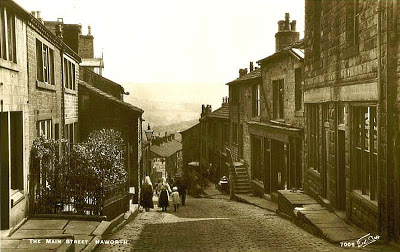
Death is on my mind. Especially since I’m in the last chapter of my life—however long or short it may be. The photo above shows the Haworth churchyard as it may have looked in Emily B’s time. Note the flat-stone grave markers, like beds. My comments follow Emily’s poem and a second photo.

Start not upon the minster wall
Sunshine is shed in holy calm
And lonely though my footsteps fall
The saints shall shelter thee from harm

Shrink not if it be summer noon
This shadow should right welcome be
These stairs are steep but landed soon
We’ll rest us long and quietly

What though our path be o’er the dead
They slumber soundly in the tomb
And why should mortals fear to tread
The pathway to their future home?

Emily Brontë, from Brontë Poems, p. 33
Published by Alfred A. Knopf 1996
© 1996 by David Campbell Publishers Ltd.

Emily Brontë was born on 30 July 1818, and died on 19 December 1848, one month after her younger brother Bramwell’s death. She lived most of her adult life in Haworth, Yorkshire, where her father was the parson. The photo above shows the main street in the 1800s. The parsonage and churchyard were near the top of the steep climb uphill. The major things missing from the photo are horses, garbage of all kinds flowing downhill, and the stench.

When I read this poem, I imagine Emily B walking up the steep hill beside me, coaching and encouraging me.

First Stanza
Don’t flinch or turn aside! Don’t be startled when you ‘come upon’ the path leading to the churchyard wall, looming at the end. Don’t swerve with dread, like horses in the heat of battle. Stay calm. Trust you’re in the best of hands. It will warm and brighten your way.

Yes, it’s uncanny and even frightening to hear your own footsteps on the stony path up this particular hill. Just remember all the saints who went this way before you. You can’t see them, but they’re cheering you on, encouraging you to stay the course instead of breaking away as though you could escape harm, pain or death.

Second Stanza
Yes, the noonday sun is blazing hot right now. Don’t try to hide from it. Look up ahead! There’s a shadow that will welcome you sooner, not later. It probably feels steeper now than it did at the beginning. It’s normal to be weary of the uphill grind. Still, your goal is just ahead. It won’t be long now. Then we can rest for a long time in utter quiet.

Third Stanza
It doesn’t matter that this path might have us walking on resting places of the dead. They’re already sleeping soundly beneath the ground in the churchyard. Besides….

…why should mortals fear to tread
The pathway to their future home?

Something like that, I think.

Thanks for visiting and reading, even though the topic isn’t everyone’s favorite.
Elouise

© Elouise Renich Fraser, 17 September 2018
Photos found at kleurrijkbrontesisters.blogspot.com

No other gods

Thou shalt have no other gods…

twilight of our small gods
descends over shallow water
teeming with refuse

ill-begotten secrets lurk
beneath ripples of shriveled minds
as once-buoyant hopes sink

ill-conceived saviors morph
into scapegoats scorned with contempt
mirrors of our self-loathing despair

Come unto me all who labor and are heavy-laden,
and I will give you rest.
Take my yoke upon you and learn of me;
For I am meek and lowly of heart
And you shall find rest for your souls.
Matthew 11:28-29

There’s nothing magical about it. No overnight resolutions of pain and anguish. Just a re-orientation to the one who leads and accompanies us to God, who already loves and grieves for each of us.

Thanks to my blogging friend Yassy, for a poem and comment yesterday that got my mind going on this post. Check out her lovely poem.

©Elouise Renich Fraser, 16 September 2018

It’s difficult to focus on 9/11

Dear Friends,
Today, our 53rd wedding anniversary, is also the 17th anniversary of the World Trade Center attacks in 2001.

At the end of October 2001 the seminary held a community forum in the chapel. I agreed to speak from the platform. I didn’t know where to begin or end. So I began where I was and went from there.

It’s difficult to focus.
Voices and images
clamor for my attention,
my response,
my analysis of what is beyond all reason.

I force myself to stay close to the bone,
close to home, close to my Christian roots.

Death is in the room.
Not a new presence,
not even unexpected.

It, too, clamors for my attention,
masquerading in terrible new configurations.

I don’t want to die,
especially if I must suffer in my death.

From the throne of his cross,
the king of grief cries out….
‘Is it nothing to you, all ye who pass by?’

There is no redemption
apart from suffering and death.
None.

I want to be redeemed.
I do not want to die, or to suffer.
I’m not a very likely candidate for redemption.

Death is relentlessly in this room.
My death.
Your death.
Christ’s death.

Unfinished family business is in this room.
Violent behaviors and attitudes
passed down from father to daughter;
Habits of not telling the truth,
passed down from mother to daughter;
Withholding of love and affection,
Relentless inspection and fault-finding,
Love wanting expression but finding no voice,
Truth wanting expression but finding no listening ear.

Unfinished family business is in the room with death–
A gnawing ache more than my body can bear.

I like to think I’m ready to die.
But I am not.
Nor will I ever be.
Not today, not tomorrow,
Not in a thousand tomorrows.

If I say I am ready to die,
I deceive myself,
and the truth is not in me.

There’s always more work to be done–
Unfinished family business
Unfinished seminary business
Unfinished church and community business
Unfinished personal business

Christ died to relieve me
of the awful, paralyzing expectation
that one of these days
I will finally be ready to die.

Christ finished his work so that
I could leave mine unfinished
without even a moment’s notice.

The Heidelberg Catechism says it all–

What is your only comfort in life and death?

My only comfort, in life and in death, is that I belong–body and soul, in life and in death–not to myself but to my faithful Savior, Jesus Christ, who at the cost of his own blood has fully paid for all my sins and has completely freed me from the dominion of the devil; that he protects me so well that without the will of my Father in heaven not a hair can fall from my head; indeed, that everything must fit his purpose for my salvation.

Therefore, by his Holy Spirit, he also assures me of eternal life, and makes me wholeheartedly willing and ready from now on to live for him.

(from the Heidelberg Catechism, 1563)

© Elouise Renich Fraser, 31 October 2001

* * * * *
Notes:
(1) The forum was held in the seminary chapel; a large wooden cross hung on the wall behind the platform.  Hence the reference to Christ’s death being in the room.
(2) The three lines beginning with “From the throne of his cross” are from John Stainer’s 1887 oratorio, The Crucifixion.

© Elouise Renich Fraser, 11 September 2018